July 31, 2026
When Buyer Power Becomes Industrial Policy: Understanding the CMRG Pressure Campaign
The conventional wisdom in bulk commodity markets has long held that sellers with scale and low-cost production hold structural advantages over fragmented buyers. For decades, Australia's Pilbara iron ore producers operated within exactly that framework, shipping hundreds of millions of tonnes annually into a Chinese steel sector hungry for reliable supply. That dynamic is now being tested in ways that go well beyond routine commercial negotiation, and the Fortescue China Mineral Resources Group iron ore supply disruption of mid-2026 is the clearest illustration yet of how fundamentally the power equation has shifted.
When big ASX news breaks, our subscribers know first
The Architecture of State-Coordinated Buying Power
To understand what is happening between Fortescue and CMRG, it helps to first understand what CMRG actually is and why its creation represented a structurally significant moment for the seaborne iron ore trade.
China's iron ore import market has historically been characterised by fragmentation on the buyer side. Hundreds of steel mills, trading companies, and state-owned enterprises competed independently for cargoes, which meant that Australian and Brazilian producers could leverage multiple competing buyers against each other to sustain favourable pricing. CMRG was created specifically to dismantle that dynamic by consolidating domestic procurement into a single, coordinated entity capable of speaking with one voice in contract negotiations.
What makes CMRG structurally different from a large commercial trading house is that it operates at the intersection of market activity and industrial policy. It can direct mills to accept or reject specific cargoes, coordinate buying behaviour across the domestic steel sector, and apply pressure tactics that no purely commercial entity would have the authority to deploy. This gives it leverage that extends well beyond what its volume alone would suggest.
Furthermore, understanding China iron ore demand trends helps contextualise why CMRG's formation was an inevitable response to shifting market conditions.
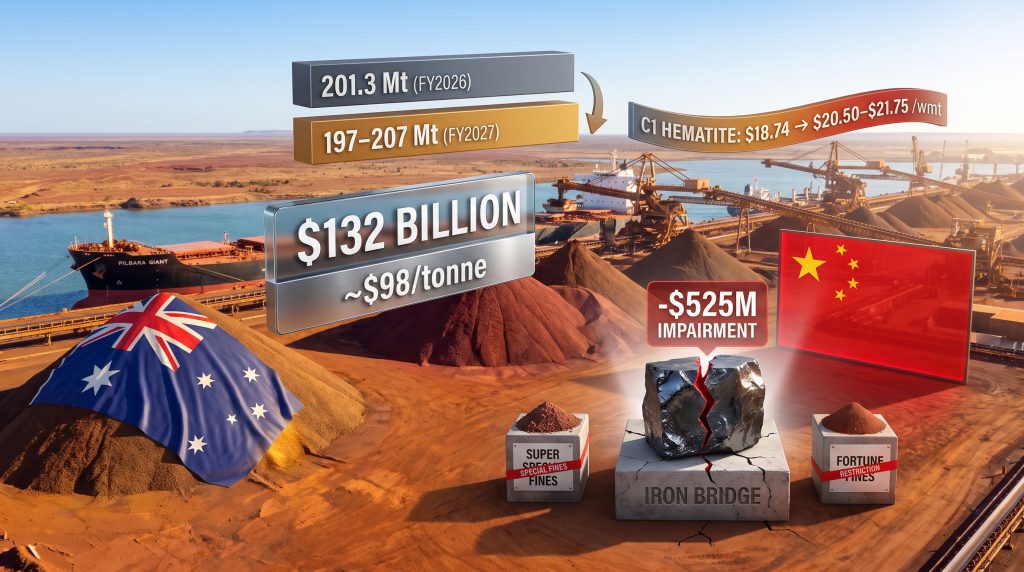
"The $132-billion seaborne iron ore market is not just a trade corridor. It is a geopolitical asset, and CMRG's creation signals China's intent to treat it as one."
The context matters here. China's steel sector is navigating a period of structural stress. Domestic construction demand, which drove decades of steel consumption growth, has contracted sharply. Mill margins have compressed under the weight of overcapacity and softening end-demand. In that environment, extracting better input costs from iron ore suppliers is not merely a commercial preference; it is an operational necessity for a sector under genuine financial pressure. Indeed, China steel market pressures have been building for some time, making CMRG's interventions increasingly inevitable.
How the Fortescue Restrictions Actually Work: Grades, Ports, and the Mechanics of Disruption
The specific mechanics of the Fortescue China Mineral Resources Group iron ore supply disruption are worth examining carefully, because the details reveal a great deal about the strategic intent behind the restrictions.
CMRG's initial intervention directed domestic steel mills not to take delivery of certain portside iron ore products from Fortescue. Crucially, the restrictions were applied at the grade level, targeting lower-specification products including Super Special Fines and Fortune Fines, rather than imposing a blanket ban on all Fortescue supply.
This selectivity is not accidental. Lower-grade iron ore fines, which carry iron content below the benchmark 62% Fe specification, are more price-sensitive and more easily displaced by alternative supply than higher-grade products. By targeting these specific grades, CMRG can apply meaningful commercial pressure while maintaining the operational fiction that it is managing inventory quality rather than conducting a supply chain blockade.
The restrictions evolved in two stages:
- Stage one targeted portside inventory already sitting at Chinese ports, with a delivery restriction reportedly effective from July 15, 2026.
- Stage two extended the restrictions to cover new purchases of the affected grades, escalating from a passive inventory management measure into active supply chain interference.
Agustín Pichot, Fortescue's CEO for growth and energy, characterised the situation on an analyst call as trade friction that undermines the stable supply of iron ore to China, expressing hope for a swift return to normal market conditions. The framing is significant: by positioning the disruption as harmful to China's own supply stability rather than solely to Fortescue's commercial interests, it reframes the narrative in a way that gives Chinese policymakers a reason to de-escalate without appearing to capitulate.
What Does Grade Targeting Mean for Suppliers?
In practice, grade-level targeting means that suppliers with diversified product portfolios are better insulated than those heavily reliant on lower-specification fines. Consequently, iron ore grades guide resources become increasingly relevant for investors seeking to understand which producers carry the greatest exposure to this type of buyer pressure.
Iron Ore Grade Dynamics: Why Product Specification Matters in a Buyer's Market
A dimension of this dispute that receives insufficient attention in mainstream coverage is the role that iron ore grade and product specification play in determining a supplier's vulnerability to buyer pressure.
Iron ore is not a homogeneous commodity. The seaborne market trades across a wide spectrum of product types, each with distinct pricing relationships to the benchmark 62% Fe index:
| Product Type | Typical Fe Content | Price Relationship | Demand Sensitivity |
|---|---|---|---|
| High-grade lump | 62–65% Fe | Premium to index | Lower: preferred by mills |
| Standard fines (62% Fe) | ~62% Fe | Benchmark | Moderate |
| Super Special Fines | Below 58% Fe | Discount to index | Higher: more substitutable |
| Fortune Fines | Below 58% Fe | Discount to index | Higher: more substitutable |
| Magnetite concentrate | 65%+ Fe | Significant premium | Lower: niche, quality-driven |
Lower-grade fines require steel mills to blend them carefully with higher-grade material to achieve target sinter feed compositions. When buyer leverage is exercised, lower-grade products are the first to face displacement because they are the most easily replaced with alternative sources without disrupting mill operations.
This is precisely why CMRG's grade-specific targeting is strategically coherent. It maximises commercial pressure on Fortescue's lower-specification product portfolio without creating the kind of supply disruption that would trigger immediate operational problems for Chinese steel mills. According to reporting on the standoff, the pricing dispute over low-grade ore sits at the very heart of these negotiations.
The BHP Precedent and What Sequential Targeting Reveals
Fortescue is not the first Pilbara producer to find itself in CMRG's crosshairs in 2026. BHP faced a comparable delivery restriction earlier in the year, establishing a pattern that transforms individual disputes into something more systematic.
| Producer | Restriction Type | Timing | Grades Affected | Status |
|---|---|---|---|---|
| BHP | Delivery ban | Earlier in 2026 | Unspecified | Resolved / Ongoing |
| Fortescue | Portside delivery + new purchase restrictions | From July 15, 2026 | Super Special Fines, Fortune Fines | Active |
The sequential nature of these interventions carries an important implication. By targeting producers one at a time rather than simultaneously, CMRG prevents the formation of a coordinated supplier response. Each producer faces the pressure alone, without the negotiating solidarity that a collective industry position might provide. This divide-and-pressure approach is a sophisticated application of buyer power that goes well beyond standard procurement tactics.
A speculative but plausible interpretation is that CMRG is also using the sequential approach to build precedent. Each negotiated settlement on CMRG's terms strengthens its position heading into the next negotiation, gradually resetting the commercial baseline across the entire Australian iron ore sector in China's favour.
How Does This Connect to Broader Supply Concerns?
These sequential interventions also compound existing iron ore surplus fears that have weighed on the sector throughout 2025 and into 2026, giving CMRG additional structural leverage in its negotiations with individual producers.
Fortescue's Operational Picture: Production Decline, Cost Inflation, and the Iron Bridge Problem
The CMRG pressure campaign is landing at a particularly challenging moment for Fortescue's operational and financial position. The company is managing three distinct pressure vectors simultaneously.
Shipment performance: Fortescue's iron ore shipments fell 5% in the June quarter to 52.7 million tonnes, though this came in marginally above the Visible Alpha consensus estimate of 52.48 million tonnes. Full-year 2026 shipments totalled 201.3 million tonnes, and FY2027 guidance of 197 to 207 million tonnes implies a broadly flat trajectory.
Cost escalation: Hematite C1 unit costs reached $18.74 per wet metric ton for FY2026, rising 6% sequentially in the June quarter driven primarily by higher diesel prices. The FY2027 cost guidance range of $20.50 to $21.75 per wet metric ton represents a meaningful step-up that compresses the margin buffer available to absorb external pricing pressure.
Iron Bridge underperformance: This is the most structurally significant of the three challenges. The Iron Bridge magnetite project, designed to produce a high-grade concentrate product that would diversify Fortescue's portfolio away from lower-specification fines, has consistently failed to reach its 22 million tonne per annum nameplate capacity. A ramp-up delay flagged in May 2026 has now crystallised into an after-tax non-cash impairment of $525 million, excluded from the company's 2026 underlying post-tax net profit. Port outload infrastructure has been identified as the primary bottleneck, with the company actively evaluating solutions to lift throughput.
The strategic irony is acute. Iron Bridge's magnetite concentrate, at 65%+ Fe, would sit at the premium end of the iron ore quality spectrum and would therefore be the least vulnerable to CMRG's grade-targeting strategy. The project's underperformance leaves Fortescue more exposed to lower-grade product restrictions, not less. Analysis of Fortescue's Super Special Fines stockpiles at Chinese ports shows how rapidly inventory dynamics can shift when buyer restrictions are imposed.
"Jefferies, which carries an underperform rating on Fortescue, observed that Iron Bridge continues to deliver below its 22 Mtpa nameplate capacity, a persistent operational shortfall with compounding financial consequences." (Jefferies analyst note, July 2026)
The next major ASX story will hit our subscribers first
Market Response: Price, Sentiment, and Investor Behaviour
The immediate market response to the Fortescue China Mineral Resources Group iron ore supply disruption provides useful signal about how traders are interpreting the situation.
Fortescue's shares fell 3.3% on the day of the announcement, against a 0.2% rise in the broader mining index, a divergence that reflects market concern about the combined impact of CMRG commercial pressure and Iron Bridge underperformance rather than a sector-wide reassessment.
Iron ore prices in Singapore held at approximately $98 per tonne, broadly flat in immediate response. This relative price stability reflects two offsetting forces:
- Downward pressure from ongoing concerns about Chinese steel demand and structural overcapacity in the sector.
- Upward support from supply uncertainty as buyers began evaluating alternative ore sources and the substitution cost of replacing Fortescue's affected grade volumes.
The flat price response also suggests that market participants are currently treating the dispute as a negotiating episode rather than a structural supply disruption, a reading consistent with historical precedent from the BHP situation earlier in the year. However, the iron ore trade risks embedded in ongoing geopolitical tensions suggest that complacency may be premature.
The Pilbara Risk Stack: Labour, Logistics, and Geopolitical Friction
The CMRG dispute does not exist in isolation. Australian iron ore producers are navigating an unusually dense concentration of operational and commercial risks across the Pilbara region simultaneously.
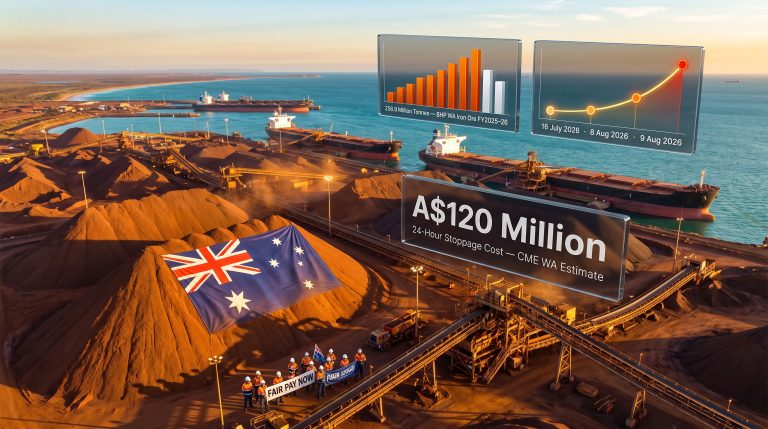
BHP is confronting what has been described as its most significant strike action in decades at Port Hedland, the critical export gateway through which the majority of Pilbara iron ore moves to international markets. The potential for export volume disruption at this chokepoint adds a logistical risk dimension to what is already a commercially pressured environment.
Fortescue CEO Dino Otranto acknowledged the sector-wide nature of these challenges, noting that the industry landscape has shifted dramatically and that Fortescue is not immune to the same pressures affecting BHP, while expressing confidence that the company's internal culture provides resilience against these headwinds.
The convergence of these risks across a short timeframe is notable:
| Risk Vector | Nature | Immediate Impact |
|---|---|---|
| CMRG Procurement Pressure | Geopolitical / Commercial | Delivery restrictions, contract uncertainty |
| Port Hedland Labour Dispute | Operational | Potential export volume disruption across sector |
| Iron Bridge Underperformance | Technical | $525M impairment, volume shortfall vs nameplate |
| Diesel Cost Inflation | Input Cost | 6% sequential C1 cost increase |
Long-Term Structural Implications: Diversification as Strategic Necessity
The broader question raised by the Fortescue China Mineral Resources Group iron ore supply disruption is not whether this particular contract negotiation will resolve, but what the episode reveals about the long-term trajectory of the Australia-China iron ore relationship.
For most of the past two decades, that relationship operated within a framework of mutual dependency: China needed reliable, low-cost iron ore at scale, and Australia's Pilbara producers needed a market large enough to absorb their enormous output. The scale of Chinese steel demand meant that buyer fragmentation was structurally unavoidable, and Australian producers could operate as effective price-setters during periods of demand growth.
CMRG's emergence changes that equation in a lasting way. Even if individual disputes resolve, the institutional architecture for coordinated buyer pressure now exists and will persist. Australian producers that remain heavily concentrated in the Chinese market face a structurally different risk profile than they did five years ago.
Fortescue's stated intention to explore customers outside China reflects a recognition of this reality. Potential diversification markets include:
- India, where steel demand growth remains strong
- Southeast Asian steelmakers expanding capacity
- Middle Eastern integrated steel projects
However, the sheer scale of China's iron ore import volumes means that meaningful diversification is a multi-year structural transition requiring significant commercial infrastructure investment.
A more immediate strategic lever is product quality elevation. The Iron Bridge magnetite project, despite its current underperformance, represents exactly the kind of high-grade product strategy that reduces vulnerability to grade-targeted buyer pressure. Resolving the port outload bottleneck and achieving nameplate capacity at Iron Bridge would materially improve Fortescue's negotiating position in future CMRG contract discussions, as premium-grade concentrate commands different commercial dynamics than the lower-specification fines currently under restriction.
Disclaimer: This article contains forward-looking statements, production guidance figures, financial estimates, and market analysis drawn from publicly available sources including Reuters and Mining Weekly reporting dated July 31, 2026. These statements involve uncertainty and actual outcomes may differ materially from those described. Nothing in this article constitutes financial advice. Investors should conduct independent research and seek professional guidance before making investment decisions.
Want to Stay Ahead of the Next Major ASX Mineral Discovery?
Discovery Alert's proprietary Discovery IQ model delivers real-time alerts on significant ASX mineral discoveries, transforming complex market data into actionable investment insights — explore historic discoveries and their remarkable returns to understand what early positioning can mean for a portfolio, then begin a 14-day free trial at Discovery Alert to secure a market-leading edge before the broader market catches on.