
July 31, 2026
When Single-Point Infrastructure Meets Labour Unrest: The Port Hedland Iron Ore Strike Explained
Global commodity markets have an uncomfortable relationship with geographic concentration. When a single facility handles enough export volume to materially influence spot prices on exchanges thousands of kilometres away, every operational hiccup carries consequences that extend far beyond the facility itself. Port Hedland, located on the northwest coast of Western Australia, is perhaps the clearest example of this dynamic in the global steel supply chain. In mid-2026, the BHP Port Hedland iron ore port strike — a workforce dispute quietly building since late 2025 — finally broke the surface in a way that is forcing commodity traders, steel mills, and mining investors to reconsider assumptions held for decades.
When big ASX news breaks, our subscribers know first
Why Port Hedland Is Unlike Any Other Bulk Export Terminal
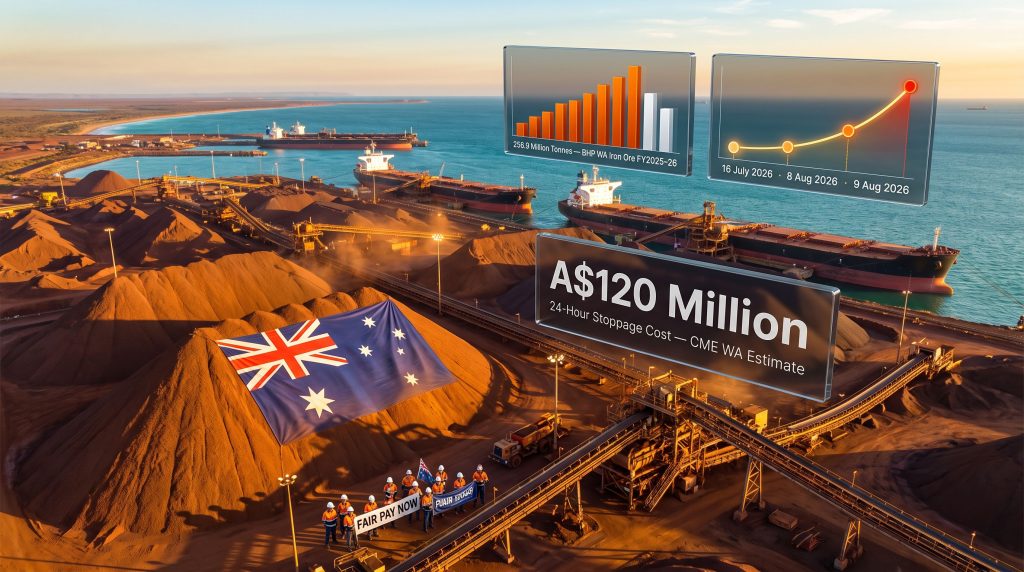
Port Hedland's claim to being the world's largest bulk iron ore export terminal is not merely a title. It reflects a structural reality: the entire Western Australian iron ore output of BHP, which totalled 256.9 million tonnes in the FY2025-26 fiscal year, moves exclusively through this one facility. There is no second port, no redundant export pathway, and no meaningful alternative infrastructure that could absorb throughput at scale in the event of a prolonged disruption.
The port functions as the critical seaborne link between the Pilbara's vast iron ore deposits and the steel mills of Asia. China, Japan, and South Korea collectively account for the dominant share of Pilbara ore imports, and their blast furnace schedules are calibrated around predictable, consistent delivery from Australian suppliers. The physical characteristics of Port Hedland's ore itself matter here: Pilbara iron ore typically grades at around 57-62% Fe (iron content), with relatively low impurity profiles that make it a preferred blend component for Asian steel mills optimising their burden mix.
The port's workforce architecture reveals a complexity that is often overlooked in headline coverage. Of the approximately 1,200 total workers at the facility, only around 450 are covered by the current enterprise agreement negotiations. Contractors are explicitly excluded from this scope, a structural decision that sits at the heart of the dispute. Up to 236 of those 450 workers hold protected industrial action rights as confirmed by Fair Work Commission records. Three unions jointly represent this workforce: the Electrical Trades Union (ETU), the Australian Workers' Union (AWU), and the Australian Manufacturing Workers' Union (AMWU).
The concentration of Australia's most critical iron ore export capacity at a single coastal terminal means that even a partial workforce stoppage involving a fraction of total employees can generate financial consequences entirely disproportionate to the headcount involved.
The Dispute That Has Been Nine Months in the Making
Understanding the BHP Port Hedland iron ore port strike requires appreciating that this is not a crisis that emerged suddenly. BHP began enterprise agreement negotiations with its Port Hedland maritime workforce in October 2025, meaning the dispute had already stretched across more than nine months without resolution before industrial action escalated in mid-2026.
The workers' core demands revolve around three interconnected issues:
- Pay equity between direct employees and contractors performing equivalent roles at the port
- Clearer job classification frameworks that provide transparent boundaries between roles and responsibilities
- Structured career progression pathways that give employees visibility over advancement opportunities
- Improved general working conditions, including the broader quality-of-life factors that have become increasingly salient in a regional Western Australian cost-of-living environment where housing costs in Pilbara towns have surged in line with the commodity boom
The contractor versus direct-employee pay gap is worth examining as an industry dynamic in its own right. Australian mining companies have increasingly structured their workforces around a core of directly employed workers supplemented by a much larger contractor pool. This model allows operational flexibility and cost management, particularly valuable during commodity price downturns. However, it creates visible pay disparities between workers doing materially similar jobs under different employment arrangements.
As labour markets have tightened post-COVID and cost-of-living pressures have intensified, this gap has become a flashpoint across multiple mining operations. Furthermore, Australia's iron ore dominance in global markets means any sustained disruption at a facility of this scale carries consequences well beyond a single company's balance sheet.
The Chamber of Minerals and Energy WA characterised the strike action as entering genuinely unprecedented territory, noting that meaningful industrial action in the Pilbara had been exceptionally rare over the preceding three decades. This observation is significant from a market psychology perspective: commodity markets that have never had to price in Pilbara labour risk are now being forced to develop a framework for doing so.
Chronological Escalation: From 63 Workers to a 48-Hour Stoppage
How Did the Action Progress?
The progression of this dispute follows a textbook pattern of graduated industrial pressure, with each round of action designed to demonstrate union credibility while preserving negotiating leverage.
| Date | Event |
|---|---|
| October 2025 | Enterprise agreement negotiations commence between BHP and Port Hedland maritime workforce |
| 16 July 2026 | First protected strike action: approximately 63 workers participate in an eight-hour stoppage |
| 17 July 2026 | A loaded vessel departs Port Hedland; BHP reports partial operational continuity |
| 31 July 2026 | ETU lodges formal notice of escalated action planned for 8-9 August |
| 4 August 2026 | Scheduled bargaining meeting between combined unions and BHP |
| 8 August 2026 | Planned 24-hour ship-loading ban commencing 05:30 AWST (21:30 GMT, 7 August) |
| 9 August 2026 | Planned 24-hour full work stoppage commencing 05:30 AWST (21:30 GMT, 8 August) |
According to reporting from the ABC, the initial strike coincided with a period of record iron ore production, heightening the financial stakes considerably. The jump from 63 workers in an eight-hour stoppage to approximately 150 workers in a planned 48-hour combined action signals a deliberate escalation strategy. The 4 August bargaining meeting functions as a structured off-ramp: a successful agreement would eliminate near-term disruption risk, while failure would trigger the most operationally significant Port Hedland stoppage in a generation.
Quantifying the Financial Exposure: What a Day of Lost Throughput Actually Costs
The CME WA estimate that a 24-hour stoppage at Port Hedland could cost BHP approximately A$120 million (around US$83 million) in lost export revenue is the headline figure that has attracted market attention. However, the actual financial impact is considerably more nuanced than a single number suggests.
| Scenario | Estimated Daily Revenue Impact | Probability of Physical Supply Disruption |
|---|---|---|
| Partial stoppage with active contingency | A$30-60 million | Low to moderate |
| Full 24-hour ship-loading ban | A$80-120 million | Moderate to high |
| Multi-day combined work stoppage | A$200 million+ cumulative | High |
| Prolonged unresolved dispute (weeks) | Material earnings revision risk | Very high |
BHP has confirmed it maintains contingency operational plans, including the capacity to deploy additional non-union personnel during stoppages to sustain critical functions. The departure of a loaded vessel on 17 July, the day after the initial strike action, suggests these contingency arrangements can preserve partial throughput. However, the degree of throughput maintained during the July action has not been fully disclosed, making it difficult to assess how effective these plans would be against a larger-scale 48-hour action involving 150 workers rather than 63.
Beyond the direct revenue impact, there are compounding indirect costs that are rarely captured in headline estimates. Cape-size bulk carriers, which are the vessel class predominantly used for Pilbara iron ore shipments, accumulate demurrage charges when held at anchor during loading bans. These charges typically range from US$15,000 to US$30,000 per day per vessel depending on market conditions, and they feed back into freight rate expectations and create basis risk for anyone holding positions in iron ore derivatives with specific delivery timelines.
Iron Ore Market Mechanics: How a Pilbara Stoppage Moves Global Prices
What Do Price Benchmarks Actually Reflect?
The iron ore spot price is benchmarked against 62% Fe fines delivered to Qingdao, China, the world's largest steel-producing nation. Price discovery occurs primarily through two exchanges: the Singapore Exchange (SGX) for iron ore derivatives and the Dalian Commodity Exchange (DCE) in China for domestic futures contracts. Both are highly sensitive to perceived shifts in Australian supply availability. Consequently, understanding iron ore price trends provides essential context for interpreting how markets respond to supply-side shocks.
A critical nuance that is often misunderstood outside specialist circles is the role of Chinese mill inventory buffers. Major Chinese steel producers typically maintain port stockpiles sufficient to cover 30 to 45 days of production requirements. This means that a 48-hour physical stoppage at Port Hedland does not immediately translate into a procurement crisis for Chinese steel mills. The physical supply disruption is likely to be absorbed without urgency.
What does move prices is speculative positioning. Iron ore futures traders on SGX and DCE will price in perceived supply risk before any physical shortage materialises, particularly given that the July 2026 stoppage was described by industry representatives as one of the first significant protected industrial actions in the Pilbara in roughly 25 years. Markets pricing this risk for the first time lack historical calibration, which can amplify short-term price volatility.
Could This Reshape Supply Chains?
A more material risk emerges if the dispute extends beyond isolated stoppages into a prolonged pattern of recurring action. At that point, the China steel demand outlook becomes particularly relevant, as Chinese steel mills may begin accelerating procurement from alternative suppliers, most notably Brazil's Vale, which operates the Carajas system producing high-grade 65% Fe ore. A sustained shift in procurement preferences would not only reduce BHP's pricing power but could also structurally reset the market share dynamics between Australian and Brazilian iron ore exporters that have prevailed for much of the past decade.
Furthermore, the iron ore surplus risk already present in 2025 means that any demand-side reallocation triggered by supply disruption could have amplified pricing consequences for Australian exporters. In addition, the global iron ore market impact of broader trade policy shifts already weighing on the sector makes the timing of this labour dispute particularly challenging for market participants seeking stable supply assumptions.
The next major ASX story will hit our subscribers first
The Fair Work Act Framework: Structural Limits on Disruption Duration
Australia's industrial relations system under the Fair Work Act 2009 creates a regulated environment for enterprise bargaining that both constrains and enables the current dispute. Workers seeking to take protected industrial action must first secure approval through a Fair Work Commission protected action ballot, a process that prevents spontaneous or wildcat strike activity and ensures that any industrial action has demonstrated majority worker support.
Of the approximately 450 workers covered by the enterprise agreement, up to 236 are eligible to participate in protected action under FWC records. This reflects the specific scope of the protected action ballot that was conducted, and it places a structural ceiling on maximum participation even if union solidarity is complete.
Critically, the FWC retains the power to suspend or terminate protected industrial action if it determines that the action is causing significant damage to the Australian economy or a significant part of it. Given Port Hedland's status as the world's single largest bulk iron ore export terminal, handling a disproportionate share of global seaborne supply, a sustained multi-week stoppage could plausibly meet this threshold.
The FWC's intervention power functions as a structural backstop that effectively caps the tail risk of an extended supply disruption. This regulatory mechanism is a key reason why the iron ore market is unlikely to face the kind of open-ended supply uncertainty that would trigger a structural price response rather than a speculative one.
BHP retains the legal avenue of applying to the FWC for intervention if the dispute escalates beyond the August action, though exercising this option carries reputational costs in terms of the ongoing employment relationship with its workforce. As reported by the AFR, the timing of this action was seen as deliberately chosen to maximise pressure on BHP at a particularly sensitive operational moment.
A Broader Labour Market Shift Reshaping Australian Mining
The BHP Port Hedland iron ore port strike does not exist in isolation. It is the most visible flashpoint in a broader structural shift occurring across Australia's resources sector. Several converging forces are reconfiguring the labour relations landscape:
-
Post-COVID labour market tightening has materially increased the bargaining leverage of skilled trades workers in regional mining operations, where alternative employment opportunities are limited and worker mobility is high.
-
Cost-of-living pressures in Pilbara towns have intensified, with housing costs in communities like Port Hedland and Karratha surging alongside mining activity, effectively eroding real wage growth even where nominal wages have increased.
-
Union campaigns for sector-wide pay equity standards have gained momentum, with both the ETU and AMWU signalling that outcomes from the Port Hedland negotiations will be used as reference points in future enterprise agreement campaigns across the broader resources sector.
-
Investor scrutiny of social licence has increased, with institutional shareholders applying greater pressure on mining majors to demonstrate constructive workforce relations rather than confrontational tactics that risk operational continuity.
The precedent risk embedded in this dispute is substantial. An enterprise agreement that establishes pay equity principles at Port Hedland would create a template that unions will seek to replicate at BHP's other Australian sites and potentially across competitor operations in the Pilbara. BHP's negotiating position therefore carries consequences well beyond the immediate dispute.
What Investors and Market Participants Should Monitor
For those with exposure to BHP equity, iron ore futures, or steel raw materials supply chains, the following variables are the most consequential:
- The 4 August bargaining outcome is the pivotal binary event: resolution eliminates near-term disruption risk entirely, while failure escalates to the most significant Port Hedland action in a generation
- Contingency effectiveness during the August action will determine the actual throughput impact versus the theoretical maximum exposure reflected in CME WA's A$120 million daily estimate
- Chinese mill port inventory levels at the time of any stoppage will determine how quickly physical supply tightness translates into procurement pressure
- SGX and DCE futures positioning in the days before and after 8-9 August will reflect market consensus on disruption probability and duration
- FWC intervention signals would indicate the dispute has reached a scale where the regulatory backstop is being actively considered, which would itself be a market-moving development
- Precedent implications for BHP's broader Australian workforce represent the longer-duration risk that extends well beyond the immediate August action
Disclaimer: This article contains forward-looking analysis, scenario projections, and financial estimates sourced from third-party industry bodies including CME WA. These figures are estimates and should not be relied upon as investment advice. Market conditions, dispute outcomes, and regulatory responses are subject to change. Readers should conduct their own due diligence before making investment decisions.
Want to Stay Ahead of Major ASX Resource Sector Developments?
Discovery Alert's proprietary Discovery IQ model delivers real-time alerts on significant ASX mineral discoveries, transforming complex resource sector data into actionable investment insights for both short-term traders and long-term investors — explore Discovery Alert's discoveries page to understand how historic mineral discoveries have generated substantial market returns, and begin your 14-day free trial today to position yourself ahead of the broader market.