
July 31, 2026
The Invisible Hand Behind Aluminium Prices: When Warehouse Floors Empty Out
Commodity markets have a language of their own, and few signals are more telling than the simultaneous movement of prices upward and inventories downward. In base metals trading, the LME aluminium price rise and stocks dip is not coincidental. It reflects a fundamental truth about physical availability: when the metal sitting in exchange-registered warehouses begins to disappear faster than it is replenished, the price discovery process adjusts accordingly. Understanding why this happens, and what it means for buyers, producers, and investors, requires looking beyond the headline numbers into the structural mechanics that drive the London Metal Exchange (LME) aluminium market.
When big ASX news breaks, our subscribers know first
Why the LME Aluminium Price Rise and Stocks Dip Matters More Than It Appears
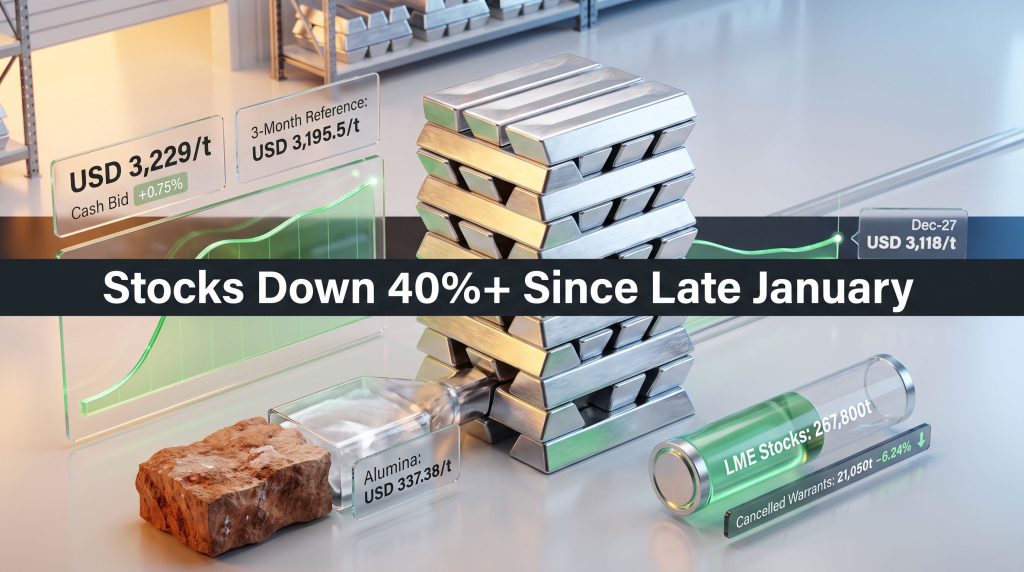
The LME aluminium price rise and stocks dip recorded in the July 30 session represents more than a single-day data point. It is the latest chapter in a multi-month story of tightening physical supply. Cash bid prices moved from USD 3,205 per tonne to USD 3,229 per tonne, a gain of 0.75%, while cash offer prices followed in lockstep, rising from USD 3,207 per tonne to USD 3,231 per tonne over the same period.
At the same time, total opening stocks fell from 269,300 tonnes to 267,800 tonnes, a single-session decline of 0.56%. Individually, these movements might seem routine. In the context of a drawdown exceeding 40% since late January, reaching stock levels not seen since September 2022, they take on an entirely different dimension. Furthermore, developments in aluminum and alumina markets suggest these pressures are part of a broader structural shift affecting the entire metals supply chain.
Reading the LME Warehouse System as a Supply Barometer
The LME warehouse network functions as a global buffer stock for primary aluminium. Metal deposited into approved warehouses receives a warrant, which is essentially a title document confirming ownership of a specific quantity of metal at a specific location. These warrants are traded on the exchange, and their status tells a great deal about market conditions.
There are two distinct categories worth understanding:
- Live warrants represent metal that is currently available for trading or physical delivery
- Cancelled warrants represent metal that has already been earmarked for withdrawal from a warehouse but has not yet physically departed
When cancelled warrants are elevated as a proportion of total stock, it signals that a meaningful portion of exchange-registered inventory is already spoken for. In the July 30 session, cancelled warrants fell from 22,450 tonnes to 21,050 tonnes, a decline of 6.24%. This reduction in cancelled warrants, while initially appearing to ease near-term delivery pressure, is occurring within an overall inventory base that has been shrinking for months.
"When live warrants and cancelled warrants decline simultaneously, the market is not experiencing administrative reshuffling. It is experiencing genuine drawdown of available physical supply, a distinction that carries significant pricing implications."
A Detailed Look at the Price Curve: What Each Contract Is Telling Investors
Aluminium is priced across multiple time horizons on the LME, and each contract point provides a different window into market sentiment and supply-demand expectations.
| Contract Type | Previous Price (USD/t) | Current Price (USD/t) | % Change |
|---|---|---|---|
| Cash Bid | 3,205 | 3,229 | +0.75% |
| Cash Offer | 3,207 | 3,231 | +0.75% |
| 3-Month Bid | 3,176 | 3,185 | +0.28% |
| 3-Month Offer | 3,177 | 3,187 | +0.32% |
| 3-Month Reference | 3,180 | 3,195.5 | +0.49% |
| Dec-27 Bid | 3,113 | 3,118 | +0.16% |
| Dec-27 Offer | 3,118 | 3,123 | +0.16% |
Several observations emerge from this data structure. The three-month reference price, which settled at USD 3,195.5 per tonne, is the benchmark most widely used in physical supply contracts globally. Its 0.49% gain reflects genuine upward repricing momentum rather than speculative noise. You can track live movements of this benchmark directly via the LME's official aluminium page.
More revealing is the relationship between the front of the curve and the longer end. Cash prices at approximately USD 3,230 per tonne sit meaningfully above the December 2027 contracts at approximately USD 3,120 per tonne. This configuration is known as backwardation, where near-term delivery commands a premium over future delivery. In commodity markets, backwardation is a classic signal of immediate physical scarcity.
When the gains at the front of the curve (+0.75%) substantially exceed gains at the back (+0.16%), the market is effectively communicating that the tightness is concentrated in the present, not the future. Longer-dated participants are not pricing in a permanent supply crisis. They are pricing in a near-term squeeze that may resolve as production responses and trade flows adjust over time.
The Tight Bid-Offer Spread: A Liquidity Quality Indicator
One often-overlooked detail in LME price data is the bid-offer spread itself. Across all contracts, the spread between bid and offer prices was just USD 2 per tonne. Tight spreads indicate a liquid, actively contested market where buyers and sellers are in close agreement on value. Wide spreads, by contrast, reflect uncertainty and reduced transaction volume. The consistency of this tight spread across cash and forward contracts on July 30 confirms that the price movement was driven by genuine market participation rather than thin-volume distortions.
Inventory Drawdown: Scale, Context, and Historical Precedent
The magnitude of the current LME aluminium inventory decline deserves careful contextualisation. A drawdown of more than 40% over approximately six months is not a seasonal adjustment. It represents a structural rebalancing of where physical metal sits and who holds it.
| Inventory Metric | Value |
|---|---|
| Current Opening Stocks | 267,800 tonnes |
| Approximate Stocks (Early July Reference) | ~290,825 tonnes |
| Stock Level Comparable Period | September 2022 |
| Drawdown Since Late January | Greater than 40% |
| Cancelled Warrants (Latest) | 21,050 tonnes |
| Live Warrants (Latest) | 245,250 tonnes |
The September 2022 reference point is significant. That period coincided with elevated energy costs disrupting European aluminium smelting capacity, creating genuine supply shortfalls that drove prices sharply higher. The current inventory trajectory is approaching comparable territory, though the drivers differ in composition.
"A drawdown exceeding 40% over a six-month window has historically preceded either sustained price support or outright upward repricing cycles in aluminium. This scale of decline is not self-correcting without a corresponding production response or demand contraction."
It is worth noting that low LME inventory alone does not guarantee a sustained price rally. Much of the metal withdrawn from exchange warehouses may have entered off-warrant storage operated by traders, producers, or end-users. This so-called "shadow inventory" can re-enter the market when price incentives are sufficient, acting as an invisible supply buffer that dampens upside momentum. Tracking only LME-registered stocks therefore provides an incomplete picture of total available supply.
Supply or Demand: Diagnosing the Root Cause of the Price Rise
Correctly attributing a price rise to either supply-side or demand-side forces matters enormously for forecasting its durability. The current evidence points predominantly toward supply-side drivers.
Supply-side factors contributing to the price environment include:
- Ongoing capacity constraints at smelters in energy-intensive production regions, where electricity cost pressures have curtailed output
- Disruptions to trade flows affecting the volume of primary aluminium reaching LME-approved warehouses
- A multi-month trend of metal being withdrawn for direct consumption rather than re-deposited into exchange storage
Demand-side context is more nuanced:
- Downstream sectors including electric vehicle manufacturing, construction, packaging, and aerospace continue to exhibit structural aluminium demand growth
- Chinese unwrought aluminium import volumes dropped 28.8% in June year-on-year, according to data cited by AL Circle, reflecting domestic supply sufficiency rather than weak Chinese demand
- Easing expectations around US Federal Reserve interest rate increases are reducing the cost of holding commodity inventories and supporting industrial metals pricing broadly
The Chinese import data deserves particular attention. A sharp decline in Chinese unwrought aluminium imports signals that China is producing enough domestically to meet its own needs. Consequently, this reduces the likelihood that Chinese buying will provide additional support to LME prices. For a market already dealing with declining exchange stocks, this removes one potential demand catalyst from the equation. This is also relevant context when assessing the broader aluminium tariff impact on global trade flows and where primary metal ultimately lands.
The Hidden Dynamic of Off-Warrant Inventory
A concept less commonly understood outside specialist circles is the distinction between LME-registered inventory and total market inventory. When metal is withdrawn from LME warehouses, it does not necessarily enter consumption immediately. Significant volumes are held in off-warrant, privately operated storage facilities by trading houses, end-users, and financial institutions. These holdings do not appear in LME stock data but exert real influence on the physical market's tightness.
During periods of backwardation, holding metal in off-warrant storage becomes less financially attractive because the contango premium, which usually compensates storage costs, disappears. This can paradoxically accelerate metal withdrawal from LME warehouses as operators seek physical delivery, intensifying the apparent stock decline even if total available supply has not changed as dramatically as headline figures suggest.
Alumina Stability: A Smelter Margin Opportunity Hiding in Plain Sight
While aluminium prices moved higher on July 30, LME alumina Platts prices held steady at USD 337.38 per tonne. This stability carries significant implications for primary aluminium producers. In addition, the global bauxite supply outlook plays a critical upstream role in determining whether these favourable margin conditions can be sustained over the medium term.
Alumina is the critical intermediate input in the aluminium production chain. The three-stage process, moving from bauxite mining through alumina refining and finally to aluminium smelting, means that cost pressures at any upstream stage propagate directly into smelter economics. When alumina costs remain flat while finished aluminium prices rise, smelter operating margins expand.
For producers with integrated upstream operations covering both bauxite and alumina production, this margin expansion is amplified. Their input costs are largely internal, meaning that rising LME aluminium prices translate more directly into improved profitability than for pure smelters reliant on third-party alumina supply. The top aluminium producers with vertically integrated operations are therefore best positioned to capitalise on this environment.
This dynamic also creates a medium-term feedback loop. Improved smelter margins incentivise higher production rates, which eventually increases the supply of primary aluminium available for market. If this production response materialises faster than demand growth, it could moderate the current price tightness. This self-correcting mechanism is why near-term backwardation does not automatically translate into a sustained multi-year bull market without persistent demand-side support.
The next major ASX story will hit our subscribers first
The CBAM Factor: A Structural Cost Shift Reshaping European Aluminium Access
One underappreciated structural force affecting aluminium market dynamics, particularly for European buyers, is the European Union's Carbon Border Adjustment Mechanism (CBAM). Aluminium is among the most carbon-intensive metals to produce, with the smelting process being highly electricity-dependent. Under CBAM, importers of aluminium into the EU must account for the embedded carbon content of their purchases, creating an additional compliance cost layered on top of LME pricing.
This mechanism does not affect LME cash prices directly, but it materially alters the landed cost economics for European buyers sourcing from high-carbon production regions. Furthermore, green metals pricing trends are increasingly shaping how buyers assess total procurement costs in regulated markets. Over time, CBAM-related cost pressures could:
- Reduce the effective supply of competitively priced aluminium available to European fabricators
- Accelerate demand for low-carbon aluminium from regions with cleaner energy grids
- Create a pricing premium for green aluminium that operates in parallel with, but distinct from, LME benchmark pricing
For investors monitoring aluminium market dynamics in 2026, CBAM represents a structural variable that may increasingly decouple European aluminium procurement economics from LME spot price movements alone.
What This Means for Different Market Participants
For Physical Buyers and Fabricators
Rising cash prices at USD 3,229 to 3,231 per tonne increase the immediate cost of metal procurement. The declining buffer of LME-registered inventory reduces the availability of spot-priced metal, pushing buyers toward forward contracts or off-market bilateral agreements. Locking in three-month forward pricing at USD 3,185 to 3,187 per tonne may represent a risk management opportunity relative to the trajectory of cash prices if the current supply tightness persists.
For Aluminium Producers
Higher realised prices combined with stable alumina input costs at USD 337.38 per tonne create a margin expansion environment. Producers with vertical integration benefit most, as their upstream cost base is insulated from spot alumina market movements. This configuration is particularly advantageous for operations that own bauxite resources and refining capacity alongside smelting.
For Commodity Investors and Traders
The current market structure presents several considerations:
- Backwardation (cash at ~USD 3,230/t versus Dec-27 at ~USD 3,120/t) signals near-term physical scarcity and is typically a positive indicator for long positioning in nearby contracts
- The 40%+ inventory drawdown creates momentum-positive conditions, but investors should monitor weekly LME stock data as a leading indicator of whether tightness is intensifying or beginning to resolve
- Off-warrant inventory levels, while not directly observable, can be inferred from freight rates, warehouse operator commentary, and regional physical premiums, providing additional data points for supply assessment
- Macro tailwinds from easing Fed rate expectations and potential USD softening provide a supportive backdrop for USD-denominated commodity prices, as they improve affordability for non-USD buyers globally
"Backwardation in base metals markets reflects genuine physical scarcity at the front of the curve. Traders monitoring LME aluminium should treat weekly inventory data as a primary leading indicator, tracking not just total stock levels but the ratio of cancelled to live warrants to gauge near-term delivery pressure."
Frequently Asked Questions: LME Aluminium Price Rise and Stocks Dip
What does it mean when LME aluminium prices rise while stocks fall?
It signals that physical metal available for immediate delivery is becoming scarcer. When buyers compete for a shrinking pool of exchange-registered inventory, upward price pressure on near-term contracts intensifies, a pattern consistent with supply tightness rather than speculative activity alone.
What are cancelled warrants on the LME and why do they matter?
Cancelled warrants represent aluminium already committed for physical withdrawal from LME warehouses. When cancelled warrants represent a large share of total stock, it indicates that much of the available inventory is already earmarked, reducing the effective supply buffer and supporting spot prices.
How does the three-month LME aluminium price differ from the cash price?
The cash price reflects the cost of metal available for immediate delivery. The three-month price is the global benchmark used in most physical supply contracts. The spread between them reveals whether the market is in contango, where future prices exceed spot prices suggesting ample expected supply, or backwardation, where spot exceeds futures, indicating near-term tightness.
Why have LME aluminium stocks fallen more than 40% since late January?
The drawdown reflects a combination of sustained physical demand, reduced primary production in certain regions due to energy cost pressures, and consistent metal withdrawal from warehouses for direct consumption rather than re-warehousing. The cumulative effect has pushed exchange-registered stocks to levels not seen since September 2022.
What is the LME alumina Platts price and why is it relevant?
The alumina Platts price at USD 337.38 per tonne represents the cost of the key feedstock used in aluminium smelting. When this figure remains stable while aluminium output prices rise, smelter operating margins improve, potentially incentivising higher production rates that could eventually ease supply tightness.
Does a rising LME aluminium price always indicate a bullish long-term outlook?
Not necessarily. Near-term price rises driven by inventory drawdowns can be self-correcting if higher prices stimulate new production or reduce downstream consumption. Sustained bullish conditions require both persistent supply constraint and robust demand growth to coexist over an extended period.
Key Takeaways: Decoding the Current Aluminium Market Signal
- Cash prices gained 0.75% in a single session, with the three-month reference settling at USD 3,195.5 per tonne
- Total LME opening stocks fell to 267,800 tonnes, continuing a drawdown that has exceeded 40% since late January and reached September 2022 comparable levels
- Cancelled warrants declined 6.24% to 21,050 tonnes, reflecting reduced near-term withdrawal commitments within a broader tightening inventory trend
- Alumina Platts held steady at USD 337.38 per tonne, supporting margin expansion for primary aluminium producers as output prices rise
- The price curve structure, with cash above longer-dated contracts, reflects a near-term supply squeeze rather than a long-term scarcity signal
- Chinese unwrought aluminium import volumes fell 28.8% in June, indicating domestic supply sufficiency and reducing the likelihood of Chinese demand providing additional LME price support
- CBAM compliance costs are reshaping the effective landed cost of aluminium for European buyers, adding a structural layer to LME benchmark dynamics
- Off-warrant inventory represents a less visible but material variable in assessing whether current LME stock declines overstate or accurately reflect true physical tightness
Readers seeking additional context on LME aluminium market dynamics, physical premiums, trade flow data, and the evolving alumina supply chain can explore pricing data and industry analysis available through AL Circle, which tracks primary aluminium pricing, inventory movements, and global trade flow developments across the aluminium ecosystem.
Want to Know When the Next Major ASX Mineral Discovery Hits the Market?
Discovery Alert's proprietary Discovery IQ model scans ASX announcements in real time, instantly converting complex commodity data across 30+ metals into clear, actionable insights — so investors can act on significant discoveries before the broader market catches on. Explore historic discoveries and their extraordinary returns, then begin your 14-day free trial at Discovery Alert to position yourself ahead of the next major find.