July 31, 2026
When Energy Infrastructure Becomes a Target: The Strategic Logic Behind Port Strikes
For decades, the doctrine of maritime conflict in the Middle East revolved around interdicting vessels in open water. Chokepoints like the Strait of Hormuz and the Bab el-Mandeb strait became synonymous with energy security risk, and insurers priced their premiums accordingly. But a fundamentally different threat architecture is now emerging, one where fixed port infrastructure, not transiting vessels, becomes the primary target. The Egypt drone attack on gas vessels at Damietta on July 29–30, 2026 crystallises this shift in ways that energy markets, maritime insurers, and regional governments are only beginning to process.
When big ASX news breaks, our subscribers know first
Why Striking a Port Is Strategically Different from Attacking a Ship at Sea
Hitting a vessel on the open ocean carries tactical uncertainty. The target moves, detection windows are narrow, and the attacker must manage complex navigation variables. Striking fixed port infrastructure eliminates most of those challenges while dramatically amplifying the consequences. A single successful hit on a moored floating storage and regasification unit (FSRU) does not just damage one vessel — it can cascade across a country's entire gas import system.
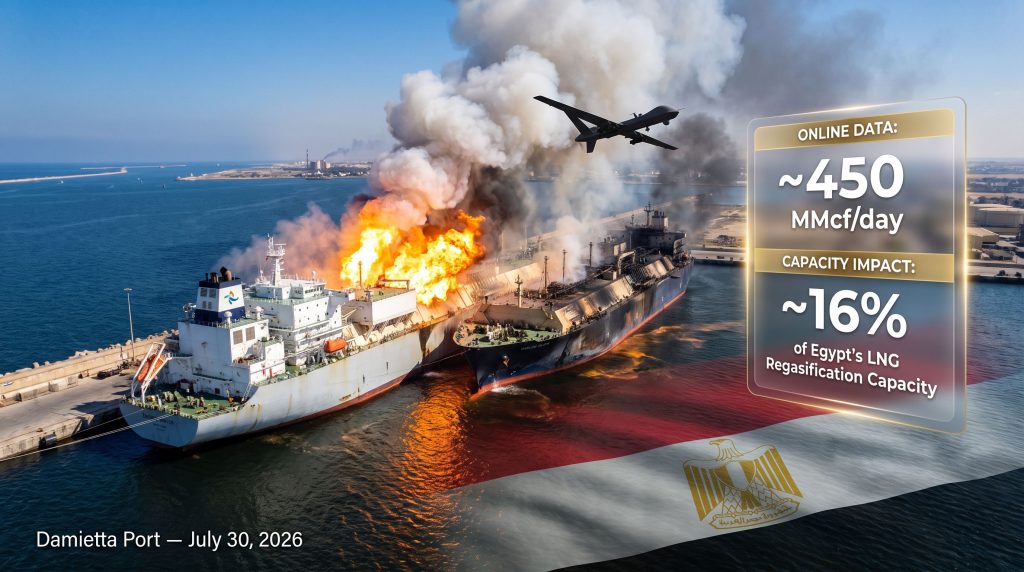
The Damietta attack illustrates this logic precisely. The drone reportedly struck the Energos Winter on its starboard side while the vessel was moored at the port, with fire subsequently spreading to the nearby LNG tanker GasLog Salem. Because both vessels were stationary and in close proximity, a single strike generated a multi-vessel incident that would have been far harder to engineer in open water.
Damietta sits on Egypt's northern Mediterranean coast, positioned close enough to the Suez Canal corridor that any sustained disruption to port operations there carries ripple effects well beyond Egypt's domestic energy system. The Suez Canal has functioned as one of the last reliable transit corridors for Gulf energy exports to global markets, and the psychological proximity of a drone strike to that artery is not lost on shipping operators or intelligence analysts. Furthermore, the broader geopolitical risk landscape across the region adds a further layer of complexity to how this incident is being interpreted.
Confirmed Facts: What Is Known as of July 30, 2026
| Detail | Status |
|---|---|
| Cause of fire | Confirmed: drone strike (Egyptian cabinet) |
| Vessels affected | Energos Winter (FSRU), GasLog Salem (LNG tanker) |
| Point of impact | Starboard side of Energos Winter |
| Casualties | None reported |
| Responsibility claimed | No group has claimed responsibility |
| Tank breach reported | Yes, at Energos Winter |
| Port operational status | Disrupted; both vessels moved offshore |
Egypt's cabinet issued an official confirmation on July 30, 2026 that a drone caused the fire, affirming that the incident was an attack rather than an accident. According to Reuters, British maritime security firm Ambrey had already identified drone causation in an initial assessment within 24 hours of the incident, with maritime risk management group Vanguard separately confirming the starboard impact and subsequent fire suppression.
Egypt's Petroleum Minister Karim Badawi visited the site personally to oversee response efforts. Egyptian authorities stated that investigations are ongoing and that measures are being taken to protect national security.
No group or state actor had publicly claimed responsibility for the attack as of July 30, 2026. All attribution scenarios remain speculative pending the conclusion of official investigations.
Understanding the Vessels Involved and Why Their Loss Matters
What Is a Floating Storage and Regasification Unit?
An FSRU is not simply a vessel that happens to carry gas. It is a piece of national energy infrastructure that happens to float. FSRUs receive supercooled LNG in liquid form from incoming tankers, store it, and then convert it back into gas through a regasification process before feeding it into a country's onshore pipeline network. Because they can be deployed relatively quickly compared to land-based terminal construction, FSRUs have become the preferred solution for countries rapidly scaling up LNG import capacity.
This operational architecture means that losing an FSRU is functionally equivalent to losing a major receiving terminal. The gas does not stop arriving at port — it simply has nowhere to be processed and distributed.
The Energos Winter: Capacity, Ownership, and Strategic Weight
The Energos Winter is owned by US-based Energos Infrastructure. Its technical, safety, and commercial management is handled by Wilhelmsen Ship Management, a Singapore-based subsidiary of the Norwegian Wilhelmsen Group. This ownership structure carries its own geopolitical significance: the vessel is American-owned, a fact that could be relevant to any eventual attribution analysis.
In terms of capacity, the Energos Winter processes approximately 450 million cubic feet of gas per day, which according to Egyptian energy consultancy ElAdl Studies equates to roughly:
- 7% of Egypt's total daily gas consumption
- 16% of Egypt's total LNG receiving and regasification capacity
A reported tank breach at the vessel suggests that repair timelines could extend well beyond what a surface fire alone would require. Tank repairs on an FSRU are highly specialised and time-consuming, potentially requiring drydock access and specialist contractors. This is not a two-week fix.
The GasLog Salem: Compounding Damage from Secondary Exposure
The GasLog Salem, an LNG tanker, sustained damage when fire spread from the Energos Winter. While its role is different from the FSRU, the loss of an LNG tanker from active service compounds Egypt's import logistics precisely when replacement cargoes may be needed most. Two sources familiar with the incident indicated both vessels are expected to remain out of service for a significant period.
Egypt's Energy Vulnerability: The Transition from Exporter to Importer
| Egypt LNG Market Shift | Detail |
|---|---|
| Previous status | Major LNG exporter following development of the Zohr offshore gas field |
| Current status | Significant LNG importer due to declining domestic production and rising demand |
| Peak demand period | Summer months, coinciding with the timing of the attack |
| Spare system capacity | Reduced by the Energos Winter outage |
Egypt's transition from gas exporter to gas importer is one of the less appreciated energy stories of the past several years. The development of the Zohr field, which came online in late 2017 and rapidly scaled to become one of the Mediterranean's largest producing assets, briefly positioned Egypt as a meaningful LNG exporter. However, production from that field has since declined faster than initially projected, while domestic electricity demand, particularly during summer cooling periods, has climbed. The result is a country that now depends on LNG imports to bridge a structural supply-demand gap, with that dependency concentrated in the same peak summer months when the Energos Winter was taken out of service.
In this context, the energy export challenges faced by other nations navigating volatile supply conditions offer a useful comparative lens, demonstrating how quickly infrastructure disruptions can reshape a country's energy posture.
Can Egypt Manage Without the Energos Winter?
According to ElAdl Studies, the outage is not expected to produce an immediate, acute supply crisis because Egypt retains alternative import facilities and fuel substitution options. However, the analysis makes clear that the attack strips the system of redundancy precisely when that redundancy matters most.
The available contingency pathways, as identified in the ElAdl note, include:
- Maximising throughput at remaining operational regasification units to offset lost capacity
- Increasing fuel oil substitution in power generation as a backup energy source
- Expanding renewable energy dispatch to reduce overall gas demand during peak hours
- Selective industrial curtailment as a last resort, temporarily reducing gas supply to non-essential industrial consumers
The distinction between an acute supply gap and a structural capacity squeeze is important. Egypt can likely avoid blackouts, but it will be operating with less buffer in its energy system at the worst possible time of year. If a second significant supply disruption were to occur before repairs are completed, the calculus changes considerably.
The Geopolitical Architecture: Where Damietta Fits in the Regional Escalation
The Damietta attack did not occur in isolation. It took place within days of Iran launching a missile strike against US forces in Jordan, and shortly after US and Saudi forces conducted strikes against Iran-aligned paramilitary groups in Iraq. The Houthi movement in Yemen simultaneously declared a naval blockade on Saudi Arabia. Analysts have described this period as representing the widest geographic spread of the conflict since US and Israeli military operations against Iran began in February 2026.
Egypt's particular significance here is that it has not been a direct party to this conflict arc. Cairo has maintained a carefully calibrated neutral posture. Striking Egyptian port infrastructure, if confirmed as a deliberate act by a conflict-linked actor, signals a potential willingness to expand target geography to non-belligerent states that host energy infrastructure of strategic value to the broader Western-aligned energy system.
The strategic message embedded in targeting a non-belligerent state's energy infrastructure is distinct from striking a party directly involved in hostilities. It communicates that the perimeter of acceptable targets is expanding, which has profound implications for other Mediterranean states in similar positions.
This escalatory pattern is consistent with broader oil market disruption trends observed across the region in 2025 and into 2026, where geopolitical flashpoints have repeatedly translated into sudden and material energy supply shocks.
The next major ASX story will hit our subscribers first
Attribution: Who Has Motive and Capability?
| Actor | Motive | Capability Assessment |
|---|---|---|
| Houthi movement (Yemen) | Naval blockade declared; anti-Western energy targeting | Demonstrated long-range drone and missile capability; previously struck Red Sea and Gulf shipping |
| Iran-aligned proxies | Potential retaliation; Energos Winter is US-owned | Operational across multiple regional theatres |
| Unknown non-state actor | Unclear | Under investigation |
The absence of a claimed responsibility is itself analytically meaningful. In asymmetric conflict, claiming an attack generates deterrence value and political messaging. Not claiming an attack preserves plausible deniability and complicates the adversary's response calculus. The strategic choice to remain silent suggests either that the perpetrating actor values ambiguity over credit, or that attribution remains genuinely unclear even to those conducting the attack.
Red Sea Precedent vs. Mediterranean Escalation: A Structural Comparison
| Dimension | Red Sea (Houthi Campaign) | Eastern Mediterranean (Post-Damietta) |
|---|---|---|
| Onset of disruption | Late 2023 | July 2026 |
| Primary targets | Commercial vessels transiting Bab el-Mandeb | Fixed port energy infrastructure |
| Rerouting options | Cape of Good Hope diversion available | Limited Mediterranean alternatives |
| Insurance premium impact | Significant and rapid spike | Emerging, currently under assessment |
| Geopolitical complexity | Iran-Houthi-US triangle | Multi-actor; attribution unresolved |
The Red Sea Houthi campaign demonstrated how sustained maritime targeting, even without destroying vessels outright, could fundamentally reprice global shipping routes and redirect cargo flows. The Eastern Mediterranean presents a more constrained rerouting environment. There is no Mediterranean equivalent of the Cape of Good Hope diversion. If port infrastructure in the Eastern Mediterranean becomes a regular target, the pressure on the Suez Canal corridor intensifies rather than disperses.
War risk insurance premiums for Mediterranean shipping lanes were already being reassessed as of late July 2026. Ambrey's rapid initial attribution of drone causation within 24 hours of the incident is noteworthy: insurers and vessel operators rely on exactly this type of real-time assessment to calibrate exposure and activate exclusion clauses. Consequently, commodity volatility hedging strategies are likely to require urgent revision for market participants with Mediterranean energy exposure.
LNG Market Implications: What Traders Are Watching
A prolonged Energos Winter outage carries specific implications for global LNG spot markets. Egypt has historically been a price-sensitive buyer of spot LNG cargoes during summer demand peaks. If the country needs to procure additional spot cargoes to compensate for reduced regasification throughput at Damietta, that incremental demand will surface in the Mediterranean spot market.
The timing is significant. Summer 2026 is already a period of elevated LNG demand across Europe and the broader Mediterranean basin. Additional Egyptian spot demand entering a tight market could apply upward pressure on short-term pricing. Furthermore, the Egypt drone attack on gas vessels at Damietta introduces a new variable into supply chain models that traders had not previously priced in for this corridor.
As Al Jazeera reported, traders with long positions in Mediterranean LNG would monitor the repair timeline closely, as the duration of the Energos Winter outage — particularly if the tank breach extends repairs significantly — becomes a direct input into demand forecasting models. The broader oil price shock dynamics observed in 2025 have already sensitised energy executives to the speed at which infrastructure incidents can translate into market repricing.
Frequently Asked Questions
What happened at Damietta port on July 29–30, 2026?
A drone struck the FSRU Energos Winter at Egypt's Damietta Mediterranean port, igniting a fire that spread to the LNG tanker GasLog Salem. Egypt's cabinet officially confirmed drone causation on July 30, 2026. No casualties were reported, and both vessels were subsequently moved offshore for assessment.
Who owns the Energos Winter and who operates it?
The vessel is owned by US-based Energos Infrastructure. Technical, safety, and commercial management is handled by Wilhelmsen Ship Management, a Singapore-based subsidiary of the Norwegian Wilhelmsen Group.
How significant is the Energos Winter to Egypt's energy system?
The vessel processes approximately 450 million cubic feet of gas per day, representing roughly 7% of Egypt's daily gas consumption and 16% of its total LNG receiving and regasification capacity, according to ElAdl Studies.
Has anyone claimed responsibility?
No group or state had publicly claimed responsibility as of July 30, 2026. Egyptian authorities confirmed drone causation and stated that investigations are ongoing.
Does this threaten the Suez Canal?
The Suez Canal has not been directly targeted. However, Damietta's position close to the canal corridor means further escalation targeting Egyptian energy infrastructure would carry significant implications for regional shipping confidence and global risk premiums on canal-adjacent routes.
Key Takeaways
- The Egypt drone attack on gas vessels at Damietta marks a geographic expansion of conflict-related targeting into the Eastern Mediterranean, moving beyond traditional open-water interdiction toward fixed port energy infrastructure
- Egypt's official confirmation of drone causation transforms this from an industrial incident into a geopolitical security event with regional implications
- The Energos Winter's capacity of 450 MMcf/day, representing approximately 16% of Egypt's LNG regasification capacity, makes a prolonged outage a material energy security concern, particularly given a reported tank breach
- A reported tank breach could substantially extend repair timelines beyond what fire damage alone would suggest, with potential drydock requirements adding months to any restoration schedule
- Egypt retains contingency options but faces reduced system redundancy during peak summer demand, the period when resilience margins matter most
- The absence of claimed responsibility is a deliberate strategic choice that complicates diplomatic and military response calculations for Egypt and its partners
- Global LNG traders, maritime insurers, and energy security analysts are monitoring the situation closely, with Mediterranean spot pricing and war risk premiums both subject to upward revision if the outage extends or escalation continues
This article is intended for informational purposes only and does not constitute financial, investment, or security advice. Forward-looking assessments regarding energy markets, geopolitical escalation, and repair timelines involve inherent uncertainty. Readers should consult primary sources and qualified analysts before making decisions based on this content. Ongoing developments should be tracked through authoritative outlets including Arab News at arabnews.com.
Want to Stay Ahead of Market-Moving Resource and Energy Discoveries?
Discovery Alert's proprietary Discovery IQ model delivers real-time alerts on significant ASX mineral discoveries the moment they hit the exchange, transforming complex data across 30+ commodities into clear, actionable insights — explore historic discoveries and their exceptional returns to understand the opportunity, then begin your 14-day free trial at Discovery Alert to secure your market-leading edge before the broader market reacts.