July 31, 2026
The Hidden Climate Cost Buried in Every Tonne of Indian Steel
Methane rarely commands the same headlines as carbon dioxide, yet tonne for tonne it is approximately 80 times more potent as a greenhouse gas over a 20-year timeframe. Within India's rapidly expanding coal sector, this distinction carries enormous practical weight. As the country accelerates domestic coking coal production to reduce a costly import dependency, India coking coal methane emissions represent a parallel and largely underappreciated problem building underground. Understanding the full scale of this challenge, and the surprisingly affordable tools available to address it, is essential for anyone tracking the intersection of industrial policy and climate accountability in one of the world's fastest-growing economies.
When big ASX news breaks, our subscribers know first
The Methane Intensity Gap: Why Coking Coal Emits More Than Thermal Coal
Not all coal is created equal from a methane perspective. The physical and geological characteristics of coal determine how much gas accumulates within the seam over millions of years, and how much of that gas is liberated when mining disrupts the surrounding rock structure.
Coking coal, also known as metallurgical coal, forms under higher pressure and temperature conditions than thermal or steam coal. These conditions produce denser, more carbon-rich seams that also tend to retain significantly higher volumes of adsorbed methane. When accessed through underground longwall or bord-and-pillar mining methods, these seams release gas at rates that substantially exceed those of open-cut or shallower thermal operations.
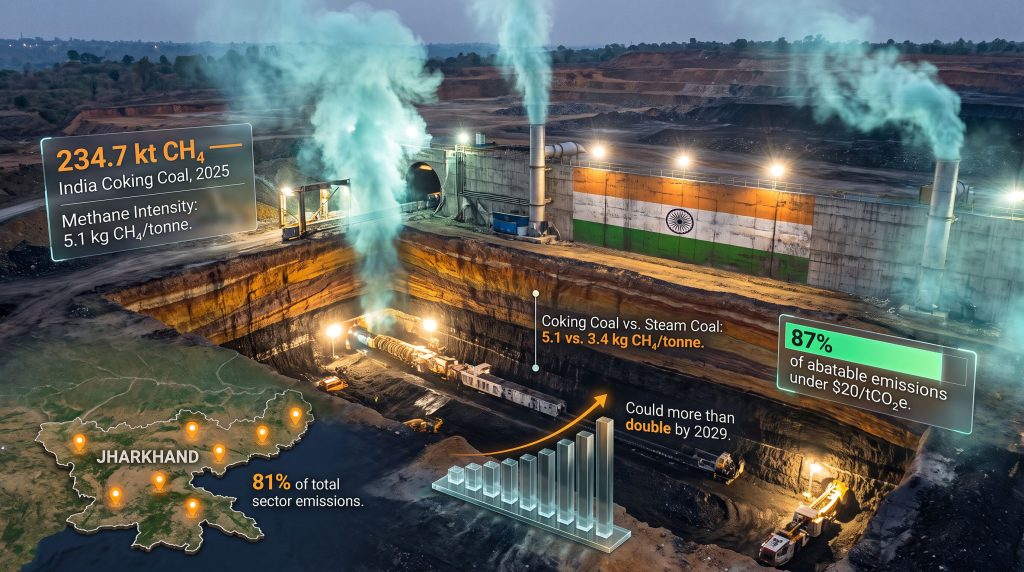
According to data from the IEA's Global Methane Tracker 2026, the methane intensity of coking coal in India sits at 5.1 kg of CH₄ per tonne of coal, compared to 3.4 kg per tonne for steam coal. That differential of roughly 50% is not a rounding error; it is a structural feature of the resource itself.
| Coal Type | Methane Intensity (kg CH₄/tonne) |
|---|---|
| Coking Coal | 5.1 |
| Steam Coal | 3.4 |
The gap widens further as India pushes into deeper reserves to meet domestic demand. As mining depths increase, in-situ gas pressures rise and methane content per tonne escalates. Underground operations require mechanical ventilation to manage gas concentrations for worker safety, and this ventilation process itself becomes a primary pathway for methane to escape into the atmosphere at scale. The deeper the mine, the higher the ventilation air methane (VAM) burden.
How Large Is India's Coking Coal Methane Footprint in 2025?
Breaking Down the IEA Global Methane Tracker 2026 Estimates
Based on IEA Global Methane Tracker 2026 data, India's coking coal mining sector generated approximately 234.7 kilotonnes (kt) of methane during 2025. When placed in the context of India's total coal-mine methane output, which the IEA estimates at around 2.2 million tonnes across all coal types in 2025, up from roughly 2.0 million tonnes in 2024, the coking coal contribution represents a concentrated and growing slice of a very large emissions problem.
What makes this data particularly significant is the measurement gap between independent estimates and India's formal reporting under the United Nations Framework Convention on Climate Change (UNFCCC). Independent, model-based and satellite-informed estimates from bodies such as the IEA consistently come in approximately 67% higher than India's officially submitted national inventory figures for coal-mine methane. Furthermore, research published by Ember Energy highlights how coal mine methane adds significantly to steel's overall climate footprint, reinforcing the urgency of closing this measurement gap.
Why Reported and Estimated Figures Diverge So Significantly
This divergence is not simply a matter of data quality. Several structural factors explain why self-reported inventories fall short of independent estimates:
- National inventory methodologies often rely on emission factors derived from older or less gas-rich mines, underestimating the methane liberation rates of newer, deeper operations.
- Reporting boundaries may exclude certain mine categories, auxiliary workings, or post-mining fugitive emissions from abandoned sections.
- Satellite-based detection captures diffuse plumes from ventilation shafts and surface infrastructure that mine-level reporting systems may miss entirely.
- Emerging coal producers frequently lack the continuous monitoring infrastructure required to generate accurate, real-time methane flow measurements.
"The approximately 67% gap between India's UNFCCC-reported coal-mine methane figures and IEA model-based estimates has direct consequences for climate accountability. If the true emissions baseline is substantially higher than officially acknowledged, both national targets and international commitments may be calibrated against an incomplete picture of the actual problem."
This measurement gap is itself an argument for investing in monitoring infrastructure, which also happens to be among the lowest-cost interventions available.
Where Are India's Coking Coal Methane Emissions Concentrated?
The Seven-Mine Problem: A Highly Skewed Emissions Distribution
One of the most striking findings in the Energy Economics and Financial Analysis (IEEFA) assessment of India's coking coal methane profile is the extreme concentration of emissions across a small number of sites. Analysis of 30 tracked operating mines reveals that just seven mines are responsible for 81% of total sector methane emissions, with Jharkhand hosting the majority of these high-emitting operations.
This skewed distribution is a feature common to many extractive industries but is particularly pronounced in underground coking coal mining, where seam depth, gas content, and production throughput compound to create a small number of very high-emitting sites surrounded by a much larger population of moderate emitters.
Mapping the Emissions Burden Across India's Coking Coal Belt
India's primary coking coal reserves are concentrated in the Gondwana geological basins of eastern and central India, with Jharkhand, Odisha, Chhattisgarh, and West Bengal hosting the bulk of known deposits. These basins were formed during the Permian period and have undergone significant tectonic stress, which contributes to elevated in-seam gas pressures compared to younger coal formations elsewhere in the world.
The geological reality creates a natural clustering of high-methane risk in the same geography where India is concentrating its import substitution push. As the country targets deeper seams with higher coking quality to displace imported Australian and Canadian metallurgical coal, it simultaneously moves into higher-methane territory. This dynamic directly shapes Indian steel prices and cost competitiveness on the global stage.
"The concentration of 81% of India's abatable coking coal mine methane within just seven mines reframes the policy challenge entirely. Rather than a nationwide sector overhaul, a precisely targeted intervention strategy at a handful of sites could deliver transformative emissions outcomes at a fraction of the cost."
What Does It Actually Cost to Reduce These Emissions?
The $20/tCO₂e Abatement Threshold: Unpacking the Economics
The economics of coal-mine methane abatement in India are considerably more favourable than the scale of the problem might suggest. According to the IEEFA report, approximately 87% of India's abatable coking coal mine methane emissions can be mitigated for less than $20 per tonne of CO₂ equivalent (tCO₂e), placing the vast majority of available reductions within the lowest cost tier of global methane abatement opportunities as measured by IEA abatement cost curve analysis.
To contextualise that figure, the social cost of carbon used in many policy frameworks exceeds $100 per tonne, and many renewable energy and industrial decarbonisation measures carry abatement costs several multiples higher than $20/tCO₂e. The economic case for methane action in India's coking coal sector is, by any reasonable standard, compelling.
The primary reason these reductions remain uncaptured is not technological or financial. It is structural: absent mandatory requirements and operational benchmarks, mine operators have limited incentive to invest in abatement infrastructure, particularly when methane management has historically been treated as a safety function rather than a climate obligation.
Cost-Effective Technologies Already Available for Mine Methane Management
The toolkit for reducing coal-mine methane is well-established and commercially proven across multiple geographies. The key approaches applicable to India's coking coal operations include:
| Abatement Approach | Cost Range | Applicability |
|---|---|---|
| Pre-drainage methane capture | Low | Underground longwall mines |
| VAM oxidation systems | Low to Medium | High-ventilation operations |
| Methane-to-energy conversion | Medium | Mines near grid infrastructure |
| Real-time monitoring systems | Low | All mine types |
- Pre-drainage: Drilling degasification boreholes ahead of the mining face to capture methane before it enters the ventilation system. This reduces both emissions and safety risk and can produce gas of sufficient purity for pipeline injection or on-site power generation.
- VAM oxidation: Ventilation air methane, even at low concentrations of 0.1 to 1.0%, can be oxidised using thermal flow reversal reactor technology to convert methane into carbon dioxide, which has roughly 28 to 80 times lower warming potential over relevant timeframes.
- Methane-to-energy conversion: Where pre-drainage yields gas at sufficient concentration and volume, combustion-based power generation or direct heat applications can convert an environmental liability into a revenue-generating asset.
- Monitoring infrastructure: Continuous methane flow monitoring at ventilation shafts provides the baseline data required for both compliance and optimisation, and represents the lowest-cost foundational investment across all mine types.
What Happens If India Does Nothing? Projecting the Emissions Trajectory
Modelling the Growth Scenario: From 2025 to 2029
The status quo trajectory for India's coal-mine methane is not flat. Without additional controls, projections suggest India's total coal-mine methane output could more than double by 2029 relative to 2019 baseline levels, driven primarily by the expansion of underground coking coal operations under the country's domestic production push.
This growth pathway reflects a compounding dynamic. Each new underground mine brought into production adds a sustained methane liberation profile that persists for the operational life of the site, typically measured in decades. Early investment in pre-drainage and monitoring infrastructure at these new sites is dramatically more cost-effective than retrofitting mature operations.
The Steel Sector Connection: Embedded Methane in India's Industrial Supply Chain
The link between India coking coal methane emissions and the steel sector is direct and unavoidable. Coking coal is the primary reductant in blast furnace steelmaking; without it, the iron ore reduction process cannot proceed through conventional primary steelmaking routes. This means every tonne of steel produced through the blast furnace pathway carries an embedded methane liability from the upstream coking coal supply chain.
Consequently, as India's steel production capacity continues to expand to meet construction, infrastructure, and manufacturing demand, that embedded methane footprint scales proportionally. The broader steel and iron ore markets are increasingly sensitive to these upstream emissions liabilities, particularly as carbon border adjustment mechanisms begin to capture scope 3 emissions in cost calculations across Europe and beyond.
The next major ASX story will hit our subscribers first
Can Demand-Side Strategies Reduce Coking Coal Methane at the Source?
Decarbonising Steel: Structural Alternatives to Coking Coal Dependence
Reducing India's coking coal methane emissions over the medium to long term ultimately requires reducing the demand for coking coal itself. Three structural pathways are relevant:
- Electric Arc Furnace (EAF) adoption: EAF technology uses electricity rather than coke to melt and process steel, drawing primarily on scrap steel as feedstock. India's EAF share of steel production remains lower than global averages, partly due to limited scrap availability and partly due to the cost structure of electricity relative to blast furnace inputs.
- Scrap steel utilisation scaling: As India's steel stock in use grows, the domestic scrap supply will organically increase over time. Accelerating collection, processing, and recycling infrastructure can bring forward the timeline for higher EAF penetration.
- Green hydrogen direct reduction: Advances in hydrogen iron reduction and hydrogen-based direct reduced iron (DRI) production represent the full elimination pathway for coking coal demand in primary steel. Cost barriers remain significant, but pilot projects are active across several Indian steel producers, with commercial viability timelines stretching into the 2030s under current trajectories.
Comparing Demand-Side and Supply-Side Methane Reduction Pathways
| Strategy | Methane Impact | Timeline | Cost Profile |
|---|---|---|---|
| Mine methane capture (supply-side) | Direct and immediate | Short-term | Low (below $20/tCO₂e) |
| EAF transition (demand-side) | Structural reduction | Medium-term | High capital |
| Scrap utilisation scaling | Moderate reduction | Medium-term | Moderate |
| Green hydrogen DRI | Full elimination | Long-term | High (currently) |
"Supply-side mine methane abatement and demand-side fuel switching are not competing strategies; they operate on different timescales and address different parts of the emissions problem. The most cost-effective near-term pathway combines rapid deployment of mine-level methane management with a longer-term structural transition in steelmaking technology."
In addition, the green iron transition underway in regions like South Australia offers a compelling international reference point for how industrial economies can structurally reduce coking coal dependence over time. Similarly, progress in green iron production more broadly demonstrates that commercial-scale alternatives to blast furnace steelmaking are advancing faster than many analysts anticipated.
What Policy Architecture Does India Need to Drive Methane Action?
From Voluntary Guidelines to Binding Mandates: The Policy Design Challenge
India's current regulatory framework for coal-mine methane treats abatement primarily as a safety matter rather than a climate obligation. Methane concentration thresholds in mine workings are governed by safety-focused legislation, but there are no binding performance benchmarks that require operators to minimise atmospheric methane releases per tonne of coal produced.
International comparisons are instructive. The United States has historically regulated coal-mine methane through a combination of safety standards and, more recently, methane reporting obligations under EPA frameworks. Australia requires methane management plans as part of mine approvals in high-gas coalfields. The European Union has moved toward explicit methane emissions limits for coal operations under its Methane Regulation framework. India has the opportunity to learn from these models without replicating their specific structures. Furthermore, strategies outlined by the IEA for reducing emissions from coal supply provide a practical international policy reference India can draw upon.
Recommended Policy Levers for Rapid Abatement Deployment
The IEEFA assessment identifies several actionable policy mechanisms that could accelerate India coking coal methane emissions abatement, grounded in cost-effective existing technologies:
- Mandatory methane management plans embedded within Environmental Impact Assessments for all new underground coking coal mines above defined output thresholds.
- Operational pre-drainage requirements for longwall operations accessing seams with in-situ gas content above established concentration triggers.
- Pilot project frameworks for methane-to-energy conversion at high-producing sites near grid infrastructure, potentially supported by grid connectivity incentives.
- Strengthened methane measurement and reporting standards aligned with independent verification methodologies to close the gap between UNFCCC submissions and satellite-based estimates.
- Alignment of domestic methane commitments with India's obligations under the Global Methane Pledge and its Nationally Determined Contributions under the Paris Agreement.
"Embedding methane management requirements directly into mine planning approvals, rather than treating abatement as a voluntary add-on, is the structural reform most capable of delivering emissions reductions at the pace and scale that India's expanding underground coking coal base demands."
Frequently Asked Questions: India Coking Coal Methane Emissions
What is India's coking coal methane emission level in 2025?
India's coking coal mining sector generated approximately 234.7 kilotonnes of methane in 2025, according to IEA Global Methane Tracker 2026 data, at a methane intensity of 5.1 kg CH₄ per tonne of coal.
Why is coking coal more methane-intensive than thermal coal?
Coking coal deposits are typically deeper and more gas-rich than thermal coal seams. Underground mining methods required to access these reserves liberate significantly more methane per tonne extracted, resulting in a methane intensity approximately 50% higher than steam coal at 3.4 kg CH₄ per tonne.
What percentage of India's coking coal methane can be reduced at low cost?
Approximately 87% of India's abatable coking coal mine methane emissions can be mitigated for under $20 per tonne of CO₂ equivalent, placing them within the most favourable tier of global methane abatement economics.
Which region in India has the highest concentration of coking coal methane emissions?
Jharkhand hosts the majority of India's highest-emitting coking coal mines. Seven mines across 30 tracked operations account for 81% of total sector methane output.
How could India's coal mine methane emissions change by 2029?
Without additional mitigation measures, projections indicate India's total coal-mine methane could more than double by 2029 relative to 2019 baseline levels, driven by underground mine expansion under the domestic production push.
What role does the steel sector play in coking coal methane emissions?
Coking coal is the essential input for blast furnace steelmaking, meaning methane released during extraction is effectively embedded in steel supply chains. A transition toward electric arc furnaces, greater scrap utilisation, and ultimately green hydrogen-based direct reduction could structurally reduce coking coal demand and its associated methane burden over time.
Key Takeaways: India's Coking Coal Methane Reduction Roadmap
- India's coking coal sector carries a methane intensity 50% higher than thermal coal, driven by geological depth and underground mining methodology.
- Emissions are highly concentrated: seven mines generate 81% of tracked sector methane, creating a targeted abatement opportunity that does not require a sector-wide overhaul.
- The economic case for action is exceptionally strong: 87% of abatable emissions fall below the $20/tCO₂e cost threshold.
- A measurement gap of approximately 67% between official UNFCCC reporting and independent estimates suggests the true baseline may be significantly larger than acknowledged in national policy frameworks.
- Without intervention, India's coal-mine methane trajectory points sharply upward through 2029 and beyond.
- A dual-track strategy combining immediate mine-level methane capture with medium-to-long-term steel sector decarbonisation represents the most structurally coherent and cost-effective emissions reduction pathway available.
Disclaimer: This article contains forward-looking projections and analytical estimates sourced from publicly available research, including IEA Global Methane Tracker 2026 data and IEEFA analysis. Projections regarding future methane emissions trajectories involve inherent uncertainty and should not be interpreted as guaranteed outcomes. Readers are encouraged to consult primary sources for the most current data. Nothing in this article constitutes financial, investment, or regulatory advice.
Want to Stay Ahead of Major ASX Mineral Discoveries Shaping the Commodities Landscape?
As the intersection of industrial emissions policy and resource extraction increasingly reshapes commodity markets, Discovery Alert's proprietary Discovery IQ model delivers real-time alerts on significant ASX mineral discoveries — instantly translating complex data across 30+ commodities into clear, actionable insights for investors at every level. Explore historic examples of major discoveries and their market returns, then begin your 14-day free trial at Discovery Alert to position yourself ahead of the next significant find.