July 31, 2026
Carbon at the Border: Understanding the CBAM Dimension of the India-EU Free Trade Agreement
When trade policy analysts discuss the future of globalisation, they increasingly point to one structural shift reshaping the competitive landscape: the embedding of environmental costs directly into trade architecture. The European Union's Carbon Border Adjustment Mechanism represents perhaps the most consequential expression of this trend. For Indian exporters, particularly those operating in carbon-intensive industries, the arrival of CBAM is not an abstract regulatory development. It is a measurable financial variable that interacts directly with the commercial logic of the India-EU FTA and CBAM relationship.
Understanding how the India-EU FTA and CBAM intersect requires moving beyond headlines and examining the actual mechanics of what was negotiated, what was achieved, and what remains unresolved.
When big ASX news breaks, our subscribers know first
What CBAM Actually Does and Why It Matters for Indian Industry
At its core, the Carbon Border Adjustment Mechanism is a trade equalisation tool. It requires exporters shipping certain carbon-intensive goods into the EU to purchase certificates equivalent to the carbon cost that EU-based producers would have paid under the bloc's Emissions Trading System (ETS). The intent is to prevent what the EU terms carbon leakage, where European manufacturers face higher production costs due to carbon pricing while competitors from regions without equivalent pricing regimes undercut them.
The mechanism operates in two distinct phases:
| Phase | Period | Core Obligation | Sectors in Scope |
|---|---|---|---|
| Transitional Phase | October 2023 to December 2025 | Embedded emissions reporting only | Steel, aluminium, cement, fertilisers, hydrogen, electricity |
| Full Implementation | From January 1, 2026 | Financial liability via certificate purchase | All transitional sectors, with potential expansion |
| Post-2026 Review | Subject to EU legislative decision | Possible broadening of goods coverage | Additional categories under assessment |
For Indian exporters, this creates two distinct compliance burdens. The first is administrative: accurately measuring, documenting, and having third parties verify the embedded carbon content of goods shipped to the EU. The second is financial: purchasing CBAM certificates priced at the prevailing EU ETS carbon price, which has fluctuated significantly in recent years, reaching above €60 per tonne of CO₂ at various points.
A critical but underappreciated aspect of the mechanism involves the distinction between default values and actual emissions data. When an exporter cannot provide verified embedded emissions figures, the EU assigns default values, typically calculated from the average carbon intensity of that product category in the country of origin. For India's steel sector, where coal-based blast furnace production remains dominant, these default values tend to be substantially higher than the EU average. This means Indian producers relying on default values face a disproportionately higher certificate cost than those who invest in proper emissions monitoring and third-party verification.
Furthermore, as part of the European raw materials strategy, the EU is increasingly aligning its trade mechanisms with long-term supply chain resilience goals, which adds additional context to why CBAM is structured as it is.
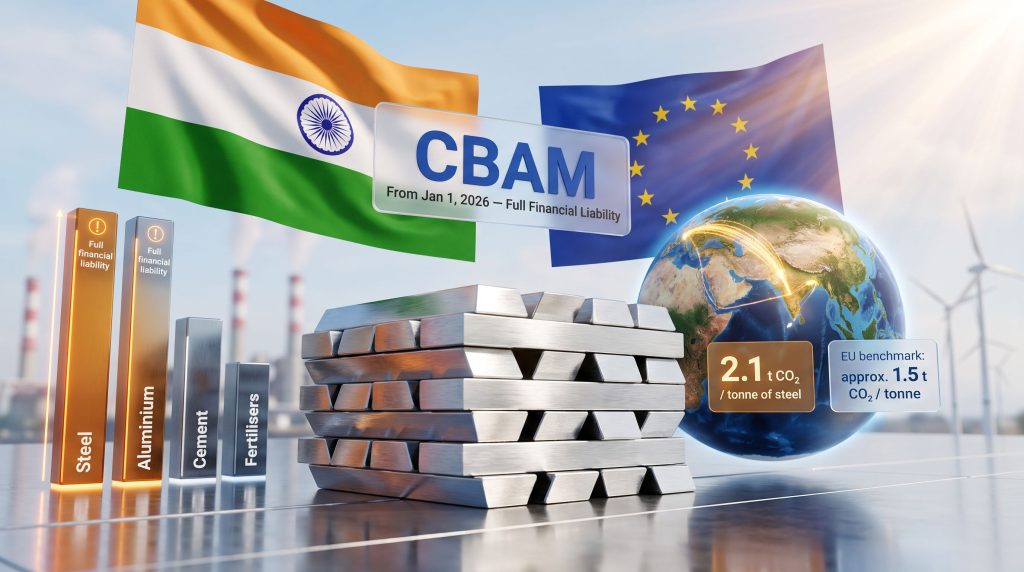
The practical implication is significant: a mid-sized Indian steel exporter shipping 50,000 tonnes annually to the EU, with a carbon intensity of around 2.1 tonnes of CO₂ per tonne of steel compared to the EU benchmark of approximately 1.5 tonnes per tonne, would pay materially more under default valuation than under a verified actual emissions approach. Closing that gap through verified reporting alone can reduce costs meaningfully, even before any production-side decarbonisation investment is made.
What the India-EU FTA's CBAM Annexure Actually Delivers
One of the most important things to understand about the India-EU FTA and CBAM is that the agreement does not suspend, waive, reduce, or defer carbon certificate obligations for Indian exporters. The EU has maintained consistently that CBAM applies uniformly across all trading partners and cannot be selectively relaxed through bilateral arrangements. This reflects both the mechanism's legal design and the EU's obligations under World Trade Organisation non-discrimination rules.
What India secured through intensive negotiations is more structural and forward-looking in character. According to Darpan Jain, Additional Secretary in India's Department of Commerce, CBAM consumed a substantial portion of the negotiating capital invested in the FTA talks. The result is a dedicated annexure within the agreement text, organised around three distinct pillars.
Pillar 1: Future Flexibility and Equivalent Treatment
If the EU extends any form of CBAM flexibility or preferential treatment to another trading partner in the future, India is contractually entitled to claim equivalent treatment under the FTA. This most-favoured-nation-style provision is a forward-looking safeguard rather than an immediate relief mechanism. Its value depends entirely on whether the EU modifies CBAM terms for any other partner in the years ahead, which remains uncertain.
Pillar 2: Technical Cooperation and Methodology Alignment
The second pillar covers collaborative work on emissions measurement methodologies and verification standards. This includes the possibility of mutual recognition between EU and Indian accreditation bodies for CBAM verifiers, which would reduce the administrative complexity and cost of third-party verification for Indian exporters. EU technical assistance toward India's broader decarbonisation agenda is also embedded within this pillar, though this does not translate into direct CBAM cost relief.
Pillar 3: SME-Focused Compliance Provisions
Small and medium enterprises face a structurally disproportionate compliance burden under CBAM. The fixed costs of establishing internal emissions monitoring systems, engaging accredited third-party verifiers, and navigating EU reporting portals do not scale proportionally with export volumes. The FTA's third pillar addresses this asymmetry through dedicated SME provisions, including streamlined reporting pathways and capacity-building commitments.
The legal review of the full FTA text has been completed, with signing anticipated in 2026 and implementation targeted from 2027. This timeline matters for exporters planning compliance investments, as the full financial liability phase of CBAM commenced on January 1, 2026, meaning the gap between current obligation and FTA implementation creates a period where Indian exporters face CBAM costs without any of the cooperative frameworks the agreement promises.
Sector-by-Sector Exposure: Where the Financial Risk Concentrates
Not all Indian exporters to the EU face equal CBAM exposure. The mechanism's current scope and India's export composition create a concentrated risk profile across a small number of industries.
| Sector | CBAM Status | India's Carbon Challenge | FTA Relief Available |
|---|---|---|---|
| Steel | Full financial liability from 2026 | Coal-dominated blast furnace production | Dialogue framework only |
| Aluminium | Full financial liability from 2026 | Energy-intensive smelting processes | Dialogue framework only |
| Cement | Obligation expanding post-transition | High process emissions from clinker production | Technical cooperation pillar |
| Fertilisers | Obligation expanding post-transition | Natural gas and coal-based ammonia production | Technical cooperation pillar |
| Hydrogen | Emerging scope | Green hydrogen development at early stage | Technical cooperation pillar |
Steel and aluminium exporters are in the most immediately exposed position. India exports significant volumes of both products to the EU, and the country's production base for these materials remains heavily reliant on coal and carbon-intensive energy sources. For these sectors, the commercial arithmetic is unforgiving: CBAM certificate costs represent a real addition to the cost of doing business in EU markets.
In addition, advances in hydrogen iron ore reduction technology are beginning to offer viable pathways for steelmakers to reduce their embedded carbon intensity, which is directly relevant to CBAM cost management. The downstream exposure is an often-overlooked dimension. Manufacturers of engineered goods, automotive components, or industrial equipment that incorporate steel or aluminium carry embedded carbon from their upstream inputs. As CBAM potentially extends to downstream goods through future EU legislative review, this indirect exposure could broaden considerably beyond the primary materials sectors.
The Net Trade Benefit Question: Do FTA Tariff Savings Offset CBAM Costs?
The relationship between tariff reductions delivered by the FTA and CBAM certificate costs is not additive. For carbon-intensive sectors, these forces can partially cancel each other out, with the net outcome depending heavily on the specific carbon intensity of individual producers.
Consider three scenarios that illustrate this dynamic:
-
The low-carbon exporter who has invested in electric arc furnace steelmaking powered by renewable energy, maintains verified actual emissions data, and operates below the EU benchmark carbon intensity. This producer benefits from both FTA tariff reductions and a relatively modest CBAM certificate cost. The net trade gain is material.
-
The average Indian producer operating with blast furnace technology and coal-based energy, using default CBAM values due to limited emissions monitoring infrastructure. For this exporter, CBAM costs partially or substantially erode the tariff savings from the FTA. The net gain is uncertain and potentially negative in margin terms.
-
The SME exporter with thin margins, limited capital for compliance investment, and no internal emissions monitoring capability. This producer faces the full weight of default CBAM values while also bearing proportionally higher compliance administration costs. The FTA's SME provisions may provide partial relief over time, but the near-term position is challenging.
The broader implication is that the India-EU FTA creates a two-speed outcome within Indian industry. Producers who have already begun decarbonisation journeys stand to gain competitively in EU markets. Those who have not face an accelerating cost disadvantage that the FTA's cooperative frameworks, while valuable, cannot resolve in the short term.
Moreover, shifts in green steel pricing dynamics are increasingly influencing how Indian producers weigh the capital expenditure of decarbonisation against the long-term CBAM cost burden.
India's Domestic Carbon Architecture and Its CBAM Connection
A dimension of the CBAM story that receives insufficient attention is the relationship between India's domestic carbon pricing mechanisms and an exporter's CBAM liability. Under CBAM rules, if an exporter has already paid a verified carbon price in their country of origin, that amount can be deducted from the CBAM certificate obligation. This deduction mechanism is central to India's long-term strategic response.
India has been developing its domestic carbon market through the Carbon Credit Trading Scheme, launched under the Energy Conservation (Amendment) Act 2022. If this framework matures into a credible, verified carbon pricing system that the EU recognises as equivalent for deduction purposes, Indian exporters could significantly reduce their CBAM financial burden. The pace and credibility of India's domestic carbon market development is therefore not merely an environmental policy question. It is a direct determinant of trade competitiveness in EU markets.
This connection also explains why the FTA's technical cooperation pillar carries strategic weight beyond its immediate compliance support functions. Aligning India's emissions measurement methodologies and verification standards with EU requirements creates the foundation for future mutual recognition, which could eventually translate into CBAM deduction eligibility. Europe's critical minerals supply chain priorities further reinforce why the EU is pushing trading partners toward more rigorous carbon accounting, as supply chain sustainability has become inseparable from resource security policy.
The next major ASX story will hit our subscribers first
The WTO Dimension and Why the EU Cannot Grant Bilateral CBAM Exemptions
India has pursued a parallel track at the WTO, formally challenging CBAM on the grounds that it discriminates against developing country exporters and constitutes a disguised trade barrier. This multilateral challenge reflects a principled position that carbon border adjustment mechanisms must be compatible with WTO rules on non-discrimination and development considerations.
The WTO challenge also explains the legal constraint that prevented India from securing direct CBAM relief through the FTA. The EU cannot grant India preferential CBAM treatment without offering equivalent treatment to all WTO members, which would fundamentally undermine the mechanism's architecture. The MFN-style clause India secured within the FTA works within this constraint by ensuring India automatically benefits if the EU ever does modify CBAM terms for any trading partner. Broader steel decarbonisation collaboration between major industry players is, however, demonstrating that bilateral industrial partnerships can meaningfully accelerate progress even where regulatory exemptions are unavailable.
Frequently Asked Questions: India-EU FTA and CBAM
Does the India-EU FTA eliminate CBAM for Indian exporters?
No. CBAM obligations remain fully in force. The FTA establishes cooperative frameworks and a forward-looking safeguard clause but does not reduce, waive, or defer any carbon certificate requirements.
When will the India-EU FTA be signed and implemented?
The legal review of the agreement text has been completed. Signing is expected in 2026, with implementation anticipated from 2027.
Which Indian industries face the most significant CBAM exposure?
Steel and aluminium exporters currently face full financial liability. Cement, fertiliser, and hydrogen producers face expanding obligations. SMEs across all these sectors face disproportionate compliance burdens relative to their scale.
Can Indian exporters reduce their CBAM certificate costs?
Yes. Exporters who submit verified actual embedded emissions data rather than relying on EU-assigned default values may achieve lower certificate costs if their production carbon intensity falls below the applicable default benchmark. Investment in low-carbon production and verified reporting infrastructure is therefore commercially strategic.
What does the MFN-style CBAM clause actually mean in practice?
If the EU grants CBAM flexibility or preferential treatment to any other trading partner in the future, India is entitled to equivalent treatment under the FTA. This is a conditional, forward-looking protection rather than an immediate benefit.
Key Takeaways for Exporters and Policymakers
-
The India-EU FTA and CBAM relationship represents a meaningful diplomatic achievement, with a dedicated CBAM annexure and structured cooperative pillars reflecting the depth of negotiating engagement on this issue.
-
CBAM financial obligations are not reduced, deferred, or waived for Indian exporters under the current agreement. Certificate costs apply from January 2026 regardless of FTA status.
-
The MFN-style future flexibility clause is a strategically important safeguard, though its practical value depends on future EU policy decisions that remain uncertain.
-
Indian producers operating below EU carbon intensity benchmarks, with verified emissions data, stand to gain the most from the combined effect of FTA tariff reductions and relatively contained CBAM costs.
-
Coal-dependent producers and SMEs without emissions monitoring infrastructure face the most challenging near-term position, with CBAM costs capable of partially or fully offsetting tariff savings.
-
India's domestic carbon market development is directly linked to long-term CBAM liability reduction, making the maturation of the Carbon Credit Trading Scheme a trade competitiveness issue as much as an environmental one.
-
The pace of India's industrial decarbonisation, particularly in steel and aluminium, will ultimately determine whether the India-EU FTA delivers its full commercial potential for heavy industry exporters.
This article is intended for informational purposes only and does not constitute financial, legal, or trade compliance advice. Exporters should seek independent professional guidance on their specific CBAM obligations and FTA compliance requirements. Policy frameworks and timelines discussed are subject to change based on EU legislative developments and bilateral negotiations.
Want to Stay Ahead of the Commodity Shifts Reshaping Global Trade?
As carbon costs and decarbonisation pressures accelerate demand for critical minerals and reshape industrial supply chains, Discovery Alert's proprietary Discovery IQ model delivers real-time alerts on significant ASX mineral discoveries — turning complex market signals into actionable investment opportunities. Explore historic examples of major mineral discoveries and their returns, then begin your 14-day free trial to position yourself ahead of the next significant find.