
August 24, 2026
When Drones Become Strategic Weapons: The New Calculus of Energy Infrastructure Warfare
Modern conflict has entered a phase where the most consequential battlefield is not measured in territory but in industrial throughput. The ability of low-cost, remotely piloted aircraft to shut down billion-dollar refining infrastructure represents one of the most significant shifts in energy security thinking since the Gulf War. The Ryazan refinery drone attack exemplifies this shift — what was once achievable only through sustained air campaigns or special operations now occurs nightly across thousands of kilometres of contested airspace, with consequences that ripple through fuel markets, military logistics chains, and civilian economies simultaneously.
Understanding why certain industrial facilities become repeated targets requires examining the structural logic of energy warfare, not just the individual incidents. The pattern emerging from Russia's interior in 2026 is not random. It reflects a calculated doctrine of cumulative degradation applied to assets that are geographically fixed, technically complex, and practically irreplaceable on short notice. Furthermore, the broader geopolitical risk landscape amplifies the strategic significance of each individual strike.
When big ASX news breaks, our subscribers know first
The Ryazan Refinery: A Structural Overview of Russia's Downstream Vulnerability
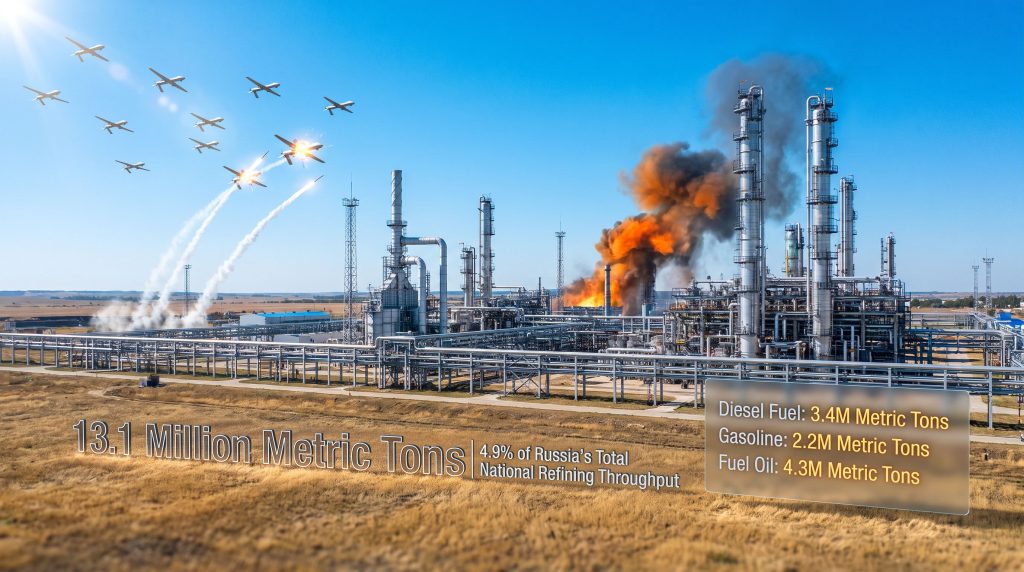
Situated roughly 180 kilometres southeast of Moscow in the Ryazan region, the Rosneft-operated refinery there occupies a position of genuine strategic weight in Russia's domestic energy architecture. According to industry sources cited by Reuters, the facility processed 13.1 million metric tons of crude oil in 2024, equating to approximately 4.9% of Russia's total national refining throughput for that year.
That single percentage point understates the facility's functional importance. Russia's refining sector is not structured as a distributed network of interchangeable plants. It consists of large, geographically concentrated installations whose outputs feed specific regional distribution systems. Consequently, removing one of the largest nodes from that network does not simply reduce throughput proportionally — it creates localised supply gaps that smaller or more distant facilities cannot rapidly absorb.
The 2024 production breakdown illustrates why this matters across multiple product categories simultaneously:
| Refined Product | Annual Volume (Million Metric Tons) |
|---|---|
| Gasoline | 2.2 |
| Diesel Fuel | 3.4 |
| Fuel Oil | 4.3 |
| Total Crude Processed | 13.1 |
Diesel output is particularly significant. At 3.4 million tons annually, the facility contributes meaningfully to supplies that underpin not only civilian transportation and agriculture but also the mechanised logistics chains that sustain military operations. Fuel oil volumes, at 4.3 million tons, flow into industrial heating, power generation backup, and export channels. A sustained disruption across all three product streams simultaneously creates compounding pressure across distinct segments of the Russian economy.
Why Refinery Shutdowns Cannot Be Quickly Reversed
One of the least understood aspects of refinery infrastructure warfare is the asymmetry between the speed of damage and the speed of recovery. A drone strike capable of triggering an unscheduled shutdown takes minutes. Restoring operations to pre-incident specifications takes weeks, and that timeline is not primarily driven by physical repair work. It is driven by the technical requirements of industrial process recommissioning.
Industry sources confirmed to Reuters that the expected shutdown duration following the July 2026 attack was approximately two weeks — a figure consistent with the May 2026 incident at the same facility. The reasons for this timeline involve three sequential phases that cannot be meaningfully compressed:
- Safety assessment and structural integrity verification of processing units, pipelines, and storage assets before any restart is attempted.
- Sequential recommissioning of primary distillation units, which must reach operational stability before secondary cracking, treating, and blending units can be safely brought online.
- Product quality restoration and specification verification, ensuring that gasoline, diesel, and fuel oil outputs meet the commercial and regulatory standards required for exchange trading and distribution.
Each phase is dependent on the successful completion of the previous one. No parallel acceleration is possible without risking equipment damage, product contamination, or hazardous pressure events. This is why industry professionals use two weeks as a baseline estimate even when physical damage appears limited.
Critically, two weeks represents the optimistic scenario. That estimate assumes damage was confined to peripheral infrastructure rather than primary distillation columns or heat exchanger networks. If core processing units sustained direct damage in the July 2026 strike, recovery timelines could extend to between three and six weeks or longer, with corresponding effects on domestic supply chains and export volumes.
The May and July 2026 Strikes: A Pattern of Cumulative Attrition
How the Incidents Unfolded
The Ryazan refinery drone attack on July 29–30, 2026 was not an isolated event. The facility had previously been struck on May 15, 2026, in an attack that caused a large fire and also halted refining operations. Ukrainian military authorities confirmed the July strike as a deliberate action targeting the Rosneft installation.
Ryazan regional Governor Pavel Malkov confirmed via his Telegram channel that Russian air defence systems had intercepted 45 drones over the region in a single night. He attributed fires at industrial sites across the region to debris from intercepted drones rather than direct hits — consistent with the framing Russian authorities have applied to infrastructure incidents throughout the conflict.
The gap between that official narrative and the operational reality confirmed by industry sources is analytically revealing. By July 31, 2026, those sources had confirmed to Reuters that the refinery had ceased crude oil processing and that a two-week shutdown was the projected recovery window.
| Perspective | Official Position | Key Emphasis |
|---|---|---|
| Ukrainian Military | Confirmed deliberate strikes on Ryazan refinery | Energy infrastructure as legitimate military target |
| Russian Regional Authorities | Acknowledged interceptions, attributed fires to debris | Emphasised air defence performance |
| Rosneft (Corporate) | No immediate public statement issued | Operational sensitivity implied by silence |
| Industry Sources | Confirmed processing halt and two-week shutdown | Focus on technical restart complexity |
The two confirmed attacks within approximately 75 days indicate a targeting doctrine focused on attrition through repetition rather than a single decisive blow. Each shutdown forces a restart cycle that stresses equipment, consumes maintenance resources, and compounds the probability of secondary failures during recommissioning. In addition, the oil market disruption caused by repeated strikes of this nature extends well beyond the immediate facility.
The Inventory Buffer: A Temporary Bridge, Not a Solution
One operationally significant detail that emerged from the Reuters reporting was that despite the complete halt in crude oil processing, the Ryazan refinery continued to offer gasoline and diesel volumes for sale on the St. Petersburg International Mercantile Exchange (SPIMEX) as of July 31, 2026.
This reflects standard industry practice when processing is interrupted. Refineries maintain product inventory buffers in storage tanks that can be drawn down to satisfy short-term commercial commitments even when production has ceased. For market observers and exchange analysts, this creates a deceptive signal: trading activity continues, suggesting operational normality, while the underlying production capacity is offline.
The risk embedded in this situation scales with shutdown duration. A two-week halt will likely be manageable through inventory drawdown if pre-existing storage levels were adequate. An extended shutdown would, however, exhaust those buffers and create a genuine gap between exchange-traded supply and physical availability.
Strategic Logic: Why Refineries Are Preferred Targets Over Oil Fields
The decision to target refining infrastructure rather than upstream extraction assets reflects a sophisticated understanding of where leverage exists in an energy supply chain. Oil fields and wellheads are often geographically dispersed, partially redundant, and capable of operating at reduced output without catastrophic systemic effects. Refineries possess none of these characteristics.
Several factors make refining capacity distinctively attractive as a strategic target:
- Geographic fixity: A refinery cannot be relocated. Every attack is delivered against a known, stationary asset.
- Technical complexity: The longer and more intricate the restart procedure, the greater the operational impact per strike.
- Supply chain centrality: Refined products, not crude oil, power military vehicles, civilian transport, agricultural machinery, and industrial heating systems.
- Export revenue sensitivity: Disrupting refined product output reduces the volumes Russia can sell internationally, compressing foreign exchange earnings during a period of sustained fiscal pressure.
The simultaneous pressure on military logistics, civilian economic stability, and export revenue generation from a single target class represents a force multiplication that crude oil disruption alone cannot achieve. Moreover, the geopolitical oil price factors at play here interact with existing sanctions pressure to compound the economic effect on Russia's downstream sector.
The next major ASX story will hit our subscribers first
Air Defence Interception and the Debris Problem
The confirmation that 45 drones were intercepted over the Ryazan region in a single night reveals an important and frequently overlooked dimension of drone warfare against industrial infrastructure. Successful interception does not guarantee that protected assets escape damage.
When air defence systems neutralise incoming drones at altitude or close range, the resulting debris falls with kinetic energy sufficient to ignite fires, rupture light structures, and damage exposed industrial equipment. Governor Malkov's attribution of fires at industrial sites to falling debris rather than direct strikes may be accurate in a narrow technical sense while still confirming that interception-generated debris caused the operational disruption.
This creates a genuine strategic dilemma for Russian air defence planners. Deploying high-density interception creates debris fields over protected industrial zones. Reducing interception density allows more drones to reach their targets directly. Neither option fully protects critical infrastructure within the defended perimeter.
Broader Market Implications: Global Refined Products and the Precedent Effect
Russia's position as a major exporter of diesel fuel, fuel oil, and naphtha means that sustained degradation of domestic refining capacity carries implications beyond Russian borders. European and Asian refined product markets, particularly those that previously relied on Russian diesel supply chains before 2022 sanctions reshaping, remain sensitive to signals about Russian refining output capacity. Furthermore, oil price movements tied to Russian infrastructure disruptions have demonstrated measurable ripple effects across global benchmark pricing.
The existing framework of Russian oil trading sanctions has already constrained Russia's ability to monetise crude oil internationally, making domestic refining throughput even more critical to its fiscal position. The Ryazan case also establishes an important precedent for how analysts and market participants should interpret the escalating use of drone technology in infrastructure warfare.
Individual strikes have always been assessed for their immediate market impact. What the repeated targeting of Ryazan in 2026 introduces is the concept of cumulative attrition pricing — where markets must factor in not the cost of a single incident but the probability-weighted impact of repeated operational interruptions to a strategically significant facility.
Disclaimer: This article contains forward-looking analysis and scenario projections based on reported events and publicly available information. It does not constitute financial advice. Market impact assessments and recovery timeline projections represent analytical scenarios, not confirmed outcomes. Readers should conduct independent research before making investment or commercial decisions.
What Repeated Strikes Reveal About Infrastructure Hardening Gaps
Has Russia Adequately Protected Its Refining Assets?
Perhaps the most strategically significant dimension of the Ryazan refinery drone attack pattern is what it reveals about the limits of current infrastructure protection measures at Russian industrial sites. The May 2026 strike prompted a shutdown. The July 2026 strike prompted another shutdown at the same facility within the same calendar quarter.
No publicly available evidence suggests that the intervening period produced meaningful physical hardening, dispersal of critical processing units, or changes to the air defence architecture over the refinery itself. For Rosneft, as a state-controlled energy major operating under both commercial and political directives, the repeated disruption of a flagship refining asset raises questions that extend beyond operational management.
The adequacy of protective investments at major industrial sites, the coordination between corporate security planning and military air defence resourcing, and the threshold at which infrastructure damage becomes structurally rather than temporarily impairing are all variables that analysts are now compelled to incorporate into assessments of Russian downstream oil sector capacity.
The broader lesson for global energy security analysts is one that predates this conflict but has been brought into sharp focus by events at Ryazan: concentrated refining infrastructure in any country represents a systemic vulnerability that asymmetric, low-cost drone technology is now uniquely positioned to exploit at scale.
Want to Understand How Geopolitical Shocks Create Mineral Discovery Opportunities?
When energy infrastructure disruptions reshape global commodity markets, the flow-on effects can rapidly surface significant opportunities in ASX-listed resource stocks — and Discovery Alert's proprietary Discovery IQ model is engineered to identify those moments in real time, delivering instant notifications on major mineral discoveries before the broader market reacts. Explore historic examples of transformative discovery returns and begin your 14-day free trial at Discovery Alert to ensure you are positioned ahead of the next major market move.