August 24, 2026
The Downstream Fault Line: Why Asia's Fuel Crisis Outweighs the Hormuz Transit Argument
Energy markets have a well-documented tendency to fixate on the most visible chokepoint rather than the most consequential one. For decades, the Strait of Hormuz has served as the symbolic flashpoint for global oil security debates, with analysts, policymakers, and traders treating crude transit volumes as the definitive measure of supply health. However, this framing contains a structural flaw: crude oil flowing through a strait is not the same as refined fuel arriving at an industrial plant, a farm, or an aircraft.
The more revealing stress indicator in 2026 is not what is moving through a geographic bottleneck, but what is failing to reach downstream markets across Asia in the form of usable, operational fuel. For a broader crude oil market overview, the distinction between crude transit and product delivery has rarely been more consequential.
The Asia refined products shortage unfolding through mid-2026 represents a qualitatively different kind of energy disruption than a crude oil transit dispute, and it deserves a fundamentally different analytical lens.
When big ASX news breaks, our subscribers know first
Understanding the Downstream Distinction
Why Refined Products and Crude Oil Are Not Interchangeable
A common misconception in mainstream energy commentary is treating crude oil availability as a direct proxy for fuel availability. In reality, the relationship between crude supply and usable fuel at the market level involves multiple conversion steps, each of which introduces its own vulnerability.
Refined products such as diesel, jet fuel, gasoline, and naphtha are the functional outputs of refinery processing. They are what actually powers trucks, aircraft, generators, irrigation pumps, and petrochemical plants. Crude oil is simply the feedstock input.
Critically, not every crude grade produces the same product mix. This is where the concept of crude grade specificity becomes essential:
- Medium-gravity, high-sulphur crudes from the Middle East are particularly well-suited for producing middle distillates, meaning diesel and jet fuel
- Asian refineries across South Korea, Japan, Singapore, and Southeast Asia have been capital-configured over decades specifically to process these Middle Eastern medium-gravity grades efficiently
- Substituting a lighter or heavier crude grade does not simply swap one input for another; it fundamentally alters the yield profile of the refinery, reducing distillate output relative to less valuable products
This crude grade specificity problem is one of the least-discussed dimensions of the current Asia refined products shortage, yet it sits at the heart of why the crisis has persisted even as some crude flows have partially recovered.
The Supply Gap in Numbers
Quantifying a Historic Distillate Shortfall
The scale of the decline in Asian refined product imports since the onset of Middle East conflict in late February 2026 is substantial by any historical measure.
| Metric | Pre-Conflict (3-Month Avg to Feb 2026) | July 2026 | August 2026 Estimate | Change |
|---|---|---|---|---|
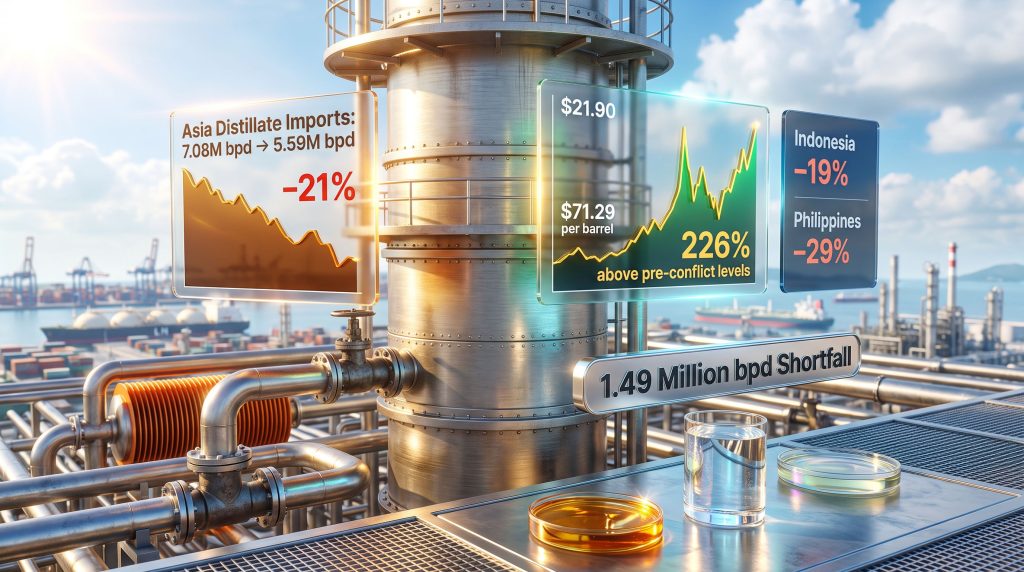
| Asia light and middle distillate imports | 7.08 million bpd | 5.60 million bpd | 5.59 million bpd | -21% |
| Net shortfall vs. pre-conflict | – | ~1.48 million bpd | ~1.49 million bpd | Sustained |
A 21% decline in distillate imports sustained across two consecutive months signals something more durable than a temporary supply shock. It points to structural disruption at the refinery input level, reinforced by export restrictions and logistical constraints that are preventing the market from self-correcting through normal redistribution channels.
To contextualise the magnitude: 1.49 million barrels per day is roughly equivalent to the entire daily fuel consumption of a mid-sized Asian economy. The region is absorbing this gap across dozens of economies simultaneously, with very unequal consequences. Southeast Asia's exposure to refined fuel shocks underscores just how unevenly these pressures are distributed across the region.
The Refinery Throughput Collapse of March 2026
The initial shock to downstream markets was most acute in March 2026, when refinery throughput cuts across the region were estimated at approximately 2.7 million bpd. This was a direct response to the sudden disruption to crude input availability following the February 28 conflict escalation involving Iran.
The downstream consequences of that throughput reduction cascaded into April and May, with collective Asian diesel, jet fuel, and gasoline exports falling nearly 3 million bpd below pre-conflict averages. The July and August stabilisation at approximately 5.59–5.60 million bpd represents a partial floor, but not a recovery.
Refining Margins as a Crisis Barometer
What Crack Spreads Reveal That Crude Prices Cannot
One of the most sophisticated ways to assess the depth of a refined products shortage is through crack spreads, which measure the profit margin a refinery earns from converting a barrel of crude into a specific refined product. Elevated crack spreads signal that product is scarce relative to crude input, meaning refinery capacity or product supply is constraining market clearance.
The crack spread data from Singapore through 2026 tells an unambiguous story:
| Product | Feb 27, 2026 (Pre-Conflict) | March 30, 2026 (Peak) | Aug 21, 2026 | Change vs. Pre-Conflict |
|---|---|---|---|---|
| Gasoil (Singapore) | $21.90/bbl | $85.63/bbl | $71.29/bbl | +226% |
| Gasoline | $8.00/bbl | N/A | $20.74/bbl | +159% |
The sustained elevation of Singapore gasoil crack spreads at more than triple pre-conflict levels through late August 2026 is not consistent with a market that has largely normalised crude supply. It is consistent with a market where the right crude grades are not arriving in sufficient volumes, and where spare refining capacity is not being deployed to compensate.
The gasoil crack spread reaching $85.63 per barrel on March 30 was a record-level reading by historical standards. The fact that it has only moderated to $71.29 per barrel by late August, remaining 226% above the pre-conflict baseline, demonstrates that the shortage has structural rather than transient characteristics.
Furthermore, even gasoline, which is derived from lighter crude fractions and should theoretically be less exposed to Middle Eastern medium-gravity crude disruptions, has seen its refining margin surge 159% above pre-conflict levels. This broader distillate and light fuel margin compression is evidence that the crisis has spread beyond its original epicentre.
The Crude Grade Mismatch: An Underappreciated Technical Reality
Why Arriving Crude Doesn't Always Translate to Arriving Fuel
One of the more technically nuanced aspects of the Asia refined products shortage is the crude grade mismatch problem. Even in scenarios where some crude volumes are reaching Asia through alternative routing or partial Hormuz recovery, the grades arriving may not match what regional refineries are optimised to process.
Asian refinery configurations represent decades of capital investment decisions made on the assumption of continued Middle Eastern medium-gravity crude availability. The refining units, particularly the vacuum distillation columns and hydrocracker units that maximise middle distillate yields, are engineered around specific crude input specifications.
When a refinery receives a lighter crude grade instead of its designed feedstock, several consequences follow:
- The yield of middle distillates (diesel and jet fuel) per barrel processed declines
- The yield of lighter products like naphtha and gasoline increases, creating a product mix imbalance
- Operational adjustments require time, expertise, and in some cases physical unit modifications
- Refinery throughput may be constrained while adjustments are made, further reducing total product output
This technical reality explains why higher crude transit claims, even if partially accurate, do not straightforwardly translate into restored refined product availability. The market is not just a volume problem; it is a specification problem. Consequently, the geopolitical oil price factors shaping upstream flows have profound downstream consequences that crude price data alone cannot capture.
The Wealth Gap in Asian Energy Security
An Unequal Distribution of Supply Stress
The Asia refined products shortage is not distributing its consequences evenly. A country's capacity to outbid competitors on spot markets for limited product volumes has emerged as the decisive factor determining import resilience.
| Economy | Pre-Conflict Avg (bpd) | August 2026 Estimate (bpd) | Decline | Vulnerability Profile |
|---|---|---|---|---|
| Philippines | 362,000 | 257,000 | ~29% | Very High |
| Indonesia | 533,000 | 432,000 | ~19% | High |
| Australia | 880,000 | 863,000 | ~2% | Low (cost-exposed) |
Indonesia is experiencing its lowest distillate import volumes in 13 months. With a population exceeding 270 million and widespread subsidised domestic fuel pricing, the country faces compounding pressure: it cannot easily pass higher spot market costs onto consumers, limiting the government's ability to outbid wealthier rivals for scarce product cargoes. The Asian energy import pressures facing lower-income economies in the region add a further layer of fiscal strain.
The Philippines has seen among the sharpest proportional contractions of any major Asian importer, with a nearly 29% decline in distillate arrivals. Agricultural communities reliant on diesel-powered irrigation and logistics networks connecting island archipelagos are among the most directly exposed.
Australia, as the world's largest diesel importer, has largely maintained import volumes through competitive spot market purchasing. However, volume security is being purchased at historically elevated prices, creating a different but equally consequential form of energy vulnerability: cost exposure rather than supply shortfall.
This divergence reveals an important structural truth about regional energy security: when supply is constrained, wealthy importers do not necessarily consume less, they simply pay more, effectively pricing less affluent economies out of available supply. The humanitarian and economic development implications of this dynamic extend well beyond simple energy market analysis.
The next major ASX story will hit our subscribers first
Industrial Cascades: Beyond Transport Fuels
Naphtha Shortages and the Petrochemical Transmission Effect
The shortage extends beyond diesel and jet fuel into naphtha, a light hydrocarbon fraction that serves as the primary feedstock for petrochemical manufacturing. Naphtha shortages cascade into production constraints across plastics, synthetic textiles, fertiliser precursors, and pharmaceutical inputs.
South Korea and Japan, both major petrochemical exporters and significant regional manufacturers, face particular exposure to naphtha supply tightness. The downstream industrial effects of sustained naphtha scarcity take months to fully manifest in production data but can compound significantly when refinery run cuts are prolonged.
The inflationary transmission pathways from this shortage are multiple and mutually reinforcing:
- Elevated diesel prices increase logistics and freight costs across supply chains, affecting consumer goods pricing
- Agricultural diesel dependency means fuel cost spikes translate directly into food production cost increases
- Jet fuel scarcity and elevated pricing pressures regional aviation operating economics, with potential knock-on effects for tourism and business travel recovery
- Naphtha-derived input cost increases affect manufacturing competitiveness across export-oriented Asian economies
The Hormuz Crude Debate: A Methodological Problem
Why Product Import Data Provides a More Reliable Signal
The contested claims around Strait of Hormuz crude transit volumes reflect a genuine methodological challenge in oil market intelligence. Vessel tracking services estimate crude transits at approximately 5 million bpd, including vessels using transponder manipulation and ship-to-ship transfers in the Gulf of Oman.
Claims of volumes approaching 15 million bpd on peak days have been made by senior US government officials, representing a significant discrepancy with independent tracking estimates. The oil market disruption risks stemming from these contested transit figures compound the difficulty of forming reliable policy responses.
The resolution of this debate matters, but it should not distract from the more verifiable data set: refined product import volumes at destination ports. Unlike strait transit estimates, which must contend with dark shipping, transponder spoofing, and the complexity of identifying cargo contents, distillate import arrivals at Asian ports are measurable with considerably greater precision.
The fact that Asian distillate imports remain 21% below pre-conflict levels through August 2026 is a demand-side confirmation that whatever is transiting the Strait of Hormuz is not restoring downstream fuel availability at a pace consistent with the higher transit volume claims. India's surging refined product exports have provided partial relief to some markets, though they have not bridged the overall supply gap.
Scenario Outlook: Pathways to Normalisation
What Would Market Recovery Actually Require?
Genuine recovery in the Asia refined products shortage would require simultaneous progress across multiple fronts, not simply an increase in crude transit volumes:
- Restoration of Middle Eastern medium-gravity crude flows to levels sufficient for Asian refineries to restore pre-conflict distillate yield profiles
- Removal of fuel export restrictions currently in place in China, Thailand, and South Korea, which are preventing intra-regional product redistribution
- Refinery throughput recovery to pre-March 2026 levels across the region's major processing hubs
- Compression of crack spreads back toward historical averages as product volumes normalise
In addition, the OPEC market influence on crude grade availability will be a critical variable in determining how quickly the right feedstock mix returns to Asian refineries. Three broad scenarios frame the near-term outlook:
- Rapid recovery (upside): Crude grade mix normalises within 60–90 days, export restrictions are lifted, and margins compress toward historical ranges by late Q4 2026
- Gradual partial recovery (base case): Distillate imports recover partially through Q4 2026, margins remain elevated above historical norms, and developing economy importers continue absorbing disproportionate supply reductions into early 2027
- Prolonged disruption (downside): Structural crude grade mismatch persists, refinery runs remain constrained, emergency government interventions accelerate strategic reserve drawdowns, and industrial impacts become visible in regional GDP data
Disclaimer: The scenario projections above represent analytical frameworks for understanding possible market trajectories and should not be interpreted as financial advice or investment guidance. Energy market outcomes are subject to geopolitical, meteorological, and regulatory variables that cannot be reliably forecast.
The Policy Acceleration Effect
Long-Term Structural Implications for Asian Energy Planning
One underappreciated consequence of the Asia refined products shortage is its potential to accelerate strategic energy planning decisions that had previously stalled. Several Asian governments were already reviewing the adequacy of their strategic petroleum reserves before February 2026; the current shortage is converting those reviews into urgent policy actions.
Calls for expanded regional fuel storage capacity, diversified refinery feedstock capabilities, and investment in refinery configuration upgrades capable of processing a wider range of crude grades are gaining meaningful policy traction. The crisis is, in a structural sense, doing what years of policy advocacy could not: demonstrating with economic data the cost of crude grade concentration risk in Asian refinery infrastructure.
For energy planners and long-term infrastructure investors, the 2026 Asia refined products shortage may ultimately be remembered less as a supply crisis and more as the event that fundamentally reoriented Asian refinery investment strategy toward feedstock flexibility and product-level resilience.
Frequently Asked Questions
What is the Asia refined products shortage?
It refers to a sustained decline in light and middle distillate imports across Asia, including diesel, jet fuel, and gasoline, following Middle East supply disruption in early 2026. Imports fell approximately 21% from pre-conflict averages of 7.08 million bpd to around 5.59 million bpd by August 2026.
Why can't Asian refineries compensate by processing alternative crude grades?
Asian refineries are physically configured to maximise distillate yields from Middle Eastern medium-gravity crudes. Processing lighter or heavier alternatives reduces distillate output efficiency and requires operational adjustments that take time and involve yield trade-offs.
Which countries are most severely affected?
The Philippines and Indonesia have experienced the sharpest proportional import declines, at approximately 29% and 19% respectively. Less wealthy economies lack the financial capacity to outbid richer importers on spot markets, causing them to absorb supply reductions directly.
What do Singapore refining margins indicate about the shortage's severity?
Gasoil crack spreads at Singapore refineries remained approximately 226% above pre-conflict levels as of late August 2026, indicating that supply tightness is structural and sustained rather than a passing market disruption.
When might the shortage ease?
Genuine normalisation requires restored crude grade flows, removal of export restrictions across major Asian producers, and refinery throughput recovery — a combination that most base-case scenarios place no earlier than late Q4 2026, with considerable uncertainty.
Want to Identify the Next Major Resource Opportunity Before the Market Does?
Discovery Alert's proprietary Discovery IQ model scans ASX announcements in real time, instantly alerting subscribers to significant mineral discoveries and turning complex data into actionable investment insights — explore historic discoveries and their returns to understand the scale of opportunity, and begin your 14-day free trial at Discovery Alert to position yourself ahead of the broader market.