
August 24, 2026
The Structural Forces Reshaping Global Thermal Coal Markets
NSW coal exports surge as demand for our coal booms, and understanding why requires looking beyond headline tonnage figures and into the mechanics of how Asian energy systems actually function. Across the Asia-Pacific region, energy security has overtaken cost efficiency as the primary driver of fuel procurement decisions, and that shift is having measurable consequences for coal-exporting economies like New South Wales. Understanding the mechanics of how procurement decisions get made, and why coal quality plays a far more decisive role than most commentary suggests, is essential context for interpreting the latest trade data.
When big ASX news breaks, our subscribers know first
The Global Energy Context Behind NSW Coal's Export Momentum
Why Asian Economies Continue to Anchor Demand for Australian Thermal Coal
The post-pandemic energy landscape across Northeast Asia has been defined by one overriding priority: supply diversification. Japan, Taiwan, and South Korea all experienced varying degrees of energy stress during 2021 and 2022, when liquefied natural gas spot prices reached extraordinary levels and regional electricity systems came under sustained pressure.
For grid operators in these economies, thermal coal offers something that LNG cannot always guarantee: predictable, contract-based supply from geographically stable trading partners. Australia, and NSW specifically, sits at the premium end of this equation due to both coal quality and supply reliability. Furthermore, global coal supply challenges continue to shape how buyers approach long-term procurement strategy.
How Energy Security Priorities Are Reshaping Long-Term Coal Procurement in the Asia-Pacific
A structural shift in procurement behaviour has been underway across Asia since approximately 2022. Rather than relying heavily on spot market purchasing, utilities in Japan, South Korea, and Taiwan have increasingly sought to lock in longer-duration supply arrangements with established exporters.
This behavioural change has a direct implication for NSW coal: demand is becoming stickier. Buyers who enter medium-term agreements are less likely to rapidly switch suppliers, even as renewable capacity expands domestically. The thermal coal growth rate of approximately 6.5% recorded in the most recent financial year reflects this dynamic directly, with energy security demand from Asian trade partners described by industry analysts as the primary catalyst.
The Role of Coal Quality in Sustaining NSW's Competitive Position in Export Markets
Not all thermal coal is equal, and this distinction matters enormously in competitive export markets. NSW produces high-calorific-value thermal coal with relatively low sulfur and ash content, characteristics that make it particularly attractive to power stations built or retrofitted to handle premium-grade feedstock.
Indonesian thermal coal, which competes directly with NSW product in Asian markets, typically carries a lower energy content per tonne. This means that in markets where carbon emissions are measured and managed at the plant level, NSW coal delivers more electricity output per unit of emissions — a genuine technical advantage that procurement officers factor into fuel blending decisions.
Higher-calorific coal allows power plant operators to achieve equivalent electricity output with lower physical coal consumption and, in some regulatory environments, improved emissions intensity per megawatt-hour generated.
How Big Is the Surge? Breaking Down the Latest NSW Coal Export Data
Key Export Volume Metrics at a Glance
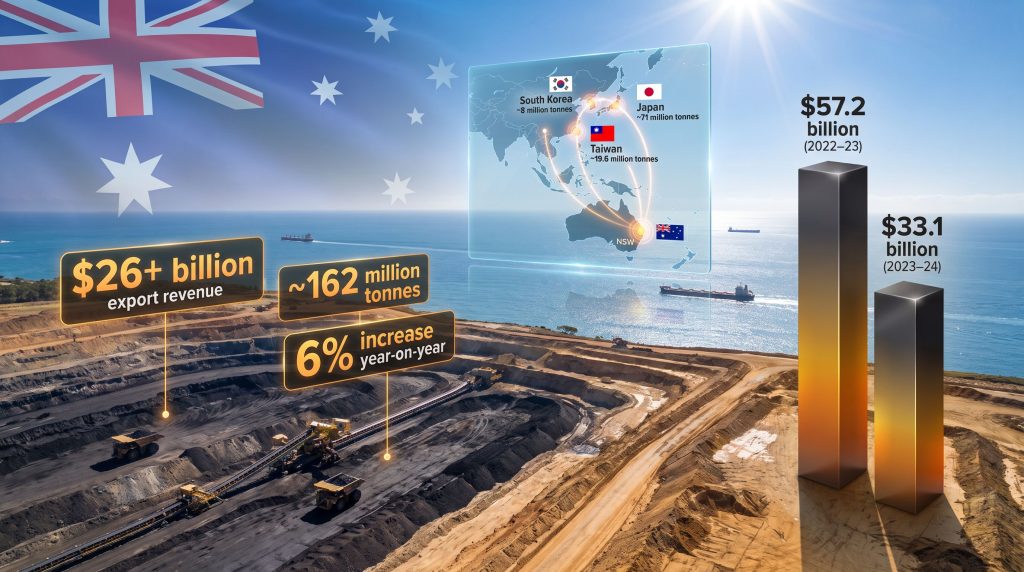
Data released by Coal Services confirms that NSW coal exports reached approximately 162 million tonnes in the most recent financial year, representing a 6% increase and nearly 9 million additional tonnes compared to the prior period.
| Metric | Latest Financial Year | Context |
|---|---|---|
| Total NSW Coal Exports | ~162 million tonnes | Up ~9 million tonnes year-on-year |
| Year-on-Year Volume Growth | ~6% | Driven primarily by thermal coal |
| Thermal Coal Growth Rate | ~6.5% | Energy security demand from Asia |
| Export Revenue (Annual) | $26+ billion | NSW's most valuable export commodity |
| Peak Export Revenue Year | $57.2 billion (2022-23) | Post-Ukraine energy price spike |
| Export Revenue (2023-24) | $33.1 billion | Normalised from peak but historically elevated |
| Export Revenue (2009-10) | $12.2 billion | Long-term baseline for comparison |
| 20-Year Volume Growth | ~80% | Structural demand expansion since early 2000s |
Is This a Volume Boom or a Price Boom? Understanding the Difference
One of the most frequently misunderstood aspects of the NSW coal export story is the distinction between volume-driven and price-driven revenue growth. Over the past decade, NSW coal export volumes have remained relatively stable, typically ranging between 155 and 173 million tonnes annually. The dramatic revenue escalation seen between 2020 and 2023 was overwhelmingly a price phenomenon, not a physical expansion of trade.
The Russia-Ukraine conflict triggered a cascade of European demand for alternative energy supply, which tightened global coal markets and sent benchmark prices to multi-decade highs.
- Volume trend: Broadly stable over a decade, with a temporary compression to approximately 140 million tonnes in 2022-23 due to weather and logistical disruptions
- Revenue trend: Highly volatile, peaking at $57.2 billion before retracing significantly
- Current dynamic: Recovering volumes combined with sustained Asian procurement demand is generating the 6% growth figure recorded in the latest year
The key insight for observers and investors is that the current export expansion is fundamentally different in character from the 2021-2023 revenue boom. Today's growth is volume-led, which typically signals more durable underlying demand rather than a price-driven windfall.
Which Countries Are Buying the Most NSW Coal Right Now?
Japan: The Dominant Buyer in NSW's Export Portfolio
Japan's position as the single largest importer of NSW coal is not accidental. The country's energy policy has been shaped by the consequences of the Fukushima Daiichi disaster in 2011, which led to the progressive shutdown of a significant portion of Japan's nuclear generation fleet. Filling that baseload gap with coal and LNG became a structural necessity.
In the most recent financial year, Japan received approximately 71 million tonnes of NSW coal, an increase of roughly 6 million tonnes year-on-year. This single trade relationship accounts for close to half of all NSW coal exports, reflecting the depth and maturity of bilateral energy trade ties.
Japan's transition toward renewable energy and potential nuclear restarts are ongoing policy discussions, but the pace of change has consistently fallen short of earlier projections, leaving coal-fired generation entrenched in the near-to-medium term baseload mix.
Taiwan and South Korea: Emerging Growth Markets
Both Taiwan and South Korea recorded meaningful increases in NSW coal imports, reinforcing the theme of broad-based demand recovery across Northeast Asia rather than concentration in a single market.
| Export Destination | Latest Volume | Year-on-Year Increase |
|---|---|---|
| Japan | ~71 million tonnes | +6 million tonnes |
| Taiwan | ~19.6 million tonnes | +4 million tonnes |
| South Korea | ~8 million tonnes | +3 million tonnes |
Taiwan's import growth is particularly notable given the island's constrained geography and heavy dependence on imported energy across all fuel types. South Korea, while further advanced in its renewable transition than Japan, continues to rely on coal for a substantial share of dispatchable power generation. In addition, China commodity demand trends continue to influence broader regional energy procurement patterns across Asia.
Why Asia Represents Over 85% of NSW's Total Coal Export Destination Base
The structural concentration of NSW coal exports into Asian markets reflects both geographic and economic logic:
- Approximately 85% of total NSW coal production is directed to export markets
- Of those exports, roughly 93% is thermal coal used primarily for electricity generation
- Japan, China, Taiwan, and South Korea function as the anchor buyers that provide baseline volume predictability
- The remaining metallurgical coal exports serve steelmaking customers across the same regional footprint
This concentration creates both an opportunity and a vulnerability. Sustained Asian demand is the pillar supporting current export economics, but a faster-than-expected energy transition across these markets would represent a significant structural disruption to NSW export revenue.
What Does 80% Growth Over Two Decades Tell Us About Structural Demand?
Separating Cyclical Price Spikes from Long-Run Demand Trends
The 80% increase in NSW coal export volumes over the past two decades is often cited without adequate context. This growth did not occur in a straight line. It was punctuated by demand contractions during the Global Financial Crisis, supply disruptions from flooding events in Queensland and NSW, and the COVID-19 trade dislocations of 2020.
What the two-decade trajectory reveals is that despite repeated predictions of structural demand collapse, Asian coal consumption continued to expand as rapidly industrialising and urbanising populations required more electricity than renewable capacity could supply in real time. Coal has repeatedly served as the dispatchable backstop during renewable build-out periods.
The Tension Between Long-Term Demand Forecasts and Current Market Reality
Global energy transition modelling consistently projects declining thermal coal demand in absolute terms through the 2030s and beyond as renewable capacity, battery storage, and efficiency gains reshape electricity systems across Asia. However, the timeline and pace of this transition remain deeply contested, and near-term demand from developing Asian nations, particularly in Southeast Asia, continues to provide a structural floor beneath NSW coal exports.
The critical investor and policy insight here is the distinction between directional trend (declining) and timing (uncertain). For industries dependent on coal royalties, employment, and export revenue, that timing gap is economically decisive. Australia's resource export outlook underscores just how consequential these timing differences can be for state and federal budgets alike.
What Are the Economic Stakes for NSW?
Coal Royalties, Government Revenue, and the Public Finance Equation
NSW coal exports generate over $26 billion in annual export revenue, establishing coal as the state's most economically significant export commodity by a substantial margin. During the peak revenue year of 2022-23, when export revenue reached $57.2 billion, coal royalties flowing to the NSW Government reached record levels, temporarily boosting state fiscal capacity.
Even at the normalised 2023-24 revenue level of $33.1 billion, coal royalties contribute materially to state government finances, funding public services and infrastructure programs that would otherwise require alternative revenue sources. According to NSW Mining, the sector has consistently demonstrated resilience even through periods of considerable market disruption.
For comparative perspective, the long-term baseline export revenue of approximately $12.2 billion in 2009-10 illustrates just how significantly the sector has grown in economic importance to NSW over the past fifteen years.
The Employment Multiplier: Direct Jobs, Supply Chains, and Regional Communities
The economic footprint of NSW coal extends well beyond the mine gate:
- Thousands of direct mining jobs are concentrated across Hunter Valley coalfields and other NSW mining regions
- An estimated 750 local businesses across supply chains depend on mining sector activity for a meaningful share of their revenue
- Regional communities in the Upper Hunter region have built their economic and social infrastructure around the mining sector over multiple generations
- Indirect employment in transport, logistics, professional services, and retail all carry exposure to mining sector performance
The Hunter Valley Operations Continuation Project: A Case Study in Approval Risk
The Hunter Valley Operations Continuation Project has become the focal point of the current policy debate around coal project approvals in NSW. The project currently sits within the NSW planning approval system, and its outcome carries significant economic consequences.
NSW Minerals Council CEO Stephen Galilee has emphasised that approximately 1,500 direct mine workers are tied to the project's outcome, with thousands of additional jobs across local supply businesses dependent on the same approval decision. Industry advocates argue that unmet export demand from Asian markets cannot be captured without timely approvals for projects already well advanced in the planning system.
The next major ASX story will hit our subscribers first
What Policy and Planning Barriers Could Limit NSW's Export Capacity?
The Approval Bottleneck: How Planning Delays Affect Export Competitiveness
The NSW planning system represents the most immediate operational constraint on the state's ability to capitalise on strong Asian demand. Multiple coal projects are currently at various stages of the approval process, and delays create compounding uncertainty for operators, workers, and regional communities alike.
From a market dynamics perspective, export capacity is finite. If NSW production stalls due to approval delays while demand continues at current levels, buyers will redirect procurement to alternative supply sources. Recapturing lost market position is considerably more difficult than maintaining it.
Balancing Energy Transition Commitments with Near-Term Export Opportunity
NSW faces a genuine policy tension that admits no easy resolution:
- Domestic energy policy is oriented towards decarbonisation and renewable energy expansion
- Export markets, particularly across Northeast and Southeast Asia, continue to demand thermal coal in growing volumes
- The economic benefits of export revenue accrue to the state regardless of domestic energy policy direction
- Planning decisions that restrict export capacity have distributional consequences for regional communities that are not offset by the state's renewable energy transition
Interestingly, broader international policy shifts — including the US coal policy revival under recent executive orders — have added a new layer of complexity to how global thermal coal supply chains are organised and priced.
Regulatory Risk Scenarios for NSW Coal Exporters
| Risk Factor | Short-Term Impact | Long-Term Impact |
|---|---|---|
| Planning approval delays | Reduced export capacity | Loss of market share to competitors |
| Global thermal coal demand decline | Minimal currently | Structural revenue reduction |
| Carbon pricing mechanisms | Moderate cost pressure | Potential competitiveness erosion |
| Asian energy transition acceleration | Low near-term impact | Demand cliff risk post-2030s |
| Competitor supply expansion | Medium market share pressure | Pricing pressure at contract renewal |
How Does NSW Coal Compare to Other Major Global Export Producers?
NSW vs. Queensland: Australia's Two Coal Export Powerhouses
Australia's coal export capacity is split between two distinct production centres with different product profiles. Queensland dominates metallurgical coal exports, supplying the coking coal used in global steelmaking. NSW, while producing some metallurgical coal, is more heavily weighted toward thermal coal for electricity generation.
This product differentiation means the two states are not direct competitors in most export markets. NSW thermal coal competes primarily against Indonesian and South African product, while Queensland metallurgical coal competes against US, Canadian, and Mozambican supply.
Where NSW Thermal Coal Sits on the Global Quality Spectrum
NSW thermal coal typically achieves energy ratings that place it in the higher calorific value bands of globally traded product. Newcastle benchmark pricing, which references NSW port deliveries, functions as the primary Asian thermal coal price reference — a status that reflects the market's assessment of NSW coal as a quality benchmark rather than a marginal supplier.
This pricing influence reinforces NSW's structural competitive position: the market prices other thermal coals at a discount relative to Newcastle specification, which means NSW producers capture a premium that lower-calorific competitors cannot easily replicate. Furthermore, India coal trading reforms could create additional demand-side pressures that further support Australian export pricing over the medium term.
Competitor Export Nations: Indonesia, Colombia, and South Africa in Context
- Indonesia is the world's largest thermal coal exporter by volume, competing directly with NSW in Japanese, Korean, and Taiwanese markets. Indonesian product is typically lower calorific value and commands a corresponding price discount.
- Colombia exports primarily to European and Atlantic basin markets but has increased Pacific basin shipments following European demand shifts post-2022.
- South Africa competes across both Atlantic and Pacific basin markets, but port infrastructure constraints have historically limited its ability to rapidly scale volumes.
None of these competitors can fully replicate the combination of coal quality, supply reliability, and proximity to Asian markets that NSW consistently delivers. According to data published by Geoscience Australia, Australia's coal resource base underpins this competitive durability over the long term.
Frequently Asked Questions About NSW Coal Exports
How much coal does NSW export each year?
NSW exports approximately 155 to 173 million tonnes of coal annually under normal market conditions. The most recent financial year recorded approximately 162 million tonnes, a 6% increase on the prior year, according to data released by Coal Services.
What is NSW coal worth in export revenue?
NSW coal generates over $26 billion in annual export revenue under current market conditions. Revenue peaked at $57.2 billion in 2022-23 following global energy price surges before normalising to approximately $33.1 billion in 2023-24.
Which countries buy the most NSW coal?
Japan is the largest single buyer, receiving approximately 71 million tonnes in the most recent financial year. Taiwan and South Korea are also significant importers, with volumes of approximately 19.6 million tonnes and 8 million tonnes respectively.
Is the NSW coal export boom driven by volume or price?
Long-term revenue growth in NSW coal exports has been primarily price-driven rather than volume-driven. Export volumes have remained broadly stable over the past decade. The current growth reflects recovering volumes and sustained Asian demand rather than a structural explosion in physical export quantities. The genuine boom years in revenue terms were 2021 to 2023, driven by extraordinary price conditions following the Russia-Ukraine conflict.
What percentage of NSW coal production is exported?
Approximately 85% of total NSW coal production is exported. Of those exports, roughly 93% is thermal coal used for electricity generation in Asian markets.
How has NSW coal export volume grown over 20 years?
NSW coal export volumes have grown by approximately 80% over the past two decades, reflecting the long-run expansion of Asian energy demand and NSW's sustained position as a premium-quality supplier to regional electricity markets. NSW coal exports surge as demand for our coal booms, and this long-run trajectory is a key part of understanding the sector's current resilience.
Key Takeaways: What the NSW Coal Export Surge Really Means
The current expansion in NSW coal exports is genuine but requires careful contextualisation:
- The 6% volume increase to approximately 162 million tonnes represents real demand growth, but sits within a decade-long pattern of relatively stable export volumes rather than a step-change in the sector's scale
- Revenue figures tell a more complex story: the real boom period was 2021 to 2023, driven by exceptional pricing rather than volume expansion
- Japan, Taiwan, and South Korea are the structural pillars of NSW export demand, with Japan alone accounting for close to half of total export volume
- Coal quality remains an underappreciated competitive advantage, with NSW's high-calorific thermal coal commanding benchmark pricing status in Asian markets
- Planning approval timelines represent the most immediate constraint on NSW's ability to capitalise on current market conditions, with the Hunter Valley Operations Continuation Project carrying particularly significant employment consequences
- Long-term demand forecasts remain mixed, but the transition timeline creates a near-term strategic window that industry participants argue must be acted upon decisively
Readers seeking additional context on NSW's coal industry, export data, and economic contribution can explore resources published by NSW Mining, the industry body representing the state's minerals sector.
Want to Catch the Next Major ASX Resource Discovery Before the Market Does?
Discovery Alert's proprietary Discovery IQ model scans ASX announcements in real time, delivering instant alerts on significant mineral discoveries across coal, metals, and beyond — turning complex resource data into clear, actionable investment insights for traders and long-term investors alike. Explore Discovery Alert's dedicated discoveries page to see how major resource finds have historically generated substantial returns, and begin your 14-day free trial today to position yourself ahead of the broader market.