July 31, 2026
The Fault Lines Beneath Global Commodity Trade Finance
Every major commodity trading scandal in modern history shares a common thread: the collapse began not with a missing cargo or a bankrupt miner, but with a piece of paper. Documents are the nervous system of commodity trade finance, and when their integrity fails, the entire credit architecture built around them can unravel with breathtaking speed. The crisis now surrounding Radiant World, one of the largest iron ore trading intermediaries on the planet, is unfolding precisely along these lines, reflecting broader commodities trade volatility that has defined recent years.
Understanding why Vitol, Cargill, and Glencore cut ties with Radiant World requires more than a surface reading of corporate statements. It demands a deeper examination of how commodity trade finance actually functions, where its structural weaknesses lie, and what the departure of multiple tier-one trading houses simultaneously communicates to the broader market.
When big ASX news breaks, our subscribers know first
How Commodity Trade Finance Creates Both Opportunity and Vulnerability
The Document-Driven Credit Machine
Commodity trade finance operates on a deceptively elegant principle: a trader secures a credit line from a bank by pledging documentary evidence of a physical commodity transaction. The bank, in turn, advances funds against invoices, bills of lading, warehouse receipts, and letters of credit that collectively represent real goods moving through global supply chains.
This system has historically maintained low default rates, which is precisely why major banks have extended enormous credit facilities to large commodity trading intermediaries. The logic is straightforward: if the documents are legitimate and the underlying cargo exists, the bank holds a tangible claim against a physical asset. The problem emerges when documents are not what they appear to be.
| Document Type | Purpose in Trade Finance | Risk if Falsified |
|---|---|---|
| Invoice | Establishes transaction value for credit | Inflated credit exposure |
| Bill of Lading | Proves cargo ownership and transfer | Double-financing risk |
| Warehouse Receipt | Confirms commodity storage | Phantom inventory fraud |
| Letter of Credit | Bank payment guarantee | Counterparty default exposure |
The table above captures the core vulnerability of document-based lending. Each instrument, when legitimate, provides a bank with confidence that capital is secured against something real. When falsified, each becomes a mechanism for extracting credit against nothing.
Why Iron Ore Is Particularly Exposed
Among commodity sectors, iron ore presents some distinctive verification challenges. Seaborne iron ore moves in enormous volumes across complex, multi-leg supply chains involving producers, port operators, shipping companies, and intermediary traders. The sheer transactional velocity means that compliance teams at lending banks are often reviewing documentation for hundreds of millions of dollars in cargo movements simultaneously.
Intermediary traders, positioned between producers and end-users, add additional layers of documentation to each transaction. Each layer represents both a commercial service and a potential point where document integrity can degrade. Furthermore, unlike exchange-cleared metals markets, where a central counterparty validates each trade, seaborne iron ore demand trends rely heavily on bilateral document verification between counterparties and their financing banks.
The opacity of seaborne logistics, combined with the volume and velocity of iron ore transactions, creates an environment where document anomalies can remain undetected for extended periods before surfacing through a compliance review at a trading house rather than a bank.
Historical Precedents That Illuminate the Radiant World Situation
Patterns From Prior Collapses
The current situation carries structural similarities to two landmark commodity trade finance failures that reshaped industry compliance standards:
-
Hin Leong Trading (2020): The Singapore-based oil trader concealed approximately $3.5 billion in losses and pledged the same oil cargo to multiple lenders simultaneously through falsified documents. When the scheme unravelled, over 20 banks were left with impaired exposure. The case fundamentally altered how lenders approach oil trade finance due diligence.
-
Agritrade International: The Singapore agricultural commodities trader collapsed amid allegations of document fraud and forged warehouse receipts, triggering cascading losses across a network of trade finance lenders. The case demonstrated how quickly collateral value evaporates when document integrity is in question.
Both cases share a recognisable pattern with the current Radiant World situation: trading house counterparties identified irregularities before formal regulatory action occurred, triggering a rapid exit that preceded the public revelation of the full extent of potential losses.
Historical Pattern: In nearly every major commodity trade finance fraud case, the initial signal came from a trading counterparty's compliance review, not from a regulator or auditor. Trading houses, by virtue of their operational proximity to transaction documentation, often function as the first line of fraud detection in global commodity markets.
The Mechanics of the Radiant World Fallout
How Three Tier-One Trading Houses Reached the Exit
Reports indicate that two of the three trading houses that severed ties with Radiant World independently identified invoices or other documents the firm had provided to its banking partners that were considered invalid. The third trading house exited after being informed of concerns raised by its peers. This sequence is important: it reveals a functioning, if informal, intelligence-sharing mechanism between major commodity trading firms.
The decision framework used by trading houses in scenarios like this typically follows a structured escalation:
- Initial Flag – A compliance or finance team identifies document inconsistencies during routine review of counterparty materials.
- Internal Escalation – The firm's risk committee convenes to assess the nature and materiality of the identified irregularities.
- Peer Intelligence Gathering – Informal or structured communication occurs between trading houses to assess whether concerns are isolated or shared.
- Credit Line Suspension – New transactions with the counterparty are halted pending the outcome of internal review.
- Full Exit Decision – If document irregularities are confirmed or remain unresolved, the trading relationship is formally terminated.
- Regulatory Notification – Depending on jurisdiction and the nature of findings, there may be a legal obligation to report suspected fraud to financial regulators.
The fact that Vitol, Cargill, and Glencore cut ties with Radiant World all reached step five simultaneously is not coincidental. It reflects the speed at which counterparty risk assessments cascade through the tier-one trading community when a shared exposure concern is identified.
Reading Between the Lines of Radiant World's Public Response
Radiant World's public statement asserting that its operations continue normally and that all allegations are inaccurate and unsubstantiated follows a pattern common to companies facing scrutiny of this nature. The legal and reputational calculus behind such a denial is straightforward: admitting irregularities, even minor ones, can accelerate credit withdrawal and trigger cross-default clauses across the firm's financing arrangements.
Cross-default clauses are a critical but underappreciated mechanism in commodity trade finance. They allow a lender to declare a borrower in default across all its credit facilities if a default event occurs with any single creditor. In a scenario where multiple lenders are simultaneously reassessing exposure, the existence of cross-default provisions can transform a liquidity challenge into an insolvency event in a compressed timeframe.
Banking Exposure and the Provision Accounting Mechanics
Intesa Sanpaolo's €200 Million Position
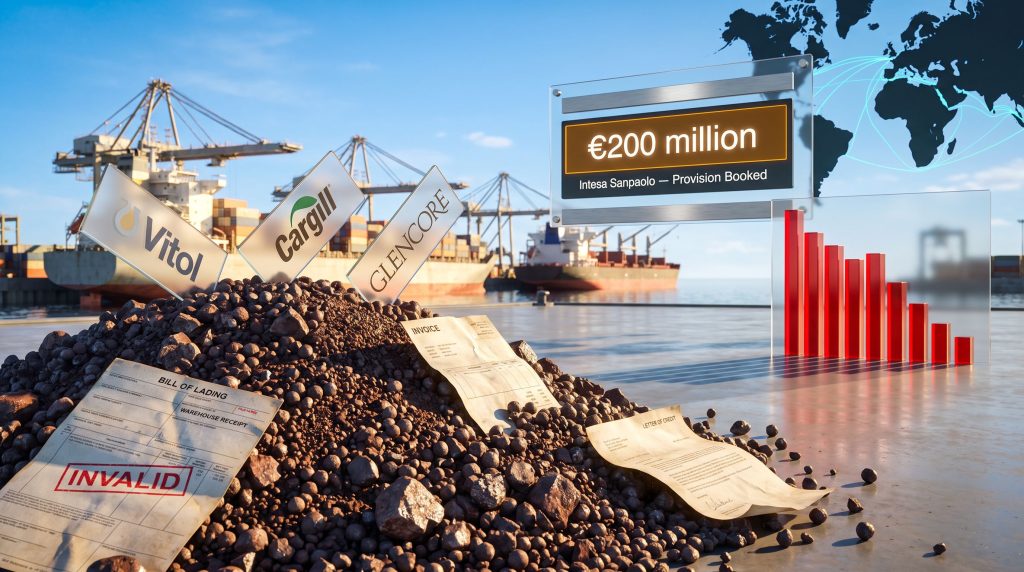
Italy's largest bank by assets has booked provisions against a €200 million (approximately $230 million USD) exposure to Radiant World. The bank's spokesperson indicated that the position is now largely covered and that there is no anticipated impact on the bank's 2026 net profit guidance.
It is important to understand what booking a provision actually means in accounting terms. A provision is not a confirmed write-off. It represents management's judgement that a loss is probable and can be estimated, but it does not necessarily mean the bank believes recovery is impossible. Provisions can be reversed if circumstances improve. However, the decision to provision at this scale signals that Intesa's risk assessment places material uncertainty over the recoverability of this exposure.
Jefferies' Point Bonita Fund: Alternative Credit Risk
Jefferies Financial Group's Point Bonita fund is separately reported to be reviewing its exposure to Radiant World. The involvement of a specialty credit fund, as distinct from a traditional bank, highlights a structural shift that has occurred in commodity trade finance over the past decade. Non-bank lenders and alternative credit vehicles have increasingly filled the financing gap left by bank regulatory constraints, often accepting higher risk in exchange for enhanced yield.
The risk profile of these vehicles differs meaningfully from banks: they typically lack deposit funding, may face redemption pressures from investors, and do not have the same regulatory capital buffers. Consequently, their exposure to events like this can generate significantly more acute liquidity pressure than an equivalent bank position.
Risk Note: This article does not constitute financial advice. References to specific financial institutions and their disclosed provisions or exposures are based on publicly reported information. Investors should conduct independent due diligence before making any financial decisions.
Structural Vulnerabilities and the Case for Market Reform
The Concentration Risk Dimension
When a single trading intermediary handles a significant share of global iron ore volume, its financial distress creates outsized ripple effects beyond its direct counterparties. Furthermore, commodity price impacts on the spot market depend on the active participation of large intermediaries. If a major participant's trading volumes are rapidly withdrawn, bid-ask spreads can widen, liquidity can thin, and smaller market participants may face reduced access to competitive pricing.
Comparing Fraud Risk Across Commodity Sectors
| Commodity Sector | Typical Credit Structure | Document Verification Standard | Notable Historical Fraud Incidents |
|---|---|---|---|
| Iron Ore | Invoice and bill of lading-based | Moderate | Emerging cases including Radiant World |
| Crude Oil | LC and prepayment-based | High | Hin Leong, ZenRock Commodities |
| Agricultural | Warehouse receipt-based | Moderate | Agritrade International |
| Metals (LME) | Exchange-cleared | High | Qingdao Port financing scandal |
The table illustrates that iron ore sits in a moderate verification environment relative to exchange-cleared metals markets. This gap in verification rigour, combined with the enormous transaction volumes involved, creates conditions where document-based fraud can achieve significant scale before detection. In addition, the China steel and iron ore market adds further complexity, given the sheer volume of seaborne cargo transiting through Chinese ports.
The Long-Term Regulatory Trajectory
Incidents of this scale historically catalyse regulatory reform. The Hin Leong collapse accelerated Singapore's review of commodity trade finance oversight frameworks. The Qingdao Port scandal prompted broader reforms to warehouse receipt verification practices across metals markets.
The Radiant World situation is likely to intensify pressure on regulators across multiple jurisdictions to extend more rigorous oversight to large commodity trading intermediaries, which currently operate with considerably less regulatory scrutiny than equivalently sized financial institutions. Digitalised trade documentation and blockchain-verified supply chain records represent the technological pathway toward closing the verification gap, though industry-wide adoption remains uneven. The transition timeline, moreover, is measured in years rather than months.
However, the global commodity tariff impacts of recent years have already begun reshaping the regulatory appetite for tighter oversight frameworks. Policymakers are increasingly aware that the intersection of trade finance opacity and geopolitical commodity flows creates systemic risk that extends well beyond individual company failures.
The next major ASX story will hit our subscribers first
Frequently Asked Questions: Radiant World and Commodity Trade Finance Fraud
What exactly did Vitol, Cargill, and Glencore identify about Radiant World's documents?
According to reporting, two of the three trading houses independently identified invoices or other documentation that Radiant World had provided to its banking partners as invalid. The third firm exited after being informed of these concerns. No formal legal charges have been publicly confirmed as of the reporting date.
Has Radiant World been formally charged with fraud?
As of the date of this reporting, no formal fraud charges have been publicly confirmed. Radiant World has denied all allegations and maintains that its operations continue normally and comply with applicable commercial and legal standards.
Why do banks extend hundreds of millions in credit to commodity trading intermediaries?
Commodity trade finance has historically maintained low default rates because lending is structured against physical cargo documentation rather than purely against a borrower's balance sheet. The theoretical security of document-backed lending has made it attractive to banks seeking yield with what appeared to be manageable collateral risk. For further context, the International Chamber of Commerce regularly publishes data on trade finance default rates that underlines this historical perception.
What is a credit provision and does it mean a bank expects a total loss?
A provision is an accounting charge taken against income to reflect the estimated probable loss on an exposure. It is distinct from a write-off, which represents a confirmed unrecoverable loss. Provisions can be reversed if circumstances change. Intesa Sanpaolo's decision to provision its €200 million Radiant World exposure reflects material uncertainty, not necessarily a conclusion that full recovery is impossible.
What happens to iron ore buyers when a major trading intermediary exits the market?
Buyers who sourced material through an affected intermediary may need to secure alternative supply arrangements quickly, often at less competitive pricing. Disruption to large-scale trading volumes can temporarily reduce spot market liquidity and increase price volatility across the iron ore market.
Key Takeaways: What the Radiant World Situation Tells Us About Commodity Markets
- Document integrity is the non-negotiable foundation of commodity trade finance. When it fails, the credit structures built on top of it collapse rapidly and non-linearly.
- Simultaneous exits by multiple tier-one trading houses are a leading indicator of systemic risk, not a lagging confirmation. These firms act on proprietary intelligence before formal investigations conclude.
- Booking a provision is not the same as confirming a loss, but at the scale of €200 million, it signals that a major bank views recovery as genuinely uncertain.
- Cross-default clauses can dramatically compress the timeline from liquidity stress to potential insolvency in commodity trade finance scenarios.
- Iron ore's moderate document verification environment, combined with the concentration of volume in large intermediaries, represents a structural vulnerability that regulatory frameworks have not yet adequately addressed.
- The broader trajectory points toward mandatory digitalisation of trade documentation and closer regulatory oversight of large non-bank commodity trading entities, though meaningful reform will take time to implement.
This article is intended for informational purposes only and does not constitute financial, legal, or investment advice. All financial figures and reported events are sourced from publicly available information. Readers should conduct independent research before drawing conclusions about the entities discussed.
Want to Stay Ahead of Significant ASX Mineral Discoveries Before the Broader Market?
Discovery Alert's proprietary Discovery IQ model delivers real-time alerts on significant ASX mineral discoveries, transforming complex mineral data into clear, actionable insights for traders and investors at every experience level — explore the historic returns major discoveries have generated and begin your 14-day free trial today to secure a genuine market-leading edge.