August 1, 2026
Iron Ore's Power Paradox: Who Really Controls the World's Most Traded Commodity?
The seaborne iron ore market has long operated under an uncomfortable paradox. A single nation accounts for roughly three-quarters of all global seaborne iron ore demand, yet for decades, the pricing architecture of that market was largely dictated by the handful of mega-suppliers who controlled the world's highest-quality, lowest-cost deposits. That paradox has now reached a breaking point. The Fortescue China Mineral Resources Group dispute is not simply a bilateral commercial disagreement. It is the most visible stress test yet of a deliberate, multi-year strategy by Beijing to fundamentally restructure who holds pricing power in the iron ore trade.
Understanding what is actually happening requires moving past the surface narrative of a contract negotiation gone wrong. The deeper story involves compressed steel mill economics, a state-engineered procurement architecture, and a supplier caught between its largest customer and the imperative to protect its commercial independence.
When big ASX news breaks, our subscribers know first
What Is China Mineral Resources Group and Why Does It Matter?
China Mineral Resources Group, or CMRG, was established by the Chinese government in 2022 with an explicit mandate: consolidate the fragmented purchasing behaviour of China's hundreds of individual steel mills into a single coordinated buying front. Before CMRG, iron ore suppliers could play different Chinese buyers against one another, fragmenting demand into smaller, more competitive pockets. A unified buyer changes this calculus entirely.
CMRG's creation mirrors a classic monopsony strategy, where a dominant buyer uses scale to compress supplier margins. In commodity economics, this is the buyer-side equivalent of what the major miners themselves once did through benchmark pricing agreements that ran until 2010. The irony is not lost on market observers.
The entity does not simply negotiate contracts. According to reporting from Bloomberg, CMRG has demonstrated a capacity to coordinate across steel mills, traders, and port operators simultaneously, effectively deploying logistics infrastructure as a negotiating instrument alongside commercial terms.
The Steel Mill Margin Crisis Driving the Dispute
To understand why the Fortescue China Mineral Resources Group dispute escalated when it did, it is essential to examine the underlying economics of Chinese steelmaking in the current cycle. China iron ore demand patterns have shifted considerably, placing steelmakers under mounting pressure.
Chinese steel mills are operating under a convergence of structural pressures that have made them uniquely sensitive to input costs:
- The prolonged contraction of China's property sector, historically one of the largest consumers of domestic steel, has materially reduced end demand.
- Excess steelmaking capacity built during the infrastructure boom years has not been meaningfully rationalised, creating a structural oversupply of finished steel.
- Infrastructure-driven steel consumption, while still present, has decelerated compared to peak expansion periods.
- Compressed mill margins have reduced the willingness of steelmakers to accept ore at prices that reflect supplier production economics rather than buyer affordability.
As Fortescue's Chief Executive Officer Dino Otranto stated on an analyst call, the margin squeeze on Chinese steel mills is the fundamental driver of the pressure being channelled through CMRG. This framing is important because it positions the dispute not as an arbitrary political manoeuvre but as an economically rational response by a buyer facing genuine financial distress in its downstream operations.
| Structural Pressure Factor | Market Impact |
|---|---|
| Property sector contraction | Reduced domestic steel end demand |
| Excess steelmaking capacity | Chronic margin compression at mill level |
| Slowing infrastructure consumption | Lower willingness to pay premium ore prices |
| CMRG coordinated purchasing mandate | Unified downward pressure on supplier terms |
Super Special Fines, Fortune Fines, and the Products at the Heart of the Conflict
Not all iron ore is equal. The Fortescue China Mineral Resources Group dispute centres on specific product grades rather than Fortescue's full product portfolio, which reveals something important about CMRG's targeting strategy.
Super Special Fines is a mid-grade iron ore product that represents a meaningful share of Fortescue's total shipment volumes into China. It is not a premium magnetite concentrate, nor is it a high-grade Pilbara blend. It occupies a commercially significant middle ground, which makes it both important to Fortescue's revenue base and strategically targetable by a buyer seeking leverage without disrupting its own essential supply.
Fortune Fines is a newer Fortescue product that had not yet completed its commercial launch into the Chinese market when CMRG directed steel mills to avoid pre-launch discussions with the Australian miner. Blocking a product's market entry is a notably aggressive tactic, as it targets future revenue streams rather than simply renegotiating existing ones.
The deliberate targeting of a pre-launch product category signals that CMRG's strategy extends beyond current contract renegotiation toward shaping the commercial architecture of future supply relationships.
A Five-Phase Escalation Playbook
The dispute did not emerge suddenly. Reviewing the sequence of events reveals a structured escalation pattern that suggests deliberate strategic coordination rather than reactive commercial behaviour.
- Negotiation stalemate: Long-term supply agreement talks between Fortescue and CMRG stall over discount levels and commercial conditions that Fortescue considers inconsistent with fair market practice.
- Deadline pressure: CMRG instructs mills and traders to take delivery of existing Super Special Fines cargoes by a specified date, with remaining port inventory subject to logistics restrictions.
- New product interference: Steel mills are directed to avoid pre-launch engagement with Fortescue regarding Fortune Fines, effectively blocking market entry for a new product category.
- USD cargo restrictions: Mills and traders are reportedly instructed not to purchase new USD-denominated Super Special Fines cargoes, adding a currency dimension to the commercial pressure.
- Public positioning: Fortescue's senior leadership publicly characterises CMRG's conduct as undermining both fair market practice and China's own iron ore supply security, escalating the dispute into the public domain.
This escalation sequence mirrors patterns observed in earlier tensions between CMRG and BHP, suggesting the entity operates from a repeatable strategic framework rather than improvising on a case-by-case basis. Furthermore, the broader iron ore price decline environment has only intensified the resolve of Chinese buyers to secure more favourable terms.
Fortescue's Operational Position and Strategic Response
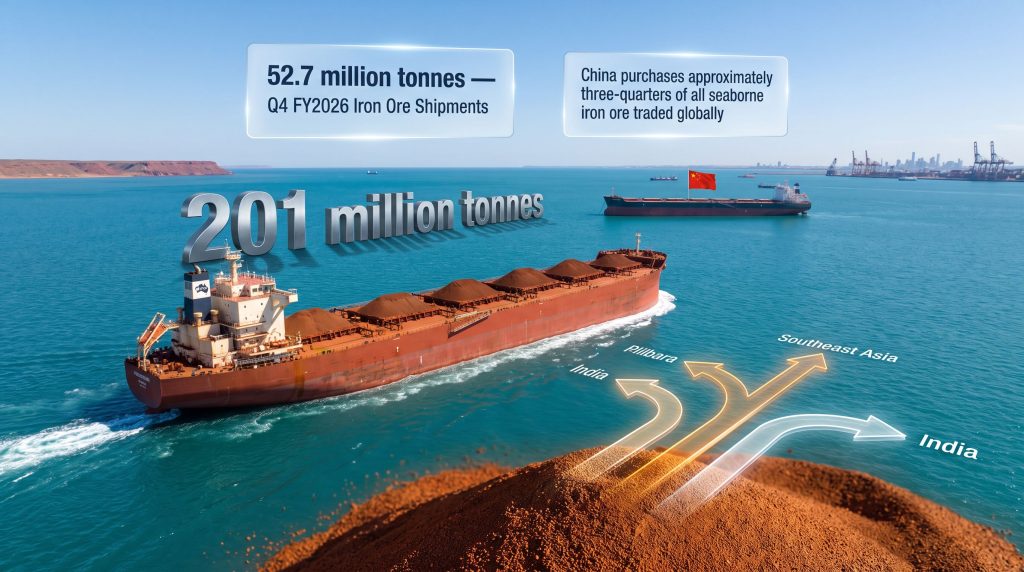
Despite the commercial disruption, Fortescue's underlying operational performance has remained robust. The company shipped 52.7 million tonnes of iron ore in the fourth quarter of FY2026, bringing full-year exports to 201 million tonnes. This scale matters strategically because it provides the financial cushion to absorb short-term revenue disruption while pursuing market diversification.
| Metric | Figure |
|---|---|
| Q4 FY2026 Iron Ore Shipments | 52.7 million tonnes |
| Full-Year FY2026 Iron Ore Exports | 201 million tonnes |
| Primary Export Market | China (largest single buyer) |
| Alternative Markets Under Exploration | Southeast Asia, India |
Fortescue's CEO for Growth and Energy, Gus Pichot, confirmed on an analyst call that the company is continuing to sell through multiple channels while actively exploring incremental demand in Southeast Asia and India. The rhetorical framing employed by Fortescue's leadership is strategically notable. By characterising CMRG's conduct as destabilising to China's own iron ore supply security, Fortescue shifts the dispute's narrative from a bilateral price argument to a systemic market integrity issue with consequences for Chinese steelmakers themselves.
The next major ASX story will hit our subscribers first
Southeast Asia and India: Real Alternatives or Aspirational Hedges?
The critical question for investors and market participants is whether Fortescue can realistically redirect meaningful volumes away from China in the near to medium term.
Southeast Asia's steel sector is genuinely expanding, driven by infrastructure investment across Vietnam, Indonesia, the Philippines, and Thailand. However, the region's collective steel demand remains a fraction of China's annual consumption, and its blast furnace fleet, which processes iron ore fines, is less developed than China's highly optimised sintering and steelmaking infrastructure.
India presents a more structurally compelling longer-term scenario. India's government has articulated explicit steel production expansion targets, and the country's domestic iron ore supply, while substantial, is increasingly constrained by quality and infrastructure limitations in certain high-growth producing states. Australian iron ore, with its established logistics chain, could theoretically become a meaningful input as Indian steelmaking capacity scales.
The honest assessment, however, is that neither market can absorb diverted Australian iron ore volumes at the scale that would meaningfully offset a sustained Chinese purchasing restriction in the near term. Consequently, the China steel and iron ore relationship remains the central axis around which Fortescue's commercial strategy must revolve.
Three Scenarios for How This Resolves
| Scenario | Description | Key Driver |
|---|---|---|
| Negotiated Resolution | Both parties reach a revised long-term supply agreement | CMRG needs volume stability; Fortescue needs price certainty |
| Prolonged Standoff | Fortescue accelerates non-China diversification; CMRG sources more from Brazil | Sustained steel mill margin pressure in China |
| Structural Realignment | Australian iron ore permanently shifts toward Southeast Asia and India | Geopolitical escalation beyond commercial dispute |
A negotiated resolution remains the highest probability outcome in the near term because the economic incentives for both parties ultimately favour resolution. China needs reliable high-volume iron ore supply to maintain steelmaking throughput, and Fortescue needs price certainty to plan capital allocation across its operations. Neither party benefits from a sustained rupture.
However, the structural realignment scenario, while currently a lower probability, carries the largest long-term implications for global trade flows if geopolitical tensions escalate beyond the commercial dimension.
The Geopolitical Dimension: Mutual Dependency as Both Shield and Weapon
Australia and China occupy an unusual position in the global resource trade. Australia depends on iron ore export revenues that flow predominantly from Chinese demand. China depends on Australian iron ore to feed a steelmaking complex that would struggle to source equivalent volumes at comparable quality and cost from elsewhere in the short term.
This mutual dependency is asymmetric in important ways. China's steel industry requires iron ore continuously. Disruptions to throughput cascade rapidly into downstream manufacturing and construction activity. Australia's federal budget and the financial health of its largest mining companies are similarly sensitive to iron ore price and volume shifts.
The leverage in this relationship does not sit exclusively with either party. What CMRG has done is identify and exploit a specific commercial vulnerability, namely Fortescue's product-level exposure, without triggering the full consequences of a systemic supply disruption.
This precision targeting is what makes the CMRG playbook sophisticated. It creates negotiating pressure without crossing the threshold that would force a structural response from the Australian government or trigger supply security concerns severe enough to destabilise Chinese steelmaking.
What This Means for Rio Tinto, Vale, and Other Major Suppliers
The Fortescue China Mineral Resources Group dispute establishes a visible precedent for how CMRG may approach contract renewals with other major iron ore suppliers. Rio Tinto and Vale, both of which supply enormous volumes into China, will be watching the resolution of this dispute closely. In addition, the China iron ore outlook suggests that CMRG's strategy of targeted pressure is unlikely to soften in the near term.
Several dynamics are worth noting for investors monitoring the broader iron ore sector:
- A successful CMRG negotiation outcome against Fortescue would likely embolden similar pressure tactics against other suppliers at contract renewal.
- Rio Tinto's higher-grade Pilbara Blend products carry a structural quality premium that provides some insulation from the discount pressure applied to mid-grade products like Super Special Fines.
- Vale's Brazilian operations, which produce high-grade pellets and sinter feed, occupy a different segment of the quality curve, though Brazil's logistical costs into China provide some natural offset to quality premiums.
- Any structural redirection of Australian iron ore toward Southeast Asia or India would likely tighten the supply available to Chinese mills from non-Brazilian sources, potentially reducing CMRG's leverage over time.
Furthermore, the global iron ore market impact of concurrent trade pressures, including US tariffs on steel, adds another layer of complexity to how major suppliers position themselves commercially.
Frequently Asked Questions
What Is CMRG and What Role Does It Play in Iron Ore Purchasing?
China Mineral Resources Group is a state-established entity created in 2022 to consolidate Chinese iron ore purchasing. Rather than having individual mills negotiate independently with suppliers, CMRG coordinates buying behaviour across steelmakers, traders, and port operators to maximise China's collective negotiating leverage.
Why Has CMRG Placed Restrictions on Fortescue Iron Ore Cargoes?
The restrictions follow a breakdown in long-term supply agreement negotiations, primarily over pricing discounts and commercial terms. The underlying driver is severe margin compression among Chinese steel mills, caused by a property sector downturn, overcapacity, and slowing steel demand.
Is Fortescue Still Selling Iron Ore to China During the Dispute?
China remains Fortescue's largest single market. The company is continuing to sell through multiple channels while the commercial dispute progresses, though specific product categories including Super Special Fines have been subject to coordinated purchasing restrictions.
Could This Dispute Affect Global Iron Ore Prices?
A prolonged dispute that materially redirects Fortescue volumes away from China could create short-term pricing dislocations, particularly for mid-grade iron ore products. However, the scale of China's purchasing dominance means any price signal would ultimately reflect Chinese demand conditions rather than supplier redirection strategies.
Has China Used Similar Tactics Against Other Major Iron Ore Suppliers?
Yes. Reporting indicates that comparable coordinated pressure tactics were deployed during earlier CMRG tensions with BHP, suggesting this represents a structured and repeatable negotiating methodology rather than a dispute-specific reaction.
Disclaimer: This article is for informational purposes only and does not constitute financial or investment advice. Statements regarding future market outcomes, trade flows, and scenario projections involve uncertainty and should not be relied upon as predictions. Readers should conduct their own due diligence before making investment decisions.
Want to Stay Ahead of Major Mineral Discoveries Before the Broader Market?
Discovery Alert's proprietary Discovery IQ model delivers real-time alerts on significant ASX mineral discoveries, transforming complex mineral data into clear, actionable insights for investors at every level — explore the historic returns major discoveries have generated and begin your 14-day free trial today to secure your market-leading advantage.