July 24, 2026
The Race Beneath the Surface: Why Africa's Mineral Wealth Is Rewriting Global Power Dynamics
Beneath the rolling savannahs of the Congo Basin, the copper belts of Zambia, and the sedimentary basins of East Africa lies a geological inheritance that the world's most powerful economies are scrambling to access. China investment in Africa is not incidental to the global energy transition — it is foundational to it. Copper conducts the electricity that powers EV motors. Cobalt stabilises the chemistry of lithium-ion battery cathodes. Manganese and rare earth elements underpin everything from wind turbines to defence-grade electronics. Africa holds an estimated 30% of the world's mineral reserves, and that figure is increasingly driving trillion-dollar investment decisions across the globe.
This is not a new dynamic, but its intensity is accelerating in ways that are reshaping the architecture of foreign capital flows into the continent. Furthermore, the critical minerals demand driven by the energy transition is adding urgency to every major investment decision being made across the continent.
When big ASX news breaks, our subscribers know first
Greenfield Investment in Africa: A Market in Structural Transition
The headline data from the UNCTAD World Investment Report 2026 tells a story that initially appears contradictory. Total announced greenfield investment value in Africa fell by approximately one-third in 2025, yet the number of new projects actually increased over the same period. Understanding this divergence is critical for anyone tracking where the real momentum in Africa's investment landscape is building.
The apparent contradiction resolves when you examine investor behaviour more carefully. What the data reflects is a deliberate rotation away from high-risk, high-capital mega-bets toward a more distributed approach, with capital being deployed across a broader range of geographies and sectors. Investors are no longer concentrating all their exposure in single transformative projects. Instead, they are building portfolios of development-stage positions across multiple African markets.
Despite this broadening, concentration at the top end of the market remains substantial. The 10 largest announced projects in 2025 still accounted for roughly 40% of Africa's total announced greenfield investment value for the year, confirming that scale still matters enormously in attracting the bulk of inbound capital.
"The divergence between declining total investment value and rising project count signals a maturation in investor behaviour, reflecting fewer speculative mega-deals and more deliberate, distributed capital deployment across multiple geographies and sectors."
China Investment in Africa: The $40 Billion Foundation
Cumulative Scale and Annual Flow
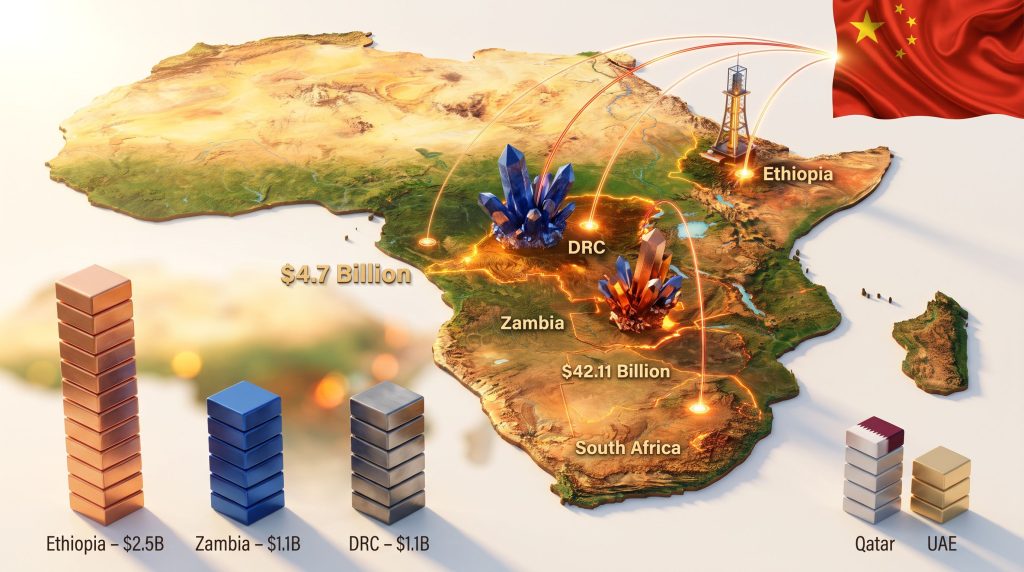
To understand China's 2025 greenfield dominance, it helps to appreciate the depth of the foundation already in place. China's total direct investment stock in Africa surpassed $40 billion by the end of 2023, with some estimates placing the figure at $42.11 billion. Annual FDI flows from China into Africa reached $3.37 billion in 2024, though this represented a 15% decline from the prior year as the post-pandemic rebound cycle normalised.
China's position is remarkable not just in absolute scale, but in comparative terms. According to research on Chinese investment in Africa, it holds the distinction of being the largest developing-country investor on the continent, outpacing peer economies by a significant margin while simultaneously competing against Western sovereign-backed capital pools and Gulf state wealth funds.
From State Enterprises to Private Capital: A Structural Shift
One of the least-discussed but most consequential developments in China's African investment posture over the past decade has been the gradual displacement of state-owned enterprise (SOE) dominance by private-sector actors. Historically, Chinese engagement in Africa was orchestrated primarily through SOEs backed by policy bank financing from institutions such as the China Exim Bank and the China Development Bank, which provided concessional lending tied to infrastructure delivery.
That model has evolved substantially. Recent data indicates that more than 70% of Chinese enterprises currently active in Africa are private-sector firms, representing a fundamental shift in how Beijing's economic footprint is organised on the ground.
This transition carries important implications:
- Private Chinese companies are typically driven by commercial return requirements rather than political relationship management, making their investment decisions more sensitive to project economics and exit strategies
- Private-sector-led investment is less exposed to the debt-trap narrative that has dogged SOE-backed infrastructure financing, potentially improving the reputational context for Chinese capital across the continent
- The diversification of Chinese investors reduces single-point-of-failure risk in bilateral relationships, spreading exposure across a much wider range of sectors and counterparties
- Private enterprises tend to operate with faster decision cycles and leaner corporate structures, potentially accelerating deployment timelines compared to bureaucratically constrained SOEs
Where China's Capital Is Anchored Geographically
| Country | Primary Investment Focus |
|---|---|
| South Africa | Manufacturing, finance, and retail exposure |
| Mozambique | Natural gas and energy infrastructure |
| Niger | Uranium and mining sector development |
| Algeria | Hydrocarbons and large-scale construction |
| Mauritius | Financial services and regional hub activity |
| Nigeria and Angola | Historical concentration in oil and infrastructure |
China's Three Flagship Projects in 2025: Breaking Down the $4.7 Billion
When the UNCTAD World Investment Report 2026 published its analysis of Africa's largest announced greenfield developments during the year, China emerged as the single largest investing economy among the top 10 projects. Three major commitments, totalling a combined $4.7 billion, were responsible for this positioning.
| Project | Investor | Host Country | Sector | Announced Value |
|---|---|---|---|---|
| Oil and Gas Development | Golden Concord Holdings (HK) | Ethiopia | Energy – Hydrocarbons | $2.5 billion |
| Oil and Gas Expansion | Fujian Xiang Xin Group | Zambia | Energy – Hydrocarbons | $1.1 billion |
| Metals and Mining | CMOC Group | DRC | Critical Minerals | $1.1 billion |
Why Each Project Carries Strategic Weight Beyond Its Dollar Figure
Ethiopia (Golden Concord Holdings – $2.5 billion): This project extends China's deepening industrial presence in East Africa at a time when the region has become a manufacturing corridor for Chinese-affiliated production networks. Ethiopia has absorbed significant Chinese-backed factory development over the past decade, and the addition of a major energy development project reinforces the vertical integration of China's East African strategy, pairing industrial capacity with energy supply.
Zambia (Fujian Xiang Xin Group – $1.1 billion): Zambia copper production is well established, but persistent energy constraints have historically limited the country's ability to fully monetise its mineral wealth at the processing and refining stage. A major oil and gas infrastructure investment signals that Chinese capital is targeting the energy bottleneck that caps Zambia's industrial output, which would ultimately benefit Chinese-affiliated copper processing operations in the region.
DRC (CMOC Group – $1.1 billion): CMOC Group is already one of the world's largest producers of cobalt, with its Tenke Fungurume and Kisanfu assets in the DRC representing some of the highest-grade copper-cobalt deposits anywhere on earth. Cobalt grades at these operations are exceptional by global standards, with ore quality that far exceeds marginal producers in other jurisdictions. The additional $1.1 billion commitment reinforces China's upstream control over a mineral that Western battery supply chains have struggled to source outside of Chinese-dominated channels.
The congolese cobalt rivalry between major powers adds further strategic urgency to every dollar deployed in this region.
"China's ongoing commitment to DRC copper and cobalt assets is not simply a financial investment. It represents a structural lock on the upstream end of the global electric vehicle battery supply chain that Western competitors have found extremely difficult to replicate at comparable cost or speed."
The Competitive Landscape: Gulf Capital, European Industrials, and Intra-African Flows
China's dominance among Africa's largest announced greenfield projects in 2025 did not go uncontested. The competitive field that year reflected a genuinely multipolar investment environment.
| Investor | Origin | Project Location | Sector | Committed Value |
|---|---|---|---|---|
| Al Jedad Holding | Qatar | Ghana | Chemicals | $5.0 billion |
| Alpha MBM Investments | UAE | Uganda | Oil and Gas | $4.0 billion |
| Dangote Group | Nigeria | Ethiopia | Chemicals | $3.0 billion |
| Möhring Energie Group | Germany | Mauritania | Renewables/Energy | Undisclosed |
| TotalEnergies | France | Angola | Oil and Gas | Undisclosed |
| BP | United Kingdom | Angola | Oil and Gas | Undisclosed |
| Stellantis | EU (multinational) | Morocco | Automotive Manufacturing | Undisclosed |
Qatar's Al Jedad Holding committed the single largest individual project of the year at $5 billion in Ghana, technically surpassing any individual Chinese project. However, Gulf investment in Africa has historically been episodic and concentrated within specific bilateral relationships rather than distributed across the continent in a sustained, multi-sector pattern.
A particularly significant data point from the 2025 rankings is the presence of Nigeria's Dangote Group as the only African-headquartered entity represented among the continent's 10 largest announced greenfield projects. While the scale of Dangote's $3 billion Ethiopian chemicals commitment is dwarfed by the aggregated positions of Chinese and Gulf investors, it signals the early emergence of intra-African capital flows at a scale previously confined to external actors.
Sector Dynamics: Where the Real Competition Is Heating Up
Energy and Hydrocarbons: The Dominant Attractor
Despite the accelerating global transition away from fossil fuels, hydrocarbons continued to attract the largest individual foreign investment commitments in Africa in 2025. This reflects a structural reality that is often underappreciated in Western policy discourse: the energy transition in Africa is not a straight substitution of renewables for hydrocarbons. It is a layered process in which gas-fired power generation plays a bridging role, and in which domestic energy poverty creates demand for hydrocarbon development that is fundamentally disconnected from export-market economics.
Critical Minerals: The Accelerating Investment Thesis
The copper-cobalt complex centred on the DRC and Zambia represents the most intensely contested resource geography in Africa. The breadth of DRC mineral wealth makes this region uniquely important for several reasons:
- The DRC produces approximately 70% of the world's cobalt supply, creating a concentration risk that has alarmed Western battery manufacturers and government procurement agencies
- Copper grades at major DRC operations such as CMOC's Tenke Fungurume and Kisanfu mines are substantially higher than the global average for producing copper mines, making them low-cost producers even at depressed copper prices
- Zambia's Copperbelt hosts some of the most extensively explored and geologically understood copper mineralisation systems in the world, reducing exploration risk for new capital entering the region
- Both countries are actively developing or reviewing mining codes, local content regulations, and royalty structures, creating ongoing regulatory uncertainty that external investors must price into project economics
Digital Infrastructure: Emerging but Subscale
UNCTAD's 2026 report flagged growing investor interest in African digital infrastructure, particularly data centres. However, African data centre projects remain considerably smaller in scale than the hyperscale developments being constructed in advanced economies. This gap reflects both demand-side constraints tied to internet penetration and electricity reliability, as well as supply-side capital availability challenges.
The next major ASX story will hit our subscribers first
China's Infrastructure Footprint: The Numbers Behind the Narrative
Beyond greenfield project announcements, China's physical and financial presence in African infrastructure development represents one of the most consequential economic relationships on the continent. Research from Deloitte estimates that China has financed approximately one in every five African infrastructure projects and physically constructed one in every three, a ratio that underscores the depth of Beijing's on-the-ground operational involvement.
Chinese policy bank financing has been particularly instrumental in developing:
- Roads and highway networks connecting landlocked mining regions to coastal export facilities
- Railway corridors designed to reduce the transport cost of bulk commodity exports
- Port upgrades that simultaneously serve Chinese-affiliated export logistics and broader regional trade
- Power generation facilities, including hydroelectric and thermal plants, that underpin industrial activity in mineral-producing regions
- Electricity transmission infrastructure connecting generation capacity to industrial consumers
Beyond hard infrastructure, Chinese investment has expanded progressively into manufacturing, agriculture, retail distribution networks, digital economy platforms, and financial services, reflecting a broadening of the engagement model that goes well beyond resource extraction. Notably, recent data on energy investments shows that a growing share of Chinese energy commitments in Africa are now directed toward renewables rather than fossil fuel projects.
The Geopolitical Dimension: Africa as a Contested Investment Arena
The intensifying competition between Chinese, Gulf, American, and European capital for African resource access is producing a negotiating environment that is increasingly favourable to African governments. The broader context of mining geopolitics is reshaping how nations with significant critical mineral endowments, particularly the DRC, Zambia, Zimbabwe, and Guinea, are leveraging competing investor interest to extract more advantageous contract terms, higher local content requirements, and improved revenue-sharing arrangements.
This dynamic introduces a strategic tension that investors on all sides must navigate carefully. The risk of contract renegotiation, royalty revision, or nationalisation pressure is not evenly distributed. Projects structured during periods of lower commodity prices or weaker state capacity are particularly vulnerable to retrospective adjustment as mineral values rise and government revenue aspirations increase.
Disclaimer: The investment data, project values, and strategic assessments referenced in this article are drawn from UNCTAD's World Investment Report 2026 and associated research. Greenfield investment announcements represent stated intentions at the time of announcement and may not reflect final committed or deployed capital. Readers should conduct independent due diligence before drawing conclusions for investment purposes.
Frequently Asked Questions: China Investment in Africa
How much has China invested in Africa in total?
China's direct investment stock in Africa surpassed $40 billion by the end of 2023, with some estimates placing the cumulative figure at approximately $42.11 billion. Annual FDI flows were approximately $3.37 billion in 2024.
What sectors does China prioritise for investment in Africa?
Chinese investment is most heavily concentrated in infrastructure, energy, mining, and construction. However, recent trends show expanding exposure to manufacturing, digital economy platforms, agriculture, retail, and financial services.
Which African countries receive the most Chinese investment?
Primary destinations in recent years have included South Africa, Mozambique, Niger, Algeria, Mauritius, Nigeria, and Angola, though project-level concentration shifts year to year based on major greenfield announcements.
Is Chinese investment in Africa primarily government-driven or private?
While state-owned enterprises and policy banks historically dominated, recent data indicates that more than 70% of Chinese enterprises currently investing in Africa are private-sector companies, representing a significant structural evolution in how Chinese capital is deployed on the continent.
Why is China focused on the DRC and Zambia specifically?
Both countries host world-class deposits of copper and cobalt, minerals that are critical inputs for electric vehicle batteries and clean energy systems. Securing upstream access to these resources is central to China's long-term industrial and technology supply chain strategy, particularly as Western economies attempt to diversify sourcing away from Chinese-controlled channels.
How does China's African investment compare to other major investors in 2025?
China investment in Africa placed it as the largest investing economy among Africa's top 10 announced greenfield projects in 2025 by aggregated committed capital, with $4.7 billion across three projects, placing it ahead of Gulf state investors, European industrial groups, and African-headquartered entities.
Want to Track the Next Major Critical Minerals Discovery Before the Market Does?
Discovery Alert's proprietary Discovery IQ model delivers real-time alerts the moment significant ASX mineral discoveries are announced — instantly translating complex geological data across 30-plus commodities into clear, actionable investment insights, so subscribers can act ahead of the broader market. Explore how historic mineral discoveries have generated extraordinary returns on Discovery Alert's dedicated discoveries page, then begin your 14-day free trial to position yourself at the forefront of the next major find.