July 24, 2026
When Processing Equipment Becomes the Pulse of the Mining Cycle
Capital equipment procurement cycles in mining rarely move in straight lines. They lurch, stall, and surge in response to commodity price expectations, balance sheet confidence, and the long-horizon planning horizons that define large-scale mine development. Yet when order books at major original equipment manufacturers begin expanding simultaneously across geographies, commodity types, and customer sizes, something more durable than a cyclical rebound tends to be at work.
The Metso June quarter orders rise mining demand signal from the Finnish minerals processing specialist offers precisely this kind of insight. Parsed carefully, the numbers point not to a one-quarter anomaly but to a procurement environment where mine operators across multiple continents are committing capital at a pace that reflects multi-year confidence in demand fundamentals. Understanding what is actually driving that commitment, and what it means for mine development timelines, aftermarket dynamics, and capital allocation strategy, requires looking well beyond the headline figures.
When big ASX news breaks, our subscribers know first
Metso's Position in the Global Minerals Processing Value Chain
From Crushing to Classification: Why Processing Equipment Is Central to Mine Economics
Metso operates at one of the most consequential intersections in the mining industry: the point where extracted ore is transformed into sellable concentrate. The company's product portfolio spans crushing, grinding, screening, flotation, filtration, and classification technologies, alongside an extensive aftermarket services business covering parts, maintenance, and optimisation contracts.
This positioning is strategically significant. Processing equipment sits at the core of mine capital expenditure hierarchies because throughput capacity directly constrains revenue generation. A mine that can extract ore but cannot process it efficiently is a mine that cannot monetise its resource, which makes processing circuit design and equipment availability among the most consequential procurement decisions a mine operator makes.
Critically, Metso's dual exposure to both new equipment sales and aftermarket services creates a compounding revenue dynamic that single-segment competitors cannot easily replicate. New equipment sales generate installation revenue and establish an installed base. That installed base then generates recurring aftermarket revenue for parts, consumables, and service contracts across the operating life of the equipment, which in large-scale grinding or flotation applications can extend across decades.
What the June Quarter Numbers Actually Reveal
A Detailed Look at the Financial Performance
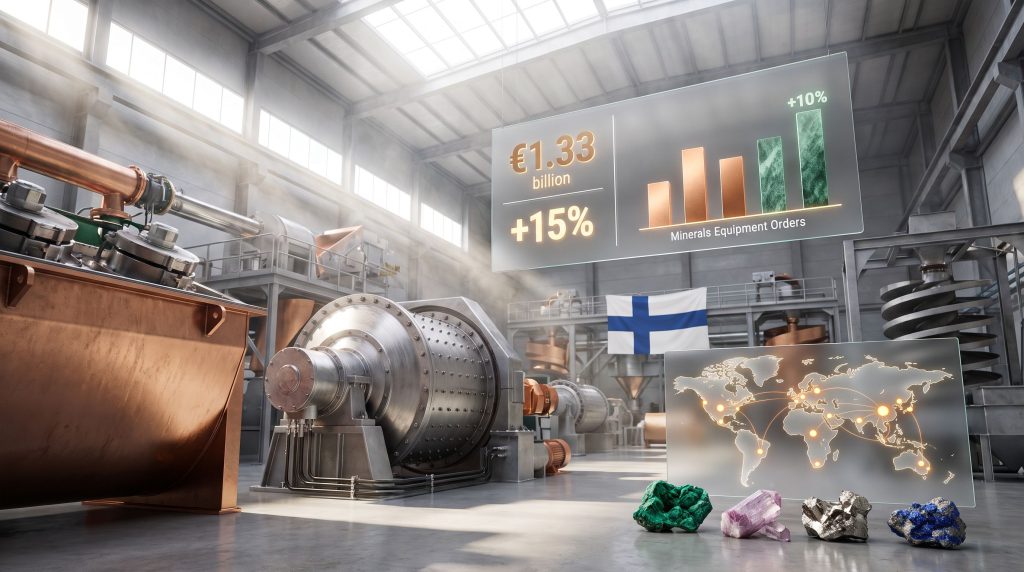
The headline figure from Metso's June 2026 quarter is an 18% year-on-year increase in total group orders to €1.46 billion. Revenue rose 6% to €1.33 billion, while pre-tax profit advanced 15% to €167 million. The Minerals segment, which encompasses the core mining processing equipment and services business, was the primary driver of order growth, with equipment orders specifically rising approximately 10% year-on-year.
| Metric | June Quarter Result | Year-on-Year Change |
|---|---|---|
| Total Group Orders | €1.46 billion | +18% |
| Minerals Segment Equipment Orders | Strong outperformance | ~+10% |
| Aggregates Segment Orders | Moderate growth | +5% |
| Group Revenue | €1.33 billion | +6% |
| Pre-Tax Profit | €167 million+ | +15% |
The Conversion Gap: Why Order Intake Outpacing Revenue Is a Positive Signal
The apparent divergence between an 18% order intake surge and a more modest 6% revenue increase is not a contradiction. It is one of the most constructive characteristics a capital equipment business can exhibit.
In long-lead-time industries like minerals processing, orders are placed and revenue is recognised at very different points in time. A flotation circuit or high-pressure grinding roll system ordered in June 2026 may not be delivered, commissioned, and revenue-recognised until late 2026 or well into 2027. When order intake consistently exceeds revenue recognition, the result is a growing backlog that functions as a forward-looking revenue pipeline with a higher degree of certainty than most financial metrics can provide.
This gap between order commitment and revenue delivery is the structural reason why experienced mining sector analysts weight OEM order intake data so heavily as a leading indicator. It effectively provides 12 to 24 months of advance visibility into future revenue trajectories.
The Demand Drivers Behind Metso's June Quarter Order Surge
Energy Transition Commodities: The Multi-Year Investment Thesis at the Mine Site Level
The structural narrative underlying elevated mining equipment demand in 2026 centres on commodities whose production must scale substantially to support electrification, battery technology, and clean energy infrastructure. Energy transition minerals such as copper, lithium, nickel, and cobalt are the primary beneficiaries of this demand thesis, and each requires substantial processing infrastructure at the mine site level.
Copper concentrate production, for example, typically involves crushing and grinding circuits capable of processing tens of thousands of tonnes of ore daily, followed by flotation cells that separate copper sulphide minerals from waste rock. The efficiency of this processing chain, measured by recovery rates and grind consistency, directly determines the economic viability of the mine. Furthermore, as new copper projects advance toward construction and operating mines push for throughput expansion, demand for Metso-class processing equipment rises in direct proportion. The ongoing copper supply crunch is one of the most compelling forces accelerating this equipment procurement activity.
The critical insight for procurement analysts is that mining equipment orders for energy transition commodities tend to be sticky once committed. Unlike surface mining equipment, which can be redeployed across sites, processing circuits are engineered for specific ore types and geometallurgical profiles. Once an operator selects a flotation or comminution configuration matched to their ore body, switching costs are prohibitive, creating long-term equipment and aftermarket relationships.
Small and Mid-Sized Orders: The Most Underappreciated Signal in the Results
Perhaps the most strategically significant aspect of Metso's June quarter performance is the reported strength in small and mid-sized order intake. This detail deserves considerably more analytical attention than it typically receives in headline-focused reporting.
In prior mining capital expenditure cycles, notably the China-driven supercycle of the mid-2000s, order book growth at major OEMs was concentrated in a small number of very large greenfield projects. That structure created extraordinarily lumpy revenue profiles, where the commissioning delay or cancellation of a single mega-project could materially damage quarterly results.
A broad base of smaller orders tells a fundamentally different story:
- Mid-tier and junior operators are committing capital, indicating that investment confidence extends well beyond the balance sheets of the major diversified miners.
- Brownfield expansion activity is elevated, since smaller orders are often associated with incremental capacity additions at existing operations rather than greenfield construction.
- Revenue predictability improves, because a pipeline of fifty medium-sized orders is far less sensitive to single-project slippage than a pipeline dominated by three large contracts.
- Geographic distribution broadens, as smaller orders tend to originate from a wider range of operating jurisdictions.
This demand breadth is arguably a more reliable indicator of a structural equipment cycle than any single large contract announcement.
Aftermarket Demand: What High Utilisation Rates Signal About the Sector
Metso's aftermarket and services demand grew alongside new equipment orders in the June quarter, a combination that carries specific diagnostic value for understanding the current state of global mining operations.
Aftermarket demand in minerals processing is driven primarily by wear rates on comminution and flotation equipment. Grinding mill liners, flotation cell rotors and stators, screen panels, and crusher wear parts all degrade at rates proportional to throughput. When aftermarket consumption is high, it indicates that processing circuits are running at or near nameplate capacity, which in turn reflects operator confidence in sustained commodity prices and an operational posture focused on maximising production volume.
The aftermarket segment also carries structural margin advantages over new equipment sales. Consumables and service contracts are priced with higher margin structures, require less capital-intensive manufacturing, and generate recurring cash flows that smooth through equipment replacement cycles. For Metso's overall financial profile, strong aftermarket growth alongside equipment growth represents the most favourable possible combination.
OEM Performance in Context: Reading the Broader Equipment Market
How Metso's Results Sit Within Wider Capital Goods Trends
Contextualising Metso's performance requires acknowledging the divergent demand dynamics visible across the capital goods sector serving extractive industries. While Metso's Minerals segment saw strong expansion, the picture across the broader equipment market is more nuanced. The mining commodity outlook for 2025 and beyond continues to underpin elevated procurement activity across multiple segments.
Volvo CE's recent results illustrated a phenomenon that capital goods analysts increasingly encounter: revenue or volume contraction at the headline level coexisting with improving profitability and margin performance. This pattern, driven by product mix shifts, pricing power, and cost discipline, reflects a sector grappling with the transition from a volume-growth model to a quality-of-earnings model.
Metso's June quarter is notable precisely because it demonstrated both volume growth and margin expansion simultaneously, a combination that becomes increasingly rare as equipment cycles mature. The 15% pre-tax profit growth against 6% revenue growth reflects meaningful operational leverage, suggesting that fixed cost absorption is improving as volumes rise through the production system.
Geographic Diversification: A Structurally Different Cycle
A feature of the current mining equipment procurement environment that distinguishes it from prior cycles is the geographic breadth of demand. The Americas, Africa, and Asia-Pacific are each contributing to minerals equipment procurement activity, driven by distinct commodity mixes and project pipelines.
This contrasts sharply with the early 2010s, when demand was heavily concentrated in Chinese-controlled or Chinese-financed projects, creating significant single-market exposure for OEMs and leaving order books vulnerable to Chinese credit cycle dynamics.
Broad geographic participation in equipment demand reduces the correlation between OEM order book performance and any single commodity market, jurisdiction, or financing environment, providing a more stable foundation for sustained order intake.
Management Guidance and What Stability Actually Means
Unchanged Outlook: Discipline or Pessimism?
Metso's decision to maintain its existing market outlook for both Minerals and Aggregates segments following a strong quarter should not be interpreted as a lack of confidence in forward conditions. In capital equipment markets with long lead times and complex delivery schedules, management teams anchor guidance to confirmed backlog and contractual delivery obligations rather than extrapolating from a single strong quarter's order intake.
Maintaining guidance after an outperformance quarter is often a signal that management views current market conditions as the norm rather than an exception. Raising guidance on the back of a single strong quarter, by contrast, would imply that the beat was unexpected and that forward conditions might revert, a far less constructive message for investors assessing the sustainability of demand.
This interpretation is reinforced by the pre-tax profit trajectory. A 15% profit advance with guidance held flat implies that the existing backlog and contracted work provide sufficient visibility to sustain current profitability without relying on speculative future orders to meet targets.
The next major ASX story will hit our subscribers first
Strategic Implications for Mine Operators and Capital Allocators
Equipment Availability as an Emerging Constraint on Energy Transition Timelines
One of the less frequently discussed consequences of elevated OEM order intake is the pressure it places on delivery lead times. When processing equipment manufacturers operate at high capacity utilisation rates across their own production facilities, delivery windows extend and the competition for production slots intensifies.
For mine operators seeking to commission new processing capacity on compressed timelines, this creates a procurement constraint that cannot be resolved by capital availability alone. A project with full financing, all required permits, and a completed engineering design can still face commissioning delays if the required processing equipment is committed to projects that ordered earlier in the cycle.
The strategic responses emerging across the industry include:
- Extended forward ordering windows, where operators place equipment orders earlier in the project development timeline, sometimes before final investment decisions are formally made.
- Framework agreements with preferred OEM suppliers, securing production slots and pricing certainty in exchange for volume commitments across multiple projects or sites.
- Modular equipment strategies, where standardised processing modules are ordered in advance and held in inventory to accelerate commissioning when project conditions are met.
Each of these responses has cost and capital allocation implications that procurement teams and project financiers are only beginning to fully integrate into development economics. The project development pipeline for new mineral deposits is placing additional pressure on this already constrained equipment supply environment.
OEM Order Data as a Leading Indicator for Mining Capital Expenditure
For institutional investors and sector analysts tracking the mining capital expenditure cycle, OEM order intake data from companies like Metso provides a leading indicator that often precedes formal capital expenditure disclosures from mining companies by one to three years.
The sequence typically runs as follows: mine operators commit to equipment purchases once they have sufficient geological, economic, and market confidence in a project. Equipment orders are placed well before construction commences and considerably before production begins. Revenue from that production, and any associated exploration or development reporting, follows substantially later.
This means that a sustained increase in minerals processing equipment orders in 2026 is potentially signalling production capacity additions that will not appear in global commodity supply data until 2028 or beyond. This timeframe is directly relevant to medium-term commodity price modelling and mine development pipeline assessment. Indeed, the commodity price impacts on mining company performance are closely intertwined with the equipment procurement decisions being made today.
FAQ: Metso June Quarter Orders and Mining Equipment Demand
What drove Metso's order growth in the June 2026 quarter?
The Minerals segment led growth, with both equipment and aftermarket demand performing strongly. A broad intake of small and mid-sized orders contributed significantly, reflecting wide participation across the customer base rather than concentration in a small number of large greenfield contracts. Customer activity tied to energy transition commodities including copper, lithium, and nickel was a primary demand driver.
Why did order intake grow faster than revenue?
Order intake represents new business committed by customers during the quarter, while revenue reflects equipment and services actually delivered. Processing equipment has extended manufacturing and delivery lead times, meaning orders placed in June 2026 will generate revenue recognition across subsequent quarters. A growing gap between the two is a positive indicator of building backlog and forward revenue visibility.
What does Metso's unchanged guidance actually signal?
Stable guidance following a strong order quarter reflects standard capital equipment industry practice. Management teams in long-lead-time businesses anchor forward projections to confirmed backlog and delivery commitments rather than extrapolating from a single quarter's intake performance. It indicates that current conditions are viewed as sustainable rather than exceptional.
Which commodities are driving minerals equipment demand in 2026?
Customer investment activity is concentrated in commodities linked to battery technology and clean energy infrastructure, particularly copper, lithium, nickel, and cobalt. Gold producers and bulk commodity operators are also contributing to equipment demand, providing further breadth to the order pipeline.
What does strong aftermarket demand indicate about current mining operations?
Elevated aftermarket consumption signals that installed processing equipment is operating at high utilisation rates, requiring ongoing wear parts replacement, maintenance services, and optimisation support. It is a reliable proxy for operational intensity and indicates that mine operators are prioritising throughput maximisation over cost reduction.
Key Takeaways: What Metso's June Quarter Tells Us About the Mining Equipment Cycle
- Total group orders rose 18% to €1.46 billion, the strongest quarterly intake performance in recent periods, led by the Minerals segment.
- Minerals equipment orders grew approximately 10%, driven by broad participation across customer sizes rather than a handful of mega-project commitments.
- Aftermarket and services demand grew alongside new equipment orders, the most constructive financial combination for OEM margin quality and revenue stability.
- Revenue of €1.33 billion represented 6% growth, while pre-tax profit advanced 15% to €167 million, confirming that operational leverage is materialising as volumes increase.
- Unchanged market guidance signals management confidence in the durability of current demand conditions rather than any expectation of reversion.
- The breadth of order intake across geographies, commodity types, and order sizes is consistent with a structural equipment demand cycle rooted in energy transition minerals rather than a short-term cyclical recovery.
- Rising OEM lead times represent an emerging project delivery risk for mine operators, making early equipment procurement a strategic priority in new mine development planning.
This article is intended for informational purposes only and does not constitute financial advice. Forward-looking statements and projections involve inherent uncertainty and should not be relied upon as predictions of future performance. Readers conducting investment analysis are encouraged to undertake independent due diligence. For ongoing technical and commercial analysis of the global mining equipment sector, comprehensive industry coverage is available from specialist publications tracking Metso June quarter orders rise mining demand and related capital goods trends.
Want to Know Which ASX Mineral Discoveries Are Driving the Next Equipment Cycle?
The surge in Metso's order books signals that serious capital is flowing into mine development right now — and Discovery Alert's proprietary Discovery IQ model ensures subscribers receive real-time alerts the moment significant ASX mineral discoveries are announced, turning complex data across 30+ commodities into clear, actionable opportunities. Explore the historic returns major discoveries have delivered and begin your 14-day free trial to position yourself ahead of the market.