
August 23, 2026
The Supply Asymmetry That Changes Everything for PGM Markets
There is a category of critical industrial input where the world's second-largest economy holds almost no domestic reserves, cannot meaningfully substitute in the near term, and is simultaneously accelerating consumption across multiple high-growth sectors. That category is platinum group metals. Understanding this structural reality is the starting point for analysing why China's 15th Five-Year Plan has elevated PGMs to a national supply-security priority, and why South African producers sit at a uniquely consequential intersection of global demand forces.
For investors and industry observers tracking China's PGMs focus and DRDGold's R10bn expansion, the convergence of these two narratives in mid-2026 is not coincidental. It reflects the alignment of long-cycle demand drivers with near-term capital deployment milestones that could reshape the competitive landscape for South African surface gold and PGM processing operations.
When big ASX news breaks, our subscribers know first
China's 15th Five-Year Plan and the Strategic Reclassification of PGMs
China's industrial planning apparatus has long distinguished between commodities that are abundant domestically and those that require active supply-security management. For decades, PGMs fell into a grey zone: strategically useful but not explicitly prioritised. The 15th Five-Year Plan changes that calculus significantly.
The plan identifies platinum group metals as critical inputs across three converging demand verticals:
- Hydrogen fuel cell technology, where platinum is the primary catalyst material and cannot currently be replaced at commercial scale without significant performance trade-offs
- AI infrastructure cooling and advanced electronics, where palladium and other PGMs serve functional roles in high-reliability components
- Emissions-control systems, where autocatalyst demand for platinum and palladium remains structurally embedded across internal combustion engine production
What makes China's position unusual compared to its approach to other critical minerals is the degree of import dependency. With lithium, China controls significant domestic reserves and has built dominant processing capacity. With rare earths, China holds both reserve and processing supremacy. With PGMs, the picture is fundamentally different.
China's domestic PGM resource base is negligible by global standards, meaning the country is structurally dependent on imports, primarily from South Africa and Russia, for a metal it now considers essential to its industrial future. This asymmetry is rare among major industrial economies and is driving procurement behaviour and long-term supply agreement strategies that did not exist at scale five years ago.
The PGM supply constraints embedded in this dynamic are further compounded by the policy response within the Five-Year Plan framework, which includes both industrial procurement strategies and the development of domestic price-discovery infrastructure, signalling a multi-decade commitment rather than a cyclical purchasing adjustment.
How China Is Reshaping Global Platinum Investment Demand
Beyond industrial procurement, China has emerged as the world's largest market for platinum bar and coin investment, a development that has significant implications for global price formation. This shift is driven by a combination of factors that are often underappreciated in Western market analysis. Furthermore, China continues to expand upstream across critical supply chains, reinforcing its strategic posture in commodity markets.
Chinese retail and institutional investors have historically concentrated precious metal accumulation in gold. The pivot toward platinum reflects several converging forces:
- Relative value perception: Platinum has historically traded at a premium to gold for much of its modern market history. The current discount to gold, which has persisted for several years, is viewed by many Chinese investors as a structural mispricing that will eventually correct.
- Industrial demand optionality: Unlike gold, which functions primarily as a monetary and ornamental asset, platinum carries embedded industrial demand optionality linked to hydrogen and clean energy transitions.
- Policy alignment: The Five-Year Plan's explicit focus on PGMs creates a policy-aligned investment narrative that resonates with both retail and institutional Chinese investors.
The development of yuan-denominated PGM pricing infrastructure through exchange developments linked to Shanghai and Guangzhou represents China's broader ambition to reduce reliance on London and New York benchmarks for metals where it is the dominant consumer. This is not merely financial architecture. It is a strategic repositioning of price-setting power, and understanding the platinum and palladium dynamics at play is essential for investors navigating this landscape.
| Metric | Gold | Platinum (PGMs) |
|---|---|---|
| China Domestic Resource Base | Moderate | Negligible |
| Investment Product Depth | Deep (bars, ETFs, futures) | Growing (bars, coins, futures) |
| Price Discovery Infrastructure | Well-established (SGE) | Developing (Shanghai/Guangzhou) |
| Strategic Policy Alignment | Moderate | High (Five-Year Plan embedded) |
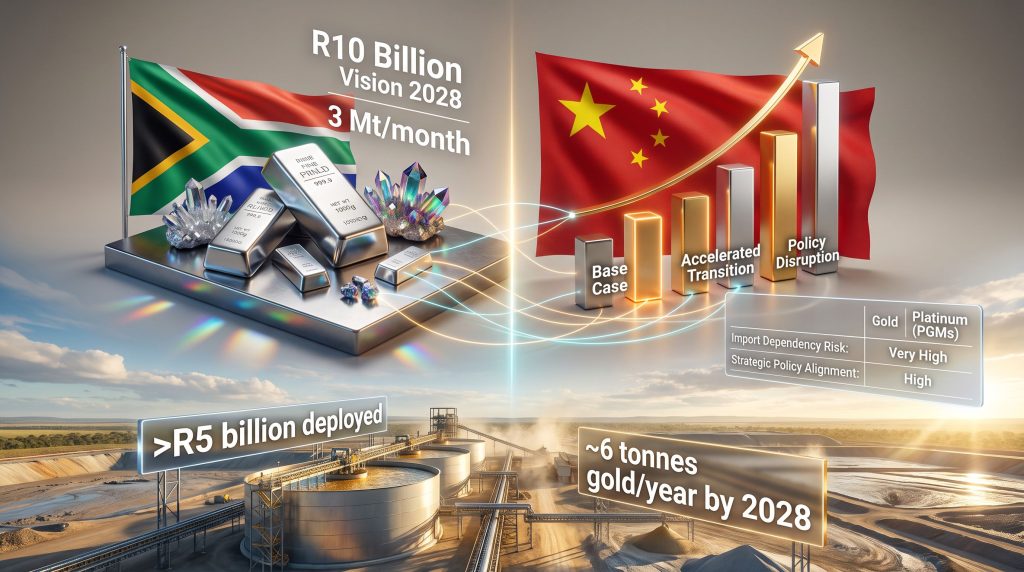
| Import Dependency Risk | Low-Medium | Very High |
DRDGold's Vision 2028: Architecture of a R10 Billion Transformation
While China's PGM policy ambitions play out at a geopolitical scale, DRDGold's Vision 2028 programme represents one of the most significant capital commitments in South African surface gold processing. The programme is specifically focused on tailings reprocessing, a mining method that deserves more analytical attention than it typically receives.
Tailings reprocessing involves extracting residual gold and other metals from previously processed surface deposits. These facilities carry a materially different risk profile than conventional underground or open-pit operations:
- No underground geotechnical risk
- No blasting or shaft infrastructure requirements
- Lower safety incident exposure
- Established surface footprint with existing permitting in many areas
- Large, predictable resource volumes that support long mine life modelling
The Vision 2028 capital programme targets a throughput increase from 2.15 million tonnes per month to 3 million tonnes per month, with annual gold output targeted at approximately six tonnes by 2028. Against a total programme budget of approximately R10 billion, more than R5 billion has already been committed and deployed as of mid-2026, placing the programme at roughly the halfway point of its capital journey.
Capital Programme Snapshot (mid-2026):
- Total Programme Budget: approximately R10 billion
- Capital Deployed to Date: more than R5 billion
- Monthly Throughput Target: 3 million tonnes (from 2.15 million tonnes)
- Annual Gold Output Target: approximately six tonnes by 2028
- Critical Path Item: Water-use licence approval for Far West Gold Recoveries infrastructure
The Far West Gold Recoveries facility is the centrepiece of the remaining capital deployment. A dedicated regional tailings storage facility associated with this operation is central to the long-term viability of the expansion, providing the physical infrastructure needed to manage processed material at the targeted throughput scale.
The Water-Use Licence: A Critical Path Item With Real Consequences
The outstanding water-use licence represents the single most material near-term constraint on DRDGold's expansion timeline. This is not a bureaucratic technicality. In South African mining regulation, water-use licences govern the operational parameters of facilities that interact with water resources, and their absence prevents full commissioning of associated infrastructure.
For investors monitoring the Vision 2028 timeline, this permitting dependency has several practical implications:
- Full commissioning of FWGR infrastructure cannot proceed until the licence is secured
- Capital efficiency metrics for the programme are partly contingent on commissioning timelines
- Dividend policy prioritisation remains weighted toward capex until key milestones, including this permit, are resolved
- South African permitting timelines have historically introduced variability into project schedules across the sector
The water-use licence bottleneck is a reminder that even well-funded, strategically sound expansion programmes carry regulatory timing risk that is largely exogenous to management execution quality. Consequently, critical minerals regulation frameworks across resource-rich nations are becoming an increasingly important variable in investment analysis.
AI as an Operational Efficiency Multiplier in Tailings Processing
One of the less-discussed dimensions of the current mining technology landscape is how well-suited lower-grade, high-volume surface operations are to artificial intelligence-driven optimisation. This is counterintuitive to many investors who associate AI adoption in mining primarily with frontier exploration or autonomous haulage in large-scale open-pit operations.
In tailings reprocessing, the economics of AI integration are compelling precisely because of the operational scale involved. When a facility processes millions of tonnes of material monthly, marginal improvements in metallurgical recovery rates generate disproportionate revenue outcomes. In addition, AI mining efficiency tools are advancing rapidly, making adoption increasingly accessible for mid-tier operators.
Key AI application areas in this operational context include:
- Real-time process control: Adjusting reagent dosing, pH levels, and flotation parameters based on continuous feed grade analysis
- Predictive maintenance: Reducing unplanned downtime on high-utilisation processing equipment
- Ore characterisation: Using sensor-based sorting and spectral analysis to improve understanding of feed variability
- Energy optimisation: Reducing power consumption per tonne processed, which is material given South African electricity cost pressures
For operations processing very large volumes of low-grade material monthly, a fractional improvement in metallurgical recovery enabled by real-time AI process adjustment can translate into meaningful additional gold output without proportional increases in operating cost. This is where AI creates genuine, measurable economic value in mining, rather than speculative future benefit.
Mid-tier operators with surface processing capabilities are arguably better positioned than large integrated miners to capture AI-driven efficiency gains quickly, because their operational complexity is narrower and their technology integration pathways are shorter.
South Africa at the Intersection of China's PGM Demand and Global Supply Constraints
South Africa accounts for approximately 70% to 75% of global platinum production and holds the majority of the world's known PGM reserves, primarily in the Bushveld Igneous Complex. This geological endowment places South African producers at the centre of any scenario involving sustained growth in Chinese PGM demand.
The transmission mechanism from China's Five-Year Plan priorities to South African producer revenues runs through platinum and palladium price formation. As Chinese industrial procurement accelerates and domestic investment demand for platinum deepens, the marginal price-setting dynamic shifts in favour of producers with large, long-life resource bases. Furthermore, the critical minerals demand story underpinning the energy transition continues to strengthen the fundamental case for South African PGM producers over the long term.
| Scenario | China PGM Demand Driver | Price Impact | South African Producer Benefit |
|---|---|---|---|
| Base Case | Steady hydrogen and autocatalyst growth | Moderate price support | Stable revenue, capex justified |
| Accelerated Transition | Rapid fuel cell and AI infrastructure buildout | Significant price uplift | Strong margin expansion |
| Policy Disruption | Substitution or demand-side policy reversal | Price pressure | Capex programmes face scrutiny |
It is worth noting that these scenarios are genuinely uncertain. Research into platinum-free catalysts for hydrogen fuel cells is active, and a technological breakthrough in this area would alter the demand picture materially. Similarly, China's hydrogen energy subsidy framework could shift in ways that affect the pace of fuel cell adoption without changing its ultimate trajectory. China's overseas asset strategy adds another layer of complexity for investors modelling long-run supply and demand dynamics in PGM markets.
Key Risks Investors Should Monitor
Several risk dimensions require ongoing attention from investors tracking this thematic space:
Geopolitical and policy risk: China's PGM demand is partially policy-amplified, not purely market-driven. Policy frameworks can be adjusted, and demand projections embedded in Five-Year Plan targets should not be treated as guaranteed outcomes.
Currency exposure: South African producers report costs in rand while receiving revenues linked to US dollar commodity prices. With the rand trading at approximately R16.86 to the US dollar and approximately R19.18 to the euro as at July 2026, currency movements create meaningful revenue variability that cannot be managed entirely through operational efficiency.
Operating cost inflation: Labour, energy, and reagent costs in South Africa have been subject to inflationary pressure. For high-throughput surface operations where unit economics are sensitive to input cost movements, sustained cost inflation can erode the margin improvements targeted by expansion programmes.
Substitution research: Long-run demand risk from platinum-free catalyst research is real and should be incorporated into any multi-decade demand modelling for PGMs.
Frequently Asked Questions
What is China's Five-Year Plan focus on platinum group metals?
China's 15th Five-Year Plan identifies PGMs as critical industrial inputs for hydrogen fuel cell technology, AI infrastructure components, and emissions-control systems. Given China's near-total import dependency for these metals, the plan treats PGM supply security as a strategic national priority, driving both procurement strategy and the development of domestic investment and pricing infrastructure.
What is DRDGold's Vision 2028 expansion programme?
Vision 2028 is DRDGold's multi-year capital programme targeting a significant expansion of its gold tailings reprocessing capacity, with a total budget of approximately R10 billion. More than R5 billion has already been deployed. Key targets include lifting monthly throughput from 2.15 million to 3 million tonnes and achieving annual gold production of approximately six tonnes by 2028.
Why is the water-use licence so important for DRDGold?
The water-use licence is a regulatory prerequisite for completing key components of the Far West Gold Recoveries infrastructure and its associated tailings storage facility. Until this permit is secured, full commissioning cannot proceed, creating a critical path dependency that affects both the programme timeline and dividend policy.
How does AI improve the economics of tailings reprocessing?
In tailings operations processing millions of tonnes of low-grade material monthly, AI-enabled process optimisation can improve metallurgical recovery rates, reduce reagent consumption, and enhance predictive maintenance scheduling. Applied at scale, these marginal improvements generate meaningful additional gold output without proportional increases in operating cost.
The next major ASX story will hit our subscribers first
Key Takeaways for Mining Sector Investors
- China's PGMs focus and DRDGold's R10bn expansion together represent a structurally significant convergence of demand-side policy and supply-side capital deployment across the PGM and surface gold sectors
- China's PGMs focus is embedded in a Five-Year Plan framework with multi-decade industrial demand drivers, not a cyclical purchasing cycle
- DRDGold's R10bn expansion is approximately halfway deployed, with throughput and output targets that are material to South African surface gold production capacity
- AI adoption in lower-grade, high-volume operations represents a genuine operational efficiency lever with measurable financial impact
- The water-use licence remains the most proximate near-term operational constraint on DRDGold's Vision 2028 timeline
- South African PGM producers hold a structurally advantaged geological position in a world where China's import dependency for these metals is deepening, though geopolitical and substitution risks require ongoing monitoring
- Currency dynamics at R16.86 to the dollar add a layer of complexity to revenue forecasting for South African producers that investors should not underestimate
This article contains forward-looking statements, scenario projections, and market analysis that involve inherent uncertainty. Nothing in this article constitutes financial advice. Readers should conduct independent research and consult qualified financial professionals before making investment decisions.
Want to Track the Next Major ASX Mineral Discovery Before the Broader Market Does?
Discovery Alert's proprietary Discovery IQ model scans ASX announcements in real time, instantly identifying significant mineral discoveries across more than 30 commodities — including the PGMs reshaping global supply dynamics — and converting complex data into clear, actionable investment insights. Explore how historic mineral discoveries have generated exceptional returns and begin your 14-day free trial today to position yourself ahead of the market.