August 24, 2026
The Geological Lottery That Made Namibia the World's Most Contested Resource Frontier
Few resource stories in modern history match the sheer improbability of Namibia's commodity endowment. A sparsely populated nation of roughly 3 million people sitting on the southwestern edge of Africa has found itself at the intersection of three of the most strategically sensitive resource categories of the 21st century: uranium for nuclear power, lithium for battery technology, and offshore oil for the transition period bridging fossil fuels and clean energy. That convergence has not gone unnoticed in Beijing.
The China Namibia strategic partnership entered a new chapter in July 2026 when President Netumbo Nandi-Ndaitwah travelled to Beijing for her first state visit outside Africa since assuming office in 2025. Eight cooperation agreements later, the bilateral relationship had evolved from a well-established investment corridor into something more structurally significant: a framework explicitly oriented toward reshaping how Namibia participates in global commodity value chains, not merely how much raw material it exports.
Understanding why this matters requires stepping back from the diplomatic optics and examining the underlying resource geometry that makes Namibia uniquely valuable in a world racing to secure the minerals underpinning energy transition technologies.
When big ASX news breaks, our subscribers know first
Namibia's Resource Profile: Why No Other African Nation Combines These Three Assets
The geological explanation for Namibia's extraordinary endowment lies in the convergence of multiple distinct tectonic and sedimentary environments within a single jurisdiction. The Damara Orogenic Belt, which cuts across central Namibia, created conditions favourable for uranium mineralisation over hundreds of millions of years. The same ancient geological architecture that produced the Husab and Rössing deposits, two of the largest uranium mines on the African continent, also created pathways for the lithium-bearing pegmatite formations now attracting commercial attention.
Offshore, the Orange Basin represents an entirely separate geological story: a deep-water sedimentary system that accumulated hydrocarbons over tens of millions of years, remaining largely unexplored until recent drilling campaigns by Shell, TotalEnergies and Galp revealed the scale of what lies beneath.
| Resource | Scale of Endowment | Global Significance |
|---|---|---|
| Offshore Oil | ~2.6 billion barrels discovered | Potential top-5 African producer by 2030 |
| Uranium | Top-3 global producer | Approximately 6-7% of national GDP contribution |
| Lithium | Confirmed commercial deposits | Export ban on raw ore since 2023 |
| Rare Earth Minerals | Significant identified deposits | Strategically critical for advanced manufacturing |
What makes this combination uniquely powerful from a geopolitical standpoint is timing. All three resource categories are reaching commercial inflection points simultaneously, just as global competition for each has intensified dramatically. Indeed, the surging critical minerals demand across the energy transition landscape has only sharpened the focus on Namibia's remarkable geological position.
China's Pre-Existing Economic Architecture in Namibia
The 2026 agreements did not emerge from a standing start. China's economic footprint in Namibia had been accumulating quietly for over two decades, creating a structural foundation that gives Beijing considerably more leverage than a fresh entrant to the market would possess.
The numbers are substantial:
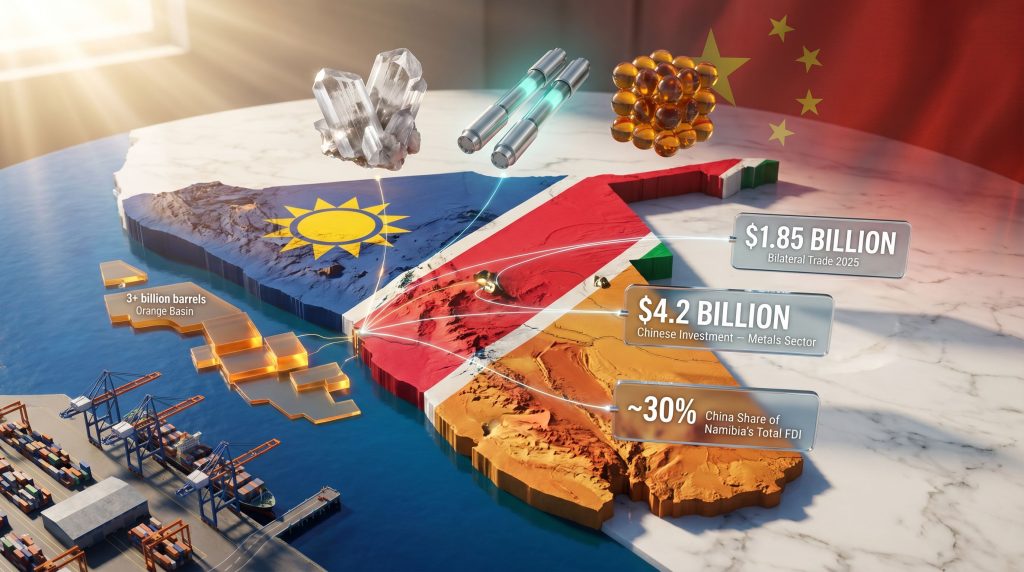
- Chinese entities have deployed an estimated $4.2 billion into Namibia's metals sector, with uranium mining absorbing the dominant share
- China accounts for approximately 30% of Namibia's total foreign direct investment
- Bilateral trade reached $1.85 billion in 2025, positioning China as Namibia's second-largest trading partner overall
- Uranium constitutes roughly 85% of all Namibian exports to China, according to IMF data, illustrating just how concentrated the commodity relationship is
The operational dimension is even more revealing. Chinese-affiliated entities hold significant stakes in both the Husab uranium mine, developed by China General Nuclear Power Corporation (CGN) subsidiary Swakop Uranium, and the Rössing mine, in which China National Uranium Corporation holds a majority interest. Together, these two operations represent a commanding upstream position in one of the world's most important uranium-producing jurisdictions.
Structural Insight: China's position in Namibian uranium is not merely a financial investment. It represents physical control over a meaningful share of global uranium output at a time when nuclear power is experiencing a genuine policy renaissance across Asia, Europe and North America. The upstream control China has established in Namibia gives it leverage that cannot be replicated through spot market purchasing alone.
The elevation of the bilateral relationship to a Comprehensive Strategic Cooperative Partnership in 2018 formalised what had already become an economically significant relationship. Furthermore, the Namibia nuclear ties that extend beyond China illustrate just how central Namibia has become to global nuclear supply strategy. The 2026 state visit agreements represent the next escalation of that trajectory.
Deconstructing the Eight Agreements: What Was Actually Committed
The substance of the July 2026 cooperation agreements spans a considerably broader domain than a conventional resource deal. Analysed structurally, the eight agreements collectively represent an attempt to embed China as a full-spectrum development partner rather than a sector-specific investor.
| Agreement Domain | Strategic Objective | Resource Linkage |
|---|---|---|
| Green Minerals Cooperation | Formalise joint development of critical minerals | Lithium, rare earths |
| Economic Partnership Framework | Establish bilateral trade and investment architecture | Broad-based |
| Uranium Value Addition | Shift from ore exports toward nuclear fuel processing | Uranium |
| Lithium Processing Commitment | Build downstream processing capacity onshore | Lithium |
| Oil and Gas Downstream Investment | Develop refining and processing infrastructure | Offshore oil |
| Infrastructure Development | Walvis Bay Port and logistics network expansion | Enabling infrastructure |
| Technology Transfer and Skills | Industrial training and knowledge transfer programs | Cross-sector |
| Clean Energy Cooperation | Joint renewable and nuclear energy development | Energy transition |
The visit to CGN facilities during the state trip is analytically significant. It signals that uranium value addition, specifically moving beyond raw oxide exports toward fuel rod fabrication or enrichment-adjacent processing, is a concrete policy objective rather than aspirational language. China backs Namibia's nuclear fuel rod production ambitions as part of a broader strategy to deepen supply chain integration across the bilateral relationship.
For Namibia, capturing more value from uranium processing would represent a meaningful shift in how the country monetises its most established export commodity. Nandi-Ndaitwah choosing Beijing as her first international destination since taking office is a deliberate signal of strategic prioritisation, particularly given the scale of investment Namibia needs to monetise its oil discoveries and expand mineral processing infrastructure before competing jurisdictions establish first-mover advantages.
The Beneficiation Imperative: Africa's Industrialisation Shift in Context
One of the most consequential aspects of the China Namibia strategic partnership on oil, uranium and lithium is its explicit orientation toward domestic processing rather than raw material export. This positions the agreements within a broader continental policy movement that has been gathering force since Zimbabwe's 2022 ban on unprocessed lithium exports demonstrated that resource-rich African nations could use export restrictions as leverage to attract downstream investment.
The pattern is now well-established across the continent:
- Zimbabwe banned unprocessed lithium exports in 2022, successfully prompting commitments to in-country processing investment
- Namibia introduced its own ban on raw lithium ore exports in 2023, directly mirroring the Zimbabwean approach
- Democratic Republic of Congo has increasingly conditioned mining licences on local processing commitments, particularly for copper and cobalt
- Guinea leveraged its dominant bauxite position to negotiate alumina refinery construction, capturing additional value per tonne
What distinguishes Namibia's position is that it is applying this beneficiation logic simultaneously across multiple commodity classes, not just lithium. In addition, advances in direct lithium extraction technology are making in-country processing increasingly viable, strengthening Namibia's hand in demanding value-added commitments from partners. The joint communique from the Beijing visit explicitly commits both governments to increasing the value added to key mineral resources through domestic processing, a structural departure from the extraction-dominant model that characterised earlier generations of African resource partnerships.
Namibia's 6th National Development Plan covering 2025 to 2030 provides the domestic policy architecture within which these international agreements operate. The plan prioritises industrialisation, job creation and economic diversification, giving the government a coherent framework for evaluating whether incoming investment commitments genuinely advance processing capacity or simply rebrand extraction agreements in the language of partnership.
The Oil Dimension: Why Pre-Production Positioning Matters
Namibia's offshore oil story is still in its early chapters, but the scale of what has been discovered in the Orange Basin has fundamentally altered the country's long-term economic trajectory. Discovered resources estimated at approximately 2.6 billion barrels across multiple offshore blocks have attracted sustained attention from major international operators, with Shell, TotalEnergies and Galp conducting appraisal drilling campaigns that have progressively derisked the resource base.
For China, the strategic logic of seeking downstream oil infrastructure agreements before first production begins is straightforward: pre-production positioning is categorically cheaper and more achievable than attempting to acquire influence in a mature producing nation where established relationships and offtake arrangements already exist.
Comparing Namibia's opportunity to other African petroleum jurisdictions illustrates the window of competitive advantage available to early movers:
| Country | Estimated Reserves | Production Status | Chinese Engagement Level |
|---|---|---|---|
| Namibia | ~2.6 billion barrels | Pre-production | Escalating rapidly |
| Angola | ~8 billion barrels | Mature producer | Deep, long-established |
| Ghana | ~5 billion barrels | Active producer | Moderate |
| Senegal | ~2.7 billion barrels | Early production | Growing |
Angola illustrates what deep, long-established Chinese oil engagement looks like in a mature African producer: decades of infrastructure financing, significant state oil company cooperation, and substantial offtake arrangements. Namibia represents the opportunity to establish equivalent depth before the production window opens, at a fraction of the entry cost.
The next major ASX story will hit our subscribers first
China's Broader African Resource Doctrine and Where Namibia Fits
The China Namibia strategic partnership does not exist in isolation. It sits within a carefully constructed framework of African resource diplomacy that Beijing has been executing through the Forum on China-Africa Cooperation (FOCAC) and Belt and Road Initiative structures for over two decades.
What makes the Namibia agreements strategically distinctive is the simultaneous targeting of three resource categories that serve entirely different aspects of China's domestic industrial requirements:
- Uranium feeds China's rapidly expanding nuclear power programme. China currently has more nuclear reactors under construction than any other nation, and its domestic uranium production capacity is insufficient to meet projected demand. Namibian uranium provides upstream supply security for a technology China views as central to its long-term energy independence.
- Lithium underpins China's globally dominant electric vehicle battery manufacturing industry. Chinese manufacturers account for the majority of global EV battery production, and securing lithium feedstock through upstream agreements in jurisdictions like Namibia provides supply chain resilience against potential disruptions.
- Oil serves dual purposes: feedstock for China's extensive petrochemical industry and strategic reserves for energy security contingency planning.
Analytical Note: The simultaneous pursuit of all three commodity classes in a single jurisdiction is not coincidental. It reflects a sophisticated resource security calculus in which Namibia functions as a hedged position across energy transition, nuclear energy and conventional hydrocarbons, reducing dependency on any single supply pathway.
However, the broader context of resource export challenges facing commodity-producing nations globally underscores just how carefully Namibia must structure these partnerships to avoid replicating the mistakes of earlier resource-dependent economies.
Three Scenarios for How This Partnership Actually Unfolds
The stated commitments in the July 2026 agreements are not self-executing. Historical analysis of comparable African resource partnerships reveals significant variance between announced objectives and delivered outcomes. Three plausible trajectories exist:
Scenario A: Full Industrialisation Partnership
Namibia successfully leverages Chinese capital and technology to build genuine domestic processing capacity across uranium, lithium and downstream oil infrastructure. Employment and tax revenue generated by processing activities add measurable economic value beyond what pure extraction would have delivered. China secures preferential long-term offtake at commercially competitive terms.
Scenario B: Extraction-Dominant Outcome
Despite the language of beneficiation embedded in the agreements, processing investment lags behind extraction activity. Chinese entities continue to benefit primarily from upstream control while Namibia's industrialisation targets remain aspirational. This outcome has characterised a number of comparable African resource partnership frameworks from earlier decades.
Scenario C: Competitive Pressure Reshapes the Terms
Western governments, multilateral development institutions and alternative investors accelerate competing proposals, creating genuine competition for preferred partner status in Namibia. Beijing deepens its industrialisation commitments to maintain positioning, ultimately delivering more value to Namibia than either party initially anticipated.
It is important to note that predicting which scenario materialises involves inherent uncertainty. Investors and analysts monitoring Namibia's resource sector should treat outcome projections with appropriate caution given the multi-year timelines and multiple variables involved.
The Geopolitical Competition Intensifying Around Namibia
China is not operating in a vacuum. Namibia, alongside Niger and South Africa, sits at the centre of a three-way competition for African uranium supply involving France, Russia and China, each with distinct strategic motivations tied to their domestic nuclear programmes and geopolitical positioning.
France historically relied heavily on Francophone African uranium, particularly from Niger, to fuel its nuclear-dominated electricity grid. Russia's Rosatom has been aggressively expanding its African nuclear services footprint, offering reactor construction, fuel supply and spent fuel management as an integrated package. China's approach, as evidenced in Namibia, focuses on upstream mine control combined with processing cooperation.
For Namibia, this competitive dynamic is an asset, not a complication. The government's ability to maintain meaningful relationships with multiple resource-hungry partners creates genuine leverage to extract better terms from each. Furthermore, the growing uranium supply deficit in global markets only strengthens Namibia's negotiating position as one of the world's most significant producing jurisdictions.
Risk Factors That Could Constrain the Partnership's Potential
Any rigorous assessment of the China Namibia strategic partnership on oil, uranium and lithium must account for the structural risks embedded in the relationship:
Risks for Namibia:
- Dependency concentration: China already absorbs approximately 25% of total Namibian exports and controls significant upstream mining assets, creating vulnerability to a single partner's economic conditions and policy preferences
- Technology transfer execution: Commitments to skills development and industrial knowledge transfer have historically underdelivered in comparable partnership frameworks across Africa
- Commodity price cyclicality: Uranium and lithium prices have both experienced severe cyclical downturns in recent years, and the economics of processing investment are highly sensitive to price environment shifts
- Sovereign policy flexibility: Deep financial integration with a dominant partner can progressively constrain a government's room to manoeuvre on policy decisions affecting the partner's interests
Risks for China:
- Western regulatory scrutiny of Chinese upstream positions in strategic mineral jurisdictions is intensifying, and Namibian assets could become subjects of diplomatic friction
- Namibia's oil sector remains pre-production, creating a multi-year lag before downstream cooperation agreements generate commercial returns
- Competing investment offers from Western institutions may erode China's preferred partner positioning over time
What Success Would Actually Look Like for Namibia
The measure of whether the 2026 agreements deliver genuine economic transformation for Namibia is not the number of agreements signed or the diplomatic optics of a Beijing state visit. It is whether, in five to ten years, Namibia is exporting processed uranium compounds rather than raw oxide, refined lithium products rather than unprocessed ore, and domestically refined petroleum products rather than crude oil.
Each of those transitions represents a quantum shift in the economic value captured per tonne of resource extracted, the type of employment created, and the technological capability resident in the Namibian economy. Consequently, Namibia and China deepening strategic cooperation must be evaluated not on its stated intentions but on whether measurable industrialisation benchmarks are met across all three commodity classes.
The China Namibia strategic partnership on oil, uranium and lithium is structurally significant precisely because it contains explicit language around value addition rather than pure extraction. Whether that language is backed by enforceable implementation commitments, adequate financing, genuine technology transfer and the political will to hold both parties accountable will determine whether this partnership becomes a model for African resource sovereignty or another chapter in the long history of aspirational frameworks that failed to restructure commodity export dependency.
Other African resource nations, from Tanzania to Zimbabwe to the Democratic Republic of Congo, are watching closely. The Namibia experiment may well define the template for how the continent negotiates its role in the next phase of global energy transition.
This article is intended for informational purposes only and does not constitute financial or investment advice. Commodity price projections, production timelines and geopolitical scenario analyses involve inherent uncertainty and should not be relied upon as the basis for investment decisions. Readers seeking further context on China's resource partnerships across Africa can explore related reporting at africa.businessinsider.com.
Want to Track the Next Major Mineral Discovery Before the Market Does?
Discovery Alert's proprietary Discovery IQ model delivers real-time alerts on significant ASX mineral discoveries across uranium, lithium, and other critical commodities, translating complex geological and market data into actionable investment insights — explore the historic returns major discoveries have generated and begin your 14-day free trial today to position yourself ahead of the broader market.