July 22, 2026
The Structural Limits Hiding Behind China's Biggest-Ever Energy Output
Energy records rarely tell the whole story. When a nation announces its highest-ever domestic oil and gas production, the instinctive interpretation is one of strength, momentum, and expanding capacity. Yet in the case of China oil and gas output record and energy squeeze in 2025, the record itself has become the starting point for a much more sobering conversation — one that exposes the widening gap between political ambition and geological reality.
Understanding why Beijing is sounding cautious notes even as production hits new heights requires a closer look at the mechanics of mature basin economics, the cost structures of frontier exploration, and the structural dependency that no domestic drilling campaign has yet been able to resolve.
When big ASX news breaks, our subscribers know first
What China's 2025 Production Record Actually Achieved
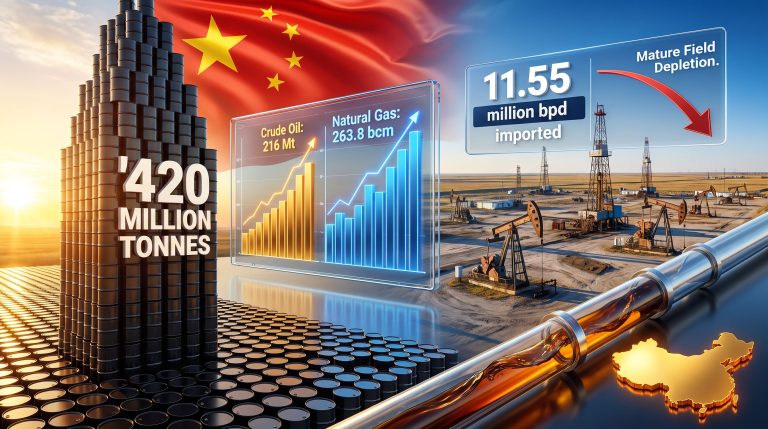
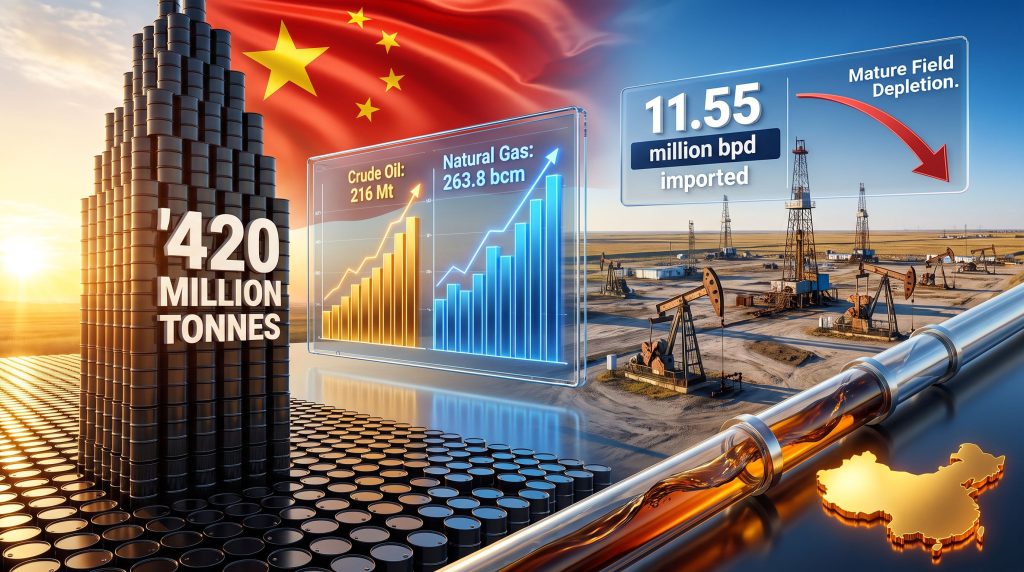
China's total oil and gas output reached 420 million tonnes of oil equivalent in 2025, a figure the National Energy Administration confirmed represents the country's highest-ever domestic production result. Within that headline number, crude oil output climbed to 216 million tonnes, while natural gas output expanded significantly to 263.8 billion cubic metres, representing a year-on-year increase of approximately 7.1%.
| Metric | 2024 Output | 2025 Record Output | Year-on-Year Change |
|---|---|---|---|
| Total Oil & Gas (oil equivalent) | ~400 million tonnes | 420 million tonnes | +~5% |
| Crude Oil | ~213 million tonnes | 216 million tonnes | +~1.4% |
| Natural Gas | ~246.4 billion cubic metres | 263.8 billion cubic metres | +~7.1% |
The divergence between crude oil growth and natural gas growth is itself a meaningful signal. Crude oil's modest 1.4% increase against gas output expanding at five times that rate points to a structural asymmetry in where China's domestic production upside actually lies. Furthermore, China's oil price role in shaping global commodity dynamics makes these internal production trends far more consequential than they might initially appear.
The Import Dependency That the Record Cannot Obscure
The NEA framed the 2025 output as having considerably enhanced self-reliance, however, the import data tells a more complicated story. Even as domestic production hit record levels, China imported approximately 11.55 million barrels per day of crude oil across the year. Domestic crude production, at roughly 4.3 million barrels per day, covers only a fraction of total national consumption.
The self-reliance framing reflects a policy aspiration more than an energy arithmetic reality. At current consumption levels, domestic output offsets less than 30% of China's total crude requirements, meaning import dependence is a structural condition, not a transitional phase.
This is not a failure of investment or effort. It reflects the fundamental scale mismatch between China's industrial energy appetite and its domestic resource endowment — a gap that has widened progressively over decades of rapid economic growth. According to the EIA's China energy analysis, this structural imbalance is expected to persist well into the next decade regardless of domestic drilling ambition.
The Dual Squeeze Constraining Further Output Growth
China's energy regulator has explicitly acknowledged that the sector now faces what can be described as a dual squeeze: simultaneous pressure from declining output at established fields on one side, and the rising cost and technical complexity of developing new resources on the other. This combination creates a compounding challenge that is structural rather than cyclical.
Mature Field Depletion: The Treadmill Effect
China's legacy oil production base includes some of the world's most historically significant oilfields. The Daqing oilfield in Heilongjiang province, which has been in operation since 1959, once produced more than 50 million tonnes annually at its peak in the 1970s and 1980s. Output at Daqing has fallen substantially from those highs, and despite ongoing enhanced recovery techniques, natural decline rates continue to act as a persistent drag on national production totals.
The NEA confirmed that most established fields are depleting rapidly and require enormous replacement volumes simply to maintain current output levels. This is what petroleum engineers refer to as the treadmill effect: operators must drill increasing numbers of new wells not to grow production, but purely to offset the natural pressure decline occurring across existing reservoir systems.
Key dynamics driving this constraint include:
- Reservoir pressure decline accelerates exponentially in the later stages of field life, requiring more energy-intensive extraction methods
- Water injection and enhanced oil recovery techniques, while extending field life, carry diminishing marginal returns over time
- The capital required per incremental barrel of output rises as mature fields age, compressing economic returns
- Replacement well counts required to offset decline at a single ageing supergiant field can number in the hundreds annually
Frontier Development: High Costs and Long Timelines
The NEA's assessment of China's new resource base is candid: new discoveries are predominantly located in deep and ultra-deep formations, deepwater offshore zones, and nanoscale unconventional reservoirs. Each of these categories carries fundamentally different cost and timeline characteristics compared to conventional onshore production.
Ultra-deep drilling, defined as operations targeting reservoirs below 4,500 metres, involves substantially higher well costs, greater technical risk, and longer development cycles. China's deepwater South China Sea assets face additional complexity from water depths, distance from shore infrastructure, and typhoon exposure.
Nanoscale unconventional reservoirs, which include tight oil and shale-equivalent formations, require hydraulic fracturing and horizontal drilling at a scale China has been working to develop but has not yet replicated at the efficiency levels achieved in the United States Permian Basin. Development timelines for these frontier categories typically span 7 to 15 years from discovery to peak production, creating a structural gap between declining legacy output and the arrival of meaningful replacement capacity.
Geopolitical Pressure and the Energy Security Doctrine
China's aggressive domestic production push cannot be understood in isolation from the geopolitical context that shapes it. Beijing's energy security doctrine explicitly treats import dependence as a strategic vulnerability, particularly given the concentration of its crude imports from Middle Eastern suppliers whose exports transit the Strait of Hormuz. The geopolitical oil price pressures emanating from this region continue to amplify Beijing's urgency around domestic production targets.
Disruptions in the Strait of Hormuz, a chokepoint through which an estimated 20% of global oil supply passes, have created sharp volatility in global energy prices and exposed the risks inherent in supply chains concentrated around a single transit point. For China, which relies heavily on Gulf crude, any sustained closure or restriction of Hormuz access would represent an acute supply shock with few rapid alternatives.
This geopolitical calculus is driving domestic production investment even where the economics would not justify it on purely commercial terms. In addition, US-China oil tensions have further reinforced Beijing's determination to reduce external energy vulnerabilities wherever possible. Maintaining output above political thresholds consequently carries strategic value that extends well beyond the wellhead economics.
The 2026 Production Targets: A More Honest Ambition
The NEA's production targets for 2026 reflect a recalibration of expectations. The regulator has set a goal of maintaining crude output above 200 million tonnes while ensuring natural gas production continues to grow — a notably more modest ambition compared to the aggressive expansion language of prior planning cycles.
This target structure carries an implicit acknowledgement that the crude production ceiling has been reached or approached. Framing the 2026 goal as maintaining rather than expanding crude output represents a meaningful shift in official language, even if it is not articulated as such in regulatory communications.
How China's Output Compares Globally
| Country | Crude Oil Output (approx. 2025) | Import/Export Status | Key Production Constraint |
|---|---|---|---|
| United States | ~13.5 million bpd | Net exporter | Permian Basin growth moderation |
| Saudi Arabia | ~9-10 million bpd | Major exporter | OPEC+ quota management |
| Russia | ~9-10 million bpd | Major exporter | Sanctions and technology access |
| China | ~4.3 million bpd | Major importer | Mature field depletion and frontier costs |
| Canada | ~5.5 million bpd | Net exporter | Pipeline and market access constraints |
China's production scale is significant in absolute terms but structurally misaligned with its consumption base in a way that no peer major producer experiences. The United States achieved energy self-sufficiency through the unconventional shale revolution, driven by the Permian Basin's stacked pay zones and relatively permeable reservoir rock. China's equivalent unconventional resource base, while large, involves more complex geology and higher per-well costs, limiting direct comparability.
What This Means for Global Energy Markets
The stabilisation of Chinese crude output near current levels carries important implications for global commodity markets. Three primary scenarios frame how China's energy balance may evolve over the medium term:
| Scenario | Domestic Output Trajectory | Import Dependency | Global Market Impact |
|---|---|---|---|
| Stabilisation | Crude holds near 4 million bpd; gas grows steadily | Imports remain ~11-12 million bpd | Sustained demand support for global crude |
| Accelerated Decline | Mature field depletion outpaces new capacity | Imports rise toward 13+ million bpd | Upward price pressure; LNG market tightening |
| Unconventional Breakthrough | Deep and shale gas development accelerates materially | Imports plateau or modestly decline | Reduced Chinese demand growth; moderate price relief |
The stabilisation scenario is most consistent with current regulatory signalling and Reuters analysis suggesting Chinese crude output is likely to plateau near 4 million barrels per day rather than continue climbing. Under this scenario, import volumes remain structurally large, providing ongoing demand support for major crude-exporting nations and sustained tightness in global LNG markets as China's gas consumption continues expanding faster than domestic supply can match.
For resource-exporting economies, a Chinese crude production ceiling is a broadly constructive development from a volume demand perspective, even as it introduces complexity around pricing dynamics and contract structures.
The next major ASX story will hit our subscribers first
Natural Gas: The More Scalable Domestic Lever
Within China's domestic energy strategy, natural gas is increasingly positioned as the primary growth vector. The 7.1% year-on-year output increase achieved in 2025 far outpaced crude oil growth and reflects both greater resource availability in accessible formations and stronger policy prioritisation of gas as a transition fuel. However, natural gas price trends suggest that even robust domestic output growth has not been sufficient to ease pricing pressures at a market level.
China holds substantial unconventional gas resources, including the world's largest estimated shale gas reserves according to the US Energy Information Administration, concentrated in formations such as the Sichuan Basin's Longmaxi shale. While extraction costs remain higher than US equivalents due to greater depth and tectonic complexity, China's shale gas production has been expanding steadily. According to research from the IEEFA on China's LNG landscape, competitive pressures within the domestic market are reshaping how international suppliers approach contract negotiations.
The implication for global LNG markets is notable: even as domestic gas production grows, China's total gas consumption is expanding fast enough that import requirements — including pipeline gas and LNG — are likely to remain elevated, sustaining pricing pressure across Asian spot markets. Furthermore, the LNG market implications for exporters are significant, with sustained Chinese import demand underpinning long-term supply agreements across the region.
Key Takeaways
- Record output does not equal energy independence. China's 2025 production milestone — a genuine China oil and gas output record and energy squeeze — coexists with import volumes that structurally dominate total supply, making the self-reliance framing a political narrative rather than an energy reality
- The production constraint is geological and economic, not policy-solvable. Mature field depletion and frontier development timelines cannot be resolved through regulatory directives or investment mandates alone
- Natural gas is China's most viable domestic growth avenue, with output expanding at five times the rate of crude oil in 2025 and deeper unconventional reserves yet to be fully developed
- Global crude markets should expect sustained Chinese import demand near current levels, providing ongoing support for exporters and limiting the downside risk of demand contraction
- The 2026 target language signals a ceiling acknowledgement, with the shift from expansion to maintenance goals representing a quiet but significant recalibration of official ambition
Disclaimer: This article is intended for informational purposes only and does not constitute financial or investment advice. Production forecasts, scenario analyses, and market projections involve inherent uncertainty and should not be relied upon as the basis for investment decisions. Readers should conduct their own due diligence and consult qualified advisors before making any investment decisions related to energy markets or commodity-exposed assets.
Want to Capitalise on the Next Major Resource Discovery Before the Market Does?
While China's energy squeeze continues to reshape global commodity demand, Discovery Alert's proprietary Discovery IQ model scans ASX announcements in real time, instantly identifying significant mineral discoveries across oil, gas, and over 30 other commodities — start your 14-day free trial today and see why historic discoveries have generated extraordinary returns.