July 22, 2026
When Waterways Become Weapons: The Strategic Stakes of the US-Iran Standoff
The most dangerous conflicts in the modern era are rarely those fought purely on battlefields. They are the ones where military force, diplomatic signalling, and control of critical infrastructure become inseparable. The current US-Iran confrontation represents exactly this kind of war — one where the geography of global energy trade is as contested as any frontline. Rubio says US still willing to negotiate over Iran crisis, yet the difference between a negotiated exit and a prolonged standoff could be measured in oil price shocks felt from Tokyo to Frankfurt.
Understanding what is actually happening between Washington and Tehran in July 2026 requires looking past the daily strike reports and examining the structural logic driving each side's behaviour.
When big ASX news breaks, our subscribers know first
The Architecture of Coercive Diplomacy
Washington is simultaneously conducting one of its most sustained military campaigns in the Middle East in over two decades while publicly signalling openness to a negotiated resolution. This is not contradictory. It is coercive diplomacy in its most deliberate form — a strategy that uses escalating military costs to create conditions where an adversary concludes that negotiation is less painful than continued conflict.
Secretary of State Marco Rubio articulated the US position clearly during a meeting of Southeast Asian foreign ministers in Manila. According to Reuters reporting on July 22, 2026, Rubio stated that Washington remained open to diplomacy but questioned whether Tehran shared that commitment, noting that if Iran demonstrated seriousness about talks, the United States would respond in kind.
This framing is strategically precise. By conditioning US engagement on Iranian seriousness, Rubio shifts the burden of diplomatic failure onto Tehran in the eyes of international observers — particularly the Southeast Asian nations present, many of whom depend on Middle Eastern energy and have their own concerns about unilateral maritime control in contested waterways.
Why Manila Was Not an Accidental Venue
The choice to deliver these remarks at an ASEAN foreign ministers gathering was deliberate. Rubio drew an explicit parallel between Iranian threats to the Strait of Hormuz and territorial disputes in the South China Sea, arguing that any precedent allowing a nation-state to control an international waterway would have consequences well beyond the Persian Gulf. The message to Southeast Asian partners was unmistakable: the principles at stake are the same ones underpinning freedom of navigation across the Indo-Pacific.
This rhetorical move serves a dual purpose. It builds diplomatic coalition support for the US position and signals to Beijing that Washington views maritime coercion as a globally linked problem — not an isolated regional dispute. Furthermore, the geopolitical landscape for metals and mining is equally affected by these tensions, as supply chain disruptions ripple across commodity markets worldwide.
Eleven Nights: What Sustained Bombardment Actually Signals
The US military completed its eleventh consecutive night of strikes on Iran on Tuesday, July 22, 2026, according to Arab News reporting. Explosions were reported by Iranian state media in Tehran, in the southeastern coastal cities of Chabahar and Konarak, and near Bushehr, which hosts Iran's only nuclear power plant. Iran activated air defences over the capital in the early hours of Wednesday morning.
Sustained nightly operations of this duration are not routine. In modern military doctrine, sequential bombing campaigns over this timeframe typically pursue one of two objectives: degrading integrated air defence networks, or imposing sufficient cumulative costs to force a strategic reassessment by the adversary. The geographic spread of reported strikes suggests both objectives may be in play simultaneously.
"Sustained sequential strikes across 11 nights represent a campaign of structural pressure rather than symbolic signalling. Each night of operations compounds the degradation of Iran's defensive infrastructure while ratcheting up the domestic political cost for Tehran's leadership."
Iran's retaliatory posture has been active. Iranian forces struck US military installations in Bahrain, Kuwait, and Jordan. A tanker was hit in the Strait of Hormuz, and Iran claimed to have struck infrastructure belonging to Amazon in Bahrain, where the company operates a regional data centre. Amazon did not confirm the report, and it could not be independently verified at time of publication.
The Ceasefire Timeline: A Fragile Architecture Under Strain
The diplomatic record of 2026 reveals a pattern of agreements reached and then eroded. The table below summarises the key milestones.
| Ceasefire Milestone | Timeline | Status |
|---|---|---|
| Initial April Ceasefire | April 2026 | Collapsed |
| US-Iran Interim Agreement | June 2026 | Under significant strain |
| Mediator-Proposed 10-Day Ceasefire | July 2026 | Pending Tehran response |
A senior Iranian official confirmed to Reuters on Monday, July 21, that Tehran had received a proposal from mediators for a 10-day ceasefire designed to salvage the June interim agreement. Iran's Interior Minister Eskandar Momeni also visited Pakistan, actively requesting that Islamabad continue its mediation efforts. The fact that Iran is engaging Pakistani intermediaries while simultaneously conducting retaliatory strikes reveals the dual-track nature of Tehran's own strategy.
This behaviour is consistent with historical Iranian negotiating patterns. During the Iran-Iraq War between 1980 and 1988, and again during JCPOA negotiations between 2013 and 2015, Iran's leadership demonstrated a willingness to engage diplomatically only when the cumulative costs of conflict or sanctions began threatening domestic economic and political stability.
Two Chokepoints, One Crisis
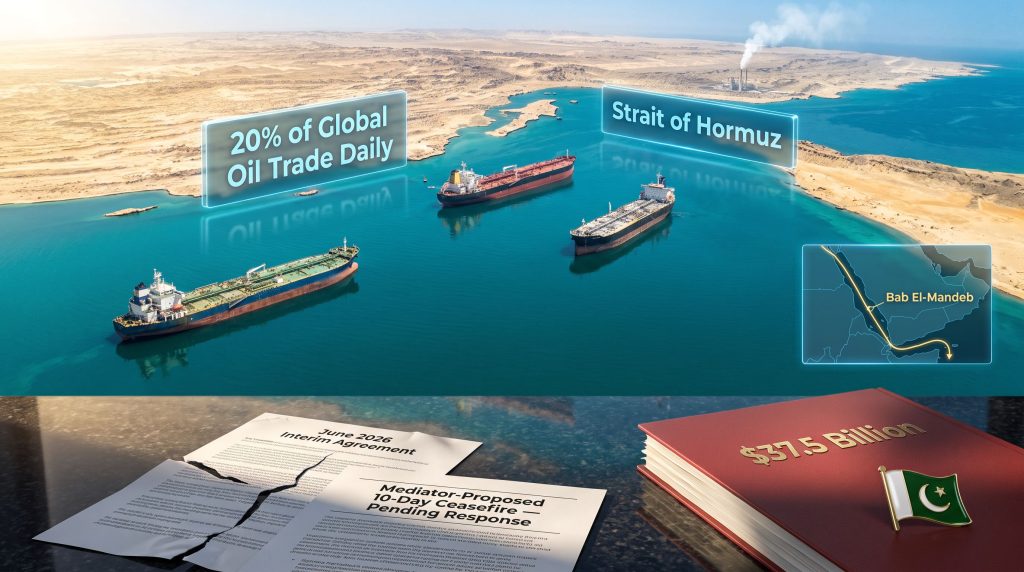
The energy market dimension of this conflict has moved from theoretical risk to active disruption. The Strait of Hormuz — the narrow passage through which approximately 20 percent of global daily oil supply transits — has been under Iranian threat throughout the conflict. However, what changed in July 2026 was the activation of a second chokepoint. These developments are already influencing crude oil prices in 2025 and beyond, as analysts reassess long-term supply outlooks.
Yemen's Houthi forces, aligned with Iran, issued letters to international shippers on Tuesday threatening to attack any vessels loading or discharging Saudi oil. The Houthis claimed to have imposed a naval blockade on the Red Sea, primarily targeting Saudi Arabia. The Bab El-Mandeb strait — known historically as the Gate of Tears — handles roughly 12 percent of global seaborne trade, including critical LNG and container cargo flows.
President Trump acknowledged the Houthi threat while stating that as of late July, the Bab El-Mandeb had not yet been closed, and making clear that the United States would respond militarily if that changed.
"The simultaneous pressure on both the Strait of Hormuz and the Bab El-Mandeb creates a dual-chokepoint scenario with no modern precedent. Saudi Arabia faces a genuinely unprecedented export vulnerability."
Saudi Arabia's Trapped Export Architecture
Saudi Arabia's exposure in this scenario is structurally acute. The Kingdom's primary crude export route passes through the Strait of Hormuz. Its main overland bypass — the East-West Pipeline running to the Red Sea port of Yanbu — terminates at a terminal now threatened by Houthi blockade activity. If both routes face simultaneous disruption, Saudi Aramco's ability to fulfil production commitments and maintain OPEC's influence on markets would come under serious pressure. The Saudi foreign minister held discussions with European counterparts on July 22 specifically focused on the Red Sea shipping threat.
The Asian Importer Dimension
The nations most immediately exposed to a Hormuz disruption are not Western economies. Japan, South Korea, India, and China collectively import the majority of Gulf crude that transits the strait. A full closure would force rerouting around the Cape of Good Hope, adding more than 15 days to shipping times and substantially increasing freight and insurance costs. War risk insurance premiums have already surged, and several commercial operators have begun rerouting or suspending operations in affected corridors.
The Financial and Human Ledger
Defense Secretary Pete Hegseth publicly estimated the total cost of the US-Iran conflict at $37.5 billion as of mid-July 2026. To contextualise that figure:
| Cost Benchmark | Estimated Total |
|---|---|
| US-Iran War (as of July 2026) | $37.5 billion |
| Gulf War (1991, inflation-adjusted) | ~$100 billion |
| Initial Iraq War Phase (2003, first year) | ~$53 billion |
President Trump confirmed that 18 US service members had been killed in the conflict to date, including four deaths attributed to Iranian strikes on US military bases in Jordan and Iraq over the preceding days. These figures carry domestic political weight that compounds over time. Historical analysis of US public support for military engagements suggests that sustained casualty rates create increasing political pressure on administrations to either demonstrate decisive progress or pursue negotiated exits.
The next major ASX story will hit our subscribers first
Three Scenarios for What Comes Next
Scenario 1: Negotiated De-escalation
The conditions for this scenario require Tehran to engage substantively with the mediator-proposed 10-day ceasefire and allow Pakistan's intermediary role to develop into a structured dialogue framework. Any durable agreement would need to address nuclear restrictions, Hormuz access guarantees, and a credible sanctions architecture. Iran's domestic economic deterioration is the primary driver that could push leadership toward this outcome. In addition, the broader trade war's impact on oil adds further economic pressure that both sides cannot ignore.
Scenario 2: Prolonged Coercive Campaign
If the 11-night strike pattern extends for weeks without diplomatic progress, the risk of Iranian strategic escalation increases substantially. Options available to Tehran include formally closing the Strait of Hormuz, intensifying Houthi naval operations in the Red Sea, and expanding proxy attacks across the region. Each of these actions would transmit directly into global energy prices, shipping costs, and inflationary pressure on oil-importing economies worldwide.
Scenario 3: Multilateral Diplomatic Intervention
A third pathway involves major powers or multilateral institutions creating a framework that gives Tehran a face-saving off-ramp. China, Turkey, and Gulf states have varying incentives to facilitate such an outcome. China is the largest single importer of Iranian oil and among the most exposed to a Hormuz disruption. Consequently, the US-China trade dynamics of 2025 further complicate Beijing's willingness to take sides in this escalating standoff.
"Historical precedent from the Iran-Iraq War and the 2015 JCPOA process suggests that Iran's threshold for meaningful diplomatic engagement is closely correlated with domestic economic stress levels. The accelerating combination of military attrition and sanctions compression may be approaching that threshold, though the timeline remains genuinely uncertain."
Frequently Asked Questions
Is the United States currently negotiating with Iran?
Washington has stated publicly that it remains open to negotiations. However, as Rubio confirmed in recent testimony before Congress, Tehran had not demonstrated the seriousness required for substantive talks to proceed as of July 22, 2026. Back-channel diplomacy through Pakistan remains active.
What is the current ceasefire status?
The June 2026 interim ceasefire, which itself replaced a collapsed April agreement, is under significant strain. As of late July 2026, a mediator-proposed 10-day ceasefire framework had been received by Tehran but not formally accepted. Rubio says US still willing to negotiate over Iran crisis, though the window for progress remains uncertain.
Why does the Strait of Hormuz matter so much?
The strait handles approximately 20 percent of global daily oil supply. US officials have argued that allowing any single state to control or toll access to this international waterway would establish a precedent with consequences for maritime freedom globally, including in the South China Sea.
How much has the conflict cost?
Defense Secretary Hegseth estimated total costs at $37.5 billion as of mid-July 2026. 18 US service members have been confirmed killed.
What role is Pakistan playing?
Pakistan has emerged as a key intermediary. Iran's Interior Minister Eskandar Momeni visited Islamabad to request continued Pakistani mediation between Tehran and Washington, indicating that informal diplomatic channels remain open despite the intensity of ongoing military operations. Furthermore, with Rubio saying the US is still willing to negotiate over the Iran crisis, Pakistan's continued involvement may prove pivotal to any lasting resolution.
Want to Know Which Mineral Discoveries Could Reshape Commodity Markets Amid Rising Geopolitical Tensions?
Escalating conflicts across critical energy chokepoints like the Strait of Hormuz and the Red Sea are already reverberating through global commodity markets — and Discovery Alert's proprietary Discovery IQ model instantly identifies significant ASX mineral discoveries that may offer strategic positioning opportunities during periods of market volatility. Explore historic discoveries and their remarkable returns on Discovery Alert's dedicated discoveries page, or begin your 14-day free trial today to stay ahead of rapidly shifting market conditions.