July 22, 2026
When Chokepoints Collide: The Global Energy Risk No Rerouting Can Solve
Global energy markets have long operated on the assumption that geographic diversification provides a sufficient buffer against supply disruption. That assumption is being stress-tested in real time. The reality of Hormuz vessel crossings fall further as security concerns linger is not a temporary spike in geopolitical noise. When two of the world's most critical maritime chokepoints face simultaneous pressure, the conventional playbook of rerouting cargo falls apart entirely. It represents a structural challenge to the architecture of global energy supply that commodity markets, policymakers, and shipping operators are only beginning to fully price in.
When big ASX news breaks, our subscribers know first
The Strait That Keeps the World's Lights On
Understanding the stakes of the current crisis requires first appreciating just how concentrated global energy flows have become around a single narrow passage. The Strait of Hormuz, a roughly 33-kilometre-wide navigable corridor between Iran and Oman, is the funnel through which an estimated 20 to 21 percent of the world's petroleum liquids move daily. It also handles approximately one-fifth of global liquefied natural gas trade, with Qatar routing a substantial portion of its output through this passage to customers across Asia and Europe.
Why Hormuz Is Irreplaceable
No other single maritime chokepoint concentrates this volume of energy value in such a confined geographic space. The Strait of Malacca, the Suez Canal, and the Danish Straits all carry significant cargo volumes, but none combine crude oil, LNG, and refined petroleum products at the scale Hormuz does. This concentration reflects decades of infrastructure investment in Gulf export terminals built around the assumption that Hormuz would remain passable.
The commercial reality is stark: when Hormuz vessel crossings fall, the consequences are not regional. They propagate through global crude benchmarks, LNG spot markets, freight indices, and ultimately consumer energy bills across three continents. Furthermore, the LNG supply outlook for key importing nations grows increasingly fragile whenever this passage faces sustained pressure.
A Traffic Profile That Should Alarm Markets
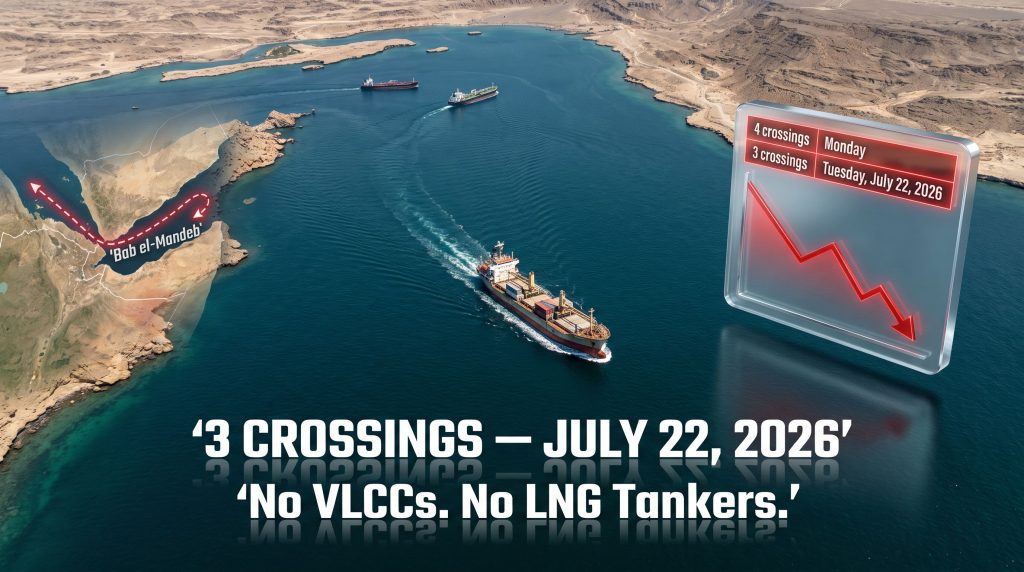
Vessel tracking data published by Kpler for Tuesday, 22 July 2026, recorded just three commodity vessel crossings through the Strait of Hormuz for the entire trading day. This followed four crossings recorded the previous day, itself already a depressed figure by any historical standard. The commodity profile of those three crossings reveals as much as the headline number itself.
| Vessel | Direction | Cargo Type |
|---|---|---|
| Kaiser (general cargo) | Outbound (exiting) | Loaded general cargo |
| H7 Smb8 (dry bulk carrier) | Inbound (entering) | Ballast (empty, entering to load) |
| Hsin Ocean | Inbound (entering) | Refined palm olein |
What the Absences Signal
The critical absence from this picture is what defines the day's significance. No very large crude carriers (VLCCs) transited the strait. No LNG tankers made the passage. These two vessel classes carry the energy cargoes that make Hormuz strategically indispensable. Their complete absence from a full trading day's traffic profile represents an operational signal that goes well beyond cautious routing decisions.
VLCCs typically carry between 2 million and 3.2 million barrels of crude oil per voyage. A single absent VLCC on any given day represents a cargo valued, at mid-2026 oil prices, in the range of hundreds of millions of dollars. A sustained multi-day absence of this vessel class from Hormuz transit data is the maritime equivalent of a production outage.
It is worth noting that the dry bulk carrier H7 Smb8 entered the strait in ballast, meaning it was travelling empty into the Gulf specifically to load cargo there. This signals that some operators still intend to conduct business inside the Gulf but are managing the timing and direction of transit carefully, rather than abandoning the route entirely.
Eleven Consecutive Nights: Why Duration Changes Everything
The US military confirmed it had conducted its latest strikes on Iran, marking eleven consecutive nights of attacks as of 22 July 2026. This detail carries more analytical weight than any single night's operation. The sustained, sequential nature of the military exchange fundamentally changes how shipping operators and their insurers model risk.
A single incident, even a severe one, produces a temporary spike in war risk premiums followed by gradual normalisation as conditions stabilise. Eleven consecutive nights of confirmed military action produces something categorically different: a sustained risk environment in which no credible de-escalation signal has emerged, and in which the probability of further escalation cannot be reasonably excluded.
For shipping operators, this distinction matters enormously:
- War risk insurance premiums are not static. They are reassessed by underwriters in response to ongoing threat signals, and sustained military activity keeps premiums elevated or pushes them higher.
- Crew safety obligations under international maritime law create legal exposure for operators who transit high-risk zones. Extended conflict periods make it harder for operators to argue that transit risk is acceptable.
- Charter party contracts and cargo insurance policies may contain war risk exclusion clauses that activate under sustained conflict conditions, creating liability gaps that operators must manage.
- Force majeure provisions in long-term supply agreements can be triggered if delivery becomes commercially or physically impracticable, adding legal complexity to already disrupted supply chains.
The compounding effect of these factors is that Hormuz vessel crossings fall not because of any single operational decision, but because an entire ecosystem of commercial, legal, and actuarial calculations simultaneously pushes operators toward avoidance. This dynamic is closely intertwined with broader oil market disruption patterns that have been building across 2025 and into 2026.
The Bab el-Mandeb Dimension: A Second Front Opens
If the Hormuz situation alone were the complete picture, energy markets would face a serious but geographically contained problem. However, the events of 22 July 2026 made clear the problem is neither contained nor simple.
On the same day that crossings fell to three vessels, two oil tankers carrying Saudi Arabian crude destined for Asian markets reversed course while approaching the Bab el-Mandeb strait at the southern end of the Red Sea. The reversals followed threats from Houthi forces, who declared their intention to blockade Saudi crude shipments through the strait. Houthi representatives also communicated to shipping companies that vessels loading or discharging cargo at Saudi Arabian ports could be targeted.
Why the Double Chokepoint Scenario Is So Dangerous
The Bab el-Mandeb is the second most consequential energy chokepoint in the region, connecting the Red Sea to the Gulf of Aden and providing the primary maritime route for Gulf crude moving toward Europe and the Suez Canal corridor. Its disruption in 2023 and 2024 during the prior Houthi Red Sea campaign already demonstrated how sustained asymmetric threats can redirect global shipping over extended periods.
The simultaneous compression of traffic at both Hormuz and Bab el-Mandeb removes the standard industry response to chokepoint disruption. When one passage is threatened, cargo is rerouted through the other or around the Cape of Good Hope. When both are threatened concurrently, rerouting options become dramatically more expensive and operationally complex, with Cape of Good Hope voyages adding weeks and substantial fuel costs to delivery timelines.
The Houthi alignment with Iran adds a strategic dimension that analysts should not underestimate. The simultaneous activation of pressure on both chokepoints, timed to coincide with the US-Iran military exchange, reflects a coordinated multi-front approach to constraining Gulf energy exports rather than an independent or opportunistic action.
Historical Precedent and What the 2026 Disruption Breaks From
Hormuz has been weaponised as a geopolitical instrument before. The Tanker War of the 1980s established the precedent of using maritime attacks to impose economic costs on adversaries. The 2019 Gulf of Oman tanker attacks triggered a prior cycle of war risk premium increases. The 2023-2024 Houthi Red Sea campaign demonstrated that asymmetric maritime threats could sustain shipping disruption for months.
What distinguishes the July 2026 disruption from these historical episodes is the identity and nature of the parties involved. The current situation involves direct, confirmed, sequential US military strikes on Iranian territory extending across eleven consecutive nights. This elevates the conflict to a level of state-on-state military engagement not seen in the Hormuz context for decades, and it removes certain de-escalation dynamics that historically limited prior disruptions.
In past episodes, Iran retained the option to signal restraint by standing down proxies or avoiding direct escalation. With direct US military engagement now a confirmed and sustained reality, the calculus for Iranian decision-making around Hormuz access has fundamentally shifted. Consequently, the oil price shock dynamics already weighing on producers are now amplified by this unpredictable maritime dimension.
The next major ASX story will hit our subscribers first
Economic Exposure: Which Markets Bear the Greatest Risk
The economic consequences of sustained Hormuz and Bab el-Mandeb disruption are not distributed evenly. The geography of energy dependency concentrates exposure on specific regions and market segments.
| Region | Primary Exposure | Structural Vulnerability |
|---|---|---|
| East Asia (China, Japan, South Korea) | Gulf crude oil and Qatari LNG | High import dependency, limited alternative supply routes |
| South Asia (India, Pakistan) | Crude oil, LNG, dry bulk commodities | Constrained by geography and limited strategic reserves |
| Europe | Qatar-sourced LNG | Competing with Asian buyers for any diverted cargo supply |
| Middle East exporters | Revenue generation and export logistics | Physically unable to move product to market at normal volumes |
Japan and South Korea are structurally among the most exposed economies. Both nations import the overwhelming majority of their crude oil from Gulf producers and have limited domestic energy resources to buffer supply shocks. South Korea operates strategic petroleum reserves, but these are designed to cover short-term disruptions measured in days to weeks, not a sustained multi-month conflict scenario.
For commodity markets specifically, the consequences flow across multiple asset classes:
- Crude oil benchmarks respond to VLCC absence data because physical delivery capacity directly affects near-term supply availability for Asian refiners.
- LNG spot prices in Asia face additional upward pressure from Qatari export uncertainty, compounding existing crude oil volatility across benchmarks.
- War risk freight surcharges add directly to the landed cost of energy in importing economies, functioning as an invisible inflation tax on consumers and industrials.
- Dry bulk markets, while less immediately visible in energy pricing, affect food security and industrial production timelines across South and Southeast Asia.
The Diplomatic Variable: Pressure and Talks Running in Parallel
Senior US officials, including Secretary of State Marco Rubio, publicly indicated that the United States remains willing to pursue diplomatic negotiations with Iran even while military operations continued. Rubio also characterised Iran's control over the Strait of Hormuz as a leverage instrument Tehran is actively deploying, calling on other countries to contribute more actively to the resolution of the crisis.
This dual-track posture, combining continued military pressure with stated openness to negotiation, is a recognisable framework in US coercive diplomacy. For shipping markets, the diplomatic variable introduces a specific form of uncertainty that is distinct from pure security risk.
The possibility of a negotiated pause creates a scenario in which war risk conditions could shift relatively quickly, but the timing is entirely unpredictable. Historical precedent from prior Gulf crises suggests that once a credible ceasefire or de-escalation signal emerges, vessel traffic can recover with surprising speed. However, war risk underwriters typically require a sustained period of calm before they reduce premiums to commercially viable levels.
Long-Term Structural Consequences for Energy Infrastructure Planning
Every major Hormuz disruption event accelerates conversations that energy security planners have been having for decades. The strategic logic of concentrating global energy export infrastructure around a single passable chokepoint has always carried embedded risk. That risk is now being priced in real time.
Several structural responses are likely to receive renewed attention in the aftermath of the current disruption:
- Strategic petroleum reserve expansion in import-dependent economies, particularly in East Asia, where current reserve levels may be insufficient to absorb a multi-month supply disruption.
- Alternative pipeline infrastructure investment, including the expansion of existing overland routes that bypass both Hormuz and Bab el-Mandeb, such as the East-West Pipeline within Saudi Arabia.
- LNG supply diversification, with Asian buyers likely to accelerate long-term contracting with non-Gulf producers including the United States, Australia, and emerging African LNG exporters.
- Maritime security architecture reform, addressing how international coalitions can more effectively protect energy chokepoints during state-level conflicts.
- Demand-side energy transition acceleration, with the current disruption reinforcing arguments for reducing structural fossil fuel import dependency. In addition, energy transition pressures were already building momentum in exposed economies well before this crisis emerged.
None of these responses materialise overnight. Infrastructure investment cycles operate over years and decades. However, the policy conversations that precede investment decisions are shaped by crisis events, and the July 2026 Hormuz disruption is the kind of event that reshapes those conversations for a generation. Shipping data from tracking services continues to confirm that Hormuz vessel crossings fall further as security concerns linger, with no immediate resolution in sight.
Disclaimer: This article contains analysis and forward-looking observations based on publicly available data and historical precedent. It does not constitute financial, investment, or trading advice. Commodity market conditions, geopolitical developments, and shipping risk assessments are subject to rapid change. Readers should conduct their own research and consult qualified professionals before making decisions based on information contained herein.
Frequently Asked Questions
What does it mean when a vessel enters the Strait of Hormuz in ballast?
When a ship enters the strait in ballast, it is travelling empty without cargo. This typically means the vessel is heading into the Persian Gulf to load a cargo at a Gulf port before returning outbound through the strait. A ballast entry indicates the operator still intends to conduct commercial activity in the Gulf but has not yet taken on the highest-risk element of the journey, which is transiting outbound with a full, high-value cargo.
Why does the absence of VLCCs matter more than the overall vessel count?
VLCCs are the workhorses of crude oil export from the Persian Gulf, capable of carrying between 2 million and 3.2 million barrels per voyage. Their absence from Hormuz transit data on any given day represents a significant volume of crude oil that did not reach its intended destination. Unlike general cargo or dry bulk movements, VLCC transits are a direct proxy for the volume of Gulf crude physically moving to market. A sustained absence of this vessel class signals a genuine supply disruption, not merely a logistical delay.
How are war risk insurance premiums calculated for Hormuz transit?
War risk premiums for vessels transiting high-risk zones are assessed by specialist marine war risk underwriters, with the Joint War Committee in London publishing listed areas considered high-risk. Premiums are expressed as a percentage of the vessel's insured hull value per voyage, and they escalate significantly during periods of active military conflict. During the 2019 Gulf tensions, war risk premiums for Hormuz transits reportedly increased by multiples of their peacetime levels. Extended conflict periods push premiums higher and may cause some underwriters to withdraw coverage entirely.
What is the Cape of Good Hope rerouting alternative and what does it cost?
The Cape of Good Hope route around the southern tip of Africa is the primary alternative for vessels unable or unwilling to transit either Hormuz or the Suez Canal-Bab el-Mandeb corridor. For a VLCC travelling from the Persian Gulf to a European destination, this alternative adds approximately 3,500 to 4,000 additional nautical miles and roughly 10 to 14 additional days to the voyage. The additional fuel consumption, crew time, and charter costs make this alternative substantially more expensive than standard routing, and it creates downstream delays in cargo delivery that affect refinery scheduling and end-market supply.
Want to Stay Ahead of the Next Major Commodity Disruption?
When geopolitical shocks reshape energy markets this rapidly, identifying mineral discovery opportunities before the broader market can make all the difference — Discovery Alert's proprietary Discovery IQ model delivers real-time ASX mineral discovery alerts, turning complex market signals into actionable insights the moment they emerge. Explore historic discovery returns on the Discovery Alert discoveries page and begin your 14-day free trial to position yourself ahead of the next major market move.