July 28, 2026
The Quiet Rewiring of Global Commodity Settlement
Across the history of modern finance, the most consequential shifts in monetary architecture have rarely announced themselves. The Bretton Woods collapse unfolded over years. The petrodollar system solidified gradually through bilateral agreements rather than grand proclamations. Today, a similarly quiet but structurally significant realignment is underway, and it is being driven not by policy announcements but by the mechanics of sanctions pressure, energy trade, and physical commodity accumulation.
Understanding the China oil for gold and silver strategy requires moving past headlines about diplomatic friction and examining the underlying financial plumbing that is being rebuilt in real time.
When big ASX news breaks, our subscribers know first
Why This Round of US Energy Sanctions Is Structurally Different
The Scale of What Is Actually Being Targeted
Not all sanctioned entities carry equal geopolitical weight. When the US Treasury targets a small independent refiner, the market adjusts. When it targets a vertically integrated national energy conglomerate embedded in shipbuilding, petrochemicals, and northeastern China's industrial backbone, the consequences are of an entirely different order.
The sanctioned entity at the centre of this episode is not a peripheral market participant. Its operational scale reflects why Beijing's response has moved beyond diplomatic protest into active financial countermeasure territory.
| Operational Metric | Scale |
|---|---|
| Annual petroleum refining capacity | 20 million tonnes |
| Ethylene production | 1.5 million metric tonnes |
| PTA and coal chemicals output | 17 million tonnes |
| Annual group revenue (2025) | approximately ¥899 billion (~USD $50 billion) |
| Capital investment base | ¥280 billion |
The northeastern Chinese industrial corridor where this complex operates is not incidental geography. It represents the traditional manufacturing and energy heartland of the country, with decades of integrated infrastructure linking refining, petrochemical production, and heavy industry. Critically, the group's involvement in shipbuilding elevates the geopolitical stakes well beyond a routine trade dispute.
Effectively, the sanctions touch a significant part of China's commercial shipbuilding capacity alongside its energy infrastructure, a combination that makes a measured or passive response from Beijing structurally implausible.
The historical distinction matters here. Previous rounds of US sanctions on Chinese refiners targeted what the industry calls teapot refineries, smaller independent operators with limited systemic importance. Sanctioning a conglomerate of this integration level and revenue scale represents a qualitative escalation, not merely a quantitative one.
How Secondary Sanctions Create Systemic Pressure
The mechanism of US Treasury sanctions in the energy sector operates through financial exclusion rather than direct prohibition. By blocking an entity's access to the US financial system, the sanctions simultaneously pressure every third-party trading partner, bank, or logistics provider that conducts business with the designated firm. This secondary pressure is designed to create a cascading isolation effect.
China's response has included a legal injunction framework seeking to block the application of these sanctions, signalling that Beijing views this confrontation as a structural challenge rather than a routine friction point requiring diplomatic management.
"When sanctions simultaneously target a company embedded in shipbuilding, petrochemicals, and northeastern China's industrial grid, the response is unlikely to remain confined to diplomatic channels. It forces the development of systemic financial countermeasures."
What Is the China Oil-for-Gold Loop and How Does It Actually Work?
The RMB Settlement Architecture
The mechanism through which China has been managing sanctioned oil imports from Iran is more architecturally sophisticated than simple barter. It operates as a multilateral settlement structure specifically designed to remain outside Western financial surveillance infrastructure.
The process unfolds in a sequence of distinct steps:
-
Iranian oil suppliers deliver crude to Chinese refinery buyers operating within the sanctioned network.
-
A regional Chinese bank, operating in China's northwestern autonomous region, opens RMB-denominated current accounts for Iranian seller entities, providing a domestic banking domicile for the proceeds.
-
Iranian sellers accumulate RMB proceeds within the Chinese domestic banking system, insulated from SWIFT-dependent settlement infrastructure.
-
Those RMB balances are deployed to purchase Chinese manufactured goods, including dual-use industrial components such as drone parts, missile components, and consumer electronics, for export via shadow logistics networks back to Iran.
-
Surplus RMB is redirected toward physical gold acquisition through domestic proxy accounts on China's primary bullion exchange, the Shanghai Gold Exchange (SGE).
The structural elegance of this mechanism lies in its invisibility to Western financial monitoring. Because transactions are denominated in RMB, cleared through domestic Chinese banking infrastructure, and settled on a domestic exchange, they generate no SWIFT transaction records and no exposure to US dollar correspondent banking systems.
Physical Gold as the Terminal Reserve Layer
Gold functions as the final store of value in this framework because it converts sanctioned oil revenue into a globally fungible, non-counterparty asset. Unlike RMB balances, which carry currency risk and regulatory exposure, physical gold held within a domestic exchange vault is beyond the reach of Western financial enforcement mechanisms.
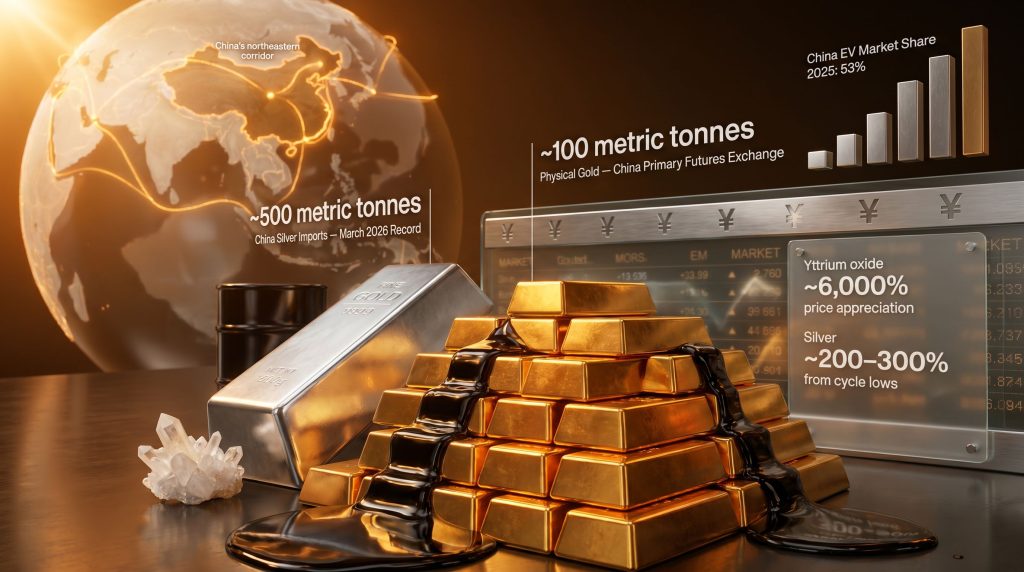
Physical gold inventories at China's primary futures exchange have been rising for several years and are estimated to have reached approximately 100 metric tonnes. A significant portion of this inventory may represent accumulated reserves held on behalf of sanctioned sovereign energy producers, including Russia and Iran, through third-party proxy account structures on the domestic SGE. This hypothesis remains analytical rather than documented, but the architecture described above makes such an arrangement operationally feasible.
Furthermore, the acceleration of US sanctions pressure is expected to increase the velocity of this gold accumulation loop rather than disrupt it. Each new sanctioned entity provides additional motivation to route oil settlement through this mechanism.
"The oil-for-gold loop converts sanctioned crude oil sales into RMB bank balances, which are then used to purchase physical gold through domestic proxy accounts, creating a settlement chain that operates entirely outside Western financial infrastructure."
How China's Gold Accumulation Challenges Dollar Reserve Dominance
The Emerging Bifurcation of the Global Reserve System
The US dollar's reserve currency status is not under immediate threat within Western-aligned economies. Among G7 nations and their allies, dollar dominance in trade invoicing, debt issuance, and reserve management remains firmly entrenched. The more consequential shift is occurring among BRICS-aligned and non-aligned nations, where physical gold is increasingly replacing US Treasury bonds as the preferred reserve collateral.
This bifurcation reflects a fundamental change in the risk calculus of non-Western sovereign entities. US Treasury bonds, once considered the universal safe haven asset, now carry political risk for nations operating under sanctions pressure or geopolitical tension with Washington. Physical gold, by contrast, carries no counterparty risk, no sanctions vulnerability, and no currency exposure.
| Reserve System | Primary Collateral | Key Participants |
|---|---|---|
| Petrodollar (incumbent) | US Treasury bonds | G7, NATO-aligned economies |
| Emerging parallel system | Physical gold | BRICS, Gulf states, Iran, Russia |
People's Bank of China policy has increasingly oriented toward gold accumulation as a structural support mechanism for RMB internationalisation. Independent analysts have suggested that China's actual gold reserves may significantly exceed officially reported figures, potentially exceeding 5,000 tonnes when accounting for accumulation through the Shanghai Gold Exchange and state-affiliated entities, though these estimates rely on inferential analysis rather than official disclosure. Consequently, gold's role in the global monetary system is being fundamentally reassessed by sovereign wealth managers worldwide.
The Petrodollar System Under Structural Stress
Yuan-denominated oil invoicing is gradually displacing dollar settlement in bilateral energy trade between China and its suppliers. Gold functions as a bridge asset in this system, enabling oil-exporting nations to accept RMB in payment without bearing the full currency risk of holding Chinese currency. By offering gold convertibility as an implicit backstop, China makes RMB-denominated trade more acceptable to partners who lack confidence in Chinese financial institutions.
Each successive round of US sanctions accelerates this structural transition by demonstrating to non-Western nations the risks of dollar dependency. The timeline for full financial system decoupling from the dollar remains long, but the directional trajectory is increasingly clear and increasingly difficult to reverse.
Why Gulf State Entities Are Selling Gold to Hong Kong at a Discount
Breaking Down the Middle Eastern Gold Flow
A notable development reported by Bloomberg in early May 2026 involves merchants and entities from Middle Eastern Gulf states offloading physical gold to Hong Kong gold exchange members at an estimated 15 to 20% discount to international spot prices. The chairman of the Hong Kong Gold Exchange confirmed observations of this activity, noting that Middle Eastern sellers were approaching exchange members in bulk.
Selling at a substantial discount to spot rarely reflects routine profit-taking. It signals one or more of the following conditions:
- Urgent capital reallocation requirements driven by regional geopolitical pressure
- Strategic repositioning away from physical gold holdings toward other asset classes or currencies
- Liquidity needs requiring rapid conversion of physical holdings to cash
- Portfolio restructuring in anticipation of changed regional financial conditions
The identity of the likely ultimate buyer is mainland Chinese institutional entities and government-affiliated purchasers, absorbing discounted supply through Hong Kong exchange intermediaries.
What Hong Kong Pricing Tells Us About Demand Dynamics
The most revealing data point in this story is not the discounted selling itself, but what is happening to Hong Kong gold prices despite it. The Hong Kong gold market is currently trading at a marginal premium to international spot, estimated at less than 0.5%, roughly one to two US dollars above the international reference price.
"If Hong Kong gold prices were falling below international spot, it would signal excess supply overwhelming demand. The fact that prices remain at a slight premium, even amid bulk discounted selling from the Middle East, is a strong indicator of sustained, large-scale mainland Chinese buying activity absorbing every available tonne."
This observation, which comes from direct market monitoring rather than inferential analysis, confirms that Chinese demand is outpacing even the discounted supply being offered by Middle Eastern sellers. Secondary retail demand in Hong Kong for physical gold provides an additional absorption layer, though the scale of institutional mainland buying appears to be the dominant factor.
China is effectively monetising Gulf geopolitical uncertainty by acquiring physical gold at materially below-market prices, a structural advantage that compounds over time as accumulation continues.
China's Silver Strategy: The Energy Transition Backdoor
Why Silver Is China's Structural Hedge Against Crude Oil Dependency
To understand why silver occupies a uniquely strategic position in China's commodity architecture, it is necessary to first understand the composition of China's energy system, which differs substantially from Western assumptions.
| Energy Source | Share of China's Electricity Generation |
|---|---|
| Thermal coal | approximately 58% |
| Solar | approximately 19% |
| Nuclear | significant minority share |
| Natural gas | less than 3% |
| Oil | less than 1% |
Source: International Energy Agency and Chinese government statistical data, cross-referenced.
China produces approximately 92% of its thermal coal domestically, meaning its power grid operates in a state of near-complete insulation from international energy market volatility. Oil accounts for less than 1% of electricity generation, making the Chinese grid structurally immune to crude oil supply disruptions in a way that most Western economies are not.
The strategic vulnerability that does exist for China lies in transportation fuel dependency on imported crude oil. This is precisely the exposure that accelerating electric vehicle adoption is designed to eliminate. Critically, both the solar infrastructure powering the grid and the EV and charging ecosystem replacing internal combustion vehicles are intensive consumers of physical silver. Silver's critical mineral status in this context remains significantly underappreciated by Western markets.
China's EV Trajectory and Its Silver Demand Implications
China's EV adoption curve has moved faster than most Western forecasters anticipated:
- 2025 full-year EV market share of new vehicle sales in China reached 53%
- Q4 2025 EV penetration rate climbed to approximately 59%
- Q1 2026 EV penetration is estimated to be approaching or potentially exceeding 70%, though final figures were not available at time of reporting
- Chinese EV exports in Q1 2026 grew by approximately 200% year-on-year, with inventory that had been building in 2025 cleared rapidly as domestic and international demand accelerated
The connection between this EV adoption trajectory and silver demand is direct and quantifiable. Silver is used extensively in electrical contacts, circuit boards, charging infrastructure, power electronics, and grid expansion required to support this transition. As EV penetration moves toward and potentially beyond 70%, the industrial silver demand implications compound across manufacturing, infrastructure, and grid reinforcement simultaneously.
The March 2026 Silver Import Signal
China's net silver imports in March 2026 reached approximately 500 metric tonnes, a figure described as the highest single-month import volume on record. This number warrants careful interpretation because it exceeds what routine industrial procurement cycles would typically require, suggesting a deliberate strategic stockpiling decision rather than ordinary supply chain management.
Simultaneously, China implemented export restrictions on silver that came into effect in early 2026, creating a deliberate supply asymmetry: importing record quantities while restricting outbound flows. This combination serves a dual purpose, building domestic strategic reserves while reducing the silver available to international markets that China competes with industrially. Analysts examining how China restricts silver supply note that the mechanisms involved are far more subtle than direct market intervention.
"Silver is functioning simultaneously as China's energy transition enabler and its monetary hedge, a dual-use strategic commodity that Western markets may be systematically underpricing relative to its strategic importance to the world's largest manufacturing economy."
The next major ASX story will hit our subscribers first
Is There an Informal Rare Earth-for-Silver Trade Happening?
Analysing a Striking Coincidence in Commodity Flows
In March 2026, China exported approximately 60 tonnes of yttrium oxide, a high-value rare earth compound, to the United States. In the same month, the US and London Bullion Market Association (LBMA) facilitated what appears to be the largest single-month silver export to China on record. The simultaneous nature of these flows has prompted analytical speculation about whether an informal strategic commodity exchange was negotiated between the two governments.
Yttrium oxide's strategic applications make it a particularly significant export:
- High-performance thermal barrier coatings applied to turbine blades in jet engines and missile propulsion systems
- Structural components within cruise missiles capable of withstanding extreme heat and high-velocity acceleration environments
- Drone guidance system components and aerospace structural materials
- Rare earth permanent magnets critical for missile guidance systems and drone propulsion
The US military-industrial complex has no domestic substitute for these applications at current technology readiness levels, creating a structural dependency that gives China significant leverage in any informal negotiation. In addition, China's rare earth export restrictions have already demonstrated Beijing's willingness to deploy these resources as strategic tools in broader geopolitical negotiations.
The Asymmetric Value Problem
The economic mathematics of any potential informal exchange heavily favour the Chinese side, and by an extraordinary margin.
| Commodity | Price Appreciation | Strategic Dependency |
|---|---|---|
| Yttrium oxide (rare earth) | approximately 6,000% from prior cycle lows | US military-industrial complex, no near-term substitutes |
| Silver | approximately 200-300% from cycle lows, recently consolidating around USD $70/oz | China's solar, EV, and grid infrastructure |
The arithmetic implication is striking. If China reduces rare earth shipment volumes by 90% whilst prices have risen by 6,000%, the revenue generated remains equivalent to previous full-volume exports. Meanwhile, the US continues supplying silver at prices that, while elevated from historical lows, remain far below their strategic value to China's energy transition programme.
China controls the majority of global rare earth mining capacity and, critically, the overwhelming majority of processing capacity. Even nations that produce rare earth ores in meaningful quantities, such as Australia and the United States, remain dependent on Chinese processing infrastructure to convert raw material into usable industrial compounds. This processing monopoly is where China's real strategic leverage resides, not simply in ore reserves.
"Even if the rare earth-for-silver exchange is informal and unacknowledged, the terms appear to favour China substantially. Selling a commodity that has appreciated 6,000% in exchange for one that has appreciated 200-300% represents a structural asymmetry that compounds with every tonne traded."
Note: The hypothesis of a formal or informal rare earth-for-silver exchange remains speculative and has not been confirmed by either government. It is presented here as an analytical possibility based on the coincident timing of documented commodity flows.
How China Is Building a Parallel Monetary Architecture
The Three-Layer Financial Sovereignty Framework
What is emerging from China's combined gold, silver, and RMB internationalisation strategy is not a single policy initiative but a layered financial sovereignty architecture operating simultaneously across three distinct domains:
- Layer 1, Energy Independence: Domestic coal dominance combined with accelerating EV and solar deployment progressively reduces crude oil import exposure, addressing the most significant remaining vulnerability in China's energy security posture.
- Layer 2, Reserve Asset Accumulation: Systematic physical gold and silver stockpiling replaces dependency on US Treasury bonds as reserve collateral, removing the vulnerability that comes with holding assets subject to potential US sanctions or asset freezes.
- Layer 3, Settlement Infrastructure: RMB-denominated trade invoicing, supported by gold as a convertibility bridge, enables non-aligned trading partners to accept Chinese currency in bilateral trade without requiring full confidence in Chinese financial institutions or full exposure to RMB currency risk.
The Shanghai Gold Exchange as Settlement Hub
The Shanghai Gold Exchange occupies a central role in this architecture as the domestic settlement hub for physical gold transactions denominated in RMB. Its growing physical inventory, expanding international membership through the SGEI international board, and increasing role in price discovery for Asian market participants all reflect its growing importance in a parallel settlement framework.
Understanding how central banks influence gold and silver markets is essential context for appreciating why this settlement infrastructure is being constructed with such deliberateness. The BRICS multilateral framework is providing institutional scaffolding for this parallel system, creating the governance structures and settlement agreements that enable bilateral trade to occur outside dollar-denominated infrastructure. Full financial system decoupling from the dollar remains a long-duration structural process measured in decades rather than years, but the foundational components are being assembled with increasing deliberateness.
What This Means for Gold and Silver Mining Equities
The Disconnect Between Metal Prices and Miner Valuations
A notable anomaly has emerged in precious metals equity markets: major gold producers are reporting record earnings and free cash flow generation while their equity prices have declined or stagnated. Major producers have reported results that reflect extraordinary profitability at current gold prices, yet share prices have sold off on the news rather than appreciating in response.
Several explanations have been offered for this disconnect:
- Concerns about a potential US dollar liquidity squeeze linked to escalating Middle East geopolitical risk
- Algorithmic selling triggered by peace negotiation headlines, which briefly reduce safe haven demand assumptions
- Institutional underweighting of the mining sector relative to underlying commodity price exposure
- Market uncertainty about the sustainability of elevated gold and silver prices over the medium term
- The structural reality that mining equities historically amplify both upside and downside moves in underlying metal prices, making institutional investors cautious about large positions in uncertain environments
A Rotation Strategy for the Current Environment
One approach gaining traction among investors who are constructive on precious metals involves systematically deploying dividend income from senior producers into quality junior developers approaching production decisions. This strategy captures the cash generation of established producers while gaining leveraged exposure to smaller developers whose valuations have not yet reflected the improved economics of the current price environment.
The historical pattern in sustained precious metals bull markets shows that miners tend to lag metal price moves for extended periods, then compress the valuation gap rapidly once institutional sentiment shifts. Analysts at Kitco note that gold remains a strategic allocation whilst silver continues to present a tactical opportunity, a distinction that matters considerably for portfolio construction in the current environment.
Risk remains real, however. Miners carry amplified downside in metal price reversals, and the current environment contains genuine uncertainty about price sustainability, geopolitical developments, and dollar liquidity conditions.
Uranium as a Complementary Allocation
Uranium equities offer energy sector upside without the tweet-driven volatility that has made oil and gas equities particularly difficult to hold through the current geopolitical environment. Nuclear power's role as a baseload complement to intermittent solar and wind in both Western and Asian energy transition plans provides a structural demand case that operates independently of day-to-day political commentary.
Uranium market trends in 2025 suggest that the investment case for nuclear energy exposure has strengthened considerably, driven by both energy security imperatives and decarbonisation commitments. From a portfolio construction perspective, combining gold and silver mining equities with uranium exposure creates a dual precious metals and clean energy transition allocation that captures multiple dimensions of the structural shifts described in this analysis.
Frequently Asked Questions: China Oil for Gold and Silver Strategy
Is China literally trading oil for gold in direct barter transactions?
No. The mechanism is more sophisticated. It involves converting oil sale proceeds into RMB bank balances within the Chinese domestic financial system, which are then used to purchase physical gold through exchange-based proxy accounts. There is no direct commodity-for-commodity exchange, and the structure is specifically designed to avoid creating traceable transaction records.
Why is China restricting silver exports while simultaneously importing record quantities?
China is building domestic silver stockpiles to support its energy transition infrastructure, particularly solar panel manufacturing and EV production, while simultaneously reducing the availability of silver to international markets. This creates a strategic supply asymmetry that strengthens China's industrial position relative to competing manufacturing economies.
Does China's gold accumulation strategy directly threaten the US dollar?
Not in the short term within Western-aligned economies. The dollar is expected to retain its reserve currency status among G7 nations and their allies. However, among BRICS and non-aligned nations, physical gold is increasingly replacing US Treasury bonds as the preferred reserve asset, gradually eroding the dollar's universal dominance in global trade settlement over a long-duration timeframe.
Why are Gulf state entities selling gold at a discount to Hong Kong?
The motivations likely include capital reallocation, geopolitical repositioning, or liquidity needs. The key observation is that despite this discounted selling, Hong Kong gold prices remain at a slight premium to international spot, confirming that Chinese buying demand is fully absorbing the available supply and then some.
What is yttrium oxide and why does it matter geopolitically?
Yttrium oxide is a rare earth compound used in high-performance thermal barrier coatings for turbine blades and structural components within cruise missiles, drones, and aerospace systems capable of operating under extreme heat and high-velocity conditions. China controls the majority of global rare earth production and, critically, processing capacity, giving it significant leverage in any strategic commodity negotiation with the United States or its allies.
Is the rare earth-for-silver exchange theory confirmed?
No. It remains a speculative analytical hypothesis based on the coincident timing of documented commodity flows in March 2026. Neither government has confirmed any such arrangement, and it should be evaluated as one possible interpretation of observable data rather than established fact.
Key Takeaways: The Strategic Commodity Realignment Underway
- US sanctions on strategically integrated Chinese energy infrastructure are accelerating China's development of dollar-independent settlement mechanisms rather than deterring the behaviour they target
- Physical gold is functioning as the terminal reserve layer in a multilateral oil settlement architecture that bypasses Western financial infrastructure entirely
- Silver is China's most underappreciated strategic asset, simultaneously an energy transition enabler and a monetary hedge operating across solar manufacturing, EV production, and grid infrastructure
- Record silver imports, export restrictions, and the potential informal rare earth-for-silver exchange suggest a level of strategic commodity coordination that Western markets have not yet fully priced into asset valuations
- The bifurcation of the global reserve system — dollar-based in the West and increasingly gold-based among non-aligned nations — is a slow-moving but structurally significant transition that is being accelerated by each new round of sanctions pressure
- Mining equity investors may be approaching an inflection point where the gap between record producer earnings and stagnant equity valuations begins to close, particularly if precious metals prices consolidate at current levels rather than reverting
Disclaimer: This article contains forward-looking analysis, speculative hypotheses, and market observations that involve significant uncertainty. Nothing in this article constitutes financial advice. Investors should conduct their own research and consult qualified financial advisers before making investment decisions. Claims about informal government-to-government commodity exchanges have not been independently verified and are presented as analytical speculation rather than confirmed fact. All statistics and figures cited reflect information available at the time of writing and may be subject to revision.
Want to Identify the Next Major ASX Mineral Discovery Before the Market Does?
As China's strategic accumulation of gold and silver reshapes global commodity dynamics, the opportunities emerging across ASX-listed precious and critical minerals explorers have rarely been more compelling. Discovery Alert's proprietary Discovery IQ model delivers real-time alerts the moment significant ASX mineral discoveries are announced, transforming complex geological and commodity data into actionable investment insights — explore the historic returns major discoveries have generated and begin a 14-day free trial to position ahead of the next major find.