
August 5, 2026
The Reserve Manager's Dilemma: Why Sovereign Gold Buying Defies Market Logic
There is a fundamental misunderstanding embedded in how most financial media covers central bank gold purchases. The coverage treats sovereign accumulation as though it responds to the same variables that move futures prices on a Tuesday morning. It does not. Reserve managers and derivatives traders occupy entirely different decision universes, operating on incompatible time horizons with incompatible objectives. Understanding this distinction is the first step toward understanding why China PBOC gold purchases have continued without interruption through one of the most turbulent stretches gold has experienced in over a decade.
When gold delivered its worst quarterly performance since 2013 during Q2 2026, shedding roughly 16% of its value, the People's Bank of China responded by accelerating its buying programme. That counterintuitive behaviour is not an anomaly. It is the logical output of a reserve management framework built around generational purchasing power preservation rather than quarterly return optimisation.
When big ASX news breaks, our subscribers know first
A Structural Reserve Imbalance Decades in the Making
The most revealing number in global reserve management is not gold's spot price. It is the proportion of national reserves held in gold across different economies. That comparison exposes a structural asymmetry that frames everything the PBOC has done over the past 20 months. Furthermore, understanding central bank gold reserves globally helps contextualise just how significant China's composition gap truly is.
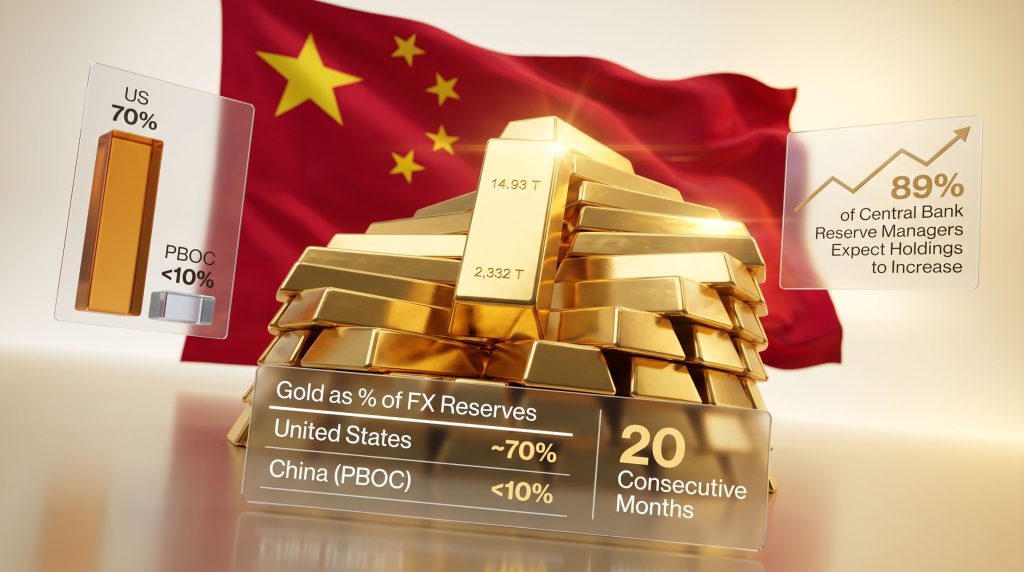
As of mid-2026, China's gold holdings represent less than 10% of its total foreign exchange reserves, according to the World Gold Council. The contrast with Western reserve managers is striking:
| Reserve Manager | Gold as % of Total FX Reserves (2026 Est.) |
|---|---|
| United States | ~70% |
| Germany | ~68% |
| China (PBOC) | <10% |
| Global Average (Advanced Economies) | ~15–20% |
Sources: World Gold Council Central Bank Gold Reserves Survey 2026; State Administration of Foreign Exchange (SAFE)
This is not a gap that closes in one fiscal year or even one decade. It represents a structural rebalancing project that operates on a multi-decade horizon. The PBOC manages approximately $3.4 trillion in total reserves, meaning even modest percentage shifts in allocation translate into enormous tonnage requirements. Closing the composition gap with Western peers at current purchase rates would require sustained accumulation well into the 2030s and beyond.
What the Gap Means for Ongoing Accumulation
Several implications flow directly from this reserve composition reality:
- The structural case for continued PBOC purchasing exists independently of gold's current price trajectory
- Each quarterly purchase decision is made against a backdrop where the destination allocation remains far from its long-term target
- Price corrections like Q2 2026's 16% decline reduce the cost of closing the gap, making them strategically advantageous rather than a deterrent
- The magnitude of the overall rebalancing task means any single year's purchases represent a relatively small increment toward a much larger objective
The 20-Month Buying Streak: What the Data Actually Shows
China's central bank extended its unbroken gold accumulation record to 20 consecutive months through June 2026, the longest documented buying streak since at least 2015. What makes this particularly significant is not simply the duration but the conditions under which it continued.
The June 2026 purchase of 14.93 tonnes (480,000 troy ounces), reported by China's State Administration of Foreign Exchange on July 7, 2026, represented the largest single-month acquisition since 2023. It arrived during a month when gold touched a low of approximately $4,002 per ounce, its weakest level since November 2025. According to China's gold reserves data, this buying streak reflects a sustained and deliberate sovereign strategy.
| Month | PBOC Gold Purchase (Tonnes) | Notable Market Condition |
|---|---|---|
| May 2026 | 9.95 | Largest monthly purchase since December 2024 |
| June 2026 | 14.93 | Largest single-month purchase since 2023 |
| Month-on-Month Change | +50% | Occurred during gold's worst quarterly decline since 2013 |
Source: China State Administration of Foreign Exchange (SAFE), July 7, 2026
The month-on-month volume increase of roughly 50% is particularly notable. It signals deliberate acceleration during a period of price weakness, consistent with counter-cyclical allocation strategy rather than momentum chasing. By the end of May 2026, total PBOC gold holdings had reached approximately 2,332 tonnes (74.96 million troy ounces), representing 8.9% of China's foreign exchange reserves.
Counter-Cyclical Buying: The Strategic Logic Behind Purchasing Into a Falling Market
The question that most retail investors ask when confronted with this data is straightforward: why buy more when prices are dropping? The answer requires separating two fundamentally different types of market participants.
A futures trader operating on a quarterly mandate faces career and performance consequences for holding a position through a 16% drawdown. A reserve manager operating on a 30-year mandate faces no such pressure. For the latter, the relevant question is not whether gold declines from $4,165 to $4,002 in a given quarter. The relevant question is whether gold preserves purchasing power relative to fiat currency systems over the next three decades. Those are categorically different calculations.
Central banks globally have averaged approximately 1,000 tonnes of gold purchases per year since 2022, representing double the accumulation pace of the preceding decade. This structural demand floor has materially altered the global supply-demand equation for gold at the institutional level. (World Gold Council Central Bank Gold Reserves Survey 2026)
In addition, central bank gold demand has demonstrated a persistent upward trajectory that reinforces the long-horizon logic underpinning PBOC strategy. Gold's all-time high reached approximately $5,405 per ounce in late January 2026. By June 2026, prices had corrected to roughly $4,002, a drawdown of approximately 26%. As of July 7, 2026, gold traded near $4,122 per ounce, still approximately 24% below the January 2026 peak.
From a cost-basis perspective, a reserve manager accumulating at these levels is building position at a meaningful discount to recent highs, with the added benefit of improved long-term average cost.
Why the $4,000 Level Functions as a Strategic Accumulation Window
Several factors converge to make the $4,000 price range strategically significant for long-horizon buyers:
- It represents a substantial correction from historical highs, improving long-term cost basis
- It reflects broad market capitulation in speculative and retail segments, reducing crowding risk
- It occurs during a period when sovereign demand remains structurally intact regardless of price
- It coincides with a Fed rate environment that has already priced in significant hawkishness, limiting further real-yield upside that would pressure gold
Jurisdictional Independence: The Geopolitical Architecture of Gold Accumulation
No analysis of China PBOC gold purchases is complete without examining the geopolitical architecture that makes gold uniquely attractive to sovereign reserve managers in the current era. Gold occupies a singular position in the reserve asset hierarchy for reasons that have nothing to do with price charts. Understanding gold in the monetary system more broadly reveals why these structural features are so compelling for sovereign institutions.
- No counterparty risk: Physical gold carries no default exposure to any issuing government, central bank, or financial institution
- Sanction immunity: Unlike sovereign bond holdings or dollar-denominated instruments, physical gold held in domestic vaults cannot be frozen through international financial mechanisms
- Dollar-system independence: SWIFT networks, correspondent banking infrastructure, and custodial arrangements are entirely irrelevant to domestically held physical gold
- Jurisdictional sovereignty: A nation holding gold in its own vaults requires no foreign permission, bilateral agreement, or custodial relationship to access its own reserves
The 2022 freezing of approximately $300 billion in Russian sovereign assets fundamentally recalibrated how reserve managers globally assess the risk profile of foreign-held financial instruments. For institutions managing large reserve portfolios denominated significantly in dollar assets, this event transformed a theoretical risk into a demonstrated one. Gold's appeal sharpened considerably as a result.
The strategic value of gold for a sovereign reserve manager is not primarily about price appreciation potential. It is about owning an asset that no external authority can restrict, freeze, or render inaccessible through financial system leverage.
China's Position Within the Global Reserve Diversification Trend
Geopolitical central bank buying has accelerated meaningfully since 2022, and China sits at the centre of this global reorientation. China has accumulated more than 350 tonnes of gold since early 2022, more than any other country globally over the same period. This accumulation has occurred alongside a broader sovereign reorientation away from dollar-denominated instruments across multiple reserve-managing nations.
Gold has consequently emerged as the dominant destination for new reserve allocation globally, surpassing US Treasuries in terms of central bank accumulation priority by volume.
The 89% Consensus: What Global Reserve Managers Are Signalling
The World Gold Council's 2026 Central Bank Gold Reserves Survey polled 76 reserve managers globally and produced a finding that deserves considerable attention from anyone tracking long-term gold market structure. An overwhelming 89% of surveyed reserve managers indicated they expect global central bank gold holdings to increase over the following 12 months. The central bank influence on long-term price structure is, therefore, becoming increasingly difficult to ignore.
| Indicator | Market Sentiment (Q2 2026) | Reserve Manager Sentiment (2026 Survey) |
|---|---|---|
| Gold price trend | Declining (~-16% quarterly) | Irrelevant to allocation decision |
| Primary driver | Fed rate expectations | Long-horizon purchasing power protection |
| Time horizon | Quarterly/annual | 10-30 years |
| Buying behaviour | Reduced (retail/speculative) | Accelerating (institutional/sovereign) |
This divergence between market sentiment and institutional reserve manager sentiment is itself an analytically important signal. When 89% of the world's professional reserve managers are oriented toward increasing gold holdings while spot markets are pricing in a declining trend, the structural demand floor is demonstrably not responding to the same variables driving short-term price action.
The World Gold Council's research has consistently highlighted that gold demonstrates recovery characteristics from the $4,000 pressure level, supported by persistent long-horizon demand distributed across multiple geographies rather than concentrated in any single buyer.
The next major ASX story will hit our subscribers first
The Data Transparency Problem: Are Official Figures the Complete Picture?
One dimension of China PBOC gold purchases that rarely receives adequate analytical attention is the potential gap between officially reported figures and actual accumulated holdings. This is not speculation in the pejorative sense. It is a recognised feature of how China reports reserve data.
Official PBOC gold data flows through the State Administration of Foreign Exchange and is self-reported without independent third-party verification. Historical patterns have shown China periodically updating its official reserve figures through large single adjustments rather than continuous real-time reporting. This suggests accumulation may be ongoing well before it appears in published statistics.
The import data discrepancy is particularly striking. According to the World Gold Council's China gold market update, Chinese gold imports reached approximately 163 tonnes in May 2026 alone, while official PBOC purchases for the same month were reported at 9.95 tonnes. The difference between these figures flows into a combination of commercial bank vaults, Shanghai Gold Exchange settlement, jewellery and industrial demand, and potentially accumulation programmes outside official reserve reporting frameworks.
Analytical Note: Official PBOC reserve data should be understood as a minimum floor for Chinese sovereign gold accumulation, not a comprehensive ceiling. The true scale of state-adjacent gold holdings across commercial banking channels and undeclared programmes remains unverifiable by external analysis.
Shanghai Gold Exchange withdrawal data, which tracks physical gold leaving exchange vaults into domestic hands, consistently exceeds the sum of official PBOC purchases and private consumption estimates. This persistent gap has led some analysts to theorise that China's total sovereign gold stockpile substantially exceeds official figures, though this remains speculative and unconfirmed.
Forward Indicators: What to Monitor Through the Rest of 2026
For investors tracking the intersection of PBOC reserve strategy and broader gold market dynamics, several near-term data releases carry meaningful informational value:
- SAFE Monthly Reserve Data (Early August 2026) — Will confirm whether the June acceleration continued or whether volumes moderated in July
- US CPI Release (July 14, 2026) — Energy-driven inflation trajectory directly influences Federal Reserve rate expectations heading into the July 29 FOMC meeting
- FOMC Meeting (July 29, 2026) — Rate decision and forward guidance affects real yield dynamics, which historically correlate inversely with gold price performance
- World Gold Council Q2 2026 Aggregate Data — Will contextualise whether PBOC acceleration reflects a broader institutional trend or a China-specific shift
Scenario Analysis: Three Pathways for PBOC Purchases Through 2026
| Scenario | Trigger Conditions | Likely PBOC Response |
|---|---|---|
| Continued Acceleration | Gold remains below $4,200; geopolitical tensions persist | Monthly volumes sustain or exceed 10-15 tonne range |
| Stable Accumulation | Gold stabilises $4,200-$4,500; no major macro shocks | Monthly volumes return to 5-10 tonne range |
| Temporary Pause | Gold surges above $4,800; domestic reserve targets approached | Short-term moderation, consistent with prior pause patterns observed in 2022-2023 |
It is worth noting that the PBOC's buying streak has continued through every Federal Reserve communications cycle since November 2024, demonstrating a remarkable insensitivity to the short-term real yield fluctuations that dominate speculative gold positioning. This suggests sovereign demand operates on a sensitivity function that is structurally decoupled from the Fed policy cycle.
Frequently Asked Questions: China PBOC Gold Purchases
How much gold has the PBOC purchased in 2026?
Through the end of June 2026, the PBOC accumulated approximately 25 tonnes of gold year-to-date, with the June purchase of 14.93 tonnes representing the single largest monthly acquisition since 2023, per data published by China's State Administration of Foreign Exchange.
What percentage of China's reserves are held in gold?
As of mid-2026, gold accounts for less than 10% of China's total foreign exchange reserves, significantly below the approximately 70% weighting maintained by the United States and comparable Western reserve managers, according to the World Gold Council.
Why does China buy gold when prices are falling?
Reserve managers operate on multi-decade allocation mandates, not quarterly performance targets. Counter-cyclical purchasing during price weakness is consistent with long-horizon cost averaging and reflects structural reserve diversification objectives rather than short-term price optimisation. The difference between buying at $4,002 versus $4,165 is statistically negligible against a 30-year mandate.
Could China's actual gold holdings be higher than officially reported?
Potentially. The gap between China's total gold import volumes and officially reported PBOC purchases suggests significant volumes may flow into channels outside official reserve reporting. However, the true scale of any undeclared holdings remains unverified and speculative. Furthermore, Bloomberg has reported that the PBOC continues adding gold even as bullion faces downward pressure, reinforcing this analytical uncertainty.
Will the PBOC continue buying gold through 2026?
Based on the World Gold Council's 2026 survey, 89% of global reserve managers expect central bank gold holdings to increase over the next 12 months. The PBOC's structural reserve composition gap relative to Western peers provides a long-term rationale for continued accumulation regardless of near-term price or policy conditions.
Key Takeaways
- The PBOC's 20-consecutive-month buying streak reflects a structural reserve rebalancing programme, not a market call on near-term gold prices
- June 2026's 14.93-tonne purchase, executed during gold's worst quarterly decline since 2013, demonstrates that sovereign demand operates on a fundamentally different decision framework than market-driven participation
- The reserve composition gap between China (under 10% gold) and Western peers (approximately 70%) represents potential accumulation spanning multiple decades at current rates
- 89% of global reserve managers surveyed by the World Gold Council expect central bank gold holdings to increase over the next 12 months, establishing sovereign demand as a durable structural floor
- Official PBOC data likely represents a minimum floor for Chinese sovereign gold accumulation, with actual holdings potentially exceeding reported figures based on import volume discrepancies
- Gold's unique combination of zero counterparty risk, sanction immunity, and jurisdictional independence makes it irreplaceable as a reserve diversification tool in the current geopolitical environment
Disclaimer: This article is intended for informational and educational purposes only. It does not constitute financial or investment advice. All figures referenced are sourced from publicly available data including the World Gold Council Central Bank Gold Reserves Survey 2026, China's State Administration of Foreign Exchange, and Bloomberg reporting dated July 7, 2026. Readers should consult a qualified financial professional before making any investment decisions. Past performance does not guarantee future results.
Want to Identify the Next Major Mineral Discovery Before the Market Does?
While sovereign institutions quietly accumulate gold on multi-decade horizons, retail investors can gain their own edge closer to home — Discovery Alert's proprietary Discovery IQ model delivers real-time alerts on significant ASX mineral discoveries, transforming complex geological announcements into actionable insights for both traders and long-term investors. Explore how historic discoveries have generated extraordinary returns on Discovery Alert's dedicated discoveries page, and begin your 14-day free trial today to position yourself ahead of the broader market.