
August 5, 2026
Africa's Next Gold Frontier Is Already Being Built
The global gold market has a habit of producing surprises in unlikely places. For much of the past two decades, West Africa dominated the exploration narrative, with Ghana, Mali, and Burkina Faso absorbing the bulk of institutional attention and development capital. Yet some of the most structurally significant gold discoveries of the 2020s have emerged not from the West African craton, but from a politically stable, arid country in the southwestern tip of the continent that most generalist investors have historically overlooked.
Namibia's gold sector is undergoing a fundamental transformation. The Namibia gold rush WIA B2Gold narrative is not a media construct. It reflects a genuine convergence of geological endowment, project-level execution, and sustained capital conviction that is quietly repositioning this southern African nation as one of the continent's most credible multi-mine gold jurisdictions.
When big ASX news breaks, our subscribers know first
The Geological Foundation: Why Namibia Deserves Serious Attention
The Damara Belt and What It Means for Exploration Upside
Understanding why Namibia has attracted institutional-grade investment requires a foundational appreciation of its geology. The Damara Orogenic Belt, a structurally complex metamorphic and sedimentary corridor that cuts across north-central Namibia, has long been recognised by geologists as prospective for gold mineralisation. However, relative to comparable Precambrian gold belts in West Africa or Western Australia, the Damara belt remains materially underexplored.
This underexplored status is not an accident. Namibia's historic mining identity was built on diamonds, uranium, and base metals. Gold was present in the geological literature but absent from the investment pipeline. That gap created an opportunity, and WIA Gold's Kokoseb discovery has become the clearest proof that the belt can host large-scale, open-pittable gold deposits.
The validation of one major deposit in an underexplored belt is historically one of the most reliable exploration catalysts in the mining sector. When Kokoseb's resource crossed two million ounces, it did not merely prove up a single mine. It announced an entire belt to the global exploration community.
Mineralisation Style and Processing Implications
The Kokoseb deposit is hosted within the Damara belt's characteristic sequence of schists and marbles. The mineralisation style, broadly classified as orogenic gold, is the same category responsible for some of the world's largest and most economically durable gold deposits. Orogenic deposits tend to exhibit several investor-friendly characteristics:
- Relatively predictable grade continuity along structural corridors
- Amenability to conventional processing methods, in Kokoseb's case, a carbon-in-leach (CIL) plant
- Scalability through along-strike and down-dip drilling extensions
- Lower metallurgical complexity compared to refractory or arsenopyrite-hosted deposits
The choice of CIL processing at Kokoseb is significant. CIL is a well-understood, cost-effective method for oxide and transitional gold ores, and its adoption signals that Kokoseb's metallurgy is unlikely to produce the kind of processing surprises that have derailed other African development projects. A throughput capacity exceeding 5 million tonnes of ore per year gives the plant meaningful economies of scale from the outset.
WIA Gold's Kokoseb Project: Four Years from Discovery to 2.93 Million Ounces
A Discovery Timeline That Rewrote the Development Calendar
The speed of Kokoseb's resource growth is arguably the defining characteristic of this project. In most African jurisdictions, moving from initial target identification to a resource exceeding two million ounces requires a decade of patient drilling, multiple funding rounds, and at least one commodity cycle. Kokoseb compressed that journey into four years.
| Year | Milestone |
|---|---|
| 2021 | Initial identification of the Kokoseb deposit |
| 2023 | Maiden resource estimate: 1.3 million ounces |
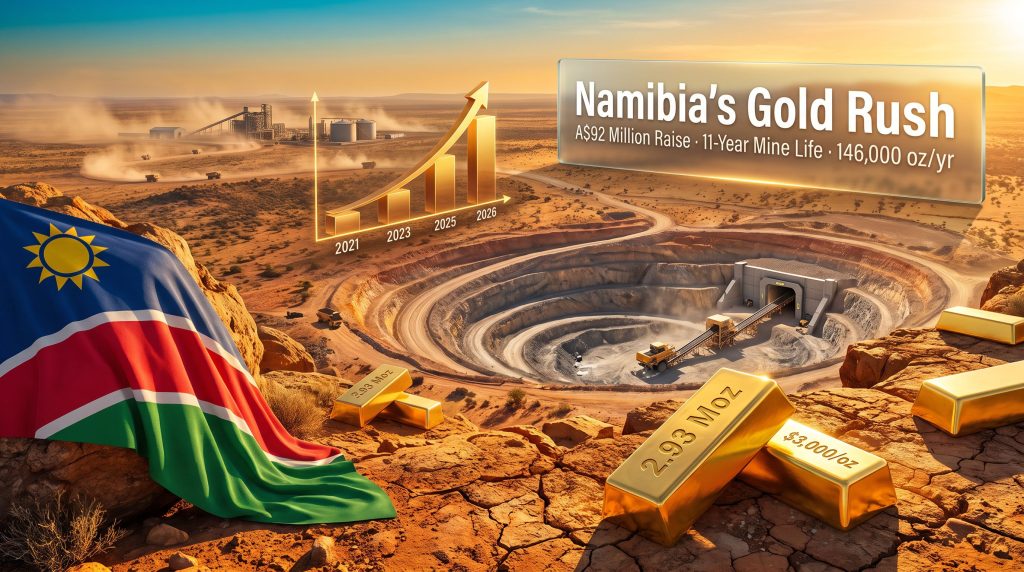
| 2025 | Resource upgraded to approximately 2.93 million ounces |
| 2026 | A$92 million capital raise completed; Final Investment Decision anticipated for August |
This trajectory matters not only as a headline achievement but as a technical signal. Resource growth of this pace suggests that early drilling was testing the deposit's core, with subsequent campaigns systematically expanding known mineralisation along strike and at depth. For investors, this pattern historically indicates further resource upside remains plausible, particularly given how underdrilled the broader Damara belt remains. Furthermore, current gold exploration trends across Africa suggest that belt-scale discoveries of this nature are attracting increasing institutional attention.
The Scoping Study Numbers: What the Economics Actually Show
WIA Gold's September 2025 scoping study provided the first comprehensive picture of Kokoseb's development economics. The key figures deserve careful attention:
- Capital cost: $358.8 million for an open-pit mine and CIL processing plant
- Ore throughput: exceeding 5 million tonnes per year
- Years 1 to 5 production: approximately 177,000 ounces per annum
- Life-of-mine average production: approximately 146,000 ounces per annum
- Total projected production: approximately 1.83 million ounces
- Expected mine life: 11 years
With gold prices above $3,000 per ounce, the project economics are compelling. The higher-grade early years production profile of around 177,000 oz/yr is particularly important for project financing, as lenders and offtakers place significant weight on the front-loaded cash flows that service debt and establish operational credibility.
The A$92 million capital raise completed in 2026 against this backdrop was a market endorsement of the project's development pathway. Institutional investors do not commit that scale of capital to a development-stage project in Africa without rigorous technical due diligence. The raise also reflects the fact that elevated gold prices have materially improved the risk-reward calculus for mid-tier gold developers operating in stable jurisdictions.
Ownership Architecture and Sovereign Alignment
WIA Gold holds an 80% stake in the Kokoseb project. The remaining 20% is retained by Epangelo Mining Company, Namibia's state-owned mining vehicle. This structure deserves more analytical attention than it typically receives in mainstream coverage.
Sovereign equity participation in development-stage projects is a double-edged feature. On one hand, it introduces a government counterparty whose interests may not always align perfectly with those of private shareholders, particularly at moments of project renegotiation or permitting decision. On the other hand, Epangelo's stake creates a powerful alignment of sovereign interests with project success. A government that owns equity in a project has a direct financial incentive to facilitate its development. For international investors assessing Namibian sovereign risk, Epangelo's structural involvement functions as a credible commitment device.
Leadership: The Combination of Local Continuity and Proven Project-Building Pedigree
| Role | Individual | Key Background |
|---|---|---|
| CEO (from 2026) | Henk Diederichs | Stellenbosch University; 20+ years in African mining operations |
| Country Manager | Keith Webb | Scotland-born; Namibia-resident since 2006 |
| Project Founder | Josef El-Raghy | Australian mining/finance executive; key figure in developing Egypt's Sukari mine during his Centamin tenure |
The Sukari connection through El-Raghy warrants elaboration. Sukari is now one of Africa's largest gold mines, producing approximately 500,000 ounces per year. The developmental pathway from exploration licence to multi-hundred-thousand-ounce producer is precisely the trajectory Kokoseb is targeting. While Kokoseb's projected annual output is smaller than Sukari's at maturity, the structural parallel of a well-capitalised team executing an African greenfields development with institutional backing is instructive.
Diederichs' appointment as CEO in 2026 signalled the project's transition from exploration-mode leadership to execution-mode leadership, a critical inflection point that often separates projects that reach production from those that stall in the development pipeline. In addition, the broader wave of African gold expansion across the continent continues to draw experienced operators into emerging jurisdictions like Namibia.
B2Gold's Otjikoto: Engineering a Production Bridge to 2032
The Open-Pit-to-Underground Transition in Context
B2Gold's Otjikoto mine, located approximately 300 kilometres north of Windhoek in the Otjozondjupa region near Otjiwarongo and Otavi, takes its name from the famous Lake Otjikoto, a sinkhole lake of geological and historical significance in the area. Established as Namibia's largest gold producer through its open-pit operations, Otjikoto reached a structural crossroads when surface mining was completed in October 2025.
The first blast at the Antelope underground project in February 2026 marked the operational pivot that most analysts had anticipated but few had examined closely for its broader implications.
| Metric | Detail |
|---|---|
| Open-pit completion | October 2025 |
| Underground first blast | February 2026 |
| Extended mine life | Through to 2032 |
| Processing method | Stockpile drawdown combined with underground ore feed |
| Regional location | Otjozondjupa, approximately 300km north of Windhoek |
The transition from open-pit to underground is universally capital-intensive, and Otjikoto is no exception. Underground mining requires fundamentally different equipment fleets, ventilation infrastructure, ground support engineering, and workforce skill profiles compared to open-pit operations. The decision to invest in this transition rather than wind down the operation reflects B2Gold's assessment that Antelope's ore body justifies the capital outlay under current gold price conditions.
The stockpile processing bridge is a financially astute element of the transition strategy. By processing accumulated surface material during the underground ramp-up phase, Otjikoto can maintain mill throughput and revenue continuity while the underground development reaches steady-state production. This approach reduces the duration and severity of the production gap that would otherwise accompany any open-pit-to-underground transition.
Twin Hills, Navachab, and Namibia's Depth of Production Pipeline
Twin Hills: Chinese Capital, Namibian Expertise
The Twin Hills project, situated approximately 15 kilometres from Karibib on the Omaruru road in central Namibia and roughly 150 kilometres northwest of Windhoek, represents a structurally distinct element of the Namibia gold rush WIA B2Gold narrative. Its development origins trace to Osino Resources and the exploration programme led by co-founder and former CEO Heye Daun.
When Shanjin International Gold Co. Ltd acquired Osino Resources in 2024, the transaction brought Chinese institutional capital into Namibia's gold sector for the first time at this scale. Critically, the original Namibian technical team retained operational leadership on the ground, preserving the site-specific geological knowledge and community relationships that Chinese acquirers have increasingly learned to value in African mining acquisitions.
Upon commissioning, Twin Hills is expected to become Namibia's third commercial-scale gold mine, generating approximately 1,000 construction-phase jobs and around 800 permanent operational positions.
Navachab: The Established Producer Making the Boldest Long-Term Bet
While newer projects attract the majority of market commentary, Navachab's strategic significance should not be underestimated. The mine holds proven reserves of 2.43 million ounces and a total resource inventory of 5.16 million ounces, figures that rival or exceed several of Namibia's newer developments in absolute scale.
The N$4 billion underground expansion programme represents one of the single largest capital commitments in Namibia's gold sector, undertaken by an existing producer with a demonstrated operational track record. The workforce trajectory tells its own story of operational confidence:
- Fewer than 500 employees in 2020
- 889 permanent staff and 598 contractors by 2025
This workforce expansion reflects not just production growth but the accumulation of institutional mining knowledge and local employment capacity that Namibia's government has explicitly identified as a core objective of its minerals strategy.
Comparing Namibia's Four Key Gold Projects
| Project | Operator | Stage | Key Resource | Projected Output | Notable Feature |
|---|---|---|---|---|---|
| Otjikoto | B2Gold | Underground transition | Established producer | Ongoing to 2032 | Antelope underground extension |
| Kokoseb | WIA Gold (80%) | Advanced development | ~2.93 Moz | ~146,000 oz/yr average | One of Africa's fastest-growing recent discoveries |
| Twin Hills | Shanjin International Gold | Development | Not publicly disclosed | ~800 permanent jobs at peak | Chinese-backed; Namibian team retained operationally |
| Navachab | Private | Operating and expanding | 5.16 Moz total resource | Ongoing production | N$4bn underground expansion underway |
The next major ASX story will hit our subscribers first
What the Capital Market Activity Signals to Investors
Reading the Funding Environment Correctly
The A$92 million raise by WIA Gold in 2026 is more than a project financing event. It is a data point about institutional sentiment toward Namibian gold assets at a moment when gold prices have been sustained above $3,000 per ounce. Understanding what drives that sentiment requires separating several contributing factors:
-
Gold price fundamentals: Sustained prices above $3,000/oz compress the payback periods on development capital and expand the range of projects that can attract debt financing on acceptable terms.
-
Jurisdictional premium: Investors burned by sovereign risk in Mali, Burkina Faso, and parts of West Africa are actively repricing the value of political stability. Namibia's consistent rule-of-law framework commands a meaningful jurisdictional discount compared to higher-risk African peers.
-
ASX as a conduit for African exploration capital: The Australian Securities Exchange has a long-established role as a primary listing venue for African-focused gold explorers and developers. The ASX's retail and institutional investor base has both the appetite and the analytical infrastructure to evaluate African development-stage projects, giving companies like WIA Gold access to capital pools that would be harder to tap on other exchanges.
-
Epangelo's equity stake as a de-risking signal: International institutions conducting sovereign risk assessments view Epangelo's structural involvement as evidence that the Namibian state has aligned its interests with project success.
Furthermore, the gold M&A activity emerging across the sector suggests that well-capitalised acquirers are watching Namibian assets with increasing interest, particularly as projects like Kokoseb advance toward construction-readiness. Completing definitive feasibility studies will be a critical next milestone in converting that interest into transactional outcomes.
Risk Factors That Informed Investors Must Monitor
No investment thesis on Namibia's gold sector is complete without an honest assessment of the risks. The following factors warrant ongoing monitoring:
-
Capital cost inflation: The $358.8 million Kokoseb development budget was derived from a September 2025 scoping study. In the current inflationary environment for mining capital goods, reagents, and labour, actual development costs may diverge materially from scoping-study estimates by the time construction commences.
-
Underground ramp-up execution at Otjikoto: The successful extension of Otjikoto's mine life depends on the Antelope underground reaching target production rates on schedule and within budget. Any technical delays in the ramp-up phase would increase the duration of the production gap and impact B2Gold's Namibian revenue profile.
-
Sovereign negotiation risk: Epangelo's 20% stake in Kokoseb creates a bilateral relationship that will require ongoing management. Any shift in Namibia's fiscal policy toward mining, including royalty rates or local content requirements, could affect project economics.
-
Gold price volatility: A sustained reversal from current price levels would alter project financing conditions and potentially delay Final Investment Decisions across the sector.
-
Permitting timelines: Even in a transparent licensing environment, regulatory approval timelines for new mine construction can introduce delays that compound financing costs and investor uncertainty.
A recent report on Namibia's gold sector highlights that despite these risks, the structural investment case for the Namibia gold rush WIA B2Gold story remains broadly intact, underpinned by sovereign stability and a deepening project pipeline.
Disclaimer: This article is intended for informational purposes only and does not constitute financial or investment advice. Any forecasts, projections, or forward-looking statements discussed herein involve inherent uncertainty and should not be relied upon as guarantees of future performance. Readers should conduct their own due diligence and consult a qualified financial adviser before making any investment decisions.
Frequently Asked Questions: Namibia Gold Mining
What is the largest gold mine currently operating in Namibia?
B2Gold's Otjikoto mine in the Otjozondjupa region has been Namibia's largest gold producer. As of late 2025, it completed open-pit operations and transitioned to underground mining through the Antelope underground project, with production expected to continue through to 2032.
What is WIA Gold's Kokoseb project and why is it significant?
Kokoseb is an advanced-stage gold development project located near Okombahe in Namibia's Erongo region within the Damara gold belt. It grew from initial identification in 2021 to a resource of approximately 2.93 million ounces by 2025. A September 2025 scoping study estimated development costs at $358.8 million, with projected average annual production of approximately 146,000 ounces over an 11-year mine life.
How many major gold projects does Namibia currently have in development?
Namibia currently has at least four significant gold projects at various stages: B2Gold's Otjikoto (underground transition through to 2032), WIA Gold's Kokoseb (advanced development with a Final Investment Decision anticipated in 2026), the Twin Hills project (development stage under Shanjin International Gold), and Navachab (operating with a major underground expansion underway). You can learn more about WIA Gold's Namibian operations directly from the company's project page.
Who owns the Twin Hills gold project in Namibia?
Twin Hills is owned by Shanjin International Gold Co. Ltd, a Chinese mining group that acquired the project through its 2024 purchase of Osino Resources. The original Namibian development team continues to lead on-site operations.
Why did WIA Gold raise A$92 million in 2026?
The capital raise was designed to accelerate drilling programmes, advance technical studies, and fast-track overall project development at Kokoseb ahead of an anticipated Final Investment Decision in August 2026. The raise took advantage of elevated gold prices to secure funding on favourable terms.
Want To Catch the Next Major African Gold Discovery Before the Market Does?
Discovery Alert's proprietary Discovery IQ model scans ASX announcements in real time, instantly identifying high-potential mineral discoveries like the Kokoseb-scale opportunities reshaping Namibia's gold sector — converting complex geological data into clear, actionable insights for investors at every experience level. Explore how historic mineral discoveries have generated extraordinary returns on Discovery Alert's dedicated discoveries page, and begin your 14-day free trial today to position yourself ahead of the broader market.