
July 7, 2026
When Minerals Become Weapons: The New Logic of Resource Geopolitics
The global economy has spent decades treating critical minerals as a procurement problem, a matter of logistics, price discovery, and contract management. That assumption is now being dismantled in real time. Across technology, defence, automotive, and medical device supply chains, the architecture underpinning modern manufacturing rests on a narrow base of elements that are difficult to mine, extraordinarily complex to process, and overwhelmingly concentrated in a single country's industrial ecosystem.
China rare earth export controls to Japan are not simply a bilateral trade dispute. They represent the clearest demonstration yet that mineral resources can be wielded as precision instruments of foreign policy, calibrated to apply pressure without triggering the blunt backlash of a full embargo. Understanding why this matters requires looking beyond the headlines and into the chemistry, economics, and geopolitical architecture of the rare earth supply chains that underpin modern industry.
When big ASX news breaks, our subscribers know first
China's Structural Grip on the Rare Earth Market
Rare earth elements are a group of 17 metals, including the lanthanide series plus scandium and yttrium, that share similar chemical properties and occur together in mineral deposits. Despite the word "rare" in their name, most are relatively abundant in the Earth's crust. The challenge lies not in their scarcity but in the extreme difficulty of separating them from each other and processing them into usable industrial forms without generating significant environmental liabilities.
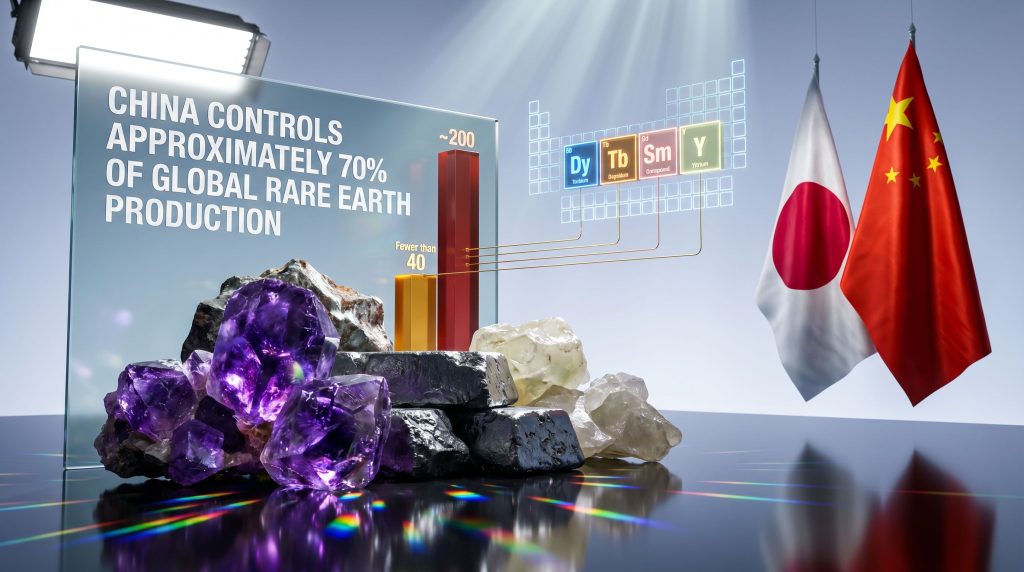
This processing complexity is precisely why China's position is so formidable. As of 2025, China controls approximately 70% of global rare earth production and holds around 60% of known global reserves, according to Satoru Yoshida, a commodities analyst at Rakuten Securities. More critically, an estimated 90% of global rare earth processing capacity sits within Chinese borders. This means that even ore extracted elsewhere in the world frequently travels to China for refining before it can enter manufacturing supply chains, giving Beijing leverage that extends well beyond its domestic mining footprint.
The downstream industries dependent on these materials span virtually every high-technology sector:
| Application | Key Rare Earths Required | Strategic Importance |
|---|---|---|
| Electric Vehicle Motors | Dysprosium, Neodymium | EV drivetrain performance |
| Permanent Magnets | Terbium, Samarium | Defence, robotics, wind turbines |
| Medical Devices | Yttrium, Gadolinium | Imaging, diagnostics |
| Consumer Electronics | Multiple REEs | Smartphones, precision instruments |
| AI Infrastructure | Multiple REEs | Data centre components, sensors |
What makes the current moment particularly consequential is the acceleration of demand across all these categories simultaneously. The buildout of artificial intelligence infrastructure, the global transition toward electric vehicles, and rising defence expenditure are converging to drive rare earth consumption higher at precisely the moment supply is being deliberately constrained.
As Takeshi Higashifukasawa, chief economist at Mizuho Research Institute, has noted, the development of AI means rare earths are now being incorporated across a far broader range of goods and throughout supply chains in ways that were not true during earlier trade disputes. Electric vehicles have compounded the exposure. The result is that corporate optimism about managing supply disruptions has become increasingly difficult to justify.
The Architecture of China's Targeted Restrictions
How Are the Controls Structured?
China's export controls on rare earth materials bound for Japan do not constitute a total embargo. The distinction matters enormously from both a legal and strategic standpoint. Furthermore, China's rare earth strategy has evolved considerably, with Beijing imposing targeted restrictions on seven categories of medium and heavy rare earth materials, specifically those with documented dual-use applications in defence and advanced technology manufacturing.
The materials at the centre of these rare earth export restrictions include:
| Restricted Material | Primary Industrial Use | Military/Dual-Use Application |
|---|---|---|
| Dysprosium | High-performance magnets | Defence motors, missile guidance |
| Terbium | Phosphors, magnets | Advanced weaponry, radar |
| Samarium | Permanent magnets | Aerospace, military hardware |
| Gallium | Semiconductors | Electronic warfare systems |
| Germanium | Optical fibre, infrared | Surveillance, defence optics |
| Graphite | Battery anodes | Energy storage for military systems |
| Yttrium | Lasers, phosphors | Precision targeting, communications |
The practical impact has been stark. Chinese customs records confirmed zero exports of terbium or dysprosium oxide to Japan between November and May, with only negligible yttrium oxide shipments recorded from December onward. For manufacturers of high-performance permanent magnets, these three elements are not substitutable. There are no commercially viable alternatives that deliver equivalent magnetic performance at operating temperatures required for EV motors or defence applications.
The restrictions were triggered following diplomatic tensions arising from Japanese Prime Minister Sanae Takaichi's statements regarding the defence of Taiwan in November, which prompted Beijing to move against shipments of dual-use mineral categories. The policy response was not immediate escalation to a full ban but rather a surgical restriction calibrated to maintain deniability of economic aggression while delivering real supply chain pain.
Japan's Exposure: Progress Made, Vulnerability Remaining
What Did 2010 Teach Japan?
Japan's relationship with Chinese rare earth dependency has a documented history. During the 2010 fishing vessel incident, Beijing effectively halted rare earth exports to Japan for approximately two months, causing significant industrial disruption and triggering a national reassessment of supply chain architecture. In the intervening years, Japan invested substantially in diversification, recycling technologies, and alternative sourcing arrangements.
The results of those efforts are measurable but incomplete. Japan imported approximately 5.2 million kilograms of rare earths from China in 2024, representing around 63% of its total rare earth imports, a meaningful reduction from the approximately 90% dependency level recorded during the 2010 episode. However, this progress masks a more complex picture.
The industries facing the greatest near-term supply risk include:
- Automotive sector: Permanent magnets used in EV motors and hybrid drivetrains depend directly on dysprosium and terbium for thermal stability at high operating temperatures
- Consumer electronics: Precision components in cameras, audio equipment, and wearable technology incorporate multiple rare earth elements throughout assembly
- Medical device manufacturing: Yttrium and gadolinium are integral to imaging systems and diagnostic equipment with no near-term substitution pathway
- Industrial automation: Motors, actuators, and robotics components used in Japan's highly automated manufacturing environment rely on rare earth permanent magnets
- Defence-adjacent manufacturing: Components subject to dual-use classification face the most direct exposure to continued restriction
A critical and underappreciated dimension of Japan's vulnerability is what might be called indirect exposure. Many Japanese companies do not procure rare earths as raw materials. They purchase finished components from suppliers who incorporate rare earths further up the supply chain. When those upstream suppliers face shortages, the effects cascade downstream in ways that are genuinely difficult to quantify at the point of final assembly.
This indirect exposure dynamic helps explain a pattern emerging in corporate risk disclosures that would otherwise seem anomalous.
The Tokyo Stock Exchange Signal: Reading Corporate Japan's Distress
One of the most reliable leading indicators of genuine economic concern is not government data releases or macroeconomic surveys — it is the language companies choose when disclosing risks to investors in regulatory filings. What has happened to rare earth disclosures on the Tokyo Stock Exchange since May 2026 is, by historical standards, extraordinary.
| Period | Monthly TSE Rare Earth Mentions | Primary Sectors Flagging Risk |
|---|---|---|
| Pre-2025 (Baseline) | Fewer than 40 | Materials, industrials |
| May–June 2026 | ~200 (May & June combined) | Consumer goods, electronics, automotive |
| Negative Impact Cited | >66% of filings | Broad cross-sector |
The doubling of rare earth risk mentions since May, and their extension beyond traditional materials and industrial companies into consumer goods and electronics firms, signals that supply chain anxiety has migrated from the factory floor to the boardroom. More than two-thirds of the approximately 200 filings in May and June that mentioned rare earths indicated that export controls were either already affecting business negatively or posed a credible future risk.
Citizen Watch filed a disclosure on June 23 noting that prolonged export restrictions on rare earths or similar measures could materially affect the group's production activities and financial performance. The company confirmed rare earths are primarily used in its motors and that there had been no immediate production or earnings impact, but it stopped short of ruling out future revisions to earnings guidance.
Medical device manufacturer Omron cited China's rare earth restrictions in its June 22 geopolitical risk assessment alongside conflicts in Ukraine and the Middle East, even while clarifying that it does not directly procure rare earths. The company acknowledged that purchased components contain materials that depend on them, an admission that perfectly illustrates the indirect exposure problem facing a large segment of Japanese industry.
The uneven distribution of supply pain across companies, as Yoshida at Rakuten Securities has explained, reflects differences in how much inventory individual firms accumulated before Beijing tightened restrictions. Companies that built substantial stockpiles in anticipation of disruption have a temporary buffer. Those that did not are already feeling the pressure. As existing stockpiles are drawn down across the economy, the divergence will narrow and aggregate pressure will intensify.
The dynamics are compounding rather than stabilising. Supply is being constrained precisely as consumption broadens across more industries, creating a situation where these materials become progressively scarcer and more strategically valuable over time.
Why 2010 Shapes Beijing's Current Calculus
The 2010 rare earth dispute provides an instructive historical counterpoint. China's response to the fishing vessel incident was a blunt, relatively short-duration supply cutoff that produced consequences Beijing had not fully anticipated. Japan's industrial community responded with accelerated investment in rare earth recycling processes, diplomatic agreements for alternative sourcing from Australia, Canada, and other jurisdictions, and sustained research into material substitution.
Several Chinese rare earth producers, having built capacity in anticipation of sustained high prices, subsequently faced financial distress as Japan successfully reduced its dependency footprint. This historical outcome has demonstrably shaped China's current approach. Rather than a total ban that would energise international diversification efforts and potentially consolidate allied resolve, Beijing has chosen targeted restrictions that maintain enough supply flow to prevent recipient nations from declaring a formal crisis while delivering real and measurable supply chain disruption to specific industrial categories.
The surgical nature of the current restrictions also makes them harder to challenge under international trade law frameworks. A complete embargo would invite WTO dispute proceedings and coordinated allied response. Targeted dual-use restrictions, framed as national security measures, occupy a far more legally ambiguous space.
Japan's rare earth recycling capabilities, built partly in response to 2010, do provide a meaningful partial buffer. Urban mining — the recovery of rare earths from end-of-life electronics and industrial equipment — has become an increasingly organised industry in Japan. However, the volumes recoverable through domestic recycling remain insufficient to replace primary supply at the scale Japan's manufacturing sector requires.
The next major ASX story will hit our subscribers first
Japan's Diversification Strategy: Realistic Assessment of Timelines
What Is Tokyo Actually Doing?
Tokyo has moved on multiple fronts to address the structural vulnerability exposed by China's restrictions. Japan's industry ministry has stated it is deploying investments and subsidies in collaboration with allied nations and private sector partners to secure stable supplies of rare earths and other critical minerals.
A bilateral framework agreed between Japan and the United States established coordinated approaches encompassing joint stockpiling arrangements, rapid-response supply protocols, and collaborative development of alternative extraction sources. At the G7 level, Japan secured agreement in June 2026 on enhanced coordination of mineral stockpiles among member nations.
Japan and the US have also initiated discussions on the joint development of deep-sea mineral deposits, which are known to contain significant concentrations of rare earth elements in polymetallic nodules and seafloor sediments. Consequently, the rare earth processing challenges associated with seabed extraction mean commercial-scale production from these sources remains years away from realisation, offering no meaningful near-term relief for manufacturers currently managing supply constraints.
The honest assessment, as articulated by Yuriy Humber, CEO of Tokyo-based consultancy Yuri Group, is that a full year of export restrictions would generate significant structural problems for Japanese manufacturers. With restrictions already four to five months old as of mid-2026, the window for a contained outcome without lasting supply chain damage is narrowing. Humber has also noted that Japanese government messaging has sought to manage the public perception of the issue, concerned that visible official alarm could trigger panic-driven market reactions that would compound the underlying supply problem.
Scenario Analysis: How Severe Could the Economic Impact Become?
The trajectory of the current restrictions creates three broadly distinct scenarios for Japanese industry and policymakers:
Scenario 1: Restrictions ease within six months. A diplomatic resolution, perhaps tied to a broader US-China-Japan framework negotiation, could allow a gradual resumption of targeted rare earth shipments. Under this scenario, most manufacturers would weather the disruption through stockpile management and partial alternative sourcing, with limited permanent structural damage.
Scenario 2: Restrictions persist for 12 or more months. This scenario produces structural supply chain damage across multiple Japanese industries. Permanent magnet manufacturers would face production curtailments. Automotive and electronics firms would need to accelerate redesign programmes to reduce rare earth intensity. Significant earnings revisions across corporate Japan would become unavoidable.
Scenario 3: Restrictions expand to additional rare earth categories. An escalation to cover light rare earths, including neodymium and praseodymium used in standard permanent magnets, would represent a qualitative escalation with systemic consequences extending well beyond Japan to affect global EV, wind energy, and consumer electronics supply chains.
The compounding factor across all three scenarios is the simultaneous acceleration of demand. AI infrastructure deployment, EV adoption curves, and defence spending growth are all driving rare earth consumption higher. Supply restrictions arrive at the worst possible moment in the demand cycle.
The Global Implications: Beyond the Japan-China Bilateral
What is happening between China and Japan carries direct implications for every technology-intensive economy that relies on Chinese rare earth processing. The European Union, South Korea, Taiwan, and the United States all share structural exposure to China's processing monopoly, even where they have made progress in diversifying primary mining sources.
The key insight that the Japan situation makes undeniable is that mining diversification alone is insufficient. So long as processing capacity remains concentrated in China, ore from Australian, Canadian, or African mines must still pass through Chinese refineries before it can enter global supply chains. In addition, alternative rare earth supply development requires sustained capital investment, regulatory permitting, environmental management infrastructure, and time measured in years rather than months.
For investors monitoring critical minerals markets, the Tokyo Stock Exchange disclosure pattern offers a leading indicator worth watching closely. When companies that do not directly procure rare earths begin flagging them as material risks in regulatory filings, it signals that second and third-order supply chain effects have reached a scale that corporate risk managers can no longer categorise as manageable within existing contingency frameworks.
The ongoing situation in Japan, as analysts at Benchmark Mineral Intelligence have noted, is a preview of a broader reconfiguration of how nations and corporations think about resource security in an era where China rare earth export controls to Japan — and potentially to other allied nations — have become instruments of state power as consequential as any conventional trade measure.
Disclaimer: This article is intended for informational purposes only and does not constitute financial or investment advice. Statistics, timelines, and economic projections referenced are drawn from available reporting and analyst commentary as of mid-2026 and are subject to change. Readers should conduct independent research and consult qualified advisers before making investment decisions.
Want to Stay Ahead of the Next Major Critical Minerals Discovery?
Discovery Alert's proprietary Discovery IQ model scans ASX announcements in real time, instantly identifying significant mineral discoveries across rare earths and other critical commodities — turning complex data into actionable investment insights before the broader market reacts. Explore how historic discoveries have delivered substantial returns on Discovery Alert's dedicated discoveries page, and begin your 14-day free trial today to position yourself ahead of the next major find.