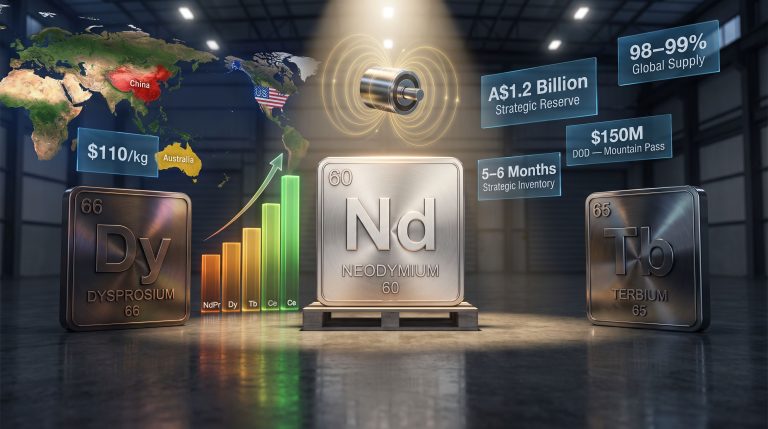
July 19, 2026
The Invisible Embargo: How Element-Level Export Controls Are Redrawing Global Supply Chains
There is a particular kind of economic pressure that leaves no obvious fingerprints. It does not arrive as a tariff hike or a declared trade ban. Instead, it materialises as a quietly suspended licensing review, a paperwork queue that never clears, a shipment that simply never boards a vessel. This is the architecture of China's rare earth export controls, and by mid-2026, Japan had become the most consequential case study in how this instrument of statecraft actually functions at industrial scale.
Understanding what is happening to China rare earth exports to Japan requires stepping back from the headlines and examining the structural logic beneath the surface.
When big ASX news breaks, our subscribers know first
China's Processing Monopoly: The Foundation of Mineral Leverage
Most discussions of rare earth geopolitics focus on reserves, yet reserves are largely irrelevant to the current crisis. The real chokepoint is processing. China controls an estimated 85 to 90 percent of global refined rare earth output, meaning that even ore extracted in Australia, Brazil, or the United States typically requires Chinese refining capacity to become a commercially usable material.
This distinction matters enormously. A rare earth oxide or metal ready for magnet production is a fundamentally different product from ore concentrate sitting at a mine gate. The separation, solvent extraction, and alloying stages that transform raw material into usable inputs involve highly specialised chemical engineering, significant capital infrastructure, and expertise accumulated over decades of investment.
Nations that allowed their own processing industries to atrophy during the low-price environment of the 2000s and 2010s are now discovering that rebuilding them is measured in years and billions, not months and millions. The rare earth processing challenges involved here extend far beyond simple capital investment.
Export licensing regimes exploit this bottleneck precisely. Beijing does not need to declare an embargo. By suspending the administrative review of export license applications for specific elements destined for specific markets, China can achieve the functional equivalent of a blockade while retaining full legal deniability under its domestic dual-use classification framework.
The mechanism is deceptively simple: when license applications are not rejected but simply not processed, exporters cannot ship. The result is a de facto supply freeze that is legally difficult to challenge at the World Trade Organisation because no formal ban has been declared.
The Dual-Use Framework: A Legal Architecture for Selective Restriction
China's April 2025 decision to formally classify heavy rare earths and rare earth magnets as dual-use materials under domestic law was not merely an administrative update. It was the legal infrastructure required to operationalise element-specific export controls at scale.
Dual-use classification enables Beijing to apply national security rationale to export decisions, a category that receives broad deference under international trade law. Once a material sits within that framework, individual shipments can be approved, delayed, or indefinitely deferred on a case-by-case basis, providing extraordinary granularity of control.
The practical implication is that China can simultaneously maintain robust magnet exports to one country, restrict oxide shipments to another, and apply total embargoes on specific elements to a third, all within the same legal framework and without any declared policy change. This is a more sophisticated instrument than the blanket export quotas that triggered WTO disputes in the early 2010s. Furthermore, China's rare earth export restrictions have evolved considerably in both scope and legal sophistication since that earlier period.
How the Japan Restrictions Escalated: A Step-by-Step Timeline
The deterioration in China rare earth exports to Japan did not happen overnight. It followed a deliberate escalation ladder tied closely to diplomatic events.
| Period | Action | Materials Affected |
|---|---|---|
| April 2025 | Dual-use classification enacted | Heavy rare earths, rare earth magnets |
| November 2025 | Supply tightening begins following Taiwan statements | Terbium, dysprosium oxide |
| December 2025 | Yttrium shipments reduced to near-zero | Yttrium oxide |
| January 2026 | Formal public tightening announced | Broad heavy rare earth category |
| February 2026 | Two additional rounds targeting major conglomerates | Major Japanese industrial buyers |
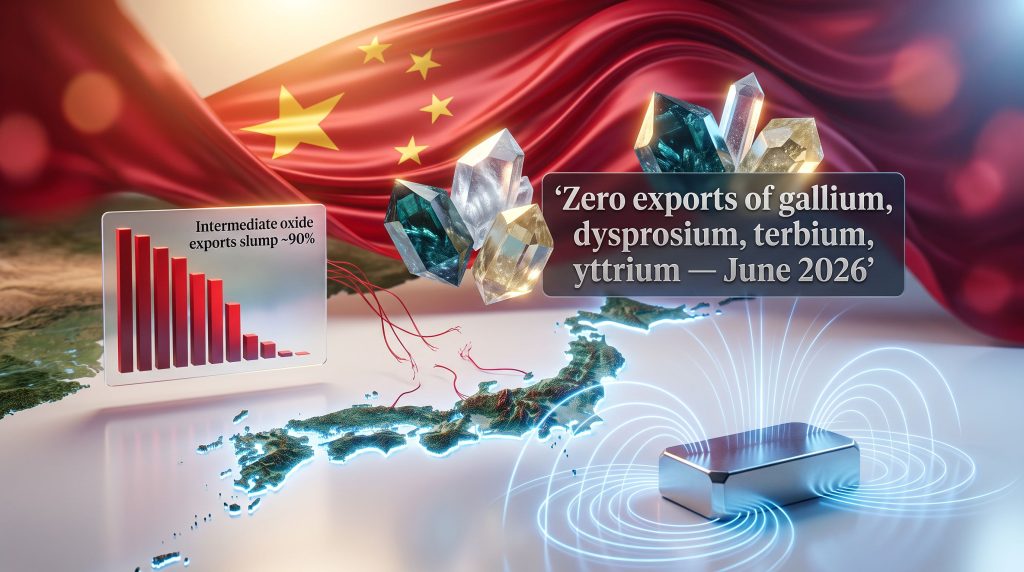
| March 2026 | Intermediate oxide imports slump approximately 90% | Rare earth oxides broadly |
| May 2026 | Minor yttrium shipment only | Yttrium oxide |
| June 2026 | Zero exports across all key elements | Dysprosium, terbium, yttrium, gallium |
The pattern visible in this timeline is instructive. The restrictions were applied incrementally and calibrated to diplomatic events, with each new round arriving at a moment of heightened political tension. This is not a supply chain accident. It is a sequenced policy response.
What Triggered the Escalation?
The trigger was Japanese Prime Minister Sanae Takaichi's November 2025 remarks on Taiwan, which Beijing interpreted as a significant provocation. What followed was a precisely engineered escalation, beginning with the elements of highest strategic sensitivity and expanding methodically through the heavy rare earth suite. According to reporting from Reuters, this episode bears striking parallels to the 2010 showdown but is considerably more targeted in its execution.
The Four Elements at the Centre of the Crisis
Not all rare earths are created equal. The specific elements suspended from export to Japan represent some of the most strategically irreplaceable materials in modern industrial manufacturing.
| Element | Critical Application | Japan's Dependency Level | June 2026 Export Status |
|---|---|---|---|
| Dysprosium | EV drive motor magnets, defence systems | Near-total | Zero exports |
| Terbium | High-performance permanent magnets | Near-total | Zero exports (since Nov 2025) |
| Yttrium | Turbine blade thermal coatings, aircraft engines | Very high | Zero exports |
| Gallium | Compound semiconductor fabrication | Very high | Zero exports |
Yttrium deserves particular attention because its applications extend well beyond what most coverage acknowledges. It is a thermal barrier coating material, applied to turbine blades in commercial aircraft engines and industrial power generation turbines to protect metal components from temperatures that would otherwise cause rapid structural failure. Supply disruptions affecting yttrium do not merely slow EV production lines. They carry implications for commercial aviation maintenance cycles and grid-scale power generation infrastructure.
Gallium in semiconductors represents an equally critical vulnerability. Gallium arsenide and gallium nitride are used in the high-frequency chips that underpin 5G infrastructure, radar systems, and power electronics. Consequently, a zero-export month for gallium is not simply a trade statistic — it is a signal reverberating through the entire semiconductor supply chain.
The Magnet Export Paradox: Reading China's Industrial Strategy
One data point from June 2026 customs figures deserves extended analysis because it reveals the deeper industrial logic driving these controls. While China sent zero dysprosium, terbium, yttrium, and gallium to Japan, its overall rare earth magnet exports were simultaneously expanding. China shipped approximately 5,649 metric tonnes of rare earth magnets globally in June, up from 4,730 tonnes in May.
This divergence is not a contradiction. It is a coherent strategy.
By restricting upstream oxide and metal exports while maintaining or growing downstream magnet shipments, China is applying pressure at the point where foreign manufacturers depend on Chinese inputs, while simultaneously competing against those same manufacturers in finished goods markets. The message embedded in the data is pointed: foreign magnet producers can either relocate manufacturing to China or accept increasing dependence on Chinese finished magnets.
This strategy represents a fundamental shift in how resource nationalism operates. Rather than simply charging more for raw materials, China is leveraging processing dominance to move the entire value chain downstream.
The next major ASX story will hit our subscribers first
Quantifying the Economic Damage to Japan
The economic costs accumulating inside Japan's industrial sector are substantial and measurable.
- A sustained three-month restriction scenario is estimated to cost Japanese industry approximately $660 billion in economic activity, with GDP contracting by around 0.11 percent
- A twelve-month restriction could suppress Japanese GDP by an estimated 0.43 percent, with compounding effects across automotive, electronics, and defence manufacturing
- Rare earth magnet exports from Japan to global customers declined approximately 35 percent in May 2026 compared to April, reaching their lowest volumes in more than a year
- Intermediate oxide imports into Japan slumped by nearly 90 percent in March 2026, indicating severe upstream pipeline depletion well before finished goods output declined visibly
The sector-by-sector vulnerability picture is equally concerning:
- Electric Vehicles: Neodymium-iron-boron magnets require dysprosium and terbium additions to maintain performance at elevated operating temperatures. Without these additions, magnet coercivity drops sharply, limiting the motor's ability to function reliably in demanding conditions.
- Defence Electronics: Precision-guided munitions, active electronically scanned array radar systems, and submarine sonar equipment all rely on high-performance permanent magnets containing heavy rare earth elements.
- Aviation and Power Generation: Yttrium thermal barrier coatings are integral to turbine blade longevity. Shortages affect scheduled maintenance intervals and the availability of replacement components for both commercial aircraft and gas turbine power plants.
- Semiconductor Manufacturing: Gallium-based compound semiconductors underpin 5G networks, satellite communications, and advanced power conversion electronics.
Why Diversification Is Structurally Harder Than It Appears
The standard policy response to supply chain concentration risk is diversification, and governments across the G7 are accelerating exactly that. The EU Critical Raw Materials Act, US Department of Defense rare earth investment programs, and Australia's Critical Minerals Strategy are all gaining urgency in the context of the Japan precedent.
However, the fundamental constraint is not ore availability. Multiple nations hold substantial rare earth reserves. The constraint is processing capacity, and building a competitive rare earth refining facility involves barriers that extend far beyond capital availability:
- Chemical engineering expertise accumulated over decades, much of which now exists predominantly within China's industrial base
- Radioactive byproduct management infrastructure, since rare earth ore bodies typically contain elevated concentrations of thorium and uranium that require licensed waste handling systems
- Solvent extraction circuit design specific to each ore's mineral chemistry, meaning processing facilities cannot simply be copied from a blueprint but must be engineered for each feedstock
- Multi-year commissioning timelines that make near-term supply substitution essentially impossible regardless of investment commitment
Even with accelerated investment commitments, analysts broadly estimate that meaningful non-Chinese processing capacity for heavy rare earths is unlikely to reach commercial scale before the late 2020s at the earliest. Japan's existing strategic stockpiles provide a buffer, but they were not designed to absorb a sustained multi-element freeze of this duration or breadth.
The US Dimension: Japan Is Not the Only Target
The June 2026 customs data carried an additional signal that received less coverage than the Japan figures but is arguably more strategically significant. The United States recorded zero yttrium imports from China for two consecutive months in mid-2026. This was not a Japan-specific restriction. It was a parallel measure applied simultaneously to a second major economy.
The concurrent restriction of yttrium exports to both Japan and the United States strongly suggests these controls reflect a coordinated strategic posture operating across multiple diplomatic theatres simultaneously. America's rare earth supply chain vulnerabilities, long acknowledged in policy circles, are consequently becoming acute in ways that were previously theoretical.
This parallel application has significant implications for how other nations assess their own exposure. If restrictions can be applied simultaneously to Japan and the United States, the assumption that any single nation's commercial relationship with China provides insulation from this type of pressure requires reassessment.
Lesser-Known Technical Dimensions of the Crisis
Several technical aspects of this situation are not well understood outside specialist circles but are highly relevant to understanding its full scope:
- Magnet coercivity and heavy rare earth additions: The reason dysprosium and terbium cannot simply be substituted or eliminated from high-performance magnet formulations is that they are added specifically to increase coercivity, the resistance to demagnetisation at elevated temperatures. An EV drive motor operating in a hot under-bonnet environment without sufficient dysprosium content risks permanent magnet degradation over time, a performance and safety issue rather than merely an efficiency concern.
- The intermediate oxide pipeline: When customs data shows a 90 percent decline in intermediate oxide imports, the downstream impact on magnet production does not manifest immediately. Manufacturers draw on existing inventory and in-process material. This means the full production impact typically lags the supply shock by weeks to months, making the eventual output contraction appear sudden even though the upstream signal was visible much earlier.
- Yttrium's supply geography: Unlike some rare earths found in geographically diverse deposits, economic yttrium production is particularly concentrated. Its occurrence as a recoverable byproduct depends heavily on the mineralogy of the host deposit, meaning that simply identifying yttrium in a geological survey does not guarantee economically viable extraction.
- Gallium's co-production dependency: Gallium is not mined directly. It is predominantly recovered as a byproduct of aluminium smelting from bauxite ore. This means gallium supply cannot be independently scaled by simply opening new mines. Increasing supply requires either expanding aluminium production or improving recovery rates from existing smelting operations, neither of which responds quickly to market price signals.
The Geopolitical Template Being Watched by Resource-Rich Nations
Perhaps the most consequential long-term implication of the Japan episode is what it demonstrates to other resource-holding nations. China's ability to apply granular, element-specific export controls — calibrated to diplomatic events, legally defensible under domestic frameworks, and operationally effective within weeks — represents a new standard in mineral-based economic statecraft. The broader rare earth geopolitical impact of these developments is reshaping strategic thinking across multiple continents.
Nations endowed with critical mineral reserves are watching carefully. The combination of resource endowment plus processing capacity plus domestic legal frameworks designed for dual-use control creates a geopolitical instrument of considerable potency. Countries currently developing their own critical mineral strategies are studying this model not merely as a threat to be countered but as a template potentially worth emulating.
Analysis from the Center for Strategic and International Studies highlights how China's rare earth campaign against Japan has evolved from the blunt instrument deployed in 2010 into a far more surgically precise mechanism of economic statecraft.
The Japan episode may ultimately be remembered less as a bilateral trade dispute and more as the moment when critical mineral supply chains became a permanent fixture of great power competition strategy, requiring industrial planners, defence ministries, and corporate boards to treat them with the same seriousness previously reserved for energy security.
Frequently Asked Questions: China Rare Earth Exports to Japan
Why did China stop exporting rare earths to Japan?
China's progressive restriction of China rare earth exports to Japan is directly linked to diplomatic friction triggered by Japanese Prime Minister Sanae Takaichi's November 2025 remarks concerning Taiwan. Beijing responded through its export licensing framework, beginning in January 2026, with restrictions intensifying through mid-2026.
Which elements are affected by the China-Japan export restrictions?
The primary materials subject to effective suspension include dysprosium, terbium, yttrium, and gallium, covering critical inputs for permanent magnet production, semiconductor fabrication, and high-temperature turbine coatings.
How dependent is Japan on China for rare earths?
Japan imports approximately 60 percent of its total rare earth requirements from China. For specific heavy rare earths including terbium and dysprosium, dependency approaches near-total reliance given China's dominance in processing these elements to usable grades.
What is the estimated economic impact on Japan?
Economic modelling suggests a three-month restriction scenario could generate approximately $660 billion in economic costs and reduce Japanese GDP by around 0.11 percent. A twelve-month sustained restriction could depress GDP by approximately 0.43 percent, with cascading effects across automotive, electronics, and defence manufacturing sectors.
Are China's restrictions permanent?
No formal permanent ban has been declared. The controls operate through suspended licensing reviews, preserving Beijing's ability to restore specific supply flows as diplomatic conditions change. The pattern of intermittent minor shipments followed by renewed zero-export periods suggests deliberate, politically managed supply releases rather than any structural reopening.
Is the United States also affected?
Yes. The United States recorded zero yttrium imports from China for two consecutive months in mid-2026, indicating the controls extend beyond a purely Japan-focused bilateral measure and feature as a dimension of broader US-China trade negotiations.
Disclaimer: This article contains economic estimates, forward-looking analysis, and market projections sourced from publicly available data and independent research. These figures represent modelled scenarios and should not be interpreted as confirmed outcomes. Readers should conduct independent analysis before making any investment or commercial decisions based on information contained herein.
Want to Identify the Next Major Critical Minerals Discovery Before the Market Does?
Discovery Alert's proprietary Discovery IQ model delivers real-time ASX alerts the moment significant mineral discoveries are announced — including the critical and rare earth minerals reshaping global supply chains — transforming complex geological data into clear, actionable insights for investors at every level. Explore historic discoveries and their returns on Discovery Alert's dedicated discoveries page, then begin a 14-day free trial to secure your market-leading advantage.