August 26, 2026
The Geopolitics of Scarcity: Understanding Rare Earth Supply Chain News in 2026
When historians look back at the early decades of the twenty-first century, they may well identify the moment rare earth supply chains moved from industrial footnote to geopolitical centrepiece as one of the defining transitions of the era. For most of the past three decades, the economics of rare earth elements were straightforward: China produced them cheaply, the world consumed them quietly, and the arrangement suited everyone well enough that few asked hard questions about what happened if it broke down.
That arrangement is now breaking down, loudly, and in ways that are reshaping investment strategies, defence procurement, alliance structures, and trade policy simultaneously. Tracking rare earth supply chain news in 2026 is no longer a niche activity for commodity specialists. It has become a form of geopolitical intelligence gathering.
When big ASX news breaks, our subscribers know first
Why China's Processing Dominance Matters More Than Its Ore Reserves
A persistent misconception in rare earth supply chain news coverage is the conflation of geological reserves with strategic control. China does not hold the largest share of the world's rare earth reserves. What it holds, and what makes it structurally dominant, is control over the value-adding stages of the supply chain that sit above mining: separation, refining, alloying, and magnet manufacturing.
This distinction matters enormously. A nation can possess vast ore bodies and still be dependent on Chinese processing infrastructure to turn those ores into usable materials. The leverage China exercises comes not from what is in the ground but from what happens in the factory. Furthermore, the rare earth processing challenges that Western nations face in replicating this infrastructure are considerable.
For the heaviest and most strategically critical rare earth elements, this processing dominance reaches near-total levels:
| Rare Earth Element | Primary Application | China's Refined Supply Share | 2026 Price Pressure Level |
|---|---|---|---|
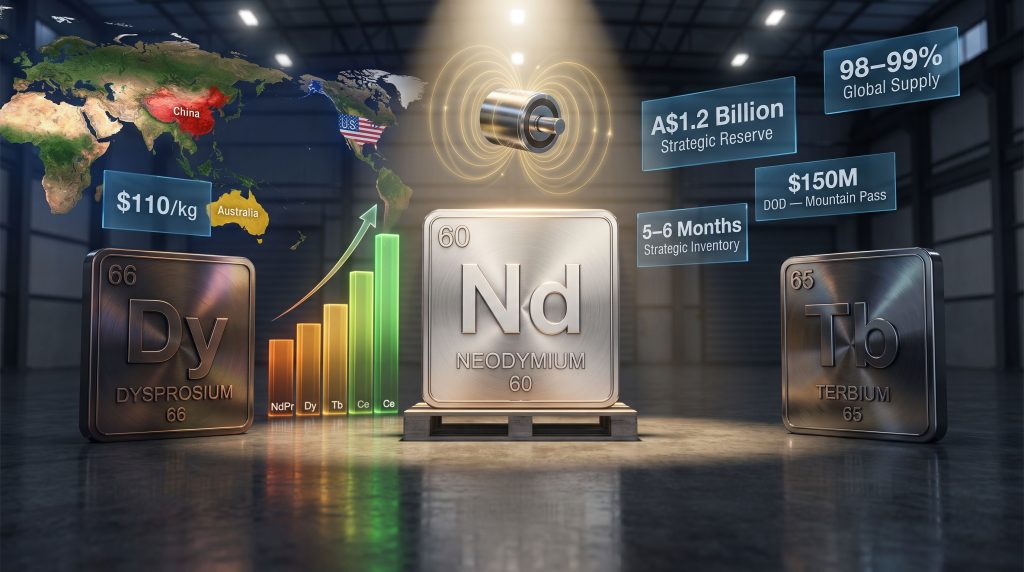
| Neodymium-Praseodymium (NdPr) | Permanent magnets for EVs and wind turbines | ~85-90% | High: U.S. floor price set at $110/kg |
| Dysprosium (Dy) | High-temperature magnet performance retention | ~98-99% | Critical: Japanese access restricted |
| Terbium (Tb) | Magnet coercivity enhancement | ~98-99% | Critical: limited non-Chinese refining capacity |
| Cerium (Ce) | Catalysts and polishing compounds | ~60-70% | Moderate: oversupply risk in some scenarios |
The table above illustrates a critical asymmetry. For light rare earths like cerium, the situation is manageable. For heavy rare earths like dysprosium and terbium, which are essential for making magnets perform reliably at elevated temperatures inside EV motors and defence systems, there is effectively no functioning non-Chinese refined supply chain at commercial scale.
This is the architecture of China's rare earth advantage: not geological luck, but decades of deliberate industrial policy compounded into infrastructure, expertise, and vertical integration that Western nations are now scrambling to replicate.
How Export Licensing Is Being Used as a Strategic Lever
China's rare earth trade strategy in 2025 marked a qualitative shift through its export licensing framework for dual-use rare earth products. Rather than relying on informal supply management, Beijing formalised a mechanism that allows it to calibrate export volumes with precision, using licensing approvals and delays as instruments of economic statecraft.
The immediate downstream effects were significant. Following the rollout of the 2025 licensing regime, Chinese magnet exports declined by an estimated 75% on a temporary basis, sending shockwaves through manufacturing supply chains in Europe, Japan, and North America. For industries operating with lean inventories and just-in-time procurement models, even a temporary 75% reduction in a critical input creates cascading delays that can take months to resolve.
June 2026 export data confirmed that rare earth shipment volumes continued to run below prior-year levels on both a month-over-month and year-over-year basis. Targeted restrictions on heavy rare earth exports to Japan, occurring amid heightened regional tensions, added a bilateral dimension to what had previously been framed primarily as a broad supply management policy.
The U.S.-China trade truce introduced a partial resumption of magnet exports, providing short-term relief to downstream manufacturers. However, the truce carries an approximately eight-month expiry window, and critically, it does not address the structural vulnerability that created the crisis in the first place. For risk modellers and supply chain planners, the truce is better understood as a pause than a resolution. If it lapses without a successor agreement, the downstream consequences for industries dependent on Chinese rare earth magnets, including defence contractors, EV manufacturers, and wind turbine producers, could be severe.
A trade truce that suspends symptoms without treating the underlying condition provides only a narrow window of relief. The structural supply vulnerability that China's export licensing regime exposed remains fully intact.
What Is Happening to Rare Earth Prices in 2026
Price dynamics in 2026 reflect a market undergoing fundamental restructuring rather than a temporary commodity cycle. The U.S. government's decision to set a floor price for neodymium-praseodymium at $110 per kilogram, roughly double prior market levels, is arguably the single most consequential price signal to emerge from the Western rare earth policy response.
Floor pricing mechanisms serve a dual function. They provide a demand-side guarantee that de-risks investment in non-Chinese processing and mining projects, and they signal to capital markets that governments are prepared to intervene structurally to ensure domestic supply chain viability. The emergence of a two-tier global pricing structure, with Chinese domestic prices sitting well below the ex-China premium now visible in Western markets, is a consequence of this policy divergence.
For heavy rare earths, the price pressure is even more acute. Dysprosium and terbium, which have essentially no commercially scaled non-Chinese refined supply, are experiencing price escalation driven not by speculative demand but by genuine scarcity at the processing stage. Japanese manufacturers, whose access to heavy rare earth exports from China has been selectively restricted, are facing downstream pressure on EV motor and defence component production schedules that cannot be resolved by simply sourcing ore from alternative countries.
The Scale of the Non-Chinese Supply Gap
Bloomberg Intelligence projections indicate that rare earth shortages are likely to persist through 2030, even accounting for the more than $10 billion in non-Chinese project funding committed globally in 2026. Non-Chinese supply capacity is expected to grow by approximately 41% over the coming years, but this growth, substantial as it sounds, remains insufficient to meet projected demand expansion driven by EV adoption, wind energy deployment, and defence procurement scaling.
The strategic inventory situation adds an additional layer of urgency. As of late 2025, Western nations collectively held approximately five to six months of strategic rare earth inventory, a buffer that provides only a narrow window of operational continuity if export restrictions escalate or a trade truce expires without renewal.
The timeline problem underlying all supply diversification efforts deserves careful emphasis. Building a functioning rare earth supply chain from the ground up is not a project measured in months or electoral cycles. It unfolds across stages, each requiring separate capital investment, regulatory clearance, and technical capability development:
- Permitting and environmental assessment (typically two to five years in Western jurisdictions)
- Mining construction and commissioning (a further two to four years)
- Separation plant development (capital-intensive, technically specialised, often the most difficult stage to replicate)
- Alloying and metallurgical processing (requires rare earth-specific metallurgical expertise not widely available outside China)
- Magnet manufacturing at commercial scale (the final, highest-value stage, where non-Chinese capacity is most critically underdeveloped)
Even projects receiving funding and regulatory approval today are unlikely to produce commercial-scale magnet output until the early 2030s at the earliest. This leaves a structural vulnerability window that spans multiple geopolitical cycles and at least two or three rounds of government policy transitions in most Western democracies.
Which Countries Are Advancing Rare Earth Diversification
United States
The most concrete U.S. progress is centred on physical infrastructure rather than policy statements. The Department of Defense has committed a $150 million loan to MP Materials to support expansion of the Mountain Pass operation in California, the only rare earth mine and processing facility currently operating at meaningful scale in North America.
Separately, the REalloys and U.S. Critical Materials memorandum of understanding aims to build a fully domestic supply chain anchored by the Sheep Creek rare earth deposit in Montana. The U.S. Army has also initiated a process to select companies capable of establishing heavy rare earth processing capacity at domestic military installations, a model that co-locates strategic material production with defence infrastructure to reduce civilian supply chain exposure.
America's rare earth supply chain investment reflects the compressed timeline within which the U.S. rare earth revival is attempting to operate. For investors and defence planners, the November 10 regulatory milestone represents a concrete decision point within the broader rebuilding effort.
Australia
Australia has proposed a A$1.2 billion strategic reserve, positioned as both a supply buffer against short-term disruption and a price stabilisation instrument for allied nations. Lynas Rare Earths remains the most operationally advanced non-Chinese rare earth producer globally, with its Malaysian processing facility and developing South Korean magnet manufacturing partnerships forming the backbone of a functioning allied supply chain node.
Europe
European policymakers have shifted their internal framing of the rare earth challenge from a trade dispute negotiation to preparation for a supply chain war, reflecting a significant escalation in strategic urgency. The EU's proposed solidarity instrument aims to fund alternative rare earth supply infrastructure, while Finland's Korsnäs project is making genuine technical progress, though it remains at an early stage relative to commercial scale requirements.
Malaysia and Southeast Asia
Malaysia's parliamentary debates over rare earth strategy have moved beyond the question of its relationship with a single processing partner toward a broader national industrial policy discussion. The central tension is whether Malaysia can leverage its geographic position and existing processing experience to obtain meaningful technology transfer, transforming itself from a processing location into a rare earth industrial power in its own right.
Central Asia and Kazakhstan
Deepening diplomatic engagement between China and Kazakhstan signals that Central Asian rare earth and critical mineral flows are increasingly being incorporated into a China-adjacent supply architecture. Western alliance strategies that fail to account for this dynamic risk systematically underestimating the degree to which Central Asian mineral flows could reinforce rather than offset Chinese supply chain dominance.
India
India's northeastern region represents an underexplored rare earth province with significant geological potential and strategic proximity advantages relative to key Asian demand centres. The gap between geological endowment and processing infrastructure is, however, substantial. Realising India's rare earth potential requires not only capital investment but the development of technical separation and refining capability that currently does not exist at meaningful scale within the country.
The next major ASX story will hit our subscribers first
The Defence Sector and the Magnet Bottleneck
One of the most consequential, and least publicly discussed, dimensions of current rare earth supply chain news concerns drone manufacturing. Western defence industrial bases are scaling airframe production capacity considerably faster than they are securing reliable rare earth magnet supply chains to power those airframes.
Drone motors operating at military performance specifications require NdPr-based permanent magnets enhanced with dysprosium for high-temperature stability. With Chinese magnet exports constrained and non-Chinese magnet manufacturing capacity at a fraction of required scale, Western drone programmes face a component bottleneck that threatens to undermine airframe production investments.
The REalloys and SRC partnership illustrates both the ambition and the open questions in the North American rare earth magnet supply chain. REalloys has established a credible capital position and articulated a clear strategic platform targeting North American magnet production. The outstanding question is whether SRC's processing methodology can be validated at commercial scale. Successful process validation would represent a meaningful step forward for the broader domestic supply chain.
Adjacent Critical Minerals: Tungsten and the Two-Market Reality
The structural bifurcation visible in rare earth markets is also emerging in tungsten. China's tungsten market found a price floor in 2026, but the more strategically significant development is the emergence of separate Chinese-domestic and ex-China tungsten pricing ecosystems. Industries dependent on tungsten carbide tooling and defence-grade alloys are increasingly being forced to choose between two fundamentally different supply architectures.
Meanwhile, China's Baogang Group has expanded beyond raw rare earth supply into advanced automotive steel engineered for EV applications. This downstream integration signals a deliberate strategic shift: Chinese state enterprises are positioning themselves to capture value not just from raw material extraction but from the next generation of EV-era engineered materials that Western manufacturers will need to compete in global automotive markets.
Brazil, Trade Policy, and the Strategic Exemption Signal
The rare earth carve-out within U.S.-Brazil tariff negotiations carries significance that extends well beyond the bilateral trade relationship. Brazil possesses substantial rare earth geological endowment, and its exemption from rare earth tariffs signals that the U.S. is beginning to deploy trade policy as a supply chain security instrument, using preferential access arrangements to build out an allied rare earth supply architecture.
This approach, if extended to other resource-rich nations, could represent the most practical near-term pathway to supply diversification that bypasses the decade-long timeline of building new processing infrastructure from scratch. Consequently, the rare earth geopolitical impact of such trade arrangements is likely to intensify considerably in the years ahead.
How Investors and Industry Professionals Should Interpret Rare Earth Supply Chain News
The most important analytical discipline for those tracking rare earth supply chain news is the ability to distinguish between short-term price movements driven by export control headlines and the slower-moving structural shifts that actually determine long-term supply security. The following signal categories provide a framework for separating genuine market repositioning from noise:
| Signal Category | What to Monitor | Why It Matters |
|---|---|---|
| Export Policy | Chinese licensing regime renewals or expansions | Directly determines near-term supply volumes |
| Processing Capacity | Non-Chinese separation plant commissioning dates | Shows when diversification becomes operational reality |
| Military Procurement | DOD and allied defence rare earth processing awards | Validates demand floor for domestic projects |
| Price Floors | Government-set NdPr and heavy REE floor prices | Reduces investment risk for non-Chinese producers |
| Alliance MoUs | Cross-border supply chain partnership agreements | Signals long-term demand commitments |
| Strategic Reserves | Government stockpile announcements | Indicates buffer capacity against short-term disruption |
One underappreciated analytical challenge is the inadequacy of traditional balance sheet frameworks for capturing rare earth supply chain exposure. A manufacturer whose production is entirely dependent on Chinese rare earth inputs may look financially healthy until the moment supply is constrained, at which point the hidden liability becomes visible all at once.
The emerging concept of strategic matter accounting, which attempts to quantify the value and risk of critical material supply chain dependencies, is gaining traction among defence contractors, EV manufacturers, and wind turbine OEMs who have recognised that conventional financial reporting does not capture the full risk picture. For in-depth analysis and tracking of these developments, Rare Earth Exchanges provides daily news updates and research-driven analysis across the full rare earth value chain.
Frequently Asked Questions: Rare Earth Supply Chain News
What are the most consequential rare earth supply chain developments in 2026?
China's expanded export licensing regime for heavy rare earths, the U.S. government's $110/kg NdPr floor price, the $150 million DOD loan to MP Materials for Mountain Pass expansion, Australia's proposed A$1.2 billion strategic reserve, and the emergence of a bifurcated global pricing structure between Chinese and non-Chinese markets are among the most structurally significant developments reshaping global rare earth supply chains in 2026.
Why does China maintain such comprehensive control over rare earth supply chains?
China's dominance stems from decades of deliberate investment in processing technology, separation infrastructure, alloying capability, and magnet manufacturing, not from having the world's largest ore reserves. This vertically integrated position gives China control over the highest-value, most technically demanding stages of the supply chain that are both the most difficult and the most capital-intensive to replicate elsewhere.
How long will it realistically take for Western nations to build independent rare earth supply chains?
Industry analysis and government assessments consistently indicate that meaningful end-to-end supply chain independence, covering mining through magnet manufacturing, is measured in decades rather than years. Projects receiving funding approval today face permitting, technical validation, and workforce development timelines that push commercial-scale magnet output into the early 2030s at the absolute earliest.
What is the current strategic inventory position for Western nations?
As of late 2025, Western nations collectively held approximately five to six months of strategic rare earth inventory, creating a narrow operational buffer that becomes critically inadequate if export restrictions escalate sharply or a trade truce expires without a successor agreement in place.
Which non-Chinese rare earth projects are most operationally advanced?
MP Materials' Mountain Pass operation in California, Lynas Rare Earths' Malaysian processing facility, and the REalloys and U.S. Critical Materials partnership anchored by the Sheep Creek deposit in Montana represent the most operationally developed non-Chinese rare earth supply chain initiatives currently active in 2026. For broader context on these developments, the Critical Minerals Institute offers additional research and expert commentary on global supply chain resilience.
The Supply Chain Is the Strategy
Rare earth supply chain news in 2026 is inseparable from the broader architecture of great-power competition. The decisions being made now, about which projects receive funding, which alliances are formalised, which processing technologies are validated, and which trade relationships are restructured, will determine the distribution of industrial and military capability through the 2030s and beyond.
For investors, the critical window is the next 24 to 36 months. This is the period within which processing capacity commitments, military procurement awards, and alliance-level supply agreements will either establish a credible non-Chinese supply architecture or confirm that Western diversification ambitions are outrunning the capital, technical capability, and political commitment required to make them real.
The structural outlook is clear: persistent supply tightness, accelerating diversification investment, and a bifurcating global market that will define who controls access to the materials powering the next generation of energy, defence, and digital technologies. The balance of supply power will not shift through policy statements. It will shift through processing plants, validated technologies, and sustained capital deployment at a scale that matches the ambition of the strategic challenge.
Disclaimer: This article contains forward-looking statements, projections, and market analysis drawn from publicly available sources and industry research. The information presented is intended for educational and informational purposes only and does not constitute financial, investment, or trading advice. Readers should conduct their own due diligence before making any investment decisions. Projections regarding supply timelines, price levels, and policy outcomes involve inherent uncertainty and may differ materially from actual results.
Want to Track the Next Major Mineral Discovery Before the Market Does?
Discovery Alert's proprietary Discovery IQ model delivers real-time alerts on significant ASX mineral discoveries across rare earths and other critical commodities, translating complex geological data into actionable investment insights for both short-term traders and long-term investors. Explore how historic mineral discoveries have generated substantial returns and begin your 14-day free trial today to position yourself ahead of the broader market.