May 12, 2026
The Quiet Signal in China's Trade Data That Copper Markets Cannot Ignore
Every few years, the global commodities market receives a signal so clear in the underlying trade data that it demands attention not as a prediction, but as a present-tense operational reality. China's refined copper import figures for April 2026 represent exactly that kind of signal. The numbers are not speculative projections built on policy sentiment or analyst modelling. They are customs data, inventory readings, and capital expenditure announcements that collectively describe a copper market under real and mounting strain.
Understanding why China refined copper imports rise on demand pull requires looking past the monthly headline figure and examining the structural forces that make this pattern persistent rather than episodic. Furthermore, the copper supply crunch building beneath the surface makes these trade flows all the more consequential for global markets.
When big ASX news breaks, our subscribers know first
Power Grid Spending Is Rewriting the Copper Demand Equation
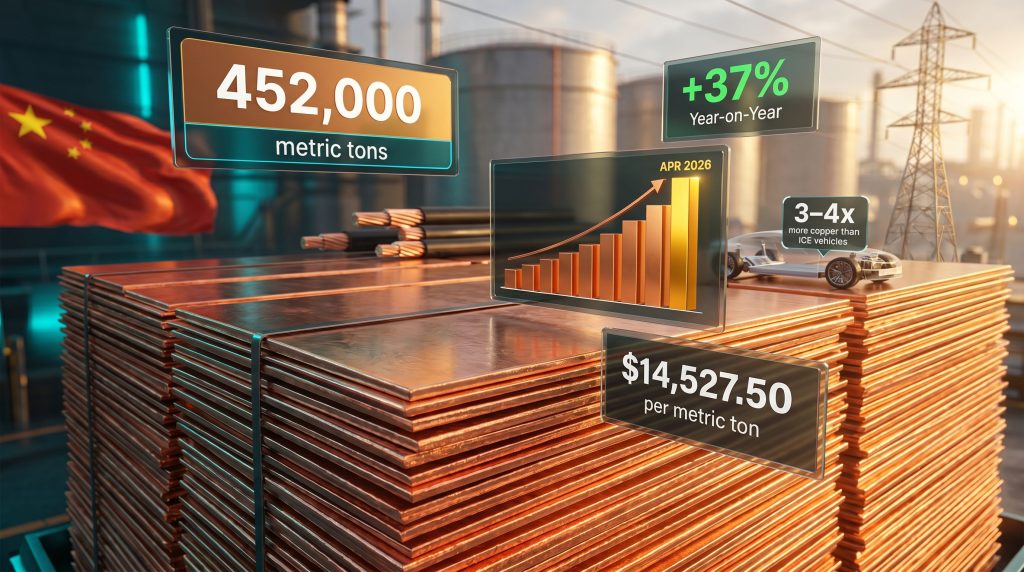
The most consequential driver behind China's surging copper appetite in 2026 is not consumer electronics or construction. It is high-voltage power infrastructure. Chinese power grid investment from January through March 2026 grew by 37% year-on-year, according to state media reporting in April. That pace of capital deployment is extraordinary by any historical comparison, and grid infrastructure is among the most copper-intensive categories of industrial investment that exists.
A single kilometre of high-voltage transmission cable requires substantial quantities of refined copper. When that investment is being deployed at national scale across thousands of kilometres of new and upgraded grid infrastructure, the cumulative copper demand created is not a short-term blip. It is a sustained and compounding off-take that industrial supply chains are being forced to accommodate.
The EV Factor: Multiplying Demand at the Vehicle Level
Running parallel to grid expansion is the continued acceleration of electric vehicle adoption across China and the broader regional market. The geopolitical disruptions of recent years, including energy price volatility linked to the Iran conflict, have intensified consumer and government interest in electrification as an energy security strategy, not merely an environmental one. This is driving EV sales at a pace that compounds copper demand beyond what grid investment alone would generate.
The copper intensity difference between an EV and a conventional internal combustion engine vehicle is significant. An electric vehicle requires roughly three to four times more copper than its petrol or diesel equivalent, accounting for the motor windings, battery management systems, charging components, and power electronics. As production scales into the millions of units per year, that multiplier effect translates into measurable incremental demand that must be sourced from somewhere.
Critically, the charging infrastructure supporting EV adoption carries its own copper requirements entirely separate from the vehicles themselves. Grid connections, fast chargers, and distribution network upgrades all consume refined metal, creating a demand cascade that begins at the vehicle and extends back through the entire energy delivery chain.
April 2026 Import Data: What the Numbers Actually Say
China's April 2026 refined copper import figures, released by customs authorities, delivered a number that caught attention across trading floors: 452,000 metric tons. That represented a 9% increase from March and the highest single-month import volume since September of the prior year. According to recent reporting on China's Q2 refined copper outlook, the momentum behind these figures is broadly expected to continue into the coming months.
Key Statistics at a Glance
| Metric | Value |
|---|---|
| April 2026 Refined Copper Imports | 452,000 metric tons |
| Month-on-Month Change (vs. March 2026) | +9% |
| Highest Monthly Volume Since | September (prior year) |
| SHFE Copper Stockpile Level | 181,333 metric tons |
| Week-on-Week SHFE Stockpile Change | -5.6% |
| Power Grid Investment Growth (Q1 YoY) | +37% |
| Benchmark Price Reference (Jan 29 Record) | $14,527.50 per metric ton |
What makes April's figure structurally significant rather than merely large is the context in which it arrived. Li Ye, deputy general manager at metals trader Eagle Metal, speaking on the sidelines of the LME Week conference in Hong Kong, noted that April's import volume on its own surpassed the combined total from the three preceding months. That is not a statement about seasonal restocking after a quiet holiday period. It is a statement about the scale of latent demand that had accumulated and was being satisfied through import procurement.
Downstream manufacturing orders began recovering sharply from March onward, confirming that the import surge was operationally motivated rather than speculative. Buyers were not building inventory in anticipation of price gains. They were sourcing material because fabrication schedules demanded it.
Reading the Inventory Signal Correctly
One of the more telling indicators preceding the April import surge was the behaviour of copper stockpiles on the Shanghai Futures Exchange. In the week before the customs data release, SHFE copper inventories fell 5.6% week-on-week to 181,333 metric tons, the lowest level recorded since January. That drawdown rate, described by Nicholas Snowdon, head of metals and mining research at Mercuria, as the largest and fastest decline in onshore inventories in months, established a clear causal sequence.
Inventory drawdowns of this speed and scale in a market the size of China's copper sector are not coincidental. They precede import surges by design, because the procurement cycle that responds to falling domestic stock levels takes weeks to move material from international suppliers to Chinese ports. The April customs data was, in a meaningful sense, the delayed answer to a demand signal that flashed in March.
The mechanism here is important for market participants to understand. When exchange-registered copper inventories fall rapidly, it signals that physical off-take is outpacing domestic supply. Trading desks respond by activating import procurement windows, particularly when the arbitrage between international benchmark prices and domestic Chinese copper prices makes imported material economically competitive. The inventory drawdown observed in late Q1 2026 opened exactly such a window, and the April import surge was the predictable result.
The Supply-Side Story: Why Domestic Output Is Falling When Demand Is Rising
The demand side of China's copper equation alone would be enough to drive elevated imports. However, Q2 2026 introduces a supply-side constraint that amplifies the import pull further. Analysts at Shanghai Metals Market flagged in a note published in early May that scheduled smelter maintenance programmes during the second quarter are forecast to reduce refined metal output from domestic facilities. This dynamic directly reinforces the global copper supply gap that has been widening across key producing regions.
Understanding the Smelter Maintenance Cycle
This is a critical technical distinction that is easy to misread. China's smelting sector is not in crisis. There is no structural failure, no unexpected outage, and no supply chain disruption driving this reduction. What is happening is routine: large copper smelters operate on scheduled maintenance cycles that require periodic shutdowns of processing equipment for inspection, repair, and upgrade. These cycles are planned well in advance and are a normal feature of copper refinery operations globally.
The problem arises not from the maintenance itself but from its timing. When scheduled maintenance windows in Q2 coincide with peak demand periods driven by electrification investment, the gap between what domestic smelters can produce and what the market requires becomes a genuine supply deficit. That deficit, regardless of its temporary nature, must be filled from somewhere. In China's case, the answer is refined copper imports from international markets.
The Dual-Track Sourcing Model
China's copper procurement strategy in 2026 reflects a sophisticated dual-track approach that is worth understanding in detail:
- Track One: Importing copper concentrate from mining operations in countries like Chile, Peru, and the Democratic Republic of Congo for processing through China's domestic smelter network. This approach captures refining margin within the Chinese economy and is the preferred long-term strategy.
- Track Two: Importing finished refined copper metal when domestic smelter output is constrained or when demand surges exceed what the smelter network can supply on any given timeframe.
The April 2026 import surge represents an intensification of Track Two activity, driven by Q2 maintenance schedules temporarily reducing the throughput of Track One. What makes this dynamic particularly interesting is that China's smelting capacity has grown substantially, with domestic refined production estimated to have expanded meaningfully in recent years. Yet even with that additional capacity, the combination of peak electrification demand and maintenance-driven output reductions still creates meaningful import dependency in specific quarters.
The Export Paradox at the Aggregate Level
An underappreciated dimension of China's copper refining position is that some smelters are reportedly evaluating whether small volumes of refined copper could be exported to European and other international markets. This may seem counterintuitive at a time when China is simultaneously running elevated import volumes. However, it reflects the geographic and operational unevenness within China's smelting sector.
Some facilities, particularly those that completed capacity expansions recently and are operating outside of maintenance windows, may have surplus output that cannot be efficiently absorbed by nearby domestic demand centres. The economics of exporting that surplus, even in modest volumes, can be preferable to holding excess inventory. This emerging dynamic signals that China's copper refining sector is approaching a scale where it can potentially influence global refined metal flows in both directions simultaneously, a structural shift with significant implications for international pricing dynamics.
Price Transmission: How Chinese Import Volumes Move Global Benchmarks
The connection between China's import volumes and international copper benchmark prices is not theoretical. It operates through a well-established market mechanism. When China draws down global refined copper availability through elevated imports, the tighter global supply-demand balance pushes LME benchmark prices higher. That dynamic was visible in real time as April's import data was processed by markets.
The copper price drivers underpinning this price transmission are multifaceted, spanning grid investment, EV adoption, and smelter capacity constraints. Benchmark copper prices climbed to their highest level since January 29 on the back of strengthening Chinese demand signals. The January 29 reference point carries particular significance: prices on that date reached $14,527.50 per metric ton, a level that traders are monitoring as a potential ceiling to retest if demand momentum holds through Q2.
Scenario Analysis: Four Possible Q2 Trajectories
| Scenario | Import Volume Trajectory | Price Implication |
|---|---|---|
| Demand sustains at April pace | 440,000-460,000 MT/month | Continued upward pressure toward January record |
| Smelter maintenance resolves ahead of schedule | Domestic supply partially offsets demand | Import volumes moderate, price stabilises |
| EV and grid demand accelerates further | Imports potentially exceed 480,000 MT/month | Benchmark retests January record highs |
| Global supply disruption compounds domestic deficit | Import surge intensifies | Price breakout scenario above prior records |
The base case among market participants at LME Week Hong Kong was that Q2 demand conditions would remain supportive of elevated import volumes, with the trajectory of benchmark prices ultimately depending on how quickly Chinese smelters return to full capacity post-maintenance.
What the Electrification Supercycle Looks Like in Customs Data
For years, the concept of an electrification-driven copper supercycle has been framed primarily as a forward-looking investment thesis. The argument was straightforward: as the world transitions away from fossil fuels toward electrified energy systems, copper demand will structurally exceed historical norms for decades. It was a compelling theory, but it remained largely theoretical in its framing.
The April 2026 customs data changes that framing entirely. When monthly import volumes exceed the combined total of the preceding three months, when exchange inventories draw down at the fastest pace in months, and when grid investment is running at 37% above the prior year, the supercycle thesis is no longer a prediction. It is being measured in real-time trade flows. Consequently, Chinese copper buying behaviour is now a primary variable in how global supply and price dynamics are being calibrated.
What Sophisticated Market Participants Are Watching
Several indicators are worth monitoring for anyone tracking this dynamic. In addition, understanding these signals is essential for developing sound copper investment strategies in the current environment:
- SHFE weekly inventory reports as a leading signal for import volumes four to six weeks ahead.
- State Grid Corporation of China capital expenditure announcements as a forward indicator of sustained copper off-take demand.
- Chinese smelter maintenance calendars published through industry consultancies, which telegraph the timing of domestic supply gaps.
- LME cash-to-three-month spread movements, which can signal whether physical tightness is developing in the global refined copper market.
- Arbitrage spread dynamics between Shanghai copper futures and LME prices, which determine when import economics are sufficiently attractive to accelerate procurement.
Each of these indicators provides a different vantage point on the same underlying dynamic: a market where demand is structurally elevated, supply is periodically constrained, and the price mechanism is working to clear that imbalance through elevated import volumes and rising benchmarks. For further context, analysts tracking copper gains have noted that geopolitical risk factors are compounding this demand-driven price environment.
The next major ASX story will hit our subscribers first
Frequently Asked Questions
Why are China's refined copper imports rising in 2026?
China refined copper imports rise on demand pull from two structurally significant sectors: power grid infrastructure investment, which grew 37% year-on-year in Q1 2026, and electric vehicle production and associated charging infrastructure. These demand drivers are coinciding with a period of reduced domestic refined output caused by scheduled Q2 smelter maintenance, creating the supply-demand gap that import procurement is filling.
What was China's April 2026 copper import volume?
Chinese customs data released in May showed April 2026 refined copper imports reached 452,000 metric tons, a 9% increase from March and the highest single-month volume since September of the prior year. Market participants at LME Week in Hong Kong noted that this single month's volume exceeded the combined import total from the first three months of 2026.
How does China's copper demand affect global prices?
When China's refined copper imports rise, the reduction in global refined copper availability tightens the international supply-demand balance, pushing LME benchmark prices higher. The April 2026 import surge coincided with benchmark prices climbing to their highest level since January 29, when they reached a record of $14,527.50 per metric ton.
Is China's copper import surge sustainable through Q2?
Market analysts and traders attending LME Week Hong Kong broadly expected Q2 2026 import volumes to remain elevated. The primary variable determining the pace of imports is how quickly Chinese smelters complete maintenance cycles and return to full output capacity. Until domestic supply recovers, demand-pull conditions will continue to support elevated import volumes.
What is the relationship between SHFE inventory drawdowns and import volumes?
SHFE copper inventory levels function as a leading indicator for import procurement activity. When exchange-registered inventories fall rapidly, it signals that physical demand is outpacing domestic supply, prompting trading desks to activate international procurement. The 5.6% week-on-week decline to 181,333 metric tons observed in late Q1 2026 preceded the April import surge by the typical procurement and shipping lead time, illustrating this causal sequence clearly.
Disclaimer: This article is intended for informational purposes only and does not constitute financial advice, investment recommendations, or solicitation to trade in any commodity or financial instrument. Commodity market forecasts, scenario analysis, and price projections discussed herein involve inherent uncertainty and should not be relied upon as the sole basis for any investment decision. Readers should consult qualified financial advisers before making any investment decisions related to copper markets or mining sector equities.
Want To Know When The Next Major Copper Discovery Hits The ASX?
Discovery Alert's proprietary Discovery IQ model scans ASX announcements in real time, instantly identifying significant mineral discoveries — including copper — so subscribers can act on actionable opportunities before the broader market reacts. Start a 14-day free trial at Discovery Alert today, or explore how historic mineral discoveries have generated substantial returns to understand what early positioning in a supply-constrained market can mean for investors.