
July 31, 2026
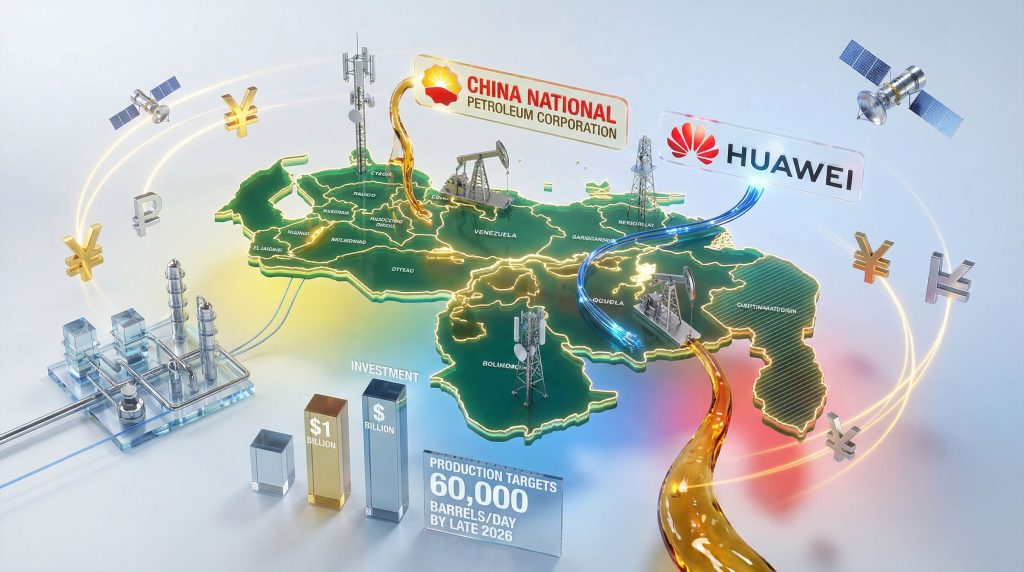
Looking at the rapid evolution of global geopolitical dynamics, Chinese economic engagement in Latin America has transformed from opportunistic investment to strategic necessity. As traditional Western financial channels face increasing restrictions, alternative economic partnerships emerge as critical components of both resource security and diplomatic influence. The sophisticated interplay between state-directed capital flows, private sector risk tolerance, and sanctions adaptation mechanisms creates a complex investment landscape that demands careful analysis, particularly when considering broader US‑China trade war impacts.
Understanding China Venezuela investments requires examining multiple layers of strategic positioning, from energy infrastructure development to telecommunications network deployment. These investments operate within frameworks designed to withstand political volatility while advancing broader regional objectives.
Energy Infrastructure and Production Operations
Chinese energy sector involvement in Venezuela centers around China National Petroleum Corporation's PetroSinovensa joint venture, established in 2008 through partnership with Venezuela's state-owned PDVSA. This operation focuses on extracting extra-heavy crude from the Orinoco Belt, which contains the world's largest proven oil reserves located within the East Venezuela Basin along the Orinoco River.
The strategic positioning within these heavy crude operations reflects China's long-term energy diversification strategy. Venezuelan crude shipments serve dual purposes: meeting Chinese refining capacity requirements while servicing Venezuela's sovereign debt obligations through commodity-backed financing arrangements. Furthermore, these energy partnerships often align with broader OPEC meeting oil impact considerations.
Private Sector Investment Acceleration
Despite challenging operating conditions, private Chinese enterprises have demonstrated remarkable resilience in pursuing Venezuelan opportunities. China Concord Resources Corporation initiated development of two Venezuelan oilfields in August 2025, operating under a comprehensive 20-year agreement signed in 2024.
Key investment parameters include:
- Total planned investment: $1 billion USD
- Production target: 60,000 barrels per day
- Target timeline: Late 2026
- Contract duration: 20 years
This private sector engagement represents a significant shift in Chinese investment patterns, where state-led initiatives previously dominated energy sector commitments. The transition reflects both evolving risk assessment frameworks and growing confidence in long-term operational viability despite political uncertainties. However, investors must remain vigilant about investment risk flags when evaluating such high-risk ventures.
Telecommunications Network Infrastructure
Chinese telecommunications giants have established dominant positions across Venezuelan communication networks through systematic infrastructure development and technology deployment. Huawei Technologies secured its initial major Venezuelan contract in 2004 through a $250 million agreement focused on fiber optic infrastructure enhancement.
The telecommunications investment portfolio encompasses:
- Fiber optic backbone infrastructure
- 4G network support and maintenance
- Technology transfer initiatives
- Local capacity building programs
These telecommunications investments create strategic dependencies that extend beyond commercial relationships into national security considerations for both nations. The infrastructure provides China with regional connectivity capabilities while offering Venezuela technological modernization otherwise unavailable through traditional Western suppliers.
When big ASX news breaks, our subscribers know first
Sanctions Navigation and Economic Adaptation
International sanctions regimes have fundamentally altered Chinese investment strategies in Venezuela, forcing adaptation of traditional financing and operational models. While comprehensive sanctions details remain classified, observable patterns indicate sophisticated circumvention mechanisms designed to maintain economic relationships despite external pressure.
The transition period during peak sanctions implementation revealed declining state-led investment flows, with total China Venezuela investments decreasing over recent years. However, this reduction was partially offset by increased private sector initiative, suggesting coordinated strategic adaptation rather than wholesale retreat.
Alternative Financial Mechanisms
Chinese enterprises have developed innovative financial structures to maintain Venezuelan operations while minimizing sanctions exposure. These mechanisms include:
- Commodity-backed financing: Direct crude oil shipments serving debt service obligations
- Alternative payment systems: Reduced reliance on traditional banking channels
- Local currency arrangements: Minimised dollar-denominated transactions
- Barter trade structures: Goods-for-services exchanges
Disclaimer: Financial mechanism details are based on publicly available information and may not reflect complete operational structures due to confidentiality requirements.
Political Risk Assessment and Asset Protection
Recent developments have dramatically altered the risk landscape for Chinese assets in Venezuela. The capture of President Nicolás Maduro by US forces on January 4, 2026, occurring just hours after a three-hour meeting with Chinese special envoy Qiu Xiaoqi to reaffirm strategic partnership commitments, represents the exact political transition scenario that investment protection frameworks were designed to address.
According to The Economic Times, Chinese investments in Venezuela exceed $100 billion in loans across various sectors, highlighting the significant exposure at stake.
Asset Vulnerability Analysis
Chinese investments face multiple layers of political risk exposure:
- Operational continuity risks: Production facility security and workforce stability
- Contract validity concerns: Legal framework changes under new government structures
- Asset nationalisation possibilities: State appropriation of foreign-owned infrastructure
- Technology transfer reversibility: Intellectual property and technical knowledge protection
The timing of political developments creates particular challenges for China Concord Resources' billion-dollar oilfield development, which targets 60,000 barrels per day production by late 2026. This timeline now operates under completely altered political assumptions.
International Legal Protections
Chinese enterprises typically structure Venezuelan investments with multiple protective mechanisms:
- International arbitration clauses: Dispute resolution through neutral tribunals
- Sovereign immunity provisions: Protection against discriminatory treatment
- Third-party insurance coverage: Political risk mitigation through specialised insurers
- Bilateral investment treaty protections: State-to-state agreement coverage
However, the effectiveness of these protections depends heavily on international recognition of governing authorities and enforcement capability across jurisdictions. Additionally, the broader tariff policy implications could affect the overall investment climate.
Regional Strategic Implications
Chinese economic engagement in Venezuela extends far beyond bilateral commercial relationships, representing a cornerstone of broader Latin American strategy development. The investments serve as testing grounds for sanctions-resistant economic models while establishing precedents for alternative development financing.
Economic Statecraft Through Resource Partnerships
Venezuela's role in Chinese regional strategy encompasses multiple dimensions:
| Strategic Element | Venezuelan Contribution | Regional Extension |
|---|---|---|
| Energy Security | Heavy crude supply diversity | Alternative supplier network |
| Financial Innovation | Sanctions circumvention models | Payment system independence |
| Technology Deployment | Network infrastructure testing | Regional connectivity hubs |
| Diplomatic Leverage | Alternative development models | South-South cooperation frameworks |
The Venezuelan investment portfolio provides China with practical experience managing high-risk, high-reward emerging market commitments while developing capabilities applicable across similar challenging environments. These strategies often parallel approaches seen in Zijin global expansion initiatives.
Investment Risk Management Frameworks
Chinese enterprises operating in Venezuela have developed sophisticated risk assessment and mitigation strategies adapted to extreme political and economic volatility. These frameworks balance aggressive growth objectives with protection of committed capital through diversified approaches.
Operational Security Protocols
High-risk environment operations require specialised management approaches:
- Local partnership selection: Careful due diligence on Venezuelan counterparts
- Security infrastructure investment: Physical asset protection systems
- Emergency response planning: Rapid evacuation and asset protection procedures
- Communication system redundancy: Multiple channels for operational coordination
Technology Transfer Limitations
Chinese enterprises carefully balance technology sharing requirements with intellectual property protection in unstable jurisdictions. This involves selective deployment of proprietary technologies while maintaining competitive advantages through controlled knowledge transfer.
According to South China Morning Post, China remains committed to its Venezuela partnerships despite recent political developments.
Future Scenario Analysis and Strategic Projections
Current political developments in Venezuela have transformed theoretical scenario planning into immediate operational reality. Chinese investment protection strategies now face real-world testing under the most challenging circumstances outlined in risk assessment frameworks.
Regime Change Impact Modeling
The capture of Nicolás Maduro creates immediate uncertainty for all China Venezuela investments, particularly affecting:
- Contract continuity: New government recognition of existing agreements
- Operational permissions: Continued production and development authorisation
- Financial arrangements: Debt service obligations and payment mechanisms
- Technology access: Telecommunications infrastructure control and management
Investment Recovery Scenarios
Chinese enterprises must now evaluate multiple potential outcomes:
- Diplomatic normalisation: Improved US-Venezuela relations creating new opportunities
- Asset renegotiation: Contract modifications under new government structures
- Operational suspension: Temporary cessation pending political stabilisation
- Strategic withdrawal: Coordinated asset liquidation and capital redeployment
Investment Disclaimer: All scenario analyses involve significant uncertainty and speculative elements. Actual outcomes may differ materially from projections based on rapidly evolving political and economic conditions.
The next major ASX story will hit our subscribers first
Belt and Road Initiative Integration Potential
Venezuelan investments represent potential integration points for broader Belt and Road Initiative expansion across Latin America. The existing infrastructure foundations and established operational relationships provide platforms for enhanced regional connectivity projects.
Future integration possibilities include:
- Infrastructure corridor development: Cross-border transportation and communication links
- Regional development finance: Expanded lending and investment frameworks
- Technology standardisation: Common telecommunications and energy system protocols
- Alternative governance models: South-South cooperation mechanism advancement
Strategic Investment Assessment Conclusion
China's Venezuelan economic exposure encompasses energy infrastructure worth billions of dollars, telecommunications networks spanning national coverage, and private sector commitments targeting significant production expansion. These China Venezuela investments operate within complex frameworks designed to manage extreme political and economic volatility while advancing strategic regional objectives.
Recent political developments have transformed theoretical risk scenarios into immediate operational challenges, testing the resilience of established investment protection mechanisms. The outcome of current uncertainties will likely influence Chinese emerging market investment strategies across multiple regions and establish precedents for sanctions-resistant economic engagement models.
Chinese enterprises in Venezuela must now navigate the most challenging operating environment since initial investment deployment, balancing asset protection requirements with long-term strategic positioning objectives. The resolution of current political transitions will determine whether Venezuelan investments serve as successful models for alternative economic partnerships or cautionary examples of extreme emerging market risks.
This analysis is based on publicly available information as of January 5, 2026. Political and economic conditions in Venezuela remain highly fluid, and investment outcomes may vary significantly from current assessments.
Are You Tracking Major Mineral Discoveries Across Volatile Markets?
While geopolitical developments create uncertainty in traditional investment markets, significant mineral discoveries continue to emerge across the ASX, offering immediate opportunities for informed investors. Discovery Alert's proprietary Discovery IQ model delivers instant notifications on major ASX mineral discoveries, transforming complex geological data into actionable insights that help investors identify opportunities ahead of broader market movements—begin your 30-day free trial today to secure your market advantage.