
July 16, 2026
The Quiet Revolution in Global Trade Architecture
For decades, the dominant narrative around Africa's place in the global trading order has been one of dependency: resource-rich but structurally disadvantaged, supplying raw materials to industrialised economies while importing finished goods at a persistent terms-of-trade deficit. That structural imbalance is now being tested by a sweeping policy shift originating in Beijing, one that carries implications far beyond any single bilateral relationship.
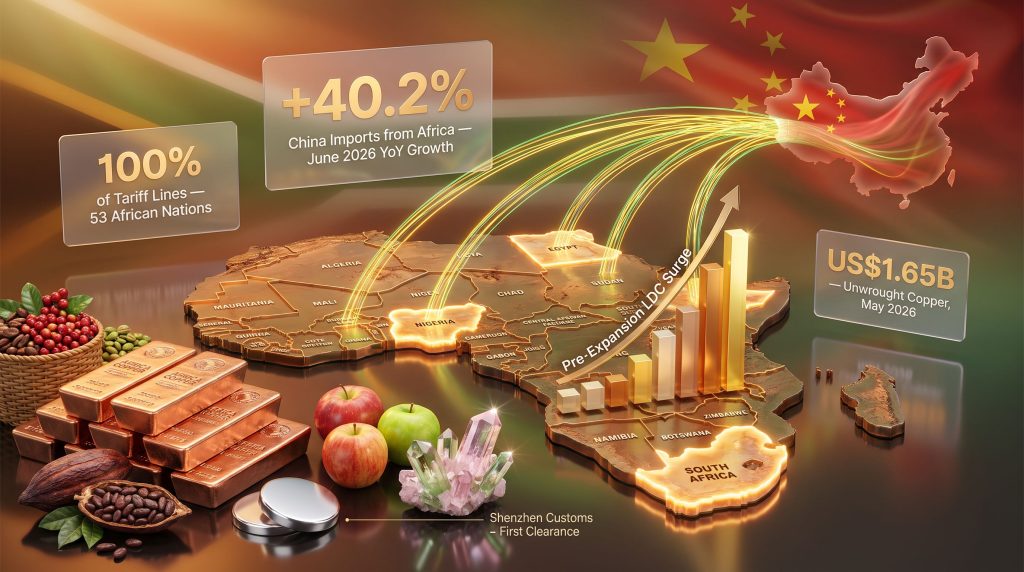
China's decision to extend zero-tariff access across every tariff line to 53 African nations, effective May 1, 2026, represents a significant dimension of the China zero-tariff policy Africa imports conversation that no major economy has previously attempted at continental scale. Furthermore, understanding what this shift means, what it is already producing in customs data, and where its limits lie, requires moving well beyond the headline numbers.
When big ASX news breaks, our subscribers know first
How the Zero-Tariff Framework Is Actually Structured
The 2026 expansion builds on a foundation already laid in December 2024, when China extended permanent zero-tariff access to imports from 33 African least developed countries (LDCs). That earlier move generated measurable results: between December 2024 and March 2026, Chinese imports from African LDCs rose 15.2% year-on-year to $21.42 billion, with coffee imports surging 70.4% and cocoa bean imports climbing 56.8%.
The May 2026 expansion takes a fundamentally different step by removing the income-tier restriction entirely. Middle-income economies, including Kenya, Egypt, Nigeria, South Africa, and Morocco, are now included under the same duty-free framework. The only nation excluded is Eswatini, which maintains diplomatic recognition of Taiwan rather than the People's Republic of China.
For non-LDC nations, the preferential access carries a two-year duration through April 2028, during which China intends to negotiate a permanent China-Africa Economic Partnership for Shared Development agreement. For the 33 LDCs, the zero-tariff status is indefinite. The fiscal scale of this commitment is notable. Economists estimate China is forgoing approximately $1.4 billion USD in annual tariff revenue under the expanded framework, a deliberate and quantifiable economic concession.
What the Early Trade Data Is Actually Telling Us
The customs data released for May and June 2026 has already produced figures that demand attention:
| Metric | May 2026 | June 2026 |
|---|---|---|
| China imports from Africa (YoY growth) | +21.1% | +40.2% |
| Unwrought copper imports from Africa | +110% / US$1.65B | Not yet published |
| Crude oil imports from Africa | +21% / US$3.11B | Not yet published |
| Rhodium powder imports | ~5x surge / US$125M+ | Not yet published |
Two details in this data deserve careful interpretation. First, both months outpaced China's overall import growth rate during the same period, which means this is not simply a reflection of broad Chinese import demand. Africa-specific momentum is identifiable in the data. Second, the acceleration from +21.1% in May to +40.2% in June suggests the policy's effects are compounding rather than plateauing in its opening months.
The Critical Minerals Story: Demand-Driven, Not Just Tariff-Driven
It would be analytically imprecise to attribute the minerals surge primarily to the zero-tariff policy. Iron ore, copper, and several other mineral categories were largely already duty-free before the 2026 expansion. The dramatic volume increases in these categories reflect something structurally different: China's escalating critical minerals demand tied to clean energy transition, artificial intelligence infrastructure, and semiconductor manufacturing.
The figures are striking on their own terms:
- Unwrought copper from the Democratic Republic of Congo and Zambia exceeded US$1.65 billion in a single month, more than doubling year-on-year.
- Rhodium powder, a precious metal with critical industrial applications in catalytic converters and chemical manufacturing, surged nearly fivefold to surpass US$125 million in May alone.
- Platinum and spodumene (a lithium-bearing mineral central to battery and fuel cell production) recorded sharp volume increases, reflecting China's aggressive scaling of its electric vehicle and energy storage supply chains.
The distinction between tariff-driven and demand-driven trade growth matters enormously for projecting the durability of this surge. Mineral volume increases tied to China's structural economic transformation are likely to persist regardless of tariff policy; agricultural gains are more directly attributable to the zero-tariff framework itself.
Crude Oil: A Geopolitical Dimension Reshaping African Supply Chains
Africa's crude oil exports to China reached US$3.11 billion in May 2026, making energy the single largest import category China sources from the continent. While tariff changes play a role, a more immediate driver is geopolitical disruption. The ongoing conflict involving the United States, Israel, and Iran has created significant uncertainty around oil flows through the Strait of Hormuz, one of the world's most strategically sensitive maritime chokepoints.
Chinese energy procurement has responded by tilting further toward African suppliers, including Angola, Nigeria, and Libya. This dynamic illustrates how the broader geopolitical metals landscape and Middle Eastern geopolitical risk are functioning as indirect but powerful accelerants to China-Africa energy trade, layered on top of the zero-tariff framework's direct incentive effects.
Agricultural Exports: The Policy's Highest-Upside Frontier
While minerals dominate the volume figures, agriculture represents the sector where the China zero-tariff policy Africa imports framework has its most transformative structural impact relative to the baseline. Agricultural goods that previously faced Most Favoured Nation (MFN) tariff rates of 8% to 30% now enter China entirely duty-free, fundamentally altering their price competitiveness against suppliers from non-African origins.
| Product | Key Export Nations | Previous MFN Tariff | Zero-Tariff Impact |
|---|---|---|---|
| Cocoa | Côte d'Ivoire, Ghana | 8%–30% | High competitiveness gain |
| Coffee | Kenya | 8%–30% | High competitiveness gain |
| Avocados | Kenya | 8%–30% | Emerging export category |
| Citrus Fruits | South Africa | 8%–30% | Significant price advantage |
| Wine | South Africa | 8%–30% | New market access opportunity |
| Apples | South Africa | 8%–30% | First batch cleared customs May 1 |
The symbolic first transaction under the new framework was a shipment of 24 tonnes of South African apples processed through Shenzhen customs on May 1, 2026. While modest in volume, it marked the opening of a meaningful new export corridor for South African horticulture into one of the world's largest consumer markets.
The pre-expansion LDC data provides a useful forecast signal: coffee imports from African LDCs surged 70.4% and cocoa bean imports climbed 56.8% following the December 2024 policy. Applying that trajectory to the now-expanded universe of eligible agricultural exporters — including South Africa, Kenya, Egypt, and Morocco — suggests the agricultural uplift could be substantial over a 12 to 24-month horizon. China's official policy documentation outlines the specific product categories and compliance frameworks underpinning this expansion.
The Structural Barriers That Tariffs Cannot Remove
Zero tariffs are a necessary condition for expanded trade, but they are not a sufficient one. Several structural constraints limit how quickly African agricultural exporters in particular can scale into Chinese market volumes:
- Cold-chain logistics deficits: Perishable agricultural goods require unbroken cold-chain infrastructure from farm to port to Chinese distribution centre. Many African export corridors lack the refrigerated storage, port-side handling capacity, and freight reliability to support large-scale perishable exports.
- Sanitary and phytosanitary (SPS) compliance complexity: Chinese food import regulations are stringent, covering pesticide residue limits, certification requirements, and approved country-of-origin protocols. Compliance capacity varies significantly across African nations, and approval processes can take years.
- State procurement inertia: Chinese state-owned enterprises and large procurement bodies operate through established supply relationships that do not automatically redirect because tariff conditions change. Building new supply chain relationships requires sustained commercial effort on both sides.
- Financial connectivity gaps: Limited integration between African economies and China's payment infrastructure, including cross-border RMB settlement systems, can create friction that slows otherwise favourable trade activity.
Tariff removal creates the opportunity; logistics, standards, and financial infrastructure determine whether that opportunity is actually captured. The historical pattern across similar trade frameworks suggests structural gaps can delay the realisation of policy intent by years.
How China's Framework Compares to Other Africa Trade Agreements
| Framework | Offering Party | Coverage | Duration | Status |
|---|---|---|---|---|
| China Zero-Tariff Policy (2026) | China | 100% of tariff lines, 53 nations | 2 years for non-LDCs; permanent for LDCs | Active since May 1, 2026 |
| African Growth and Opportunity Act (AGOA) | United States | Duty-free on eligible goods | Multi-year, subject to renewal | Renewal uncertain |
| EU-Africa Economic Partnership Agreements | European Union | Partial, country-specific | Ongoing negotiation | Fragmented |
| China LDC Zero-Tariff Policy (2024) | China | 100% of tariff lines, 33 LDCs | Permanent | Active since Dec 1, 2024 |
China's framework is currently the broadest in continental scope and the most uniformly applied of any major economy's Africa trade arrangement. The key vulnerability is the non-LDC two-year sunset clause, which introduces a renegotiation risk that African governments and exporters must actively plan around.
The African Growth and Opportunity Act, for context, has faced recurring renewal uncertainty and applies selectively to eligible product categories rather than covering all tariff lines. For African export planners weighing near-term market access reliability, China's current offer is structurally more predictable, at least through April 2028. The Brookings Institution's analysis of whether this zero-tariff policy can genuinely rebalance China-Africa trade offers a sobering assessment of the structural hurdles that remain.
The next major ASX story will hit our subscribers first
The Strategic Logic Behind Beijing's Trade Concessions
Reading this policy purely as an economic gesture misses its broader function. In addition to resource security objectives, China's zero-tariff expansion serves at least three simultaneous strategic purposes:
- Resource security: Locking in preferential access to African critical minerals, energy, and agricultural commodities as global supply chain competition intensifies — particularly given evolving US-China trade war impacts on global sourcing patterns.
- Geopolitical positioning: Deepening relationships with African governments at a moment when Western economic engagement with the continent is fractured and uncertain, reinforcing Beijing's influence across multilateral forums where African votes matter.
- Market development: Creating conditions for Chinese manufactured goods and infrastructure investment to flow into African markets as purchasing power and export revenues expand, establishing long-term commercial reciprocity.
The two-year non-LDC window functions as a structured negotiating runway. If the proposed China-Africa Economic Partnership for Shared Development agreement is concluded on terms favourable to Beijing, the zero-tariff access becomes permanent and the commercial relationships built during the window period become institutionalised. Considerations around energy security in minerals supply chains are also central to Beijing's calculus here.
What the Two-Year Window Means for African Exporters
For African governments and export industries, the period between now and April 2028 represents a defined strategic opportunity with a hard deadline. The China zero-tariff policy Africa imports framework rewards early movers; however, those that treat this as a two-year experiment rather than a structural transition will likely find themselves renegotiating from a weaker position. Consequently, the priorities for maximising the window are clear:
- Accelerating port and cold-chain infrastructure development to enable perishable agricultural exports at scale.
- Pursuing SPS compliance certification with Chinese authorities for additional agricultural product categories and producer regions.
- Engaging Chinese commercial partners directly to build supply relationships that persist beyond any single policy cycle.
- Participating constructively in the Economic Partnership negotiations to advocate for permanent agricultural zero-tariff access and harmonised standards frameworks.
Countries that use the window to build genuine trade infrastructure will be positioned to lock in long-term gains, and those exploring broader commodities diversification strategies will find this period particularly consequential for portfolio positioning.
Frequently Asked Questions: China Zero-Tariff Policy Africa Imports
Which African countries are excluded from China's zero-tariff policy?
Only Eswatini is excluded from China's 2026 zero-tariff framework, due to its diplomatic recognition of Taiwan rather than the People's Republic of China. All 53 other African nations maintaining diplomatic ties with Beijing are eligible under the expanded policy.
What products benefit most from China's zero-tariff policy for Africa imports?
The greatest beneficiaries are agricultural products that previously faced MFN tariff rates of 8% to 30%, including cocoa, coffee, avocados, citrus fruits, wine, and apples. Minerals such as copper and iron ore were largely already duty-free and see demand-driven rather than tariff-driven volume growth.
How long does China's zero-tariff policy for Africa last?
For the 33 African LDCs, zero-tariff access is permanent. For the 20 non-LDC African countries newly included in the 2026 expansion, the preferential rate applies for two years until April 2028, pending the outcome of ongoing partnership agreement negotiations.
How much tariff revenue is China forgoing under this policy?
Economists estimate China is forgoing approximately $1.4 billion USD in annual tariff revenue under the expanded zero-tariff framework, representing a deliberate and quantified strategic concession.
How does China's Africa policy compare to the US AGOA program?
China's policy covers 100% of tariff lines across 53 nations through a unified framework, while AGOA applies selectively to eligible goods and faces uncertain renewal prospects. China's approach is currently broader in scope and more stable in its near-term application, making it the more predictable framework for African export planners operating on a two-to-three year horizon.
This article presents publicly available trade data and policy analysis for informational purposes. Trade forecasts and projections involve inherent uncertainty and should not be relied upon as the sole basis for commercial or investment decisions. Readers are encouraged to consult primary customs data sources and independent economic analysis when evaluating the trajectory of China-Africa trade flows.
Want to Stay Ahead of the Commodity Discoveries Driving Global Trade Shifts?
As African mineral exports surge and critical minerals demand reshapes supply chains worldwide, Discovery Alert's proprietary Discovery IQ model delivers real-time ASX mineral discovery alerts, transforming complex commodity data into actionable investment insights — explore historic discovery returns on the Discovery Alert discoveries page and begin your 14-day free trial to position yourself ahead of the next major find.