August 20, 2026
The Global Race to Manufacture Green Aluminium Is Just Beginning
Across the industrial world, a quiet but consequential shift is underway. The question of where aluminium gets made is becoming as strategically important as how much gets made. Energy costs, carbon regulations, and supply chain geography are converging to redraw the map of global aluminium manufacturing. Emerging economies with abundant renewable resources, strategic port access, and large labour pools are repositioning themselves not as raw material exporters but as value-added industrial producers. Egypt, sitting at the intersection of three continents with one of the world's most critical maritime corridors running through its territory, is making a calculated bid to be at the centre of this transformation.
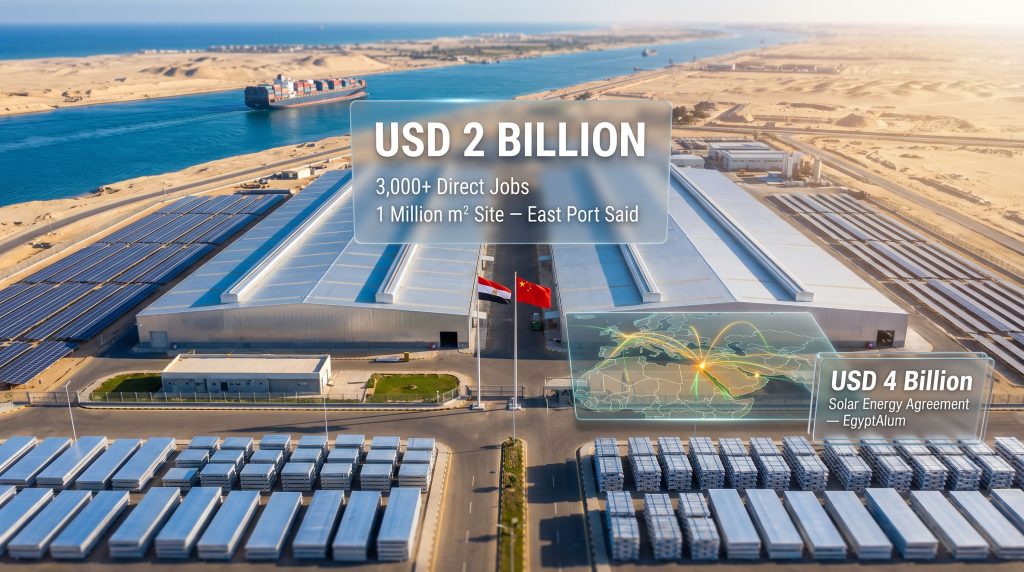
A proposed USD 2 billion Chinese aluminium investment in Egypt centred on a clean energy complex within the Suez Canal Economic Zone is one of the most significant signals yet that this geographic and industrial realignment is gathering momentum. Furthermore, aluminium industry leaders globally are watching this development closely as it could reshape competitive dynamics across multiple markets.
When big ASX news breaks, our subscribers know first
The Suez Canal Economic Zone: More Than a Transit Corridor
Why Industrial Capital Is Flowing Into SCZone
The Suez Canal Economic Zone has long been understood as a logistics asset. What is less widely appreciated is its evolution into a genuine industrial manufacturing destination. The SCZone's legal and regulatory architecture was specifically designed to reduce friction for large-scale foreign manufacturers, offering customs facilitation, tax incentive structures, and streamlined approvals within a special economic framework that sits partly outside Egypt's standard regulatory environment.
For export-oriented heavy industry, this matters enormously. A facility positioned within SCZone gains preferential logistics access to the Suez Canal itself, meaning finished goods can reach Mediterranean, Red Sea, Gulf, East African, and European markets through a single port corridor. Very few locations on earth offer this breadth of market reach within a single operational footprint.
Egypt's Triangulated Market Position
Egypt's geographic advantage is not simply about proximity to Europe. It is about the rare combination of simultaneous access to:
- African markets, where aluminium demand is growing rapidly alongside urbanisation and infrastructure development
- Middle Eastern markets, where construction and manufacturing activity drives substantial aluminium consumption
- European markets, which represent the world's most demanding and highest-value aluminium import destination
No single alternative manufacturing location in Southeast Asia or West Africa replicates this triangulated access. That geographic reality is central to why a Chinese aluminium manufacturer identified in reports as Henan Zhongfu Industry Co., one of China's prominent aluminium producers, is examining Egypt as an overseas production base rather than simply an export destination.
Project Architecture: What the Proposed Complex Would Actually Do
Scale, Footprint, and Industrial Scope
The proposed facility would occupy a site exceeding 1 million square metres in the East Port Said area of the Suez Canal Economic Zone. At that scale, this is not a downstream processing plant or a simple fabrication facility. The design intent is an integrated aluminium manufacturing complex, combining multiple production stages within a single industrial precinct.
The product mix being discussed reflects where aluminium demand is heading globally:
- Aluminium sheet products for construction and industrial applications, representing the broadest volume market
- Battery-grade aluminium components serving the electric vehicle and energy storage sectors, among the fastest-growing aluminium end-use categories
- Specialised materials for automotive, aviation, and railway applications, which command significant price premiums over commodity sheet
| Project Detail | Specification |
|---|---|
| Proposed Investor | Henan Zhongfu Industry Co. |
| Total Investment Value | USD 2 billion |
| Location | Suez Canal Economic Zone, East Port Said |
| Site Area | Over 1 million square metres |
| Direct Employment | 3,000+ jobs |
| Energy Model | Clean energy-powered production |
| Target Export Markets | Egypt, Africa, Middle East, Europe |
| Current Project Status | Discussion and planning stage |
The Technology Transfer Dimension That Capital Alone Cannot Buy
Egyptian authorities have framed the proposed investment in terms that go beyond the financial headline. The focus on technology and expertise transfer reflects a sophisticated understanding of what industrial development actually requires. Capital investment builds physical capacity. Technology transfer builds institutional capability, which is the more durable and strategically valuable outcome.
For Egypt, this distinction matters because the country currently lacks large-scale domestic capability in battery-grade aluminium component fabrication and advanced aerospace-specification materials production. Embedding those manufacturing methodologies, workforce skills, and process technologies within Egyptian industrial infrastructure creates productive capacity that persists regardless of any single investor relationship.
The Clean Energy Calculus: Why This Is Not Optional
Energy Intensity and the Carbon Cost of Aluminium Production
Aluminium smelting sits near the top of the industrial energy consumption hierarchy. Producing a single tonne of primary aluminium through conventional electrolytic reduction requires between 13,000 and 17,000 kilowatt-hours of electricity, roughly equivalent to the annual electricity consumption of several average households. At that energy intensity, the source of power is not a secondary consideration. It is the primary determinant of both the cost structure and the emissions profile of any aluminium operation.
Coal-powered aluminium production, which still dominates output in parts of China and India, carries an embedded carbon intensity that is becoming a direct financial liability rather than merely an environmental concern. In addition, green metals pricing trends increasingly reflect this carbon cost differential, with clean-energy producers commanding measurable premiums in forward contracts.
CBAM: When Carbon Becomes a Tariff
The European Union's Carbon Border Adjustment Mechanism represents a structural shift in how aluminium trade economics work. Under the CBAM framework, which progressively tightens from 2026 onward:
- Aluminium exporters shipping into EU markets must declare the embedded carbon content of their products
- Importers bear a carbon price equivalent to what EU-based producers pay under the Emissions Trading System
- Facilities powered by clean energy carry measurably lower CBAM liabilities, translating directly into lower landed costs in Europe
- Coal-powered competitors face the full carbon price differential, eroding their cost advantage over time
For a clean-energy aluminium complex in Egypt, access to abundant solar and wind resources transforms the country's renewable endowment from an environmental asset into a structural export competitiveness advantage in Europe's market.
This is a decisive factor in the investment logic. Egypt's solar irradiance levels consistently rank among the highest globally. Developing aluminium production powered by renewables in Egypt is not an aspirational sustainability statement. It is a market access strategy for the world's most lucrative aluminium import destination. Consequently, aluminium tariff impacts in other regions are further accelerating the search for tariff-resilient manufacturing locations.
Egypt's Parallel Decarbonisation Push at Home
The proposed Henan Zhongfu investment does not exist in isolation. Egypt is simultaneously advancing a USD 4 billion solar energy agreement designed to supply the state-owned aluminium producer EgyptAlum with renewable electricity. The parallel nature of these two initiatives, one focused on attracting foreign clean-energy manufacturing investment and the other on decarbonising domestic aluminium production, indicates a coherent national industrial strategy rather than opportunistic deal-making.
Chinese companies already hold a meaningful operational footprint within Egypt's renewable energy infrastructure, having participated in solar and wind project development across the country. This existing presence reduces integration risk for a clean-powered aluminium facility, since renewable energy supply chains, grid connection expertise, and bilateral investment frameworks are already embedded in the Egyptian market. For further context on China's industrial demand dynamics, the pressures driving Chinese manufacturers to seek overseas production bases are well documented.
Competing Locations: How Egypt Stacks Up
A Comparative Framework for Emerging Aluminium Manufacturing Destinations
| Competitive Factor | Egypt (SCZone) | Southeast Asia | West Africa |
|---|---|---|---|
| Geographic Access to EU Markets | High | Low | Moderate |
| Access to African Markets | High | Low | High |
| Renewable Energy Availability | High (solar, wind) | Variable | Variable |
| Port and Canal Infrastructure | Strong (Suez access) | Strong | Developing |
| Workforce Scale | Large, growing | Large | Moderate |
| Special Economic Zone Framework | Established | Established | Emerging |
| CBAM Competitive Positioning | Favourable | Unfavourable | Moderate |
The CBAM variable is increasingly the differentiating factor. Southeast Asian aluminium producers, despite competitive labour costs and strong port infrastructure, face a significant structural disadvantage in European market access due to their grid's current reliance on fossil fuel generation. Egypt, with its solar potential and proximity to Europe, is positioned to capture market share as CBAM pricing bites harder through the late 2020s. Australia's own green metals leadership trajectory offers a useful comparative example of how renewable-powered production can reshape export competitiveness.
Economic Impact: Reading Beyond the Headline Job Figure
Employment Multipliers and the Broader Labour Market Effect
The projected 3,000+ direct jobs associated with the proposed complex represents only the most visible layer of the employment impact. Industrial economists consistently apply employment multiplier ratios when assessing manufacturing facility impacts, accounting for upstream supply chain roles in raw materials procurement, logistics, and utilities, as well as downstream employment in processing, distribution, and export services.
Applying a conservative multiplier of 2.5 times to the direct employment projection suggests a potential total employment effect exceeding 7,500 positions across the broader Egyptian economy. More optimistic multiplier assumptions, which are defensible for integrated manufacturing complexes with diverse supply chain requirements, push that figure higher still.
Export Revenue Potential and Foreign Exchange Generation
An integrated aluminium complex of this scale targeting African, Middle Eastern, and European export markets carries substantial foreign exchange generation potential. Comparable facilities operating at full capacity in similarly positioned economies have demonstrated annual export revenues in the USD 800 million to USD 1.5 billion range. For an economy actively managing foreign exchange dynamics as part of its macroeconomic stabilisation programme, recurring hard currency inflows from manufactured exports represent a qualitatively different form of economic benefit than one-off capital inflows.
The next major ASX story will hit our subscribers first
What Remains Uncertain: A Realistic Assessment
Project Status and the Gap Between Discussion and Commitment
Intellectual honesty requires a clear-eyed reading of where this project actually stands. The investment has not been formally committed through binding agreements. No construction commencement has been announced. Regulatory approvals have not been confirmed. The following table maps what is and is not established:
| Status Element | Confirmed | Unconfirmed |
|---|---|---|
| Investor interest formally expressed | Yes | |
| Government-level discussions held | Yes | |
| Formal binding investment commitment | Not yet confirmed | |
| Construction commenced | Not yet confirmed | |
| Regulatory approvals granted | Not yet confirmed | |
| Energy supply agreements finalised | Not yet confirmed |
This article reflects the project's status as at the time of reporting. The proposed USD 2 billion investment remains at the discussion and planning stage. Readers should not interpret coverage of this proposal as confirmation of project execution or timeline certainty.
Macro and Geopolitical Variables That Could Shift the Timeline
Several external factors have a legitimate bearing on whether and when this project progresses:
- Global aluminium price volatility affects project return projections and investor appetite for large capital commitments
- Egypt's macroeconomic trajectory, including currency dynamics and the ongoing stabilisation programme, influences the real cost environment for foreign investors
- Evolving US-China trade tensions create downstream uncertainty for Chinese overseas industrial investment patterns globally
- CBAM implementation pacing affects the urgency of establishing clean-energy production capacity in EU-proximate markets
Frequently Asked Questions
What Is the Proposed Chinese Aluminium Investment in Egypt?
Henan Zhongfu Industry Co., a major Chinese aluminium manufacturer, is in discussions with Egyptian authorities regarding a USD 2 billion integrated aluminium manufacturing complex in the Suez Canal Economic Zone. The facility would operate on clean energy and is projected to generate more than 3,000 direct jobs. This represents one of the most significant examples of Chinese aluminium investment in Egypt's clean energy complex development to date.
Where Would the Aluminium Complex Be Located?
The proposed facility would be situated within the Suez Canal Economic Zone, with East Port Said identified as the specific development location. The site footprint is described as exceeding 1 million square metres.
What Products Would the Complex Produce?
The proposed output mix includes aluminium sheet products for construction and industrial use, battery-grade aluminium components for electric vehicles and energy storage systems, and specialised materials for automotive, aviation, and railway applications.
Why Is Clean Energy So Central to the Investment Rationale?
Aluminium production is among the most electricity-intensive industrial processes globally, consuming between 13,000 and 17,000 kWh per tonne of primary output. Clean energy-powered facilities carry significantly lower CBAM liabilities when exporting to European markets, converting Egypt's solar and wind resource endowment into a structural export competitiveness advantage. The IEA's analysis of critical minerals in clean energy transitions further underscores why low-carbon aluminium production is becoming strategically essential.
Has the Investment Been Formally Approved or Committed?
No. As of current reporting, the project remains at the discussion and planning stage. Formal investment commitments, regulatory approvals, and confirmed construction timelines have not been publicly announced.
How Does This Fit Egypt's Broader Industrial Strategy?
The proposal aligns with Egypt's national objective of attracting foreign industrial capital, securing technology and expertise transfer, developing the SCZone into a globally competitive export manufacturing hub, and decarbonising its aluminium sector in parallel through renewable energy investment.
What This Signals for the Wider Industry
The Emergence of Clean Manufacturing as a Competitive Frontier
The strategic logic underpinning the proposed Chinese aluminium investment in Egypt's clean energy complex reflects something larger than a bilateral industrial transaction. It illustrates the degree to which decarbonisation regulation, renewable energy economics, and trade geography are now jointly determining where major manufacturing capital flows.
Investors and industry observers tracking the global aluminium sector should watch not only whether this specific project proceeds, but what it reveals about the broader competitive repositioning underway. Locations combining renewable energy abundance, strategic port access, large labour pools, and functional special economic zone frameworks are becoming magnets for manufacturing capital that previously had far fewer geographic choices.
Egypt, however, if it successfully executes on its dual-track strategy of attracting foreign clean-energy aluminium investment while decarbonising domestic production, could emerge as a genuinely significant node in the global aluminium supply chain by the early 2030s. That is a transformation worth watching carefully, regardless of whether the Henan Zhongfu proposal reaches financial close on its current terms.
Want to Track the Next Major Mineral Discovery Before the Market Does?
Discovery Alert's proprietary Discovery IQ model delivers real-time alerts on significant ASX mineral discoveries, transforming complex data across 30+ commodities into clear, actionable insights for both short-term traders and long-term investors — explore historic discoveries and their exceptional returns, then begin your 14-day free trial at Discovery Alert to position yourself ahead of the market.