August 20, 2026
The Rail Bottleneck Hiding in Plain Sight: Why South Africa's Coal Export Ceiling Is a Supply Problem, Not a Port Problem
When infrastructure investors and commodity analysts evaluate export capacity constraints, the instinct is to focus on what is visible: the terminal berths, the stockpile footprint, the shiploaders. In South Africa's coal export system, this instinct leads to a fundamentally misleading diagnosis. The Richards Bay Coal Terminal has always had more capacity than the country's rail and mining sectors have been able to feed it. Understanding why the SA coal exports supply ceiling sits at approximately 75 million tonnes per annum requires looking well beyond the waterfront.
When big ASX news breaks, our subscribers know first
RBCT's Design Capacity and the Gap That Has Always Existed
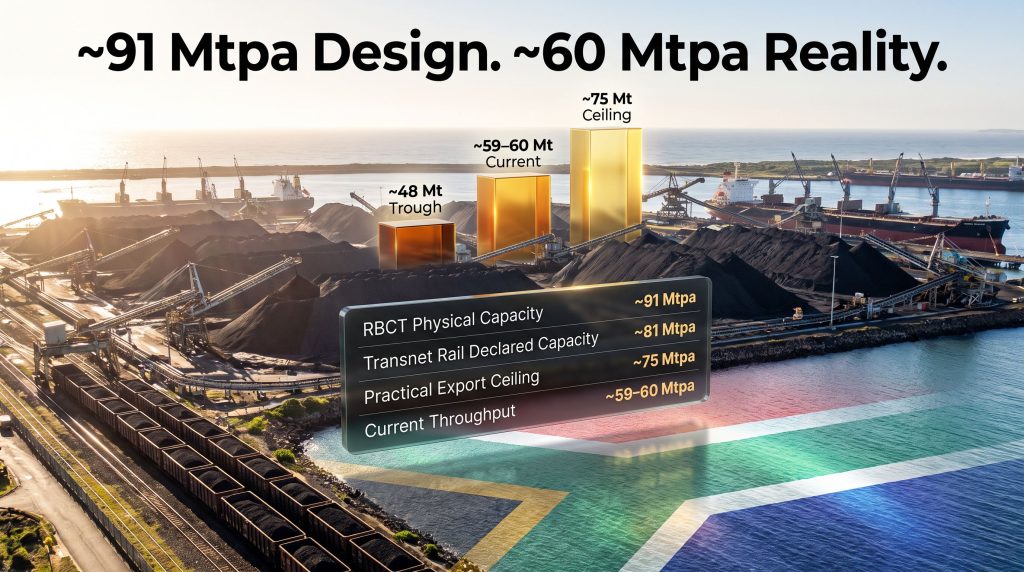
The Richards Bay Coal Terminal was purpose-built and progressively expanded to serve as the anchor of South Africa's coal export ambitions. The Phase 5 expansion, formalised around 2006, pushed the terminal's engineered throughput capacity to approximately 91 million tonnes per annum. At the time, senior figures across the industry, including those leading major coal producers, were aligned on the expectation that South Africa's mining output and Transnet's rail network would grow to fill that capacity.
That expectation was never realised in practice. Historical peak throughput at RBCT reached approximately 76 million tonnes before a prolonged deterioration set in. The gap between the terminal's theoretical design capacity and its best-ever demonstrated throughput is itself revealing: even at the industry's highest historical point of performance, the terminal was operating at roughly 84% of its nameplate capacity, with the binding constraint sitting upstream in the rail corridor rather than at the port.
"The 91Mt design capacity of RBCT has never been tested under real operating conditions. The true ceiling has always been determined by what Transnet Freight Rail can move from the coalfields to the coast, not by what the terminal can load onto vessels."
The Three Layers of Constraint
A useful way to frame the SA coal exports supply ceiling is through three distinct but interrelated bottlenecks:
| Constraint Layer | Approximate Ceiling | Primary Driver |
|---|---|---|
| RBCT Physical Design Capacity | ~91 Mtpa | Terminal infrastructure |
| Transnet Rail Declared Capacity | ~81 Mtpa | Logistics network |
| Practical Sustained Export Ceiling | ~75 Mtpa | Rail performance + industry supply |
| Current Annualised Throughput | ~59-60 Mtpa | Transnet operational recovery |
Each layer represents a separate problem requiring a separate solution, and crucially, resolving one does not automatically resolve the others.
The Collapse and Recovery of South Africa's Coal Export Volumes
The deterioration of South African coal exports from their historical peak was neither sudden nor attributable to a single cause. It reflected the compounding effects of deferred maintenance across Transnet Freight Rail's rolling stock fleet, deteriorating track infrastructure, and operational management failures across the coal corridor. Volumes fell from the historical peak of approximately 76 million tonnes to a trough of around 48 million tonnes per annum, representing a contraction of nearly 37% from peak throughput.
What is less widely appreciated is that this decline unfolded over years rather than months, and that the recovery has been similarly gradual. The South Africa mining decline has compounded these challenges, with the coal corridor recovering at annual increments of between 5% and 8% — a pace that reflects the sustained nature of the structural repairs required rather than a rapid operational turnaround.
Exxaro Resources' half-year results for the period to June 2026 provided one of the clearest recent data points on this recovery trajectory. Transnet Freight Rail delivered 30.95 million tonnes to RBCT in that six-month period, which annualises to approximately 59.9 million tonnes. That represents a 5% improvement over the approximately 56.8 million tonnes recorded on an annualised basis in 2025, consistent with the multi-year recovery pattern.
Recovery Trajectory: Key Benchmarks
| Period | Approximate Volume | RBCT Utilisation (vs. 91Mt) |
|---|---|---|
| Historical Peak | ~76 Mt | ~84% |
| Trough Period | ~48 Mt | ~53% |
| 2025 Annualised | ~56.8 Mt | ~62% |
| H1 2026 Annualised | ~59.9 Mt | ~66% |
| Practical Industry Ceiling (Assessed) | ~75 Mt | ~82% |
The 75Mt Ceiling: A Supply-Side Problem, Not Just a Rail Problem
The most strategically significant insight emerging from current industry discourse is that the 75 million tonne threshold may represent not just a rail recovery ceiling, but an industry supply ceiling. The distinction matters enormously for investors and producers alike.
Exxaro CEO Ben Magara articulated this position clearly during an August 2026 analyst presentation following the company's interim results. His assessment was that even if Transnet successfully restores and expands rail capacity beyond 75Mt, the collective production capability of South Africa's coal mining sector may be insufficient to fill that corridor. Older mines approaching end-of-life, limited greenfield development in the pipeline, and the geographic concentration of remaining high-quality resources all create a supply-side constraint that exists independently of logistics performance.
Furthermore, this is a perspective that challenges the conventional assumption that logistics recovery automatically translates into export volume recovery. The argument is more nuanced: "if the industry cannot collectively supply beyond 75Mt, then additional rail capacity above that threshold will remain structurally underutilised."
Scenario Analysis: What Would It Take to Exceed 75Mt?
Scenario 1: Rail Recovery Without Supply Growth (Base Case)
- Transnet restores declared capacity toward 80Mt or above
- Domestic coal mining supply remains constrained at approximately 75Mt
- Result: Excess rail capacity, unused terminal slots, no net export gain beyond the supply ceiling
Scenario 2: Supply Concentration Among Major Producers
- Well-resourced producers absorb unused export entitlements from exiting or scaling-back smaller operators
- Life-of-mine extensions and targeted resource development unlock incremental volumes
- Result: Exports approach but do not structurally exceed 75Mt without new mine development
Scenario 3: Full System Alignment (Optimistic)
- Transnet achieves 80Mt or above in declared capacity
- Major producers with deep geological resource bases expand output
- Unused export allocations are systematically acquired or leased by high-capacity operators
- Result: Exports could approach 80Mt, though sustained delivery at this level has no historical precedent
"The critical point for investors is that Scenario 3 requires simultaneous resolution of both the logistics and supply constraints, something South Africa's coal industry has never managed to achieve across the full export corridor."
Export Entitlement Economics: The Mechanics of a Secondary Market
One of the less publicly understood dynamics of South Africa's coal export system involves the allocation mechanism at RBCT. Producers hold entitlements to move defined volumes through the terminal, and these entitlements do not simply disappear when a producer reduces output or exits the market. They can be acquired or leased by other parties, creating a secondary market with significant strategic implications.
For producers with large, long-life resource bases and the operational capacity to ramp up output, entitlement acquisition represents a capital-efficient pathway to export volume growth. Rather than waiting for terminal expansion or new rail investment, these producers can effectively expand their market share by absorbing the unused allocations of smaller or exiting operators. The broader coal supply challenges facing the industry make this secondary market increasingly important.
Magara flagged this mechanism explicitly, noting that life-of-mine extensions and the uptake of other producers' unused export entitlements — whether through purchase or leasing arrangements — represent credible volume growth pathways for operators with sufficient resource depth.
Key dynamics shaping the entitlement market include:
- Producers with long-life geological reserves are best positioned to justify acquiring entitlements
- Entitlement acquisition reduces capital expenditure compared to greenfield terminal or rail investment
- Market concentration among major producers could allow the industry to approach the 75Mt ceiling without new infrastructure
- Geological quality of remaining reserves matters as much as volume, since export pricing is sensitive to calorific value and ash content specifications
The Waterberg Corridor: Understanding the C-Line's Underutilised Potential
Beyond the primary Richards Bay coal corridor, the Waterberg coalfields in Limpopo represent South Africa's most significant underdeveloped coal resource base. The geological endowment of the Waterberg is substantial, with coal seams of considerable thickness and relatively consistent quality, though the region's distance from the coast has historically constrained its economic attractiveness relative to the established Mpumalanga operations.
The C-line rail route connecting the Waterberg to the broader Transnet network has a declared capacity of approximately 4 million tonnes per annum, though this capacity is shared between coal producers and ferrochrome operators. This shared-access structure creates an inherent scheduling tension that limits coal's ability to utilise the full corridor allocation. In addition, coal rail disruptions in neighbouring regions have further highlighted the vulnerability of single-corridor dependencies.
Current coal throughput on the C-line is annualising at approximately 1.2 million tonnes based on the approximately 600,000 tonnes moved in the first half of 2026, representing roughly 30% of declared capacity. Magara confirmed that Exxaro sees considerable additional headroom on this route and that the company's ambitions for Grootegeluk mine's export volumes through this corridor remain well ahead of current performance.
"At 30% utilisation of declared capacity, the C-line represents one of the most accessible near-term volume growth opportunities in South Africa's coal export system, requiring scheduling resolution rather than new infrastructure investment."
Grootegeluk's Geological Advantage
The Grootegeluk mine in the Waterberg holds a notable geological distinction: it is one of the world's largest opencast coal mines by resource volume, with coal seams that allow for high-volume, mechanised bulk mining operations. The mine produces a range of coal products, including both thermal and coking coal blends, though the bulk of its export-quality product is thermal coal suited to Asian and Indian power generation markets. This resource depth is precisely what underpins confidence in the mine's ability to supply additional volumes if logistics constraints can be progressively resolved.
The next major ASX story will hit our subscribers first
South Africa in the Global Seaborne Coal Context
Understanding the SA coal exports supply ceiling also requires situating South Africa within the broader seaborne thermal coal trade, where the country occupies a mid-tier position by volume but punches above its weight in terms of pricing influence in certain regional markets.
| Exporting Nation | Approximate Annual Seaborne Exports | Primary Export Infrastructure |
|---|---|---|
| Indonesia | ~450-500 Mtpa | Multiple ports |
| Australia | ~350-380 Mtpa | Multiple export terminals |
| Russia | ~180-200 Mtpa | Multiple Baltic and Pacific ports |
| Colombia | ~70-80 Mtpa | Puerto Bolivar and others |
| South Africa | ~55-60 Mtpa (current) | Richards Bay Coal Terminal |
South Africa's reliance on a single export terminal creates a structural vulnerability that multi-port exporters do not face. Any operational disruption at RBCT — whether weather-related, labour-related, or infrastructure-related — affects the entirety of the country's export capacity simultaneously. This concentration risk is one reason why achieving sustained throughput near the 75Mt ceiling would require not just volume growth but operational consistency and reliability improvements across the entire logistics chain.
The demand-side picture adds further complexity. India remains the most important growth market for South African thermal coal, with geographic proximity and price sensitivity creating a natural trade flow. However, Indian buyers are also cost-conscious and will substitute Indonesian or Australian supply when pricing differentials justify it. According to South Africa's coal export outlook, European demand is in structural decline due to energy transition commitments, removing what was historically a meaningful demand backstop for South African exports.
The Hidden Variable: Industry Collective Action and Mine Replacement
Perhaps the most underappreciated dimension of the SA coal exports supply ceiling debate is the collective action problem facing the industry. Individual producers may have the resource base and the operational ambition to grow volumes, but the aggregate supply picture depends on what happens across the full industry — including producers that are scaling back, approaching end-of-life, or choosing to prioritise domestic supply over export markets.
Opportunities for coal mine expansion elsewhere in the world provide a useful contrast to South Africa's more constrained development environment. South Africa's coal royalty and regulatory framework, combined with the complex community and environmental permitting requirements for new mine development, means that replacing production from ageing operations with new mine capacity is neither fast nor certain.
Furthermore, fluctuations in metallurgical coal prices influence investment decisions across the broader sector, adding another layer of uncertainty for producers weighing long-term capital commitments. The pipeline of credible new coal mine developments that could contribute meaningful export volumes over the next decade is limited, as recent export data confirms the downward pressure on volumes. This reinforces the argument that 75Mt may represent a genuine medium-term ceiling for the industry as a whole, even if a small number of well-resourced operators have the capacity to grow individually.
Disclaimer: This article contains forward-looking analysis, industry assessments, and scenario projections that are inherently speculative. Readers should not interpret this content as financial or investment advice. All volume figures and projections are based on publicly available industry data and analyst commentary and are subject to change as market and operational conditions evolve.
Want to Stay Ahead of the Next Major Mineral Discovery?
Discovery Alert's proprietary Discovery IQ model delivers real-time alerts on significant ASX mineral discoveries, transforming complex resource data into actionable investment insights for both short-term traders and long-term investors — explore historic examples of exceptional discovery returns to understand the opportunity, then begin your 14-day free trial at Discovery Alert to position yourself ahead of the broader market.