August 20, 2026
When the Cycle Turns: Reading the Iron Ore Market's Structural Signals
Few industrial commodities reveal the inner workings of the global economy as candidly as iron ore. As the foundational raw material for steel production, its price trajectory reflects not just supply and demand mechanics, but the deeper rhythms of urbanisation, industrial policy, and economic transformation. When major forecasting institutions begin revising their price outlooks in a consistent direction, it rarely signals a temporary blip. More often, it marks the beginning of a multi-year recalibration.
That appears to be exactly what is unfolding in the iron ore market heading into 2026 and beyond.
When big ASX news breaks, our subscribers know first
The BMI Iron Ore Price Forecast Downward Revision: What the Numbers Actually Say
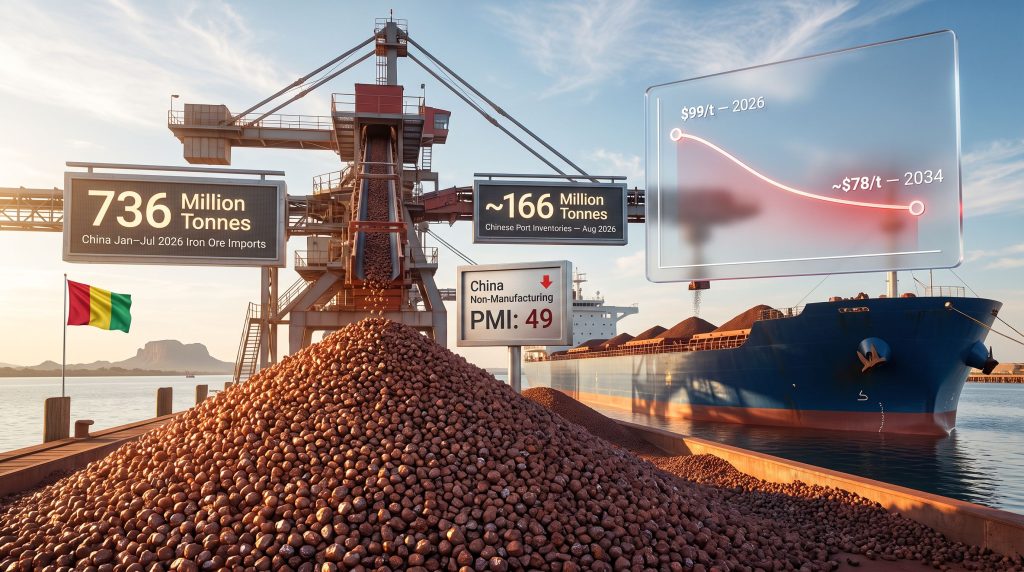
The BMI iron ore price forecast downward revision, issued by Fitch Solutions company BMI, now projects a 2026 annual average of approximately $99 per tonne, stepping back from a prior estimate of $101 per tonne. A subsequent revision has brought the range to $95–$99 per tonne, reflecting continued deterioration in the underlying demand environment. Furthermore, these iron ore surplus pressures are compounding across the broader seaborne market.
While a $2 per tonne move may appear modest in isolation, its implications compound significantly across the volume scale at which major producers operate.
| Forecast Period | Previous Estimate | Revised Estimate | Change |
|---|---|---|---|
| 2026 Annual Average | $101/t | $99/t | ▼ $2/t |
| 2026 (Revised Range) | $97/t | $95/t | ▼ $2/t |
| Long-Term Outlook (2034) | N/A | ~$78/t | Multi-year downtrend |
Why Small Per-Tonne Movements Create Large Revenue Consequences
For context, consider a major producer shipping 250 million tonnes annually. A $2/t reduction in average realised price translates directly to $500 million in lost annual revenue before any cost offsets or hedging instruments are applied. Multiplied across the industry's largest players, the cumulative revenue erosion from this revision is measured in the billions.
This is precisely why institutional price revisions carry significant weight for capital allocation decisions, project financing, and dividend sustainability calculations across the global mining sector. Consequently, iron ore demand prospects remain a closely monitored variable for major investors worldwide.
China's Demand Contraction: Structural Shift or Cyclical Weakness?
The central question facing iron ore market participants is whether China's reduced appetite for ferrous metals represents a temporary economic soft patch or a permanent structural transition. The evidence increasingly points toward the latter. In addition, the evolving picture of China steel and iron ore dynamics suggests this is not simply a short-term dislocation.
The PMI Signal: When the Index Falls Below the Waterline
China's official non-manufacturing Purchasing Managers' Index declined to 49 points in July 2026, dropping from 50.2 in June. In PMI methodology, a reading below 50 indicates contraction. This matters enormously for iron ore because the non-manufacturing PMI captures construction and services sector activity, both of which are direct drivers of steel consumption and, by extension, iron ore demand.
A PMI reading below 50 is not simply a statistical curiosity. For construction-linked commodity markets, it functions as a real-time demand destruction signal with lagging price implications measured in quarters, not months.
The Property Sector: A Prolonged Structural Drag
China's real estate sector, once the engine of its steel-intensive growth model, remains deeply subdued. Property construction activity drives an outsized share of steel consumption through demand for structural beams, reinforcing bar, and sheet metal used in residential and commercial development.
The July 2026 Politburo meeting, closely watched by commodity markets for signs of fiscal intervention, provided no catalyst for recovery:
- No new stimulus measures targeting construction or property development were announced.
- The Chinese government signalled growing tolerance for a lower economic growth trajectory rather than pursuing aggressive demand-side intervention.
- Ferrous metal markets received no policy relief from the meeting's outcomes.
This signals something important: policymakers in Beijing appear less inclined to use real estate-led stimulus as an economic lever, a meaningful departure from historical precedent that has significant long-term implications for iron ore demand curves.
China's Economic Identity Shift: From Steel-Intensive to Services-Led
BMI's analysis highlights a structural reorientation within China's economy, moving away from capital-intensive industrial activity toward services and less steel-hungry infrastructure formats. This transition, sometimes described through the concept of steel intensity ratio (the volume of steel consumed per unit of GDP growth), points to a declining demand coefficient even in scenarios where China's economy continues expanding.
As steel intensity ratios fall, each percentage point of GDP growth generates progressively less iron ore demand. This is not a cyclical phenomenon that reverses when credit conditions ease; it is a structural reconfiguration of how China grows.
Supply Side: Why Production Volumes Are Not Following Prices Lower
Historically, commodity price weakness tends to prompt supply curtailment. However, the current iron ore market is not behaving according to this script.
Major Miners Holding Their Ground
Global iron ore majors, operating at the lowest end of the cost curve, continue maintaining and in some cases increasing output volumes despite softening price realisations. High-volume, low-cost producers are price-takers in the sense that their economics remain viable even as benchmark prices retreat, meaning they have limited incentive to cut production. According to analysts tracking iron ore price trends, this dynamic is expected to persist well into the medium term.
Simandou: A Game-Changing Supply Variable
The Simandou iron ore project in Guinea represents one of the largest undeveloped high-grade iron ore deposits anywhere on Earth. Its progressive production ramp-up is introducing meaningful additional tonnage into an already well-supplied seaborne market.
What makes Simandou particularly significant from a market structure perspective is the quality of the ore. High-grade iron ore deposits, those with iron content above 62% Fe, command premium pricing and are increasingly sought after by steelmakers optimising for efficiency and lower carbon emissions per tonne of steel produced. Simandou's entry into the seaborne trade does not merely add volume; it adds high-grade volume that could displace lower-grade supply from existing producers, reshaping competitive dynamics within the market.
Port Inventory Levels as a Leading Indicator
One of the most reliable near-term signals for iron ore price direction is inventory accumulation at major Chinese receiving ports. As of mid-August 2026, iron ore stockpiles across 45 major Chinese ports reached approximately 166 million tonnes, approaching record highs.
Elevated port inventories create a self-reinforcing bearish dynamic:
- Mills reduce spot purchasing when existing stockpiles are adequate, suppressing near-term demand signals.
- Elevated inventory visibility discourages speculative buying from trading intermediaries.
- High port stocks act as a visible price ceiling, as buyers have little urgency to secure forward supply.
The Import Paradox: Why China Is Buying More While Using Less
One of the more counterintuitive features of the current iron ore market is that Chinese import volumes remain robust even as domestic steel output contracts and construction demand weakens.
China imported 736 million tonnes of iron ore in the first seven months of 2026, representing a 5.9% year-on-year increase versus the same period in 2025. This apparent contradiction resolves when two less-discussed factors are considered.
Declining Domestic Ore Quality
China's domestic iron ore deposits are, on average, significantly lower grade than seaborne supply from Australia and Brazil. As high-quality domestic reserves become progressively depleted, the effective iron content per tonne of domestically mined ore falls, compelling steelmakers to import higher-grade seaborne ore to maintain blast furnace efficiency. Even when total steel output is flat or declining, the mix shift toward imported high-grade ore sustains import volumes.
Steel Export Markets Absorbing Production Surplus
China's steel producers have partially compensated for weak domestic demand by redirecting output toward export markets. A resilient global economy, particularly across Southeast Asia and parts of the Middle East, has sustained external demand for Chinese steel products. This export outlet allows steelmakers to maintain blast furnace utilisation rates higher than domestic demand alone would justify, indirectly sustaining iron ore import demand.
The Green Steel Variable: A Longer-Term Price Wildcard
An underappreciated dimension of long-term iron ore price modelling involves the transition toward green steel production methods. The green iron transition is expanding its share of global steelmaking capacity through electric arc furnace technology, which relies on scrap steel rather than iron ore. As scrap availability increases and carbon pricing mechanisms mature, the structural demand base for iron ore per tonne of steel produced is expected to narrow further.
However, direct reduced iron (DRI) based green steel pathways, which use hydrogen-based iron reduction rather than coking coal, actually favour higher-grade iron ore. This creates a quality divergence within the market: long-term volume demand for iron ore may decline, but premium demand for high-grade ore (above 65% Fe) could prove more resilient than headline price forecasts suggest.
The next major ASX story will hit our subscribers first
Long-Term Price Trajectory: A Decade of Managed Decline
BMI's price path through 2034 reflects a market that progressively rebalances around lower structural demand and sustained supply growth. Notably, BMI's updated iron ore price view for 2026 confirms this downward trajectory is being revised with increasing conviction.
| Year | Projected Price Range | Primary Driver |
|---|---|---|
| 2026 | $95–$99/t | Weak Chinese demand, near-record port stocks, Simandou ramp-up |
| 2027–2029 | Gradual decline | Constrained steel production growth, rising seaborne supply |
| 2030–2032 | Continued softening | Services-led Chinese economy reduces steel intensity |
| 2034 | ~$78/t | Structural demand contraction, sustained supply growth |
What the $78/t Long-Term Floor Represents
The $78/t long-term price estimate is best understood not as an arbitrary target but as a reflection of where the marginal cost of seaborne supply is expected to settle once higher-cost producers have rationalised capacity. At that price level, the lowest-cost tier of producers, primarily large Australian and Brazilian operations, retain acceptable margins while higher-cost supply faces increasing pressure.
Risk Scenarios: What Could Break the Downtrend
Market forecasts carry inherent uncertainty, and the BMI iron ore price forecast downward revision is no exception. Several scenarios could alter the trajectory in either direction.
Upside risk factors include:
- A sudden reversal in Chinese fiscal policy, with targeted construction or infrastructure stimulus exceeding market expectations.
- Material supply disruptions in major producing regions, whether from weather events, labour action, or infrastructure failures.
- Faster-than-expected adoption of DRI-based green steel pathways creating a structural premium for high-grade ore.
- Geopolitical developments delaying or disrupting the Simandou project ramp-up timeline.
Downside risk factors include:
- Accelerated deterioration in China's property sector beyond current baseline projections.
- Additional supply growth from mid-tier and junior producers incentivised by spot prices above breakeven thresholds.
- Faster-than-anticipated substitution of steel with alternative construction materials in key end-use applications.
Frequently Asked Questions: Iron Ore Price Forecasts and Market Outlook
What Is BMI's Current Iron Ore Price Forecast for 2026?
BMI has revised its 2026 iron ore price forecast to a range of approximately $95–$99 per tonne, down from a previous estimate of $97–$101 per tonne, citing persistent weakness in Chinese industrial demand and healthy global supply volumes.
Why Did BMI Issue a Downward Revision to Its Iron Ore Price Forecast?
The BMI iron ore price forecast downward revision reflects the combination of weakening Chinese construction activity, a non-manufacturing PMI below the 50-point contraction threshold, near-record port inventories at 166 million tonnes, and the absence of meaningful stimulus from the July 2026 Politburo meeting.
What Is the Long-Term Iron Ore Price Outlook Through 2034?
BMI projects a sustained multi-year price decline, with iron ore prices expected to reach approximately $78 per tonne by 2034, driven by China's structural transition away from steel-intensive industries and continued growth in global seaborne supply.
How Does the Simandou Project Affect Global Iron Ore Supply?
The Simandou project in Guinea is introducing large volumes of high-grade iron ore into the seaborne market, amplifying supply-side pressure at a time when Chinese demand growth is decelerating. Its high iron content makes it attractive to quality-focused steelmakers, potentially displacing lower-grade supply from established producers.
Is China's Iron Ore Demand Decline Permanent?
The weight of structural evidence suggests the decline is at least partially permanent. China's pivot toward services-led economic growth, the progressive depletion of high-quality domestic ore reserves, and the long-term contraction of its real estate sector all point to a structurally lower baseline for iron ore consumption intensity over the coming decade.
Key Market Metrics at a Glance
| Metric | Value | Significance |
|---|---|---|
| BMI 2026 Forecast (Revised) | $95–$99/t | Downward revision from $97–$101/t |
| Long-Term Price Target (2034) | ~$78/t | Multi-year structural downtrend |
| China Jan–Jul 2026 Imports | 736 million tonnes | +5.9% YoY despite weak steel output |
| Chinese Port Inventories (Aug 2026) | ~166 million tonnes | Near-record highs across 45 major ports |
| China Non-Manufacturing PMI | 49 points | Below 50 contraction threshold |
| Key New Supply Variable | Simandou, Guinea | High-grade seaborne supply entering market |
The iron ore market in 2026 is defined by a tension between persistent import volumes and deteriorating end-use demand, between short-term supply inertia and long-term structural rebalancing. For mining operators, investors, and analysts, the BMI iron ore price forecast downward revision is less a cause for immediate alarm than a data point confirming a trajectory that structural forces have been building toward for several years. Navigating this environment requires separating cyclical noise from the deeper signals of permanent economic transformation.
Disclaimer: This article contains forward-looking statements, price forecasts, and market analysis drawn from third-party research. These projections involve inherent uncertainty and should not be construed as financial or investment advice. Readers should conduct their own due diligence and consult qualified financial advisors before making any investment decisions.
Want to Stay Ahead of Significant Mineral Discoveries Before the Broader Market Reacts?
While iron ore navigates a prolonged structural downtrend, Discovery Alert's proprietary Discovery IQ model scans ASX announcements in real time, instantly alerting subscribers to high-potential mineral discoveries across more than 30 commodities — visit the Discovery Alert discoveries page to explore historic examples of exceptional returns, and begin your 14-day free trial to position yourself ahead of the market.