August 20, 2026
When Document Trust Breaks Down: The Hidden Fragility of Commodity Trading Finance
The global commodity trading industry runs on a largely invisible infrastructure of paper promises. Letters of credit, warehouse receipts, shipping documents, and trade invoices form the connective tissue between raw material producers and the steel mills, smelters, and manufacturers that consume their output. For most of history, this system has functioned with remarkable efficiency. But its central weakness is also its defining feature: the entire architecture depends on document integrity. When that integrity is called into question, the consequences can unravel with extraordinary speed.
The situation now surrounding the Radiant World Singapore police investigation offers one of the most instructive case studies in recent memory of how quickly a commodity trading house can move from operational dominance to existential threat when allegations of document irregularities surface.
When big ASX news breaks, our subscribers know first
Understanding the Scale of Radiant World's Market Position
To appreciate the significance of the Radiant World situation, it is worth first understanding the operational footprint the firm had built over two decades. Founded by Pinkesh Nahar in the early 2000s, Radiant World grew from its Singapore base into a genuinely global trading operation, maintaining offices across seven international locations: Singapore, Dubai, Shanghai, London, Geneva, Connecticut, and Mumbai, employing more than 100 staff across those hubs.
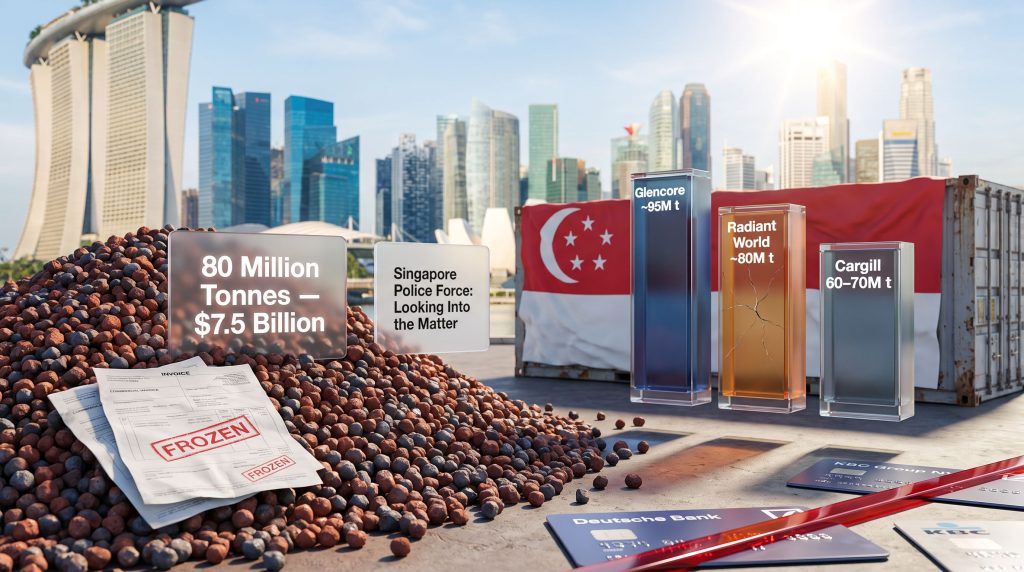
The firm's iron ore trading volumes tell an even more striking story. Radiant World reportedly moved more than 80 million tonnes of iron ore annually, a figure that translates to a value exceeding $7.5 billion at prevailing SGX benchmark prices. To contextualise that number, consider the following comparison:
| Trading Entity | Estimated Annual Iron Ore Volume | Business Model |
|---|---|---|
| Glencore Marketing Division | ~95 million tonnes | Integrated miner and trader |
| Radiant World | ~80 million tonnes | Independent trader |
| Cargill | 60 to 70 million tonnes | Diversified commodity trader |
What makes Radiant World's position particularly noteworthy is that it achieved near-Glencore-scale iron ore throughput as a pure independent trader, without the backing of captive mining assets or diversified revenue streams. This is an operationally impressive achievement, but it also highlights a structural vulnerability that lies at the heart of the current crisis. Furthermore, understanding iron ore price trends helps contextualise just how significant these trading volumes are in dollar terms.
The Structural Vulnerability That Makes Trading Houses Different
Independent commodity traders occupy a fundamentally different risk profile from vertically integrated miners. Where a company like Rio Tinto or BHP generates revenue from physical extraction and can absorb short-term credit disruptions, a trading house relies entirely on the continuous availability of revolving credit facilities, bank guarantees, and counterparty confidence to fund its operations.
This creates what might be called a trust-dependent business model. The mechanics work as follows:
- A trading firm uses bank-issued letters of credit to purchase physical commodities from producers.
- Those commodities are shipped against trade documents, which are then used to draw on financing facilities.
- The firm sells the commodity to end buyers, repays the credit facility, and repeats the cycle.
- At every stage, the integrity of the underlying documentation is the foundation upon which the entire credit architecture rests.
When document integrity is questioned, even allegations alone can trigger a simultaneous withdrawal of credit from multiple banking relationships. Unlike a manufacturing business that can weather a short-term credit squeeze through inventory liquidation, a trading house is the credit cycle. Disruption does not slow operations; it can halt them entirely.
"The commodity trading model is unique in finance: the firm's entire operational capacity can be rendered non-functional within days if counterparties lose confidence in its documentation practices, regardless of whether underlying allegations are ever proven."
The Allegations at the Centre of the Radiant World Singapore Police Investigation
Reports that triggered the Radiant World Singapore police investigation centred on alleged invoicing improprieties and document irregularities connected to the firm's iron ore trade financing arrangements. The specific concern, as reported, involved the potential use of invalid or falsified trade documents as instruments to raise working capital.
This type of alleged conduct, if proven, would constitute trade finance fraud. The mechanism is not unique to Radiant World and has appeared in various forms across the commodity trading sector. A document representing a physical cargo is used to secure financing, but the document either does not correspond accurately to the underlying goods or is used multiple times to raise credit against the same physical assets.
Radiant World publicly characterised all such claims as inaccurate and without substantive foundation. Critically, as of the time of reporting, no formal criminal charges had been filed against the firm or its principals in any jurisdiction. According to Reuters, the Singapore Police Force confirmed it had received reports about the company and was actively examining the matter, without disclosing the identity of those who filed complaints or specifying the precise nature of the allegations.
Separately, reporting indicated that both the U.S. Department of Justice and the Commodity Futures Trading Commission (CFTC) had directed scrutiny toward the firm, though no U.S. charges had been publicly announced. The DOJ and CFTC investigations have added further complexity to an already volatile situation for the firm's global operations.
| Regulatory Body | Jurisdiction | Status at Time of Reporting |
|---|---|---|
| Singapore Police Force | Singapore | Actively investigating, no charges filed |
| U.S. Department of Justice | United States | Under scrutiny, no charges announced |
| CFTC | United States | Under scrutiny, no charges announced |
Important legal context: An active police investigation does not constitute a finding of guilt. Regulatory and law enforcement inquiries frequently conclude without charges being filed. The legal presumption of innocence applies throughout any investigative process.
How Lenders and Counterparties Responded
The market response to the emerging allegations illustrated precisely the credit contagion dynamic described above. Deutsche Bank and KBC Group NV froze certain Radiant World Singapore bank accounts following the news. Both institutions declined to provide public comment on their actions. Multiple additional lenders reportedly suspended credit lines extended to the firm.
Commodities broker Marex Group took a more comprehensive step, freezing all Radiant World accounts rather than applying partial restrictions. This distinction matters operationally:
- A partial account freeze limits new credit but may preserve access to existing balances for operational purposes.
- A complete account freeze by a brokerage severs the firm's ability to execute trades, clear derivatives positions, or meet margin requirements.
- When a broker freezes all accounts, the firm effectively loses access to the futures and derivatives markets it relies upon to hedge physical price exposure.
Marex also declined to comment publicly on its actions.
The Aluminium Inventory Sale: A Distressed Liquidity Signal
Facing acute liquidity pressure from the simultaneous withdrawal of banking and brokerage relationships, Radiant World moved to convert physical assets into cash. The firm sold a substantial portion of its aluminium inventory to STG, a trading company whose principals are associated with the U.S. hedge fund Squarepoint.
This transaction represents a textbook distressed-liquidity manoeuvre. When credit markets become inaccessible, physical commodity holdings become the only available source of immediate cash. The willingness to sell inventory at what are likely compressed prices signals the severity of the liquidity squeeze the firm was navigating. Squarepoint declined to comment on the transaction.
Operational Consequences: Staff Reductions and Executive Departures
The first visible human consequences of the crisis emerged at Radiant World's Dubai operation, where a number of back-office staff were laid off. The exact headcount reduction was not publicly confirmed, with sources describing it as involving a small number of operations staff. A company spokesperson declined to comment on the workforce reductions.
Separately, Radiant World's Head of Refined Metals departed the firm less than two years after joining. The timing of this senior exit, relative to the public emergence of the crisis, attracted attention from industry observers, though no causal connection between the departure and the allegations has been established.
What Operational Paralysis Looks Like for a Trading House Under Credit Siege
Without access to trade finance, the day-to-day operations of a commodity trading firm become functionally impossible. The cascade of consequences includes:
- Inability to purchase physical inventory on standard credit terms.
- Loss of capacity to hedge price exposure through futures and options.
- Inability to issue letters of credit required by shipping companies and counterparties.
- Failure to maintain margin requirements at clearing houses and brokers.
- Counterparty refusal to enter new contracts pending resolution of allegations.
Each of these constraints reinforces the others, creating a compounding operational paralysis that is extremely difficult to reverse without a credible and documented resolution of the underlying concerns. In addition, commodity trade hedging strategies that firms rely upon to manage price risk become entirely inaccessible when brokerage accounts are frozen.
The next major ASX story will hit our subscribers first
Singapore as the Epicentre of Iron Ore Price Discovery
The geographic focus of the Radiant World Singapore police investigation is not coincidental. Singapore occupies a structurally unique position in global iron ore markets that makes it the natural centre of gravity for trading houses operating across this commodity.
The Singapore Exchange (SGX) iron ore derivatives contract functions as the primary global benchmark for seaborne iron ore pricing. It is the reference price used by Australian and Brazilian miners, Chinese and Indian steel mills, and the trading houses that intermediate between them. SGX's iron ore futures market provides price discovery, hedging capacity, and settlement infrastructure for what is among the world's largest commodities by volume and value.
Singapore's legal infrastructure, English-language commercial law tradition, and geographic positioning between the Southern Hemisphere production centres and the principal Asian consumption markets make it an ideal operational base for firms at the scale Radiant World had reached. Singapore's regulatory authorities have also demonstrated increasing willingness to pursue commodity trading misconduct cases. The China steel and iron ore market remains the dominant demand driver underpinning the entire SGX pricing ecosystem, which is why Singapore's role as a regulatory and trading hub carries such outsized importance.
The Broader Pattern: A Recurring Vulnerability in Commodity Trade Finance
The dynamics at play in the Radiant World situation are not without historical precedent. The global commodity trading sector has experienced several high-profile collapses over the past decade in which document-based financing was allegedly manipulated to extract capital beyond the value of underlying physical goods.
What makes these cases structurally similar is the fundamental information asymmetry between trading firms and their lenders. Banks extending letters of credit or trade finance facilities typically rely on document verification rather than physical inspection of the underlying commodities. This creates an opportunity for manipulation that is difficult to detect until the volume of fraudulent documentation reaches a threshold that triggers counterparty scrutiny.
"The document-trust model that enables efficient global commodity trade also creates a systemic vulnerability: the same document infrastructure that facilitates legitimate trade can, if corrupted, sustain fraudulent capital extraction across multiple banking relationships simultaneously."
However, it is important to note that broader market pressures also play a role. Global commodity market tariffs and geopolitical risks in metals and mining have created an increasingly strained environment for independent trading houses, amplifying the financial pressure that can sometimes lead to risky financing practices across the sector.
Takeaways for Trade Finance Risk Management
The Radiant World case reinforces several critical risk management principles for banks, brokers, and counterparties operating in commodity trade finance:
- Document verification protocols must go beyond surface-level checks to include cross-referencing of shipping data, port records, and counterparty confirmations.
- Counterparty due diligence should include ongoing monitoring of a firm's banking relationships and credit facility status, not merely periodic onboarding reviews.
- Concentration risk in commodity trade finance portfolios requires active management; multiple banks extending facilities to the same trading house amplifies systemic exposure.
- Real-time credit monitoring tools are increasingly necessary given the speed with which counterparty confidence can collapse in a document-integrity crisis.
Frequently Asked Questions: Radiant World Singapore Police Investigation
Has Radiant World Been Formally Charged with Any Crime?
No. As of the reporting period, no formal criminal charges had been filed against Radiant World or its principals in any jurisdiction. The Singapore Police Force confirmed it was investigating, and U.S. regulatory bodies were reported to be conducting scrutiny, but investigative activity does not constitute charges or convictions.
What Specific Allegations Triggered the Investigation?
Reports centred on alleged invoicing irregularities and document improprieties connected to iron ore trade financing. The specific mechanism alleged involved using invalid documents to raise working capital. Radiant World denied these characterisations.
Why Did Banks Freeze Radiant World's Accounts?
Financial institutions typically freeze accounts associated with entities under active investigation as a risk management and regulatory compliance measure, not as a determination of guilt. Account freezes protect the institution from potential liability while investigations proceed.
How Large Was Radiant World's Iron Ore Trading Operation?
Radiant World reportedly traded approximately 80 million tonnes of iron ore annually, valued at more than $7.5 billion at SGX benchmark prices, placing it among the largest independent iron ore trading houses globally.
What Is the SGX Iron Ore Benchmark?
The Singapore Exchange iron ore derivatives contract serves as the primary global benchmark for seaborne iron ore pricing. It is the reference price used by miners, traders, and steel mills across Asia and increasingly globally to hedge and settle physical iron ore transactions.
Disclaimer: This article is intended for informational purposes only and does not constitute legal, financial, or investment advice. The Radiant World Singapore police investigation is ongoing. No formal charges have been filed. All parties are presumed innocent unless proven guilty through due legal process. Readers should conduct independent research and consult qualified advisers before drawing conclusions from this or any related reporting.
Want to Stay Ahead of Major Commodity Market Movements?
Discovery Alert's proprietary Discovery IQ model scans ASX announcements in real time, delivering instant alerts on significant mineral discoveries — transforming complex commodity data into clear, actionable investment insights for traders and investors at every level. Explore how historic mineral discoveries have generated substantial market returns on Discovery Alert's dedicated discoveries page, and begin your 14-day free trial today to position yourself ahead of the broader market.