
August 20, 2026
The Invisible Architecture Keeping Global Oil Markets Alive
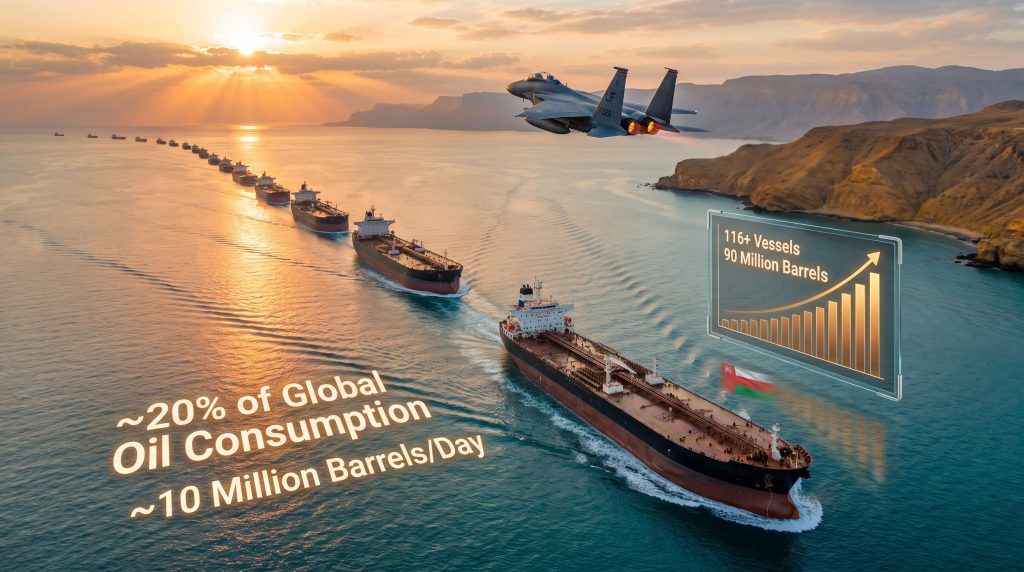
Every barrel of oil that leaves the Persian Gulf must pass through a corridor of water so narrow that, at its most constrained point, the navigable shipping lane measures barely two miles wide in each direction. For decades, the Strait of Hormuz has functioned as the circulatory valve of the global energy system, largely taken for granted by markets and policymakers alike. That assumption collapsed in early 2026, when escalating US-Iran hostilities transformed this passage into an active conflict zone, severing roughly half of the Gulf's pre-war export capacity almost overnight.
What emerged in response was something the energy world had never seen at this scale: a fully operational, militarily managed commercial shipping corridor, quietly assembled by US Central Command and coordinated from a task force based at Fort Bragg, North Carolina. The existence of this US secret oil shipping corridor in the Strait of Hormuz was not publicly confirmed until Axios reported its operational details, citing two US officials. Even then, its full architectural complexity had not been previously disclosed.
Understanding this operation requires stepping beyond the headlines and examining the engineering of energy security itself.
When big ASX news breaks, our subscribers know first
Why the Strait of Hormuz Cannot Simply Be Replaced
The Geometry of Irreplaceability
The argument that alternative export routes could absorb Hormuz disruptions has circulated in energy policy circles for years. In practice, the substitution math simply does not work at the volumes involved.
The strait currently handles approximately 20% of global oil consumption, roughly 25% of all globally traded crude, and close to 11.4 billion cubic feet of LNG per day. Saudi Arabia's East-West pipeline, which bypasses the strait entirely by routing oil to the Red Sea port of Yanbu, has a capacity ceiling of around 5 million barrels per day, and it was already operating near capacity before the conflict began. The UAE's Habshan-Fujairah pipeline adds perhaps another 1.5 million barrels per day of bypass potential. Combined, these alternatives address a fraction of what the strait handles on a normal day.
This structural irreplaceability is precisely why control of the strait confers such disproportionate geopolitical leverage, and why the US decision to militarise its management represents a strategic calculation of the highest order. The broader context of geopolitical trade tensions reshaping global supply chains makes this intervention all the more significant.
What Pre-Conflict Volumes Looked Like
| Metric | Figure |
|---|---|
| Pre-conflict daily Gulf oil exports | ~20 million barrels/day |
| Share of global oil consumption | ~20% |
| Share of globally traded crude | ~25% |
| Daily LNG transit volume | ~11.4 billion cubic feet |
| Current corridor-supported daily exports | ~10 million barrels/day |
| Peak corridor throughput (high-volume nights) | 15-20 million barrels/day |
The corridor has restored roughly half of pre-conflict export capacity. That is a meaningful achievement under active threat conditions, but it also means the global market is absorbing a structural supply deficit of approximately 10 million barrels per day compared to pre-war baselines.
How the US Secret Oil Shipping Corridor Actually Works
The Southern Channel: Why Oman's Coastline Was Selected
The corridor runs through the strait's southern channel, hugging the Omani coastline rather than the centre or northern sections of the waterway. This routing decision reflects several interlocking military and logistical considerations.
Iran's coastal military infrastructure is concentrated along the northern shore, which borders Iranian territory directly. Maximum distance from those assets reduces exposure time for transiting commercial vessels. The US Central Command campaign that preceded the corridor's establishment specifically targeted Iranian radar installations and maritime surveillance infrastructure covering the southern route, creating a degraded detection environment that makes the corridor viable.
Proximity to Omani ports, particularly Sohar and Fujairah, also provides critical staging and ship-to-ship transfer capability. Empty tankers inbound from the Arabian Sea can be held, organised, and dispatched in structured convoy groupings before entering the more contested sections of the waterway.
The Four Operational Layers of the Corridor
The operation is more than an escort mission. It functions as a layered logistics and force-protection system with distinct operational components working simultaneously.
Layer 1: Surveillance Degradation
Before any commercial tanker entered the southern channel under US coordination, Central Command executed a targeted two-week campaign against Iran's ability to monitor and interdict that route. Iranian radar stations covering the corridor were struck, and maritime surveillance infrastructure used by the Islamic Revolutionary Guard Corps (IRGC) to track vessel movements was disrupted. According to US officials cited by Axios, Tehran's remaining monitoring capacity along the southern route is now limited to a small number of repaired radar stations and observers positioned aboard minor IRGC vessels.
Layer 2: Convoy Architecture
Tankers are not simply waved through. They are organised into structured inbound and outbound convoy groupings, with between 15 and 20 vessels transiting nightly. Inbound convoys carry empty tankers from the Arabian Sea into Gulf loading terminals; outbound convoys move loaded vessels into international waters. Defined transit windows, coordination checkpoints, and military communication protocols govern each movement.
Layer 3: Multi-Domain Force Protection
US Air Force assets provide persistent air defence coverage against Iranian drone and cruise missile threats. Aerial and water-based drone surveillance maintains real-time situational awareness along the corridor. Helicopter assets and dimmed-light transit protocols reduce the visual and electronic signature of convoy movements. Furthermore, transponder management, including selective disabling of AIS tracking systems, is employed to reduce targeting vulnerability for participating vessels.
Layer 4: Command and Coordination
The task force coordinating the entire operation is based at Army headquarters in Fort Bragg, North Carolina. Regional Gulf partner nations are integrated into the operational framework, contributing intelligence, logistics support, and in some cases port access. This distributed command architecture, spanning a continental US hub and multiple Gulf partners, is itself a novel model for managing commercial energy flows under conflict conditions.
The Volume Dispute: How Much Oil Is Actually Moving?
Reconciling the Numbers
One of the more analytically important tensions surrounding this operation concerns the actual volumes being transported. Multiple sources have produced differing figures, and the gap between them matters for understanding the corridor's real market impact.
| Source | Volume Claim | Timeframe |
|---|---|---|
| US operational officials | ~10 million barrels/day (baseline) | Ongoing nightly operations |
| Peak throughput (US officials) | 15-20 million barrels/day | High-volume nights |
| Reuters reporting | At least 90 million barrels | Early May to June 11 |
| Trump public statement | More than 100 million barrels | Cumulative total |
| Reuters vessel count | At least 116 ships involved | As of mid-June 2026 |
| Trump vessel count | More than 200 commercial ships | Public claim |
Analytical note: The discrepancy between the Reuters-tracked cumulative figure of approximately 90 million barrels and the Trump administration's claim exceeding 100 million barrels is consistent with the difference between verified ship-tracking data and broader operational estimates. Neither figure contradicts the 10 million barrels per day baseline; both are plausible depending on accounting methodology and the time window applied.
As Al Jazeera reported, questions persist over whether all vessels counted in these figures were directly coordinated through the US corridor framework or transited independently. The more consequential number, however, remains the 50% restoration rate relative to pre-conflict baselines. Sustaining 10 million barrels per day is preventing catastrophic market disruption, but it is not restoring normal supply. The remaining shortfall continues to exert structural upward pressure on global crude benchmarks.
What 10 Million Barrels Per Day Means in Practice
The scale becomes clearer when mapped against consuming economies. Japan imports approximately 3 million barrels per day, nearly all of it from Gulf producers. South Korea imports around 2.8 million barrels per day with heavy Gulf exposure. India's Gulf dependency accounts for roughly 60% of its total crude imports.
At the corridor's current baseline, these economies are receiving oil, but at reduced volumes, higher insurance premiums, and longer transit risk windows than pre-conflict conditions. The market consequence is not shortage in the acute sense, but a persistent tightness that keeps price floors elevated across all global benchmarks. This dynamic is reflected directly in crude oil price trends that analysts have been tracking throughout the conflict period.
The Control Question: What "Total Control" Actually Means
Official Claims vs. Operational Reality
President Trump publicly asserted that the United States exercises total control over the Strait of Hormuz, characterising the waterway as effectively under American authority. The operational picture reported across multiple news organisations presents a more layered reality.
What US officials have confirmed:
- The corridor has been operational for several weeks with nightly convoy movements
- US forces have successfully neutralised multiple incoming Iranian missile threats
- Iran's surveillance capacity along the southern route has been materially degraded
- The task force coordinates tanker movements through structured protocols
What remains contested:
- A US defence official told CNBC that American forces are not formally escorting vessels, but rather communicating with ships that voluntarily choose to transit the corridor
- Al Jazeera reported that some vessels continue to transit with Iranian authorisation, paying fees to IRGC-affiliated entities, suggesting parallel control structures remain active alongside the US-managed corridor
- The Guardian noted that while shipping volumes appear to be recovering, significant questions persist about the precise scope of US operational authority across the strait's full length
The distinction between escorting and coordinating is not semantic. Escort operations imply a formal military protection commitment and carry defined rules of engagement. Coordination implies that commercial operators are making independent risk assessments and voluntarily joining convoy groups, with no guaranteed US military intervention if something goes wrong. That distinction matters enormously to shipping insurers, tanker operators, and the governments of cargo-owning nations.
Iran's Residual Capabilities
Degraded does not mean eliminated. Iranian forces have continued firing missiles toward perceived shipping lanes since the corridor became operational. US forces have intercepted these threats, but the fact that they continue arriving confirms that Iran retains a residual interdiction capability.
The IRGC's continued toll-collection from some vessels transiting with Iranian authorisation suggests Tehran is pursuing an economic parallel strategy rather than a complete blockade posture. This is a strategically rational response: a full blockade invites maximum US military response, while selective harassment combined with toll extraction preserves both leverage and revenue. The oil geopolitics analysis surrounding this conflict underscores how deliberately calibrated Tehran's approach appears to be.
Historical Parallels and What They Reveal
Operation Earnest Will: The Closest Precedent
The 1987–1988 US tanker reflagging operation during the Iran-Iraq War is the historical analogue most frequently cited by analysts. Under Operation Earnest Will, the US Navy reflagged Kuwaiti tankers under American colours and provided direct naval escort through the Persian Gulf, deterring Iranian attacks and establishing a durable US military presence in the region.
| Operation | Period | Trigger | Scale | Outcome |
|---|---|---|---|---|
| Operation Earnest Will | 1987-1988 | Iran-Iraq War tanker attacks | 11 Kuwaiti tankers reflagged | Reduced attacks; entrenched US Gulf presence |
| Combined Maritime Forces anti-piracy | 2001-present | Somali piracy surge | Multi-nation coalition | Significant reduction in piracy incidents |
| Hormuz corridor operation | 2026 | US-Iran conflict | 15-20 tankers nightly; 116+ ships total | ~10M barrels/day sustained |
The 2026 corridor operation is substantially more complex than Earnest Will across every dimension. It involves active Iranian missile interdiction attempts rather than mine-laying and small-boat harassment. It requires multi-domain force protection spanning air defence, drone surveillance, and electronic signature management. It is coordinated from a continental US command hub rather than a forward naval presence. And it is sustaining volumes that dwarf the 1987 operation by an order of magnitude.
The next major ASX story will hit our subscribers first
Global Market Consequences: Beyond the Barrel Count
The Supply Gap's Ripple Effects
The corridor's most significant macroeconomic function is preventing a complete collapse of Gulf export flows. However, the structural shortfall it leaves unaddressed generates consequences across multiple commodity and financial markets simultaneously.
- Crude price floors: The persistent 10-million-barrel daily shortfall below pre-conflict levels maintains upward pressure on Brent and WTI and Brent futures benchmarks, effectively creating a conflict premium that compounds over time
- Refinery feedstock challenges: Facilities configured for Gulf crude grades, particularly the sour medium grades that dominate Gulf production, face ongoing availability constraints, compressing margins and elevating refined product prices
- LNG market transmission: The strait's role in transiting approximately 11.4 billion cubic feet of LNG per day means that corridor instability propagates directly into European and Asian natural gas markets. The disrupted LNG supply outlook has cascading effects on power generation costs and industrial competitiveness
- Strategic reserve depletion: Major importing nations have been drawing down strategic petroleum reserves to buffer the supply shortfall, progressively eroding the emergency cushion available for future disruption events
Regional Exposure by Economy
| Region | Gulf Oil Dependency | Primary Vulnerability |
|---|---|---|
| Japan | Very high (~90% Gulf exposure) | Refinery feedstock, LNG imports |
| South Korea | High (~70% Gulf exposure) | Petrochemical feedstock, fuel oil |
| India | High (~60% Gulf crude imports) | Fuel cost inflation, current account pressure |
| China | Moderate-high | Refinery feedstock diversification under stress |
| Europe | Moderate | LNG pricing, refined product availability |
| United States | Lower (domestic buffer) | Global price contagion, allied supply security |
Five Structural Shifts This Operation Signals
The establishment of the US secret oil shipping corridor in the Strait of Hormuz is not merely a tactical response to a specific crisis. Indeed, it signals broader structural shifts in how energy security, military doctrine, and global trade interact.
- Military-commercial energy logistics convergence is becoming permanent. The corridor demonstrates that sustaining global oil markets during conflict scenarios may increasingly require direct military operational involvement rather than diplomatic deterrence alone.
- Surveillance degradation as a commercial enabler is a new doctrine. Targeting Iranian radar infrastructure as a precondition for commercial corridor viability represents an operational innovation: kinetic military action specifically calibrated to create the conditions for civilian shipping.
- Chokepoint vulnerability is systemic, not episodic. The strait's concentration of global energy trade creates structural fragility that military operations can temporarily manage but not fundamentally resolve without addressing underlying geopolitical tensions.
- Parallel control structures define the new normal. The coexistence of US-coordinated convoys and IRGC toll-collecting vessels transiting simultaneously suggests that the strait operates under contested, overlapping authority rather than singular control — a paradigm with no clear historical precedent.
- The 50% restoration threshold has become a de facto market floor. Sustaining approximately 10 million barrels per day appears to be the operational target that prevents catastrophic disruption while the broader geopolitical stalemate continues. Markets have begun pricing this baseline as a new normal rather than a temporary condition.
Forward assessment: The corridor's long-term viability depends entirely on whether the US-Iran stalemate evolves toward a negotiated framework or escalates further. A diplomatic resolution would allow pre-conflict export volumes to gradually resume. Further escalation could stress the corridor's force-protection architecture against more sophisticated Iranian countermeasures. Neither pathway is currently deterministic, and the asymmetry of outcomes between them represents one of the most consequential unresolved variables in global energy markets today.
As CNBC's reporting on the strait operation highlights, the corridor reflects an unprecedented convergence of military power and commercial energy logistics that will shape strategic planning well beyond this specific conflict.
Frequently Asked Questions
What is the US secret oil shipping corridor in the Strait of Hormuz?
It is a militarily coordinated maritime operation that organises commercial oil tankers into structured convoy groups transiting a southern channel along Oman's coastline through the Strait of Hormuz. The operation integrates convoy logistics, air defence, Iranian surveillance degradation, and coordination between a US task force and regional Gulf partners to sustain oil exports into global markets during the ongoing US-Iran conflict.
How many barrels of oil per day is the corridor moving?
The baseline is approximately 10 million barrels per day, representing roughly half of pre-conflict Gulf export volumes. Peak throughput on high-volume nights has reached between 15 million and 20 million barrels per day. Cumulative volumes since the operation began in early May 2026 have been reported at over 90 million barrels, with some public claims exceeding 100 million barrels total.
How many tankers transit the corridor each night?
Between 15 and 20 tankers navigate the southern corridor nightly. Reuters reported that at least 116 vessels had been involved in the operation as of mid-June 2026.
Is the US formally escorting tankers through the strait?
This is contested. A US defence official told CNBC that American forces are not formally escorting vessels but are communicating with ships that voluntarily choose to transit the corridor. The operational coordination framework is distinct from a formal military escort commitment, which carries different legal and rules-of-engagement implications.
Can Iran still threaten ships in the corridor?
Yes. Iran retains a residual capacity to fire missiles toward shipping lanes and has continued doing so. US forces have intercepted multiple incoming threats. Iran's surveillance infrastructure along the southern route has been significantly degraded, but a limited number of repaired radar stations and IRGC observer vessels remain operational. Consequently, some vessels continue transiting with Iranian authorisation and IRGC fee payments, indicating Iran's leverage has been reduced but not eliminated.
Disclaimer: This article is intended for informational purposes only and does not constitute financial, investment, or policy advice. Operational details and volume figures cited reflect reporting available at the time of publication and are subject to change as the situation evolves. Forward-looking assessments regarding geopolitical outcomes involve inherent uncertainty and should not be treated as predictions.
Want To Stay Ahead of the Commodity Shifts Driving Energy Markets?
As geopolitical tensions reshape global oil supply chains, the ripple effects extend across the entire resources sector — and Discovery Alert's proprietary Discovery IQ model delivers real-time alerts on significant ASX mineral discoveries, turning complex commodity data into actionable investment insights before the broader market catches on. Explore why historic mineral discoveries have generated exceptional returns, and begin your 14-day free trial today to position yourself ahead of the next major opportunity.