August 20, 2026
The Architecture Problem at the Heart of the Graphite Crisis
The global energy transition is built on an uncomfortable paradox. The materials required to decarbonise the world economy are themselves subject to some of the most concentrated and geopolitically fragile supply chains ever assembled. Graphite sits at the centre of this tension. Not because the earth is running low on carbon, but because the infrastructure required to transform raw graphite into battery-grade material has been built almost exclusively within a single geography over the past three decades.
Understanding the Graphite Earth approach to graphite scarcity means first dismantling a common misconception: that scarcity is a geological phenomenon. It is not. The real constraint is architectural, and that distinction changes everything about how investors, policymakers, and supply chain strategists should think about this market. The global graphite shortage is, fundamentally, a structural crisis rather than a mineral one.
When big ASX news breaks, our subscribers know first
Is Graphite Actually Scarce, Or Is the Problem Something Else Entirely?
The Difference Between Geological Abundance and Supply Chain Vulnerability
Carbon is among the most abundant elements in the earth's crust. Graphite deposits exist across multiple continents. The challenge is not that we are running out of the mineral. The challenge is that the infrastructure to mine, process, and refine graphite into usable battery or advanced-material grade product is overwhelmingly concentrated in a handful of nations.
The scale of this concentration is striking. The top three graphite-producing nations collectively account for roughly 88 to 89% of global mined output, while the top three refining nations control an estimated 97 to 98% of processing capacity. This dual concentration means that even if new deposits are discovered elsewhere, the processing infrastructure required to add value to that ore remains almost entirely within the same geographic corridor.
This is the distinction that analysts often collapse when discussing graphite supply risk:
- Material scarcity refers to physical depletion of a mineral, a scenario that is not imminent for graphite.
- Geopolitical scarcity refers to the risk that access to processing or refining capacity is disrupted through trade policy, export controls, or geopolitical friction.
The second form of scarcity is far more immediate, and far harder to resolve on short timescales. Building a new mine takes years. Building a competitive refining industry outside the existing dominant geography takes decades.
How Demand Growth Is Amplifying an Existing Structural Problem
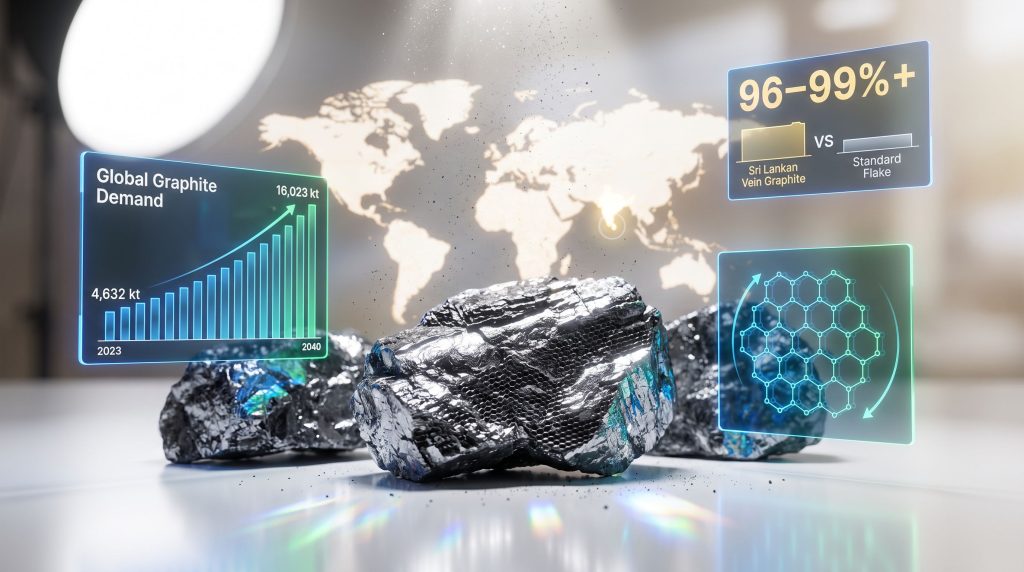
Into this structurally fragile environment, an enormous wave of new demand is arriving. According to the IEA's graphite report, total graphite demand is projected to climb from approximately 4,632 kilotonnes in 2023 to 10,419 kilotonnes by 2030, representing a roughly 125% increase over seven years. The trajectory extends further to an estimated 16,023 kilotonnes by 2040, driven predominantly by battery anode requirements as electric vehicle adoption accelerates globally.
Furthermore, the broader critical minerals demand picture reinforces just how exposed battery supply chains have become. Even modest disruptions to the existing graphite supply chain — whether through export restrictions, environmental policy changes, or diplomatic friction — have the potential to create outsized effects on downstream battery manufacturers who have built their production planning around a single-source model.
"The graphite supply problem is not about running out of the mineral. It is about the fact that refining and processing infrastructure is overwhelmingly concentrated in a single region, making diversification a strategic imperative for battery supply chains worldwide."
What Makes Sri Lankan Crystalline Vein Graphite Strategically Distinct?
The Mineralogical Case for Vein Graphite as a Premium Feedstock
Not all graphite is created equal, and this is a point that tends to be underappreciated outside specialist geological circles. The vast majority of the world's mined graphite is disseminated flake graphite, found in metamorphic rock formations where carbon is dispersed through the host rock in irregular concentrations. Purifying this material to battery grade requires multiple energy-intensive processing steps involving high-temperature thermal treatment and chemical washing.
Sri Lankan crystalline vein graphite is formed through an entirely different geological process. During deep crustal metamorphism, carbon-bearing fluids migrate along structural fractures and recrystallise under extreme pressure and temperature conditions, producing veins of almost pure crystalline carbon. The result is a naturally occurring graphite with carbon content regularly measured at 96 to 99% or higher, significantly exceeding the typical 85 to 95% carbon content of standard flake graphite from conventional deposits.
This mineralogical distinction is not merely academic. It has direct implications for the processing intensity required to reach advanced-material or battery-grade purity:
| Graphite Type | Typical Carbon Content | Processing Intensity | Primary Use Case |
|---|---|---|---|
| Standard Flake (China/Mozambique) | 85 to 95% | High | Battery anodes (bulk) |
| Sri Lankan Crystalline Vein | 96 to 99%+ | Low to Medium | Advanced materials, graphene |
| Synthetic Graphite | 99%+ | Very High | Premium battery anodes |
| Recycled Graphite | Variable | Medium | Emerging circular supply |
One underappreciated geological detail is that Sri Lanka's vein graphite is considered by many mineralogists to be geologically unique. The island's graphite deposits are associated with granulite-facies metamorphic terrains — some of the deepest and highest-temperature crustal environments on earth. The resulting crystalline structure exhibits a degree of lattice ordering that is rarely matched by surface-processed synthetic equivalents, and this structural quality is precisely what makes the material attractive as a graphene precursor. According to research published in the Lyell Collection, such deep-crustal graphite formations represent a distinct and strategically significant mineralogical category.
Why Feedstock Purity Changes the Economics of Graphene Production
Conventional graphite-to-graphene conversion processes begin with a purification problem. Standard flake graphite, even after industrial processing, retains silicate impurities, metal oxides, and other contaminants that interfere with graphene layer separation. Removing these impurities requires either aggressive chemical oxidation — typically the Hummers method or its variants — or extremely high-temperature thermal purification, both of which carry substantial energy costs and environmental footprints.
When the starting feedstock already exhibits 96 to 99% carbon purity, the initial purification burden is dramatically reduced. The downstream processing pathway to few-layer graphene becomes materially less energy-intensive, translating into:
- A lower carbon footprint per unit of graphene produced
- Reduced chemical waste from processing steps that can be shortened or eliminated
- Lower operating costs per kilogram of finished graphene material
- A more defensible lifecycle emissions profile as battery manufacturers face increasing scope 3 emissions scrutiny from investors and regulators
This emissions advantage is becoming commercially meaningful. Battery manufacturers in Europe and North America are under growing pressure to account for the embedded carbon in their input materials, not just the operational emissions of their factories. A graphene or graphite supplier that can demonstrate lower processing emissions per tonne holds a measurable commercial advantage in procurement decisions.
How Does the Graphite Earth Model Reframe Value Creation in the Graphite Sector?
Moving Beyond Tonnage: The Shift From Bulk Commodity to Performance Material
The traditional mining industry has long measured success through a simple lens: volume. Tonnes per annum, strip ratios, cost per tonne mined. These metrics are well-suited to bulk commodities where the primary competitive variable is scale and cost efficiency. They are, however, poorly suited to evaluating high-purity specialty material operations, where quality per tonne rather than quantity per tonne determines commercial value.
The Graphite Earth approach to graphite scarcity reframes graphite not as a bulk commodity input but as a performance material, where the physical characteristics of each tonne determine its downstream application and price point. A tonne of crystalline vein graphite suitable for graphene conversion commands a fundamentally different market price than a tonne of standard flake destined for the bulk anode market.
The Three Strategic Pillars of the Graphite Earth Approach
The commercial architecture of this model rests on three interconnected pillars:
- Feedstock differentiation: Accessing a naturally high-purity deposit rather than competing on volume with the world's lowest-cost conventional flake producers — a competition that companies outside China's integrated supply chain are structurally disadvantaged in.
- In-process value addition: Converting vein graphite into few-layer graphene through a lower-energy refinement pathway, targeting higher-margin end markets in battery enhancement, composites, and advanced electronics rather than the bulk anode commodity market.
- Supply chain positioning: Offering a geographically and geopolitically distinct supply source outside the most concentrated nodes of the existing graphite chain — a characteristic that carries increasing strategic value as battery manufacturers seek to de-risk their procurement.
"This three-pillar structure is fundamentally different from the conventional junior mining playbook, which competes primarily on resource size and cost-per-tonne metrics. A model built around material performance, processing efficiency, and supply chain positioning requires a different analytical toolkit to evaluate correctly."
What Is Few-Layer Graphene and Why Does It Command a Premium?
Graphene is a single atomic layer of carbon atoms arranged in a hexagonal lattice. In this two-dimensional form, it exhibits extraordinary electrical conductivity, mechanical tensile strength approximately 200 times greater than steel by weight, and thermal conductivity that exceeds virtually all other known materials. Few-layer graphene (FLG), consisting of between two and approximately ten stacked atomic layers, occupies a commercially important middle ground.
Key application areas currently attracting commercial investment include:
- Battery performance enhancement: Adding small concentrations of graphene to lithium-ion anodes can improve rate capability, cycle life, and thermal stability without requiring complete anode redesign.
- Composite materials: Graphene-enhanced polymers and metals exhibit improved strength-to-weight ratios relevant to aerospace, automotive, and construction sectors.
- Conductive coatings: Thin graphene films can replace conventional metallic coatings in anti-corrosion and electromagnetic shielding applications.
- Next-generation electronics: Graphene's electron mobility properties make it a candidate material for transistors and sensors operating beyond silicon's speed limits.
The ability to produce FLG from a naturally pure vein graphite feedstock using a low-energy process represents a meaningful cost and emissions advantage over synthetic graphene production routes, which typically begin from petroleum-derived precursors processed at temperatures exceeding 2,500 degrees Celsius.
How Does the Graphite Earth Strategy Compare to Other Responses to Graphite Scarcity?
A Comparative Framework: Five Pathways to Addressing Graphite Supply Risk
The global response to graphite supply concentration is not a single strategy but a portfolio of approaches, each with distinct advantages and limitations. Understanding where the vein graphite and graphene model sits within this broader landscape is essential for any analyst trying to size the addressable opportunity correctly. In addition, examining the wider battery metals landscape provides further context for how these strategies interact.
| Strategy | Key Advantage | Key Limitation |
|---|---|---|
| New natural flake graphite mining | Adds volume, diversifies geography | Long lead times; still depends on China-dominated refining |
| Synthetic graphite expansion | High purity achievable at scale | Higher lifecycle emissions; energy intensive; petroleum feedstock dependency |
| Silicon anode doping | Reduces per-cell graphite content | Silicon anode technology still maturing at commercial scale |
| Battery recycling and graphite recovery | Circular supply; no new extraction required | Recovery rates and processing economics still developing |
| High-purity vein graphite plus graphene conversion | Low energy processing; non-concentrated source; premium pricing potential | Scale limitations of vein graphite deposits |
The critical insight here is that these strategies are not mutually exclusive. Battery supply chains will ultimately draw on several of them simultaneously. For instance, the emerging battery recycling process is developing rapidly as a complementary circular supply pathway alongside primary production. The question for investors is not which single strategy wins, but which strategies occupy defensible commercial positions within a diversified future supply architecture.
Why Lifecycle Emissions Increasingly Favour Natural Processing Pathways
The Energy Transitions Commission has noted that synthetic graphite can technically close supply gaps in the battery materials market, but its higher lifecycle emissions create a structural disadvantage as battery manufacturers adopt comprehensive scope 3 emissions accounting frameworks. Synthetic graphite production requires petroleum needle coke processed at temperatures above 2,500 degrees Celsius in energy-intensive Acheson furnaces, carrying a carbon intensity that is difficult to reconcile with major manufacturers' sustainability commitments.
Consequently, low-energy natural processing pathways — particularly those beginning from high-purity feedstocks that minimise upstream purification requirements — are structurally positioned to benefit from tightening lifecycle emissions standards. Furthermore, innovative approaches such as the recycled graphite product being developed by emerging players signal that circular and low-emission supply solutions are gaining serious commercial traction.
What Are the Broader Implications for Critical Mineral Supply Chain Resilience?
Geopolitical Risk Repricing in Battery Material Markets
The past several years have seen a significant shift in how battery manufacturers and the governments that regulate them think about supply chain concentration. Export controls on graphite implemented by major producing nations in 2023 demonstrated, in concrete terms, what analysts had long theorised: that concentration creates leverage, and that leverage can be exercised with limited warning.
Policy responses have been substantial across multiple jurisdictions:
- The US Inflation Reduction Act creates domestic content requirements that incentivise battery supply chains sourcing materials from non-restricted trade partners.
- The EU Critical Raw Materials Act establishes benchmarks for strategic mineral supply diversification and supports investment in processing capacity within or allied to the European sphere.
- Various national critical mineral strategies across Australia, Japan, South Korea, Canada, and the UK have introduced mechanisms to support development of alternative supply sources.
Sri Lanka's geographic position outside the dominant graphite supply corridor makes vein graphite operations there relevant to these policy objectives. Relevant to is the appropriate framing here. Relevance to a policy framework does not constitute project-specific government support, and investors should evaluate commercial viability on fundamentals rather than assumed policy benefits that have not been formally extended to any specific operation.
The Scalability Question: Can Vein Graphite Supply Compete at Battery Market Scale?
This is the most substantive challenge to the vein graphite model, and it deserves a direct answer. Crystalline vein graphite deposits are geologically less common than disseminated flake deposits. Sri Lanka's reserves, while high-quality, are not comparable in scale to the massive flake graphite deposits of Mozambique, Tanzania, or the established Chinese production regions.
The strategic response to this reality is the deliberate pivot toward higher-value, lower-volume graphene applications. The addressable market for few-layer graphene in battery performance enhancement and advanced composites is fundamentally distinct from the bulk anode graphite market, both in terms of volume requirements and achievable price per kilogram. A vein graphite operation producing graphene for battery enhancement additives is not competing with a Mozambican flake graphite operation — it is addressing a different segment of a rapidly expanding material ecosystem.
"Analysts evaluating this model should apply separate demand forecasting for graphene-enhanced applications rather than mapping performance against standard battery graphite demand curves. The two markets have different growth drivers, different pricing mechanisms, and different competitive dynamics."
The next major ASX story will hit our subscribers first
Frequently Asked Questions: Graphite Scarcity and the Graphite Earth Approach
What is graphite scarcity and why does it matter for battery supply chains?
In the context of battery supply chains, graphite scarcity refers primarily to the concentration of mining and refining infrastructure within a small number of countries rather than any physical shortage of the mineral itself. With demand projected to more than triple between 2023 and 2040 under major energy transition scenarios, the structural fragility of a highly concentrated supply chain poses material risks to battery manufacturers who have limited near-term alternatives.
How does Sri Lankan vein graphite differ from conventional flake graphite?
Sri Lankan crystalline vein graphite is formed through a distinct deep-crustal geological process associated with granulite-facies metamorphism, producing a naturally higher-purity carbon structure than most disseminated flake deposits. The elevated purity reduces the processing steps required to reach advanced-material grade, resulting in lower energy consumption and a potentially lower lifecycle emissions profile per tonne of refined output.
What is few-layer graphene and how is it produced from vein graphite?
Few-layer graphene consists of between two and approximately ten atomic layers of carbon, exhibiting enhanced electrical, mechanical, and thermal properties compared to bulk graphite. Producing it from high-purity vein graphite feedstock can reduce the chemical and thermal processing intensity relative to conventional graphene production routes, which typically require heavily refined or chemically treated graphite as a starting material.
Is the Graphite Earth approach scalable enough to address global graphite demand?
The model appears oriented toward a specific and distinct segment of the graphite material ecosystem, targeting high-performance graphene applications rather than bulk anode supply. Given geological constraints on vein graphite deposit scale, commercial logic favours premium positioning in lower-volume, higher-margin end markets rather than volumetric competition with conventional large-scale producers.
Rethinking Graphite Value in an Era of Supply Chain Scrutiny
From Extraction Volume to Material Intelligence
The dominant paradigm of measuring mining success by tonnes extracted is increasingly misaligned with the value drivers of the critical minerals transition. What matters in an era of supply chain scrutiny is not simply how much material can be moved, but what quality that material is, how efficiently it can be processed, and where in the global supply architecture it sits.
Operations that combine feedstock quality, low-energy processing economics, and geopolitical supply chain positioning occupy a structurally differentiated commercial position relative to conventional bulk producers. The Graphite Earth approach to graphite scarcity ultimately recognises that the sector's demand trajectory — from 4,632 kilotonnes in 2023 toward 16,023 kilotonnes by 2040 — creates commercial space for multiple supply models to coexist, including premium niche producers targeting graphene-enhanced applications that are developing rapidly.
Key Takeaways for Investors, Policymakers, and Supply Chain Strategists
- Graphite scarcity is fundamentally a supply chain architecture problem rather than a geological one, and resolving it requires investment in processing diversification, not merely new mine discovery.
- Sri Lankan crystalline vein graphite occupies a distinct mineralogical tier, with naturally high carbon content that reduces processing intensity and lifecycle emissions per unit of finished material.
- High-purity natural feedstocks offer a lower-energy pathway to graphene production compared with synthetic alternatives, with a more favourable embedded carbon profile as emissions accounting standards tighten.
- The Graphite Earth approach to graphite scarcity represents a clearly differentiated strategic response to supply concentration, built around feedstock quality, processing efficiency, and market positioning rather than resource scale.
- Evaluating this model requires an analytical framework designed for specialty performance materials rather than bulk commodity mining, including separate demand forecasting for graphene end markets.
This article contains forward-looking projections and demand forecasts drawn from third-party sources including the International Energy Agency. These projections are subject to significant uncertainty and should not be interpreted as guarantees of future outcomes. Readers should conduct independent research and seek professional financial advice before making investment decisions related to any company or sector discussed.
For ongoing technical and commercial coverage of the global mining sector, including critical minerals and supply chain dynamics, Mining Magazine provides in-depth analysis at miningmagazine.com.
Want to Stay Ahead of the Next Major Critical Minerals Discovery?
Discovery Alert's proprietary Discovery IQ model scans ASX announcements in real time, instantly identifying significant mineral discoveries across graphite, battery metals, and over 30 other commodities — turning complex data into actionable investment insights before the broader market reacts. Explore how historic discoveries have generated substantial returns on Discovery Alert's dedicated discoveries page, and begin your 14-day free trial today to position yourself at the forefront of the critical minerals transition.