August 20, 2026
The Economics of Control: Why Vertical Integration Is Redefining Competitiveness in Primary Aluminium
Few industrial sectors expose the vulnerabilities of fragmented supply chains as starkly as primary aluminium production. The economics of smelting are brutally transparent: energy typically accounts for 30 to 40 percent of total production costs, alumina feedstock contributes another 25 to 35 percent, and together these two variables determine whether a smelter operates profitably or at a loss across commodity cycles. For producers who source both externally, margin compression during periods of elevated input costs is not a risk scenario — it is a near certainty.
This structural reality is reshaping how the most strategically sophisticated aluminium producers are positioning themselves for the next decade. The competitive divide between integrated and non-integrated operators is widening, and Chuangxin Industries' integrated aluminium strategy represents one of the most comprehensive attempts by any producer to close off those vulnerabilities simultaneously across energy, feedstock, geography, and sustainability dimensions.
When big ASX news breaks, our subscribers know first
Why Non-Integrated Producers Face a Structural Disadvantage
To understand what full vertical integration actually delivers, it helps to first understand what its absence costs. A conventional aluminium smelter purchasing power from the grid and alumina from third-party refiners is exposed to two independent commodity markets simultaneously. When both move adversely at the same time — as occurred during the European energy crisis of 2021 to 2022 — smelters across the continent curtailed or shuttered capacity entirely.
The cost exposure gap between integrated and non-integrated smelters is not linear. Each layer of integration does not simply add a fixed cost saving; it removes a variable that previously amplified losses during downturns. Consider the compounding effect:
- A producer with captive power eliminates electricity price risk entirely.
- A producer that also refines its own alumina eliminates feedstock price risk.
- A producer that additionally owns bauxite mining assets eliminates the upstream supply disruption risk that flows through into alumina availability.
Each step reduces not just direct costs but also the volatility of the cost base itself, which is arguably more valuable than any single period's cost saving when assessed over a full commodity cycle.
What Chuangxin Industries' Integrated Aluminium Strategy Actually Encompasses
Chuangxin's production architecture is built around three interlocking pillars: captive energy generation, in-house alumina refining, and electrolytic aluminium smelting. Its domestic operations are anchored in Inner Mongolia and Shandong, two regions with distinct logistical and resource advantages for large-scale aluminium manufacturing.
Inner Mongolia provides access to abundant wind resources and significant solar irradiation potential, making it one of China's most favourable locations for co-locating renewable generation with energy-intensive smelting. Shandong offers proximity to port infrastructure, supporting both raw material import logistics and finished product distribution. The geographic pairing is not accidental; it reflects a deliberate design around minimising both input costs and output distribution costs within the same operational framework.
The company's own power generation and alumina refining capacity are structured to meet its production requirements internally, insulating operations from external price fluctuations across both of the two largest cost categories in primary aluminium manufacturing. This approach mirrors what other aluminium industry leaders have pursued as a long-term competitive imperative.
H1 2026 Financial Performance: Integration Delivering Measurable Earnings Leverage
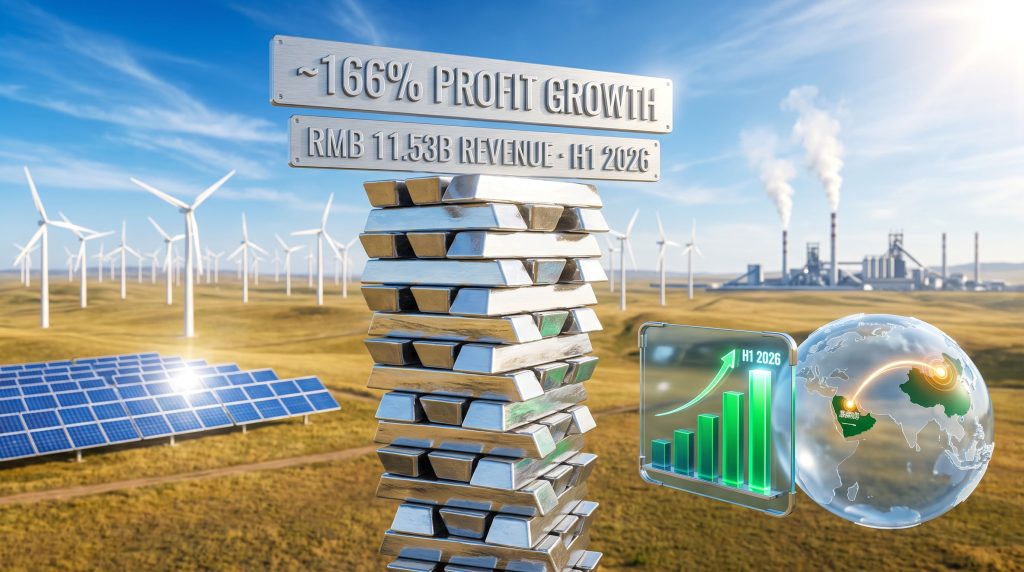
The financial results from the first half of 2026 provide concrete evidence of the integrated model's earnings leverage under favourable market conditions.
| Financial Metric | H1 2026 Result |
|---|---|
| Revenue | RMB 11.53 billion (USD ~1.7 billion) |
| Attributable Profit | RMB 2.30 billion (USD ~342 million) |
| Year-on-Year Profit Growth | ~166% |
Three factors drove this outcome simultaneously: higher realised aluminium prices reflecting improved global demand conditions, lower production costs attributable to the integrated supply structure, and reduced finance costs. The convergence of all three in a single reporting period is unusual and reflects both market timing and structural execution. Furthermore, China industrial demand trends have played a meaningful role in supporting elevated pricing environments across base metals, including aluminium.
The demand backdrop underpinning higher prices is itself structurally significant. Growth in artificial intelligence infrastructure, electric vehicle manufacturing, and renewable energy deployment are all aluminium-intensive at scale. Data centres require aluminium in cabling, heat management systems, and structural components. Electric vehicles use approximately 130 to 250 kilograms of aluminium per unit depending on vehicle class. Utility-scale solar and wind installations rely heavily on aluminium framing, wiring, and transmission infrastructure.
These are not cyclical demand pulses; they represent durable structural consumption growth that is likely to sustain elevated aluminium pricing over medium-term horizons.
Producers who have locked in low-cost, vertically integrated supply structures ahead of this demand wave are positioned to capture disproportionate margin expansion compared to peers still purchasing inputs at market rates.
The Renewable Energy Moat: 1,150 MW and Counting
Chuangxin's renewable energy programme in Inner Mongolia is one of the more technically ambitious components of its integration strategy. As of H1 2026, the company had commissioned 1,040 MW of wind power capacity and 110 MW of solar capacity within the region, totalling 1,150 MW of installed renewable generation co-located with its smelting operations.
The strategic logic of co-location deserves closer examination. Grid-connected renewable purchase agreements, which many producers rely on to improve their green energy credentials, deliver partial carbon benefits but limited cost certainty. Power delivered via the grid still carries transmission charges, balancing costs, and exposure to grid pricing mechanisms. Captive, co-located generation bypasses all of these intermediary costs and delivers electricity at the actual levelised cost of energy from the generation asset itself.
In Inner Mongolia, where wind capacity factors can reach 30 to 40 percent and solar irradiation is above the national average, the economics of co-located generation are particularly compelling. The broader renewable programme is targeting a green electricity share exceeding 50 percent of total aluminium production once fully operational — a threshold that carries both cost implications and significant commercial positioning value. This transition towards low-carbon metals production is becoming a defining competitive differentiator across the broader metals sector.
Why the 50% Green Electricity Threshold Is Commercially Critical
The 50 percent green electricity threshold is not an arbitrary sustainability target. It sits at the intersection of several converging regulatory and market dynamics:
- The European Union's Carbon Border Adjustment Mechanism (CBAM) is progressively applying carbon pricing to imported goods including aluminium, creating cost penalties for high-carbon production and commercial advantages for low-carbon supply.
- Premium green aluminium pricing in European, North American, and Middle Eastern markets is becoming a real and measurable price differential rather than a niche positioning exercise.
- Major downstream manufacturers in the automotive, aerospace, and packaging sectors are increasingly requiring supply chain carbon disclosure and are beginning to preference or contractually specify low-carbon aluminium content in procurement.
Aluminium producers achieving renewable electricity shares above 50 percent in smelting operations are approaching the threshold where green aluminium premiums and carbon compliance advantages begin to materially alter the effective price received per tonne, independent of the LME benchmark.
Comparing Integration Models Across the Aluminium Industry
| Integration Approach | Cost Benefit | Carbon Benefit | Scalability |
|---|---|---|---|
| Captive wind + solar (co-located) | High | High | Medium |
| Grid renewable purchase agreements | Low to Medium | Medium | High |
| Hydropower-based smelting | High | Very High | Geography-dependent |
| Conventional grid-powered smelting | None | None | High |
Chuangxin's captive wind and solar model sits in the high cost benefit and high carbon benefit quadrant, with the scalability constraint being the primary limitation. That constraint, however, is being addressed through the ongoing commissioning programme rather than representing a fundamental ceiling. The green metals transition underway globally suggests that producers achieving this level of renewable integration early will carry lasting structural advantages.
The Saudi Arabia Project: From China-Concentrated to Multi-Geography Platform
Perhaps the most strategically significant element of Chuangxin Industries' integrated aluminium strategy is its 500,000-tonne-per-year integrated aluminium project in Saudi Arabia. The project is being developed through a partnership structure, with required regulatory approvals now secured and construction actively underway.
The choice of Saudi Arabia as the location for international expansion is not incidental. Gulf region energy cost structures are among the most competitive globally for energy-intensive industrial processes, and aluminium smelting is among the most energy-intensive manufacturing processes that exist. Access to competitively priced energy at scale is a fundamental prerequisite for viable smelting economics, and the Saudi industrial landscape is structured to accommodate large-scale energy-intensive foreign investment as part of broader economic diversification objectives.
Beyond energy economics, the project delivers a geopolitical risk diversification benefit that is increasingly valuable for Chinese aluminium producers. Origin-based trade measures, tariff structures, and carbon border mechanisms applied specifically to Chinese-produced goods create a growing rationale for establishing production capacity outside China. A Saudi Arabian production origin provides a structurally different customs and trade position for aluminium sold into key importing regions. Consequently, the ongoing aluminium tariff impacts reshaping global trade flows make geographic diversification of this kind a strategically rational hedge.
If trade policy frameworks continue to differentiate by production origin, a 500,000-tonne annual capacity operating from Saudi Arabia could serve as a tariff-neutral supply point for markets where Chinese-origin aluminium faces additional friction — a structural hedge that purely domestic producers cannot access.
This is not a speculative outcome. Origin-based trade differentiation is already embedded in current US tariff structures, the EU's CBAM framework, and procurement policies in several other major importing economies. The directional trend is established even if the precise magnitude of future policy shifts remains uncertain. CRU Group has highlighted the significance of Chuangxin's HKEX listing as a milestone for Chinese aluminium producers pursuing international capital markets engagement at this scale.
Upstream Resource Security: Closing the Bauxite and Alumina Loop
The third strategic dimension of Chuangxin's integration programme involves investments in upstream alumina refining capacity and bauxite mining assets. This layer of the strategy addresses feedstock supply security rather than energy cost, though the two are operationally interconnected.
Alumina pricing is itself subject to significant cyclical volatility. Global bauxite supply is geographically concentrated, with Guinea, Australia, and a small number of other jurisdictions accounting for the majority of traded volumes. Disruptions to bauxite supply chains — whether from weather events, logistical constraints, or political factors in producing countries — have historically transmitted into sharp alumina price spikes that compress smelting margins for producers dependent on spot or short-term contract purchasing.
Owning upstream bauxite and alumina assets achieves several simultaneous objectives:
- It removes feedstock price risk from the cost base and replaces it with a more predictable internal transfer cost.
- It improves scheduling certainty, allowing smelters to optimise operational continuity without building excessive inventory buffers.
- It enables quality consistency in alumina feed, which has technical implications for electrolytic cell performance and energy efficiency at the smelting stage.
- It creates an additional earnings stream that is counter-cyclical to smelting margins in some market configurations, providing portfolio-level income smoothing.
Layered on top of physical integration, Chuangxin's investments in automation, digital manufacturing platforms, and energy-saving process technologies compound the efficiency advantages further. In electrolytic aluminium production, marginal improvements in energy consumption per tonne of metal produced translate directly into meaningful cost savings at scale.
The next major ASX story will hit our subscribers first
ESG Governance: Institutional Signal or Commercial Prerequisite?
The establishment of a board-level ESG committee and the publication of Chuangxin's inaugural ESG report are worth examining beyond their surface-level governance significance. For a company pursuing international partnerships, export market access, and potentially international capital markets engagement, formal ESG governance infrastructure is increasingly a prerequisite rather than an optional enhancement.
International institutional investors and sovereign wealth fund co-investors typically require ESG disclosure frameworks before committing capital to large-scale industrial projects. The Saudi Arabia partnership structure, whatever its precise configuration, is likely to involve parties whose own governance requirements mandate a counterpart with credible sustainability reporting. Deloitte China's involvement in assisting Chuangxin's SEHK listing further underscores the level of institutional governance rigour applied to the company's capital markets programme.
Viewed through this lens, the ESG committee and inaugural report are commercially functional components of the international expansion programme rather than standalone sustainability initiatives. The renewable energy programme and the ESG governance framework are therefore commercially interdependent: the renewable capacity creates the underlying sustainability performance, while the ESG framework provides the reporting infrastructure to translate that performance into commercially and financially actionable credentials.
Risk Factors and Execution Challenges
A strategy of this scope and geographic ambition carries material execution risks that warrant clear acknowledgment:
- Construction and commissioning risk on the Saudi Arabia project is real. Large-scale greenfield aluminium smelter development carries significant schedule and cost overrun exposure, particularly in jurisdictions where the contractor ecosystem for this type of infrastructure is less established.
- Renewable energy intermittency in co-located smelting operations requires sophisticated grid management and potentially backup capacity to avoid production disruptions. Electrolytic aluminium cells are sensitive to power interruptions, and unplanned outages carry significant restart costs.
- Currency and regulatory risk across multiple jurisdictions introduces complexity that domestically concentrated operators do not face.
- Geopolitical developments in either China or the Gulf region could affect operational continuity or partnership structures in ways that are inherently difficult to forecast.
These risks do not undermine the strategic logic but they do underscore the execution complexity involved in simultaneously advancing integration, renewable transition, and geographic diversification across multiple geographies and timelines.
What Full Strategy Execution Could Look Like by 2027 to 2028
If the Saudi Arabia project reaches full 500,000-tonne annual capacity alongside the domestic renewable programme achieving its greater than 50 percent green electricity target, and with upstream resource investments maturing, Chuangxin Industries' integrated aluminium strategy would represent a materially different competitive entity than it does today.
The combined production platform would span two major geographies, be partially insulated from both Chinese domestic policy risk and origin-based trade measures in export markets, carry a verifiable green aluminium credential increasingly valued by premium customers, and operate from a lower and more stable cost base than most non-integrated peers. The three-vector strategy of cost integration, renewable transition, and geographic diversification would have moved from concurrent development initiatives into a unified, compounding competitive position.
This article contains forward-looking statements and scenario analysis based on publicly available information. Readers should not interpret projections or strategic assessments as guarantees of future financial performance. Investors and industry participants should conduct independent research and seek professional advice before making any decisions based on the information contained herein.
Want to Track the Next Major ASX Mineral Discovery Before the Market Moves?
Discovery Alert's proprietary Discovery IQ model delivers real-time alerts on significant ASX mineral discoveries, transforming complex data across more than 30 commodities into clear, actionable insights for both short-term traders and long-term investors — explore historic discoveries and their exceptional returns to see what early positioning can deliver, and begin your 14-day free trial today to stay ahead of the market.