August 20, 2026
China's Gold Market Is Running on Three Different Engines Simultaneously
Chinese gold demand in July is best understood through a multi-channel lens rather than a single headline number. Global commodity markets rarely move in a tidy, unified way, and China's gold market is a clear example. Furthermore, wholesale demand, ETF activity and official-sector reserve buying can all point in different directions at the same time.
Chinese gold demand in July 2026 is a textbook illustration of that complexity. Wholesale physical demand softened, yet institutional buying through futures and funds climbed. Meanwhile, the jewellery sector remained subdued under price pressure, while the People's Bank of China extended one of the most consequential reserve-building streaks in modern monetary history.
When big ASX news breaks, our subscribers know first
The Three-Channel Framework: Why China's Gold Market Defies Simple Interpretation
China's position as the world's largest gold market means its demand signals carry major weight for global pricing and supply dynamics. For deeper context, this also aligns with broader trends in China's gold market dominance. However, the market itself is not monolithic.
It functions across three structurally distinct demand channels:
- Official-sector accumulation, driven by the People's Bank of China
- Private investment demand, expressed through ETFs, futures and physical investment products
- Jewellery consumption, which is highly sensitive to prices, seasonal cycles and consumer confidence
These channels do not move in lockstep. In fact, their divergence is often the most useful signal. A market where official buying surges while jewellery demand contracts tells a very different story from one where all three channels strengthen together.
PBoC Reserve Accumulation: The Institutional Backbone of Chinese Gold Demand
Twenty-One Consecutive Months of Buying
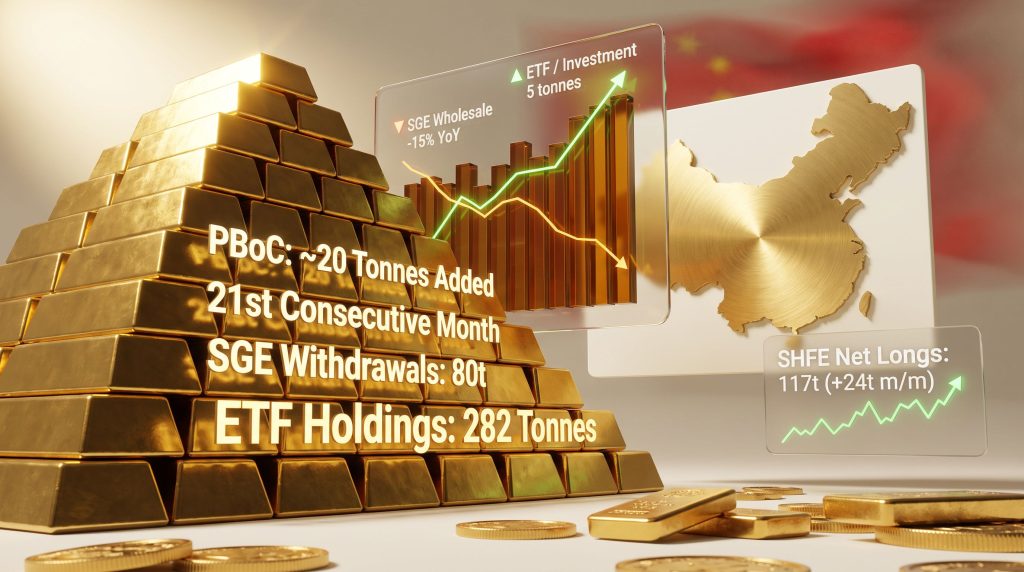
The most significant July data point does not come from retail or wholesale metrics. Instead, it sits in China's official reserve figures. The People's Bank of China added roughly 20 tonnes to its gold holdings in July 2026, extending its buying streak to 21 consecutive months.
Critically, that was the largest monthly addition since October 2023. In addition, this sustained run of purchases points to deliberate reserve diversification rather than routine portfolio management. It also reflects the wider importance of central bank gold demand in the current market cycle.
The PBoC's buying streak now represents one of the most consistent and consequential accumulation programmes by any central bank in the current cycle, with implications that extend well beyond China's own balance sheet.
The Global Supply Absorption Effect
What is less discussed is the impact on global supply. When one buyer consistently removes 15 to 25 tonnes per month from available metal, the cumulative effect becomes material. Over 21 months, this programme has absorbed well over 300 tonnes from global supply flows.
Consequently, this creates a structural price floor that can operate independently of jewellery demand or retail sentiment. It also supports the broader theme of central banks influencing gold prices across international markets. In a larger sense, it also reinforces the role of gold in the monetary system.
Shanghai Gold Exchange Withdrawals: Reading the Wholesale Signal Correctly
The July Numbers in Context
SGE withdrawals are widely viewed as the best proxy for China's wholesale physical gold demand. In July 2026, withdrawals totalled 80 tonnes, down 8% month on month and 15% year on year.
At first glance, that looks soft. However, context matters.
| Metric | July 2026 | Month-on-Month | Year-on-Year |
|---|---|---|---|
| SGE Withdrawals | 80 tonnes | -8% | -15% |
| Gold ETF Holdings | 282 tonnes | +5 tonnes | Positive |
| PBoC Reserve Addition | ~20 tonnes | Largest since Oct 2023 | 21st consecutive month |
| SHFE Net Longs | 117 tonnes | +24 tonnes | Bullish |
| Chinese ETF AUM | ¥250 billion (~US$37B) | +3% | Rising |
Seasonal Patterns and the High-Base Problem
The World Gold Council described wholesale demand as tepid, but largely because of familiar seasonal patterns. Jewellery fabrication typically softens through Q2 and early Q3, before restocking begins later in the year ahead of Lunar New Year demand.
In addition, the year-on-year comparison is distorted by a strong base in July 2025. That makes the current slowdown look sharper than it may actually be. According to a World Gold Council market update, strong official-sector buying remained a defining feature even as wholesale trends softened.
June also matters here. Chinese gold imports jumped to a two-year high in June after a temporary price dip triggered aggressive physical buying. Therefore, July's softer wholesale figures may partly reflect an inventory digestion phase rather than a collapse in underlying demand.
Investment Demand: The Channel That Is Quietly Strengthening
ETF Inflows Signal a Meaningful Shift
While physical demand weakened, financial demand moved the other way. Chinese gold-backed ETFs recorded net inflows of roughly RMB 5 billion, or about US$744 million, in July. Total holdings rose by 5 tonnes to 282 tonnes.
Assets under management climbed 3% to ¥250 billion, equivalent to around US$37 billion. This rebound mirrors broader patterns in gold ETF inflows globally, although the domestic Chinese drivers remain distinct. A separate market analysis on Chinese ETF demand also highlighted the July recovery in fund flows and futures activity.
Several forces likely drove this:
- Persistent geopolitical uncertainty
- Weak domestic equity performance
- Confidence reinforced by continued PBoC buying
- Price stabilisation after earlier volatility
What the Shift Towards Financial Gold Instruments Reveals
One of the more interesting structural trends is the shift from purely physical buying towards financial gold exposure. ETF inflows rising while SGE withdrawals fall is not a contradiction. Instead, it suggests China's gold investment market is maturing.
A decade ago, much of this demand would have shown up through bars, coins or jewellery. Now, investors have more liquid and flexible options. Therefore, SGE data alone is becoming a less complete measure of total investment behaviour.
The divergence between rising ETF inflows and falling wholesale withdrawals points to a structural evolution in how Chinese investors engage with gold, one that makes SGE data alone an increasingly incomplete measure of total investment demand.
Shanghai Futures Exchange Positioning Reinforces the Bullish Bias
The ETFs were not the only positive signal. Net long positions on the Shanghai Futures Exchange climbed by 24 tonnes during July, finishing at 117 tonnes. That suggests professional and institutional participants were positioning for higher prices.
Taken together, ETF inflows and rising net longs indicate that investment demand was gaining momentum. As a result, Chinese gold demand in July looked stronger in financial channels than in physical ones.
The Jewellery Sector's Structural Dilemma
When Price Becomes a Barrier
China's jewellery sector remained under pressure throughout July. The yuan-denominated gold price was broadly flat, offering little relief to cost-sensitive consumers. At elevated price levels, discretionary purchases become more difficult, especially in lower-tier cities where income growth has moderated.
The World Gold Council's view was that physical investment demand held broadly steady from June, but not enough to offset weaker jewellery consumption. In other words, gold's strength as a store of value may be undermining its affordability as a consumer product.
Cyclical Softness or Something More Durable?
Analysts remain divided on whether the weakness is temporary or more structural. On one hand, the seasonal argument is credible given the normal Q2-Q3 slowdown. On the other, the 15% year-on-year decline in SGE withdrawals may suggest high prices are changing purchasing behaviour more permanently.
Both views may hold some truth. However, if consumers continue shifting towards investment products over fabricated jewellery, the usual Q4 recovery could be shallower than historical patterns imply.
The next major ASX story will hit our subscribers first
The Macro Backdrop: What Drove Sideways Gold Performance in July?
Competing Forces and the Attribution Model
Gold's price in yuan was essentially flat through July. According to the World Gold Council's attribution model, a weaker US dollar and stronger investor positioning supported prices. However, rising bond yields acted as the main headwind.
This helps explain the sideways trade. Gold faces an opportunity cost when yields rise because fixed-income assets become more attractive. Even so, the metal held firm, which suggests structural support remained intact.
De-dollarisation as a Long-Term Demand Floor
The geopolitical element deserves more attention. China's reserve diversification away from US dollar assets is not a short-term tactical move. Rather, it is a strategic response to the risks tied to foreign-held reserve assets.
For China, gold is an asset with no counterparty risk and no direct exposure to sanctions. Consequently, Chinese gold demand in July cannot be separated from this longer de-dollarisation theme, which is likely to outlast short-term market cycles.
Forward Outlook: Key Variables to Watch Through Q4 2026
What Could Strengthen Demand?
Several factors could support the market in coming months:
- Continued price gains could attract momentum investors
- Seasonal jewellery restocking in Q4 may lift wholesale demand
- Further PBoC buying would keep supply absorption elevated
- Geopolitical stress could trigger more safe-haven flows
What Could Create Headwinds?
There are also clear risks:
- A stronger Chinese equity market could pull capital away from gold
- Higher yuan gold prices may further weaken jewellery demand
- Easing geopolitical tensions could reduce the safe-haven premium
A Unified Picture: Three Channels, Three Different Stories
| Demand Channel | July 2026 Status | Trend Direction | Primary Driver |
|---|---|---|---|
| PBoC / Central Bank | ~20t added, 21st consecutive month | Strongly Positive | Reserve de-dollarisation |
| ETF / Investment Funds | +5t inflows, 282t total | Recovering | Geopolitical risk, equity weakness |
| SHFE Net Longs | 117t (+24t month on month) | Bullish positioning | Price momentum expectations |
| SGE Wholesale | 80t (-8% MoM, -15% YoY) | Seasonally weak | Seasonal patterns, high prices |
| Jewellery Consumption | Subdued | Structurally pressured | Elevated yuan gold price |
Ultimately, Chinese gold demand in July does not tell one story. It tells several at once. Official-sector buying remains the dominant structural signal, while investment demand through ETFs and futures is strengthening.
Meanwhile, wholesale and jewellery softness appears real, though partly shaped by seasonality, high-base effects and June's front-loaded buying surge. Therefore, the clearest conclusion is that China's gold market is not weakening uniformly. Instead, it is rotating between different engines of demand.
Disclaimer: This article is intended for informational and educational purposes only and does not constitute financial advice. Gold markets involve significant risk, and past performance is not indicative of future results. All forecasts and forward-looking statements are speculative in nature and should not be relied upon as the basis for investment decisions. Readers should conduct independent research and consult a qualified financial adviser before making any investment decisions.
Want to Stay Ahead of the Next Major ASX Mineral Discovery?
Discovery Alert's proprietary Discovery IQ model delivers real-time alerts on significant ASX mineral discoveries, cutting through complex data to surface actionable investment opportunities the moment they are announced — explore historic discoveries and their returns to understand what early positioning can mean, then begin your 14-day free trial at Discovery Alert to secure your market-leading edge.