May 15, 2026
Market Dynamics Behind Chinese Graphite Dominance
The global battery supply chain has reached a critical inflection point where geopolitical tensions intersect with strategic mineral dependencies. Chinese manufacturers have established overwhelming market control in graphite active anode material production, leveraging state-supported pricing strategies that fundamentally challenge the economic viability of Western competitors. This dominance creates cascading risks throughout the electric vehicle ecosystem, particularly as battery manufacturers require reliable, cost-competitive sourcing for mass production.
When the US International Trade Commission reversed tariff protections on Chinese graphite imports in March 2026, the Syrah Resources US tariff reversal highlighted the complex interplay between trade law, national security considerations, and commercial realities facing Australian resources companies operating in global markets. Furthermore, this decision demonstrates how tariffs impact markets across multiple sectors.
When big ASX news breaks, our subscribers know first
Understanding the International Trade Commission's Reversal Framework
Legal Standards in Antidumping Investigations
The US trade protection system operates through a dual-track framework requiring both the Department of Commerce and the International Trade Commission to reach affirmative determinations before tariffs can be imposed. The Department of Commerce focuses on whether foreign producers are selling products below fair value or receiving government subsidies, while the ITC evaluates whether domestic industries face material injury from these practices.
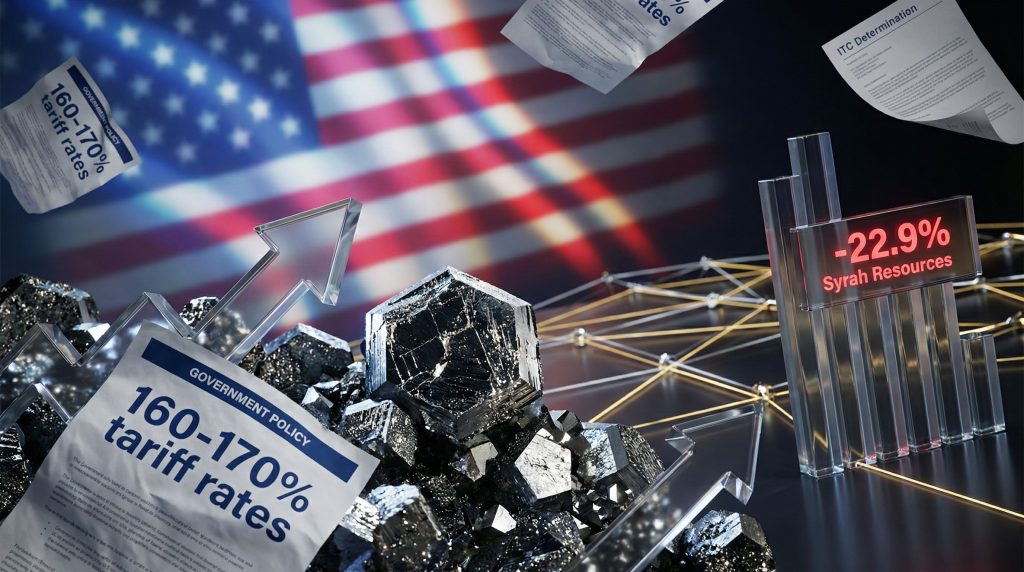
In February 2026, the Department of Commerce concluded that Chinese graphite active anode material producers warranted antidumping and countervailing duty rates of 160-170%, finding that major Chinese battery and graphite AAM producers operated under de facto government control. This determination covered all natural and synthetic graphite AAM products, including those contained in blended materials, components such as anode slurries, and subassemblies like electrodes imported from China.
The North American Graphite Alliance, which includes Syrah Resources as a member organisation, had petitioned for this investigation based on evidence that Chinese producers benefited from government subsidisation patterns that created unfair competitive advantages in US markets. In addition, this investigation reflected broader concerns about Trump's tariff implications on critical industries.
ITC's Injury Determination Methodology
The International Trade Commission's March 13, 2026 decision to overturn the Commerce Department's tariff determination centred on injury assessment standards rather than disagreement with the subsidisation findings. Under US trade law, the ITC must determine whether domestic industry experiences material injury or threatened material injury by reason of subject imports.
The Commission's negative determination suggests insufficient evidence that Chinese graphite AAM imports caused demonstrable harm to the establishment or operations of a domestic AAM industry in the United States. This legal standard requires proof that:
- Domestic industry suffers declining market share due to subject imports
- Price depression or suppression occurs in domestic markets
- Lost sales or revenue directly correlate to unfairly traded imports
- Employment, production capacity, or capital investment declines
The ITC's decision effectively nullified the tariff protections despite the Commerce Department's confirmation of Chinese government subsidisation, demonstrating how trade law's injury requirements can override dumping determinations. However, this development must be viewed within the broader context of the US–China trade war and its ongoing implications.
Australian Graphite Producers Face Strategic Repositioning
Immediate Market Response Analysis
Australian equity markets responded decisively to the ITC announcement, with Syrah Resources shares declining 22.9% and Novonix Limited falling 5.0% on March 13, 2026. This market repricing reflected investor recalibration of near-term revenue prospects for Australian graphite producers previously benefiting from protected US market access.
| Company | Share Price Impact | Strategic Implications |
|---|---|---|
| Syrah Resources (ASX: SYR) | -22.9% | Vidalia facility timeline extended |
| Novonix Limited (ASX: NVX) | -5.0% | Supply chain diversification accelerated |
The differential impact between these companies reflects their varying exposure to US market dynamics, with Syrah's Vidalia facility representing direct competition against Chinese AAM producers, while Novonix maintains broader supply chain optionality. Consequently, investors closely monitored the market developments.
Competitive Landscape Restructuring Dynamics
Syrah Resources acknowledged that the ITC determination could delay sales from its Vidalia facility and limit near-term demand growth for AAM produced in the United States. However, the company maintained that its facility produces high-quality AAM with full readiness for commercial ramp-up, claiming cost competitiveness with Chinese and Indonesian producers when operating at commercial volumes.
This competitive positioning reveals critical aspects of graphite AAM economics:
- Scale dependency: Unit costs decline significantly with production volume increases
- Quality differentiation: Technical superiority and reliability provide competitive advantages
- Customer qualification: Long-term relationships matter more than short-term pricing
- Supply security: Strategic sourcing considerations beyond cost competitiveness
The removal of tariff protections forces Australian producers to compete primarily on operational efficiency, technical capabilities, and supply chain reliability rather than trade-policy-supported cost advantages. For instance, this situation aligns with Australia's broader critical minerals strategy for maintaining competitiveness.
Alternative Trade Protection Mechanisms Provide Residual Support
Existing Tariff Architecture Beyond Antidumping Duties
Despite the ITC reversal, multiple layers of trade protection continue affecting Chinese graphite imports into the United States. These alternative mechanisms include:
Section 301 Tariffs: Currently effective on Chinese natural graphite and synthetic graphite AAM as part of broader trade remedies addressing intellectual property practices and market access barriers under the Trade Act of 1974.
Section 122 Trade Act Provisions: Applying tariff measures to specific graphite materials categories through alternative legal frameworks independent of antidumping investigations.
Section 232 National Security Considerations: Under active consideration for graphite materials based on national security supply chain vulnerabilities under the Trade Expansion Act of 1962.
The cumulative effect of these alternative protection mechanisms means Chinese graphite producers still face significant trade barriers, though at potentially lower rates than the proposed 160-170% antidumping duties.
Strategic Policy Implementation Timeline
The US Administration's critical minerals and national security agenda continues encouraging ex-China and domestic sourcing strategies for AAM, independent of specific antidumping determinations. This policy framework reflects bipartisan support for supply chain diversification in strategic materials sectors.
Policy implementation priorities include:
- Domestic processing capacity development incentives
- Strategic mineral reserve establishment programmes
- Defense production act authorities for critical materials
- International partnership frameworks with allied nations
These structural policy supports provide longer-term strategic advantages for non-Chinese graphite producers, even without specific tariff protections. Furthermore, understanding how US tariffs and inflation interact becomes crucial for long-term planning.
Investment Risk Assessment Framework for Battery Materials
Vidalia Facility Commercial Viability Scenarios
Syrah Resources' strategic options centre on the commercial viability of its Louisiana-based Vidalia facility, which represents the company's primary exposure to US graphite AAM markets. The facility's economic performance depends heavily on capacity utilisation rates and customer adoption timelines.
| Scenario | Capacity Utilisation | Timeline | Revenue Impact |
|---|---|---|---|
| Accelerated Commercial Adoption | 80-90% | 12-18 months | Significant positive |
| Gradual Market Penetration | 50-70% | 18-24 months | Moderate positive |
| Delayed Customer Qualification | 20-40% | 24+ months | Limited positive |
The facility's cost competitiveness claims at commercial volumes suggest high fixed costs with declining marginal costs at scale. This economic structure means achieving minimum production thresholds becomes critical for profitability, regardless of tariff protection levels.
Technology Differentiation Strategies
Australian graphite producers increasingly emphasise quality differentiation and technical capabilities rather than cost competition alone. Key competitive advantages include:
- Quality consistency: Reduced variability in AAM specifications for battery manufacturing
- Supply reliability: Predictable delivery schedules and capacity availability
- Technical support: Engineering assistance for customer battery optimisation
- ESG compliance: Environmental and governance standards exceeding Chinese competitors
These differentiating factors become more important as battery manufacturers prioritise supply chain risk management over pure cost minimisation, particularly for premium automotive applications.
Global Supply Chain Concentration Risks
Chinese Market Dominance Assessment
Chinese control of graphite AAM production creates systemic vulnerabilities throughout the global battery supply chain. This concentration risk extends beyond pricing considerations to include:
- Geopolitical supply disruption potential during international tensions
- Quality control standardisation across diverse Chinese production facilities
- Technology transfer requirements for companies operating in Chinese markets
- Environmental compliance variability across different regional Chinese producers
Battery manufacturers increasingly recognise these concentration risks, driving demand for alternative sourcing strategies despite potential cost premiums for non-Chinese suppliers.
Investment Implications for Alternative Supply Development
The ITC decision paradoxically may accelerate long-term investment in non-Chinese graphite capacity by highlighting the limitations of trade protection as a sustainable competitive advantage. Alternative supply development requires:
- Capital allocation toward operational efficiency rather than trade protection dependencies
- Technology investment in differentiated production processes creating competitive moats
- Customer relationship development emphasising supply security over cost minimisation
- Geographic diversification across multiple production jurisdictions
These investment priorities align with broader supply chain resilience trends accelerating across critical mineral sectors globally.
The next major ASX story will hit our subscribers first
Syrah Resources' Strategic Response Options
Appeal Process Evaluation Framework
Syrah Resources indicated consideration of potential appeals against the ITC determination, though specific legal grounds remain undisclosed. Appeal process evaluation requires analysis of:
- Legal precedent success rates for challenging ITC injury determinations
- Timeline and cost implications of extended legal proceedings
- Market opportunity costs during appeal resolution periods
- Probability assessment for successful determination reversal
The company must balance potential legal remedies against commercial imperatives for immediate market development activities.
Direct Market Development Strategies
Independent of trade protection outcomes, Syrah Resources emphasised continued pursuit of Vidalia facility production ramp-up and commercial AAM sales development. This strategic approach reflects confidence in the facility's underlying competitiveness when operating at commercial volumes.
Alternative market development strategies include:
- Direct customer relationship building through technical collaboration and long-term partnerships
- Premium market positioning for high-performance battery applications requiring superior quality
- Regional expansion beyond US-focused market development into other Western jurisdictions
- Technology licensing opportunities leveraging proprietary AAM production processes
These strategies position the company for growth independent of specific trade policy outcomes while building competitive advantages difficult for Chinese competitors to replicate.
What Are the Broader US-China Trade Dynamics?
Critical Minerals as National Security Assets
The graphite AAM trade dispute reflects broader US-China strategic competition over critical mineral supply chains essential for energy transition technologies. Battery materials represent dual-use assets with both commercial and national security implications, complicating traditional trade policy approaches.
Strategic considerations include:
- Defence industrial base requirements for domestic battery production capacity
- Electric vehicle adoption targets requiring reliable AAM supply chains
- Grid-scale energy storage deployment dependent on battery material availability
- Technology leadership competition in next-generation battery chemistries
These national security dimensions provide political support for continued policy measures supporting domestic and allied graphite production capacity, even when specific trade remedies face legal challenges.
Industry Advocacy and Future Policy Development
The North American Graphite Alliance's continued advocacy efforts suggest ongoing industry mobilisation for alternative policy supports beyond antidumping duties. Future policy development may include:
- Legislative responses providing direct support for domestic AAM production
- Defence production authorities prioritising critical mineral processing capacity
- International partnership frameworks with allied nations for supply chain cooperation
- Research and development funding for advanced graphite processing technologies
Three key factors that could still protect US graphite producers despite the ITC reversal: existing Section 301 tariffs on Chinese imports, potential Section 232 national security designations, and bipartisan Congressional support for critical minerals supply chain independence.
Strategic Takeaways for Resources Sector Investors
Risk Management in Trade-Dependent Commodities
The Syrah Resources US tariff reversal demonstrates critical risk management principles for investors in trade-sensitive commodity sectors:
- Diversification across jurisdictions reduces dependency on specific trade policy outcomes
- Operational competitiveness provides more sustainable advantages than regulatory protection
- Customer relationship depth creates barriers to competitive displacement
- Technology differentiation enables premium pricing independent of cost competition
Investors should evaluate companies based on fundamental competitive advantages rather than temporary trade policy supports when assessing long-term value creation potential.
Long-Term Outlook for Australian Battery Materials
Despite near-term challenges from the ITC decision, structural demand growth drivers support continued investment in Australian battery materials companies:
- Global electric vehicle adoption acceleration requiring expanded AAM production capacity
- Energy storage deployment growth creating additional demand for graphite materials
- Supply chain diversification imperatives favouring non-Chinese production sources
- Technology advancement opportunities in next-generation battery materials
Disclaimer: This analysis contains forward-looking statements and investment considerations based on current market conditions and policy frameworks. Trade policy outcomes, commodity pricing, and company performance may vary significantly from projections. Investors should conduct independent due diligence and consider professional advice before making investment decisions. Past performance does not guarantee future results, and all investments carry inherent risks including potential loss of capital.
The intersection of geopolitical tensions, supply chain security concerns, and commercial competitiveness will continue shaping opportunities for Australian resources companies operating in critical minerals sectors. Success requires balancing policy tailwinds with fundamental operational excellence to create sustainable competitive advantages in global markets.
Are You Tracking the Next Wave of Critical Mineral Discoveries?
Discovery Alert's proprietary Discovery IQ model delivers instant notifications when significant ASX mineral discoveries are announced, giving subscribers the crucial advantage of identifying actionable opportunities in graphite, battery metals, and other critical commodities before broader market awareness develops. Explore how historic mineral discoveries have generated substantial returns and begin your 14-day free trial today to position yourself ahead of evolving supply chain dynamics and emerging investment opportunities.