July 7, 2026
India's Unconventional Gas Frontier: Why CBM Contracts Are Becoming Strategic Assets
The global energy transition narrative often overshadows a quieter but economically critical story unfolding beneath India's coal-bearing geology. While headlines focus on solar gigawatts and green hydrogen ambitions, a parallel effort to unlock India's vast unconventional gas reserves is gaining momentum through long-term production contracts, specialised drilling programmes, and an expanding roster of private sector service providers. Coal Bed Methane sits at the centre of this effort, and the recent decision by Reliance Industries Limited to extend its CBM production contract with South West Pinnacle Exploration offers a window into how this segment is maturing.
When big ASX news breaks, our subscribers know first
Understanding Coal Bed Methane and Why It Differs From Conventional Gas
CBM is not simply natural gas extracted from a different location. The extraction process is fundamentally distinct from conventional hydrocarbon production, and understanding these differences is essential to grasping why contracts in this space are structured the way they are.
In a conventional gas well, pressure drives hydrocarbons toward the surface relatively quickly after perforation. CBM, by contrast, is trapped within the micropore structure of coal seams, held in place by hydrostatic pressure from groundwater saturating the formation. Before methane can flow, operators must systematically dewater the coal seam, often over months, to reduce pressure sufficiently for gas desorption to begin.
This dewatering phase has several important implications:
- It requires specialised drilling rigs capable of handling both water extraction and methane capture simultaneously
- Production curves for CBM wells are inverse to conventional wells, meaning output is low initially and increases over time as dewatering progresses
- Water disposal and management becomes a significant operational and environmental consideration
- The multi-phase nature of production justifies long-duration contracts rather than short-cycle service agreements
Madhya Pradesh sits atop the Sohagpur, Johilla, and Satpura coalfields, which are among India's more geologically prospective CBM zones. The region's Gondwana-age coal formations, which are broadly correlatable to high-rank coals found across central India, offer the combination of sufficient coal rank, seam thickness, and gas content necessary for commercial CBM extraction.
Technical Note: Coal Rank and CBM Prospectivity
Coal rank matters enormously in CBM prospectivity. Higher-rank coals, such as bituminous and sub-bituminous varieties, tend to have greater gas generation potential and better permeability characteristics once dewatered, making them more commercially viable than lower-rank lignitic coals.
The Scale of India's CBM Resource Base and Why It Remains Underdeveloped
India holds an estimated 2.6 trillion cubic metres of CBM resources, a figure that places it among the top CBM-endowed nations globally. Yet despite this geological abundance, commercial extraction remains confined to a small number of active blocks, with the overwhelming majority of resources still untapped.
Several structural factors explain this gap between resource potential and production reality:
- Permeability challenges — Many Indian coal seams exhibit naturally low permeability, requiring hydraulic fracturing or other stimulation techniques to achieve commercial flow rates
- Water management complexity — The volumes of produced water from dewatering operations require treatment and disposal infrastructure that adds capital and operational cost
- Long development timelines — The pre-production dewatering phase can stretch over 12 to 24 months, demanding patient capital and operational continuity
- Regulatory fragmentation — CBM blocks in India have historically been governed under separate licensing frameworks from conventional gas, creating administrative complexity for operators seeking to optimise combined asset portfolios
The Hydrocarbon Exploration and Licensing Policy (HELP), introduced to streamline licensing and encourage private sector participation across unconventional segments, has progressively improved the commercial environment. India's natural gas share in primary energy consumption currently sits at approximately 6%, against a stated government target of reaching 15% by 2030. CBM, alongside coal mine methane and tight gas, is expected to contribute meaningfully to bridging this gap. Furthermore, the India LNG import taxes structure adds further complexity to how domestic versus imported gas economics are balanced in national supply planning.
RIL Extends Coal Bed Methane Production Contract with South West Pinnacle Exploration: The Core Details
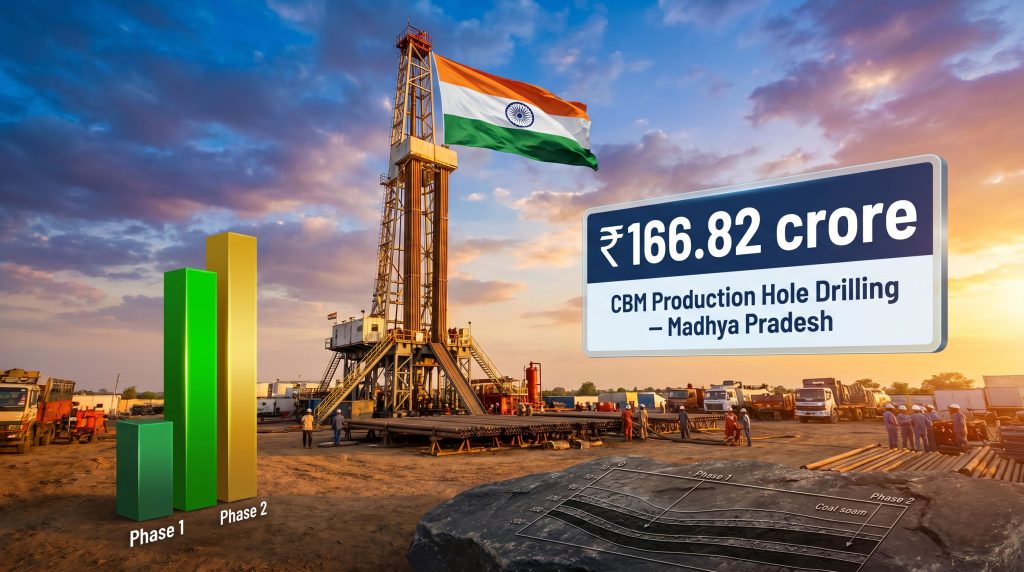
Against this industry backdrop, RIL extends Coal Bed Methane production contract with South West Pinnacle Exploration in a move that carries both operational and strategic significance. The extended agreement covers CBM production hole drilling services across RIL's licensed acreage in Madhya Pradesh and represents Phase 2 of an ongoing programme that has been running for over 14 months under Phase 1.
| Parameter | Detail |
|---|---|
| Contract Value (Excluding GST) | ₹158+ crore |
| Contract Value (Including GST) | ₹166.82 crore |
| Primary Contract Duration | 15 months |
| Extension Options | Up to three additional six-month periods |
| Location | Madhya Pradesh, India |
| Contract Type | CBM Production Hole Drilling |
| Revenue Commencement | Q2 FY 2026-27 |
| Programme Phase | Phase 2 of ongoing CBM programme |
A particularly noteworthy aspect of this contract structure is that no additional capital asset deployment is required for Phase 1 operations. SWPE already has the necessary drilling rigs, associated equipment, and trained personnel in place from Phase 1 activity, allowing revenue generation to commence from the second quarter of FY 2026-27 without a capital expenditure lag. For a services company managing working capital cycles, this is a meaningful operational advantage.
Phase 2 introduces an additional set of drilling rigs and expanded manpower, which is expected to approximately double SWPE's operational capacity within the Madhya Pradesh project area relative to Phase 1. This scaling of operational footprint without requiring re-mobilisation from scratch reflects the efficiency dividend of maintaining an incumbent contractor across project phases. You can read more about South West Pinnacle's contract win and its broader implications in the Economic Times coverage of this announcement.
Why RIL's Contract Structure Reveals a Broader Operational Philosophy
The decision to extend rather than re-tender is more strategically revealing than it might initially appear. CBM drilling in central India is not a commodity service easily sourced from any available contractor. The technical specificity of production hole drilling for CBM, the familiarity crews develop with local geological conditions across successive wells, and the logistical complexity of operating in Madhya Pradesh's interior all create genuine switching costs.
By building multiple optional six-month extension periods into the contract architecture, RIL has effectively created a flexible long-duration engagement that allows operational continuity while preserving contractual review points. This approach is consistent with how major upstream operators globally manage technically demanding unconventional drilling programmes, where crew learning curves and site-specific knowledge accumulate over time and represent real economic value. These industry evolution trends are increasingly shaping how upstream operators structure long-term service relationships across Asia.
Investor Insight: What Contract Extensions Signal
For exploration services companies, contract extensions from established upstream counterparties like RIL carry a different quality of revenue visibility than new tenders. Extensions reflect demonstrated operational performance rather than merely competitive pricing, and they typically carry lower execution risk premiums.
South West Pinnacle Exploration: Operational Capacity Reaches an Inflection Point
SWPE's commercial trajectory has been building incrementally. The company had previously completed two separate CBM-related engagements for RIL before the current programme commenced, establishing a track record that clearly informed RIL's decision to extend and expand the relationship.
What makes the current period genuinely distinct in SWPE's development history is the simultaneous activation of all its core service verticals for the first time. The company now has CBM production hole drilling, two-dimensional seismic surveys, and aquifer mapping all running concurrently, rather than sequentially. This multi-vertical operational mode suggests the company has crossed a threshold of organisational capacity, equipment availability, and technical workforce depth that positions it for more complex, multi-disciplinary tenders going forward.
Following the public announcement of the contract extension, SWPE's share price recorded gains in the range of approximately 4% to 7%, reflecting market recognition of the improved order book position and revenue visibility.
The next major ASX story will hit our subscribers first
The CMPDI Coal Exploration Award: Diversification Into the Public Sector
In close succession to the RIL announcement, SWPE received a Letter of Award from the Central Mine Planning and Design Institute Ltd., a wholly owned subsidiary of Coal India Ltd., for detailed coal exploration services in Jharkhand. This contract is valued at ₹5.89 crore and structured for completion within a 180-day window, meaning revenue recognition falls within the current fiscal year.
While smaller in absolute value, this award introduces an important dimension to SWPE's revenue profile. The distinction between private sector clients and public sector entities like CMPDI matters from a risk diversification standpoint:
- Public sector contracts in India's mining establishment tend to follow well-defined procurement processes and payment frameworks
- CMPDI's remit covers exploration support across Coal India's vast reserve base, creating potential for repeat engagement as exploration programmes cycle through different regions
- Jharkhand's coal geology, particularly in the Damodar Valley coalfields, represents some of India's most prolific coal-bearing territory, making exploration contracts in this region technically substantive
India's Gas Demand Trajectory and the Role of CBM in the Supply Architecture
Contextualising this contract within India's broader energy economics helps clarify why active CBM production programmes matter beyond their immediate commercial scale. India's natural gas demand is projected to grow substantially through the remainder of this decade, driven by three converging forces: industrial feedstock requirements for fertiliser and petrochemical production, the accelerating expansion of city gas distribution networks connecting urban and peri-urban households, and power sector diversification away from coal-only baseload.
Imported LNG, which currently fills a significant portion of India's gas supply gap, exposes the country to global price volatility. The LNG supply outlook for 2025 and beyond highlights how price fluctuations in global markets directly shape the commercial urgency of expanding domestically sourced alternatives. The LNG price spikes experienced following the European energy crisis of 2021-2022 had direct pass-through effects on Indian industrial consumers, reinforcing the policy and commercial case for expanding domestically sourced gas production.
CBM's advantage in this context is its geographic dispersion. Unlike offshore conventional gas fields requiring expensive pipeline infrastructure, CBM blocks in central India can supply regional demand centres through shorter pipeline connections, reducing transport costs and improving supply security for inland markets. However, the broader energy export challenges facing the region illustrate how interconnected domestic supply decisions and international trade dynamics have become.
Sector Context: A Limited Commercial Track Record
India's CBM commercial production history dates to the early 2000s, with Great Eastern Energy Corporation pioneering production in West Bengal's Raniganj coalfield. Despite over two decades of activity, the sector has consistently underperformed against reserve estimates, making each sustained, multi-phase production programme like RIL's Madhya Pradesh operations relatively notable within the sector's limited commercial track record.
Key Takeaways for Investors and Industry Observers
The RIL extends Coal Bed Methane production contract with South West Pinnacle Exploration announcement, viewed through multiple analytical lenses, offers the following structured takeaways. Furthermore, understanding the broader commodity price impacts on service companies in this space can provide additional context for evaluating SWPE's near-term financial performance.
- Revenue quality: The ₹166.82 crore (including GST) contract provides SWPE with assured, medium-term revenue from a counterparty of RIL's financial standing, representing a material improvement in order book quality
- Capital efficiency: The absence of additional capital deployment requirements for Phase 1 operations translates directly into stronger near-term cash flow conversion
- Operational milestone: The concurrent activation of all service verticals for the first time marks a structural capacity threshold for SWPE
- Client diversification: The CMPDI award adds public sector exposure, complementing the private sector anchor relationship with RIL
- Sector positioning: This contract sits within a decade-long national effort to commercialise India's unconventional gas resources, with CBM playing a sustained if underappreciated role in domestic supply planning
Disclaimer: This article is intended for informational purposes only and does not constitute financial advice. Share price movements, contract valuations, and revenue projections referenced herein are based on publicly available regulatory filings and market data. Investors should conduct independent research and consult qualified financial advisers before making investment decisions. Forward-looking statements regarding revenue commencement, operational capacity, and market conditions involve uncertainty and actual outcomes may differ materially from projections.
Want to Catch the Next Major Resource Discovery Before the Broader Market Does?
Discovery Alert's proprietary Discovery IQ model instantly translates complex ASX mineral announcements across 30+ commodities into clear, actionable insights — ensuring subscribers are positioned ahead of the market the moment a significant discovery is made. Explore historic examples of exceptional discovery returns and begin a 14-day free trial at Discovery Alert to secure a real-time edge in resource and energy sector investing.