
July 7, 2026
The Policy Trap: Why Australia's Gas Reservation Scheme Could Destroy the Supply It Seeks to Protect
Energy policy history is littered with interventions designed to solve affordability problems that ended up creating supply crises. Price controls on natural gas in the United States during the 1970s are a textbook example: capping wellhead prices suppressed exploration investment so severely that shortages emerged within years, forcing a painful deregulation process that took nearly a decade to complete. The Australia domestic gas reservation scheme, scheduled to take effect on 1 July 2027, carries structurally similar risks according to independent analysis.
Understanding why requires moving beyond the headline percentage and examining the policy's architecture, its interaction with existing market dynamics, and the long-lag investment economics that govern new gas supply development. Furthermore, Australia's resource and energy exports are already navigating a complex global environment, making the design of this policy particularly consequential.
When big ASX news breaks, our subscribers know first
What the Australia Domestic Gas Reservation Scheme Actually Does
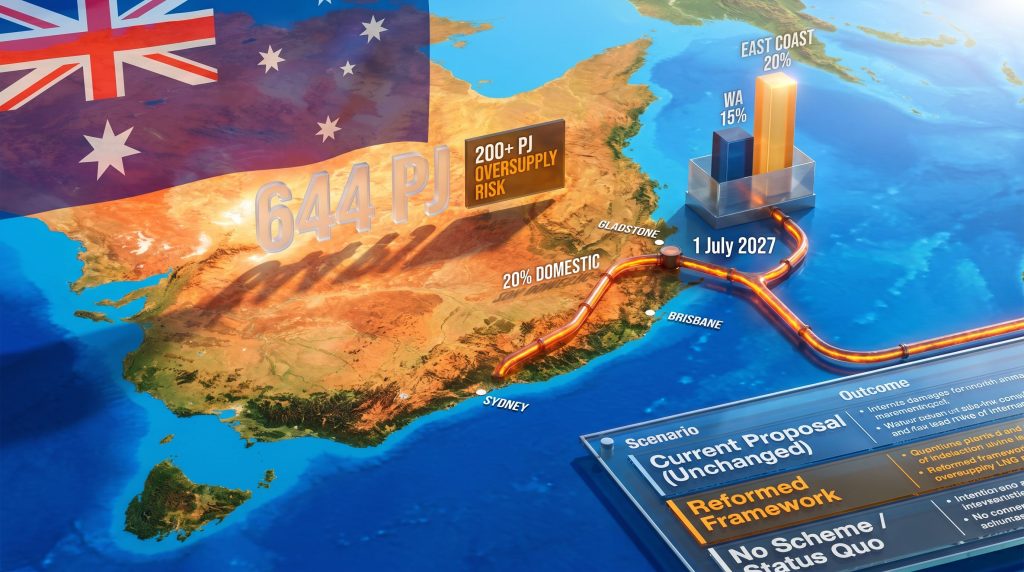
The federal government's east coast framework mandates that LNG exporters direct 20% of their total export volumes toward domestic Australian users each year. The scheme targets only uncontracted spot volumes, meaning existing long-term export agreements remain legally protected. It is designed to unlock approximately 644 petajoules of domestic gas annually, replacing the previous voluntary Australian Domestic Gas Security Mechanism (ADGSM) with a binding legal obligation.
The geographic scope is confined to the east coast gas network, primarily fed by Queensland-origin LNG projects. This is a structurally distinct system from Western Australia's pipeline network, a point that becomes important when evaluating whether WA's reservation experience is genuinely transferable to the east coast context.
The scheme sits within the federal government's broader Future Gas Strategy, which also encompasses reforms to the gas market code. It represents the first mandatory national reservation requirement placed on LNG exporters since Australia's energy market restructuring in the early 2000s. You can review the draft design framework and provide feedback directly through the government's consultation process.
Comparing the East Coast Scheme to Western Australia's 15% Model
Western Australia introduced its domestic gas reservation policy in 2006, requiring new gas developments to reserve 15% of production for domestic use. After nearly two decades of operation, it is frequently cited as a working precedent for the east coast proposal. However, a closer comparison reveals meaningful structural differences that complicate any direct equivalence.
| Feature | WA Domestic Gas Reservation (2006) | East Coast Federal Scheme (2027) |
|---|---|---|
| Reserve Requirement | 15% of export volumes | 20% of export volumes |
| Policy Type | Mandatory | Mandatory |
| Applies To | New gas developments | Uncontracted (spot) LNG exports |
| Price Objective | Below export parity | Domestic affordability wedge |
| Geographic Scope | Western Australia only | East coast (Queensland-origin LNG) |
| Duration | ~20 years operational | Commencing July 2027 |
The east coast scheme sets a higher reservation percentage than WA's model, yet applies it against a fundamentally different market structure. Western Australia has historically operated with undersupplied domestic gas conditions relative to industrial demand, which gave the reservation mechanism genuine supply-additive force. The east coast market, by contrast, currently operates with adequate near-term supply, raising serious questions about whether a 20% mandate is calibrated to actual demand conditions or is simply a round number selected for political optics.
There is also an important distinction in application logic. WA's policy attached reservation obligations to new field development, creating a prospective supply incentive. The east coast scheme redirects volumes from existing export commitments, which is a fundamentally different and potentially more disruptive mechanism.
What Resource Economics Says About Mandatory Reservation
Classical resource economics identifies a deadweight loss risk when gas is mandatorily redirected from higher-value export markets to lower-value domestic applications. The standard policy counter-argument is that domestic price suppression generates broader industrial competitiveness benefits, particularly for gas-intensive manufacturers across New South Wales and Victoria.
The unresolved tension between these two positions is not academic. It determines whether the scheme delivers net welfare gains or simply redistributes costs from energy consumers to gas producers and, ultimately, to future supply availability. Consequently, commodity prices and company performance across the broader resources sector are likely to feel the downstream effects of whichever direction this policy takes.
The Structural Oversupply Problem: What Independent Modelling Reveals
Independent analysis conducted by Wood Mackenzie projects that the 20% mandate would inject more than 200 petajoules of additional gas into an east coast market that is already adequately supplied. This is not a marginal volume. To contextualise the scale, total east coast residential and commercial gas consumption runs at roughly 200 to 250 petajoules annually, meaning the mandated oversupply volume is comparable to the entire non-industrial consumption base.
The modelling identifies a self-reinforcing negative policy cycle:
- Mandated oversupply floods the domestic market with volumes priced to satisfy regulatory obligations rather than commercial returns.
- Wholesale gas prices are suppressed below the economic threshold required to justify new upstream investment.
- Investment in exploration and development withdraws progressively from the east coast basin.
- The existing supply base ages without replacement, creating a structural supply shortfall in the post-2030 period.
- The resulting scarcity drives domestic gas prices sharply higher, precisely the outcome the scheme was designed to prevent.
Critical Risk Assessment: This sequence is not speculative extrapolation. It maps directly onto the documented outcomes of the US gas price control era and mirrors the investment deterrence observed following Australia's own east coast gas price cap intervention, which took years to partially reverse.
How the Scheme Threatens Domestic-Focused Producers
A policy detail that receives insufficient public attention is the competitive structure of the east coast gas market. Domestic-focused gas producers currently supply approximately two-thirds of the east coast market. These are not LNG export majors. They are mid-tier and independent producers whose commercial viability depends on domestic market pricing.
When LNG exporters are legally compelled to inject 200+ petajoules of additional supply into the market, they are not adding molecules that were previously unavailable. They are displacing commercially motivated domestic producers with regulatory obligation-driven supply. The result is a market crowded by mandated volumes rather than competitive supply decisions, with smaller producers unable to sustain operations at the resulting suppressed price levels.
The regions most exposed to this dynamic are Victoria and New South Wales, where new supply development is most urgently required. Perversely, the scheme's strongest supply-crowding effects would be concentrated precisely where Australia can least afford to deter new investment.
Australian Energy Producers Chief Executive Samantha McCulloch has stated publicly that the proposed framework is fundamentally unworkable in its current form, and that without substantial changes it would ultimately lead to lower supply, higher prices, and reduced tax and royalty revenue for governments.
Sovereign Risk and Australia's LNG Export Reputation
Australia ranks among the top three global LNG exporters, competing directly with Qatar, the United States, and increasingly Canada for long-term supply contracts with Asian energy buyers. The reliability of Australian supply commitments is a foundational commercial proposition that underpins billions of dollars in infrastructure financing and decadal purchase agreements.
Mandatory diversion frameworks that can redirect volumes away from export commitments, even when technically limited to uncontracted spot gas, send a signal to international investors and buyers about the predictability of Australia's regulatory environment. That signal carries consequences:
- Project financiers pricing sovereign risk into upstream investment returns require higher hurdle rates, reducing the pool of commercially viable new developments.
- Asian LNG buyers with long-term procurement horizons may weight competing supplier jurisdictions more heavily when reassessing contract renewals.
- Exploration companies evaluating Queensland and Northern Territory licence applications factor policy predictability into their capital allocation decisions.
These effects are diffuse and slow-moving, which makes them politically easy to discount in the near term. However, their cumulative impact on Australia's upstream investment pipeline is likely to be substantial over a 10 to 15 year horizon. In addition, trade war impacts on energy markets are already introducing fresh uncertainty into global LNG pricing dynamics, compounding the sovereign risk challenge facing Australian exporters.
Five Design Principles for a Workable Reservation Framework
Australian Energy Producers' formal submission on the draft framework outlines a set of structural design improvements that the organisation argues are necessary to make the scheme functional without destroying the investment environment it depends on. These recommendations represent the policy design consensus that has emerged from industry consultation and deserve serious analytical attention.
- Demand Calibration: Domestic supply obligations must be indexed to verified, real-time market demand conditions rather than fixed percentage mandates applied regardless of whether the market actually requires additional supply.
- Contract Sanctity: Existing long-term LNG export contracts must receive complete legal protection, with reservation obligations confined strictly to genuinely uncontracted volumes entering new commercial arrangements.
- Export Release Valve: Gas legitimately offered to the domestic market but not commercially purchased by domestic buyers should be freely exportable without additional regulatory hurdles or ministerial discretion requirements.
- Predictable Compliance Architecture: Annual ministerial approval processes introduce the kind of regulatory uncertainty that is most damaging to long-investment-horizon upstream projects. A performance-based, rules-driven compliance framework would deliver greater investment predictability.
- Jurisdictional Sensitivity: Western Australia and the Northern Territory operate under distinct market structures, infrastructure configurations, and existing policy frameworks. The scheme's practical application must reflect these differences rather than imposing a uniform national template.
Policy Design Warning: A reservation scheme that undermines investment confidence in upstream gas development will ultimately produce the outcome it was designed to prevent: higher domestic gas prices and reduced supply reliability beyond 2030. The critical consultation window sits between mid-2026 and early 2027, before commercial decisions lock in ahead of the July 2027 commencement date.
The next major ASX story will hit our subscribers first
The Approval Bottleneck: The Hidden Variable Determining Policy Success
No discussion of domestic gas affordability in Australia is complete without addressing the regulatory approval pipeline. A significant volume of identified gas resources across the east coast and northern basins remains stranded in environmental, planning, and regulatory approval queues. These are not undiscovered resources awaiting exploration investment. They are technically characterised deposits awaiting administrative decisions.
Australian Energy Producers has formally linked the reservation scheme's long-term effectiveness to parallel reforms that accelerate approval timelines for new upstream projects. The logic is straightforward: a reservation mechanism operating on a shrinking or stagnant supply base does not solve affordability. It redistributes a declining volume pool in ways that may satisfy political optics while accelerating the underlying supply deterioration.
Fast-tracking project approvals currently delayed in regulatory pipelines would, according to McCulloch, deliver more immediate and durable domestic affordability improvements than any volume mandate applied to existing export operations. Moreover, government intervention in resources sectors has a mixed historical record precisely because approval bottlenecks often undermine the objectives that intervention was designed to achieve.
What Industrial Gas Users Actually Require
Large gas-consuming industries including fertiliser manufacturing, chemical production, aluminium smelting, and glass manufacturing require price certainty and volume reliability across multi-year contract horizons. Spot market availability, which is precisely what the reservation scheme primarily targets, does not address the procurement structures these industries actually use.
A genuinely effective industrial gas policy would combine reservation obligations with mechanisms that facilitate long-term contract formation at predictable price structures. The current scheme design, focused on unlocking spot volumes, may satisfy domestic supply metrics while failing to deliver the contract tenor and pricing stability that manufacturing sector competitiveness actually depends on.
Scenario Modelling: Three Policy Trajectories
| Scenario | Design Approach | Projected Outcome |
|---|---|---|
| Current Proposal (Unchanged) | Fixed 20% mandate, annual ministerial approval | Structural oversupply 2027-2030; investment withdrawal; supply shortfall post-2032 |
| Reformed Framework | Demand-calibrated, performance-based, contract-protected | Stable domestic supply; maintained investment; competitive market preserved |
| No Scheme / Status Quo | Voluntary ADGSM retained | Continued price volatility; no structural price wedge; risk of shortage in southern states |
The reformed framework scenario is the only trajectory that satisfies both the government's stated affordability objectives and the investment conditions required to sustain long-term supply. The no-scheme scenario preserves investment signals but leaves southern state consumers exposed to continued price volatility. The current proposal as drafted produces outcomes that are arguably worse than either alternative.
Furthermore, the broader context of a global economy under tariffs and shifting trade alliances means that Australia's LNG competitiveness cannot be taken for granted, making the design quality of domestic gas policy even more critical to get right.
Frequently Asked Questions: Australia's Domestic Gas Reservation Scheme
What is the purpose of Australia's domestic gas reservation scheme?
The scheme is designed to ensure a portion of gas produced for LNG export is made available to Australian domestic users, with the goal of keeping domestic gas prices affordable and preventing supply shortfalls, particularly in New South Wales and Victoria.
When does the east coast gas reservation scheme start?
The mandatory east coast Australia domestic gas reservation scheme is scheduled to commence on 1 July 2027.
How much gas must LNG exporters reserve for domestic use?
Under the current proposal, LNG exporters must supply 20% of their total export volumes to the domestic market, targeting approximately 644 petajoules of annual domestic supply.
Does the scheme apply to existing LNG export contracts?
No. The reservation obligation applies to uncontracted spot gas, meaning volumes not already committed under existing long-term export agreements remain protected.
How does the east coast scheme differ from Western Australia's reservation policy?
Western Australia has operated a 15% domestic reservation requirement since 2006, applying to new gas developments. The east coast federal scheme sets a higher 20% threshold and targets uncontracted LNG export volumes rather than new field development.
What are the main criticisms of the proposed scheme?
Key concerns include:
- Structural oversupply crowding out domestic-focused producers who supply approximately two-thirds of the market.
- Suppressed wholesale prices eliminating investment incentives for new exploration.
- Sovereign risk signals to international project financiers and LNG buyers.
- The risk that mandated price suppression destroys the commercial foundations required to develop future supply.
What changes has industry recommended to improve the scheme?
Industry submissions call for demand-calibrated obligations, full protection of existing contracts, a rules-based compliance framework replacing annual ministerial approvals, an export release mechanism for unsold domestic gas, and jurisdictional recognition of WA and NT market differences.
Key Takeaways: Evaluating Australia's Gas Reservation Policy
- The 20% domestic reservation mandate is the most significant structural intervention in Australia's east coast gas market in over two decades.
- Independent modelling projects more than 200 petajoules of structural oversupply under the current design, a volume that would crowd out domestic producers and suppress the investment signals needed for future supply development.
- A well-calibrated scheme must be demand-responsive, contract-protective, and compliance-predictable to avoid replicating the investment deterrence documented from previous Australian market interventions.
- The policy's long-term success depends as much on upstream approval reform as on the reservation percentage itself.
- New supply investment remains the only mechanism that can deliver durable domestic gas affordability. Reservation mandates redistribute existing supply; only new exploration and development creates additional molecules.
- Australia's dual role as a major LNG exporter and a nation requiring affordable domestic energy creates a structural policy tension that volume mandates alone cannot resolve.
This article presents policy analysis and independent industry research for informational purposes. It does not constitute financial or investment advice. Forward-looking projections and modelling outcomes referenced herein are subject to change based on evolving market conditions and policy decisions. Readers should consult qualified advisers before making investment or commercial decisions based on energy market analysis.
Readers seeking additional context on Australia's gas market policy landscape can explore related industry reporting and analysis published by Petroleum Australia at petroleumaustralia.com.au, which covers ongoing developments in the domestic gas reservation debate and broader east coast energy security issues.
Want to Stay Ahead of the Resource and Energy Discoveries Shaping Australia's Investment Landscape?
Discovery Alert's proprietary Discovery IQ model delivers real-time alerts on significant ASX mineral discoveries, instantly converting complex resource data into actionable investment insights for both short-term traders and long-term investors. Explore historic discoveries and their market returns to understand the scale of opportunity, and begin your 14-day free trial today to position yourself ahead of the broader market.