
July 7, 2026
The Boardroom as a Battleground: Institutional Capital Rewrites the Rules in Global Mining
Across the global mining sector, a structural power shift has been quietly building for over a decade. Pension funds, once characterised as patient, passive holders of large-cap equity, have increasingly stepped into roles that were previously reserved for activist hedge funds and controlling shareholders. The transformation is not accidental. As environmental, social, and governance frameworks have matured, and as commodity markets have grown more strategically complex, long-duration institutional investors have concluded that passive ownership is no longer compatible with their fiduciary obligations.
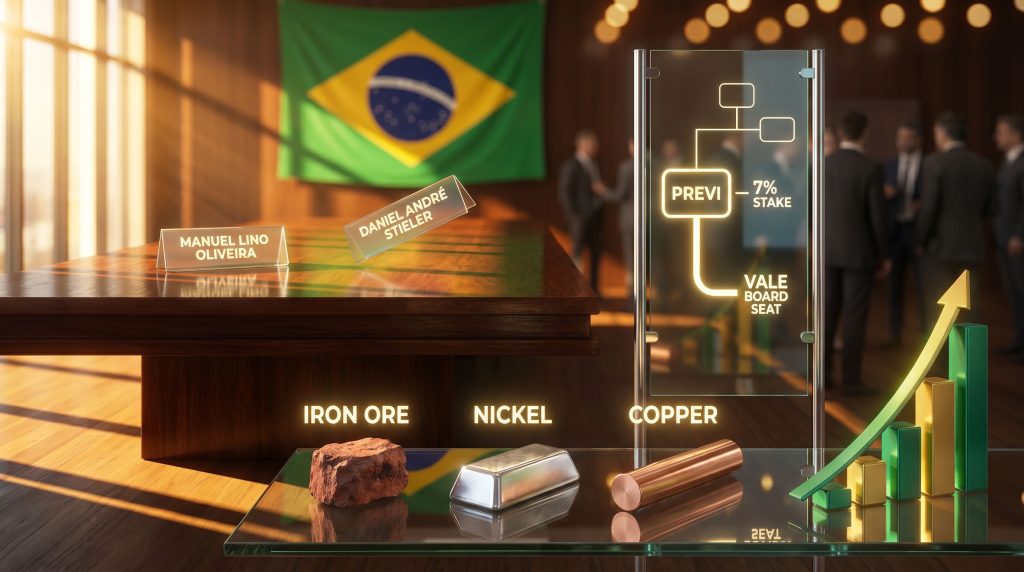
The removal of Vale chairman Stieler pushed out by pension fund Previ is the latest and perhaps most consequential example of this trend playing out at the highest levels of the global mining industry. Understanding why it happened, how it was executed, and what it signals about the future of mining governance requires looking beyond the headline and into the structural dynamics that made this outcome almost inevitable.
When big ASX news breaks, our subscribers know first
Why Pension Funds Are Rewriting Mining Governance
From Passive Capital to Active Board Intervention
The conventional view of institutional shareholders, particularly pension funds, as passive recipients of dividends and capital gains has been systematically dismantled over the past decade. State-linked pension funds in Brazil, Canada, Australia, and Scandinavia have increasingly adopted governance frameworks that treat board composition as a direct investment variable rather than a background condition.
This evolution is partly philosophical and partly structural. Pension funds operate on multi-decade time horizons that align poorly with management teams focused on quarterly earnings cycles. When a mining company's board composition is perceived to introduce strategic misalignment, governance risk, or reputational exposure, a pension fund with a long-duration mandate has strong incentive to intervene. The long-term cost of inaction, in such cases, clearly outweighs the short-term friction of board confrontation.
In the Brazilian context, this dynamic is further amplified by the political dimension of state-linked capital. Previ, which manages retirement savings for employees of state-owned Banco do Brasil, holds approximately 7% of Vale's equity. That stake is large enough, under Brazilian corporate law, to trigger an extraordinary shareholder meeting, which is precisely the mechanism Previ deployed on June 11, 2026, when it formally requested a vote on Stieler's removal.
"The ability to compel an extraordinary shareholder meeting is one of the most powerful tools available to minority institutional shareholders under Brazilian securities regulation, transforming a 7% stake into a decisive governance lever that far exceeds its proportional weight."
Furthermore, these mining governance risks are not confined to Brazil alone. Similar dynamics have unfolded across global mining majors, where institutional shareholders are reshaping board accountability in ways that would have seemed unlikely just a decade ago.
A Precise Sequence: How Stieler's Exit Unfolded
Timeline of the Governance Dispute
The events leading to Stieler's resignation did not emerge suddenly. They followed a deliberate, escalating sequence that reflected months of deteriorating alignment between Previ and Vale's board leadership.
| Date | Event |
|---|---|
| February 2026 | João Fukunaga, then-Previ president, resigns from Vale's board, signalling a breakdown in institutional trust |
| June 11, 2026 | Previ formally requests an extraordinary shareholder meeting to vote on Stieler's removal |
| Shortly after | Vale's board votes against the proposal, arguing insufficient grounds for removal ahead of Stieler's April 2027 mandate expiry |
| July 6, 2026 | Stieler resigns as chairman and vacates his board seat, effective immediately |
| Post-resignation | Vale cancels the removal agenda item; the July 22 meeting proceeds with remaining items, including the election of a new chairman |
Fukunaga's February departure was particularly significant. As a Previ-aligned voice within the Vale boardroom, his exit removed the last internal mechanism through which the pension fund had maintained influence over day-to-day governance. Once that channel closed, a direct shareholder intervention became the only remaining path.
The Political Dimension That Made Conflict Inevitable
Stieler's appointment as Previ's president occurred during the administration of former President Jair Bolsonaro. As Brazil's political landscape shifted fundamentally after the 2022 election, board members whose appointments carried strong associations with the prior political era found themselves in increasingly precarious positions within state-linked institutional structures.
This is not a uniquely Brazilian phenomenon. Across emerging markets, state-linked pension funds frequently reflect the governance philosophies of the political administrations that appoint their leadership. When administrations change, so do the governance priorities of those funds, and board members at portfolio companies become early indicators of that ideological realignment. Indeed, Rio Tinto governance shifts following shareholder pressure offer a comparable precedent in how quickly political and institutional dynamics can reshape board structures at major miners.
Stieler's decision to resign on July 6 rather than face the scheduled July 22 shareholder vote was strategically calculated. A public defeat at a shareholder meeting would have created a permanent record of institutional rejection, damaged his professional standing, and introduced reputational risk to Vale itself. By stepping down proactively, he preserved optionality while allowing the company to frame the transition as orderly rather than adversarial.
The Competing Slates: What the July 22 Meeting Will Decide
Candidate Profiles and Shareholder Dynamics
With Stieler's departure confirmed, the July 22 extraordinary meeting transforms from a removal vote into a chairman election, potentially featuring two competing leadership slates.
| Candidate/Slate | Backing | Profile |
|---|---|---|
| Manuel Lino Oliveira | Previ | Independent Vale board director; positioned as governance reformer |
| Marcel Gaspar / Eda Gomes | Vale's existing board | Internal continuity candidates; represent institutional operational knowledge |
| José Maurício Pereira Coelho | Appointed by Previ | Fills a vacant Vale board seat ahead of the vote |
The outcome will depend on shareholder coalition dynamics beyond Previ's 7% position. Vale's ownership structure includes a dispersed institutional and retail shareholder base, and the alignment of other significant holders will ultimately determine which slate commands a majority. This makes the July 22 meeting genuinely contested rather than a foregone conclusion.
"In governance disputes at mining majors, the decisive factor is rarely the initiating shareholder's stake size alone. It is the ability to construct a coalition of aligned institutional interests that converts a minority position into a majority outcome."
How Board Transitions Reshape Mining Strategy
Capital Allocation at a Critical Commodity Juncture
Vale's commodity portfolio sits at the intersection of three of the most strategically important materials in the global economy. The company is the world's largest iron ore producer, a major global nickel supplier, and holds a growing copper portfolio that has attracted considerable strategic attention.
| Commodity | Vale's Position | Key Strategic Dynamic |
|---|---|---|
| Iron Ore | World's largest producer | Revenue dominated by Chinese steel demand cycles; price sensitive to property sector conditions |
| Nickel | Major global supplier | Critical input for EV battery supply chains; subject to significant supply-side competition from Indonesia |
| Copper | Growing strategic portfolio | Energy transition demand driver; Base Metals division subject to ongoing strategic review |
Board composition changes at mining majors of Vale's scale rarely leave capital allocation frameworks unchanged. Historical precedent across the sector demonstrates consistently that boardroom transitions precede strategic pivots rather than follow them. In particular, Vale's broader critical minerals strategy will likely come under renewed scrutiny as a newly aligned board recalibrates long-term priorities.
Vale's Base Metals division, which houses its nickel and copper assets, has been the subject of considerable speculation around potential strategic partnerships or partial divestiture. Furthermore, asset sales and joint ventures in the sector have historically followed major governance transitions, suggesting that Vale's upcoming leadership change could catalyse significant structural decisions. A newly elected chairman aligned with Previ's governance agenda may approach that review with different priorities, particularly around ESG accountability frameworks, dividend discipline, and the pace of capital commitments to growth projects.
The Brumadinho Legacy and Why Governance Stakes Are Elevated
Vale's governance context cannot be assessed without acknowledging the shadow cast by the Brumadinho tailings dam failure of January 2019, which killed 270 people and became one of the worst industrial disasters in Brazilian history. That event, following the Mariana dam collapse in 2015 which also involved a Vale joint venture, fundamentally restructured the relationship between Vale's board and its institutional shareholders.
Since Brumadinho, Vale's board accountability has operated under a degree of institutional scrutiny that exceeds standard practice for mining majors. Every governance decision, including the composition of the board itself, is assessed through the lens of whether it is consistent with a company that has credibly reformed its safety and accountability culture. This elevated scrutiny makes the current leadership transition more consequential than a routine chairmanship change.
For institutional investors with ESG mandates, particularly pension funds managing public-sector retirement capital, Vale's governance quality is not simply a proxy for financial performance. It is a direct reputational and fiduciary exposure. Previ's intervention can therefore be understood partly as a proactive effort to ensure that Vale's board composition meets the governance standards that Previ's own stakeholders expect. Consequently, the management red flags that preceded this intervention serve as a useful case study in how governance deterioration escalates when institutional channels of influence are progressively closed off.
The next major ASX story will hit our subscribers first
What Investors Should Monitor Through This Transition
Key Risk and Signal Variables
For investors tracking Vale's strategic trajectory, several specific variables will serve as early indicators of how this governance transition translates into operational and financial outcomes.
- Base Metals strategic review progression: Any acceleration or pause in partnership discussions around Vale's nickel and copper assets will signal the new chairman's priorities.
- Capital return framework: Previ's stated focus on long-term value creation and governance improvement may translate into a reassessment of Vale's dividend and buyback policies.
- ESG commitment intensity: New board leadership backed by a pension fund with ESG obligations is likely to push for enhanced disclosure, tighter safety protocols, and more aggressive emissions targets.
- Cost of capital trajectory: Governance quality improvements, if credibly executed, can compress a company's equity risk premium over time, supporting valuation multiple expansion.
- Relationship with the Brazilian government: Vale's complex historical relationship with Brazilian political administrations means that board composition carries macroeconomic signalling value beyond the company itself.
The Broader Pattern: Pension Funds as Mining's New Power Brokers
The case of Vale chairman Stieler pushed out by pension fund Previ is best understood not as an isolated boardroom conflict but as a data point within a broader structural trend. Across the global mining sector, pension funds are increasingly unwilling to treat board composition as outside their remit. Their long-duration capital, ESG obligations, and exposure to systemic risks from climate, regulation, and commodity price cycles have converged to create a new category of institutional shareholder, one that behaves more like a strategic stakeholder than a passive investor.
However, this trend carries important implications for how mining companies structure their governance frameworks going forward. Independent director selection processes, succession planning timelines, and board skills matrices are all coming under greater institutional scrutiny. In addition, mining governance risks have demonstrated repeatedly that companies which fail to proactively engage with their largest institutional shareholders on governance design are likely to face the kind of public confrontation that ultimately forced Stieler's resignation.
The episode, moreover, highlights the extent to which management red flags — when left unaddressed — can erode institutional confidence to the point where a direct shareholder intervention becomes unavoidable. In that sense, the Vale chairman Stieler pushed out by pension fund episode offers a textbook illustration of how governance breakdowns unfold at the highest levels of the global mining industry.
This article is analytical and informational in nature and does not constitute financial advice. The events described involve forward-looking elements, including the outcome of the July 22 shareholder meeting, which remain subject to change based on shareholder voting outcomes and other factors.
Want to Stay Ahead of Major Shifts in the ASX Mining Sector?
Discovery Alert's proprietary Discovery IQ model delivers real-time alerts on significant ASX mineral discoveries, transforming complex market data into actionable investment insights for both short-term traders and long-term investors. Explore how historic discoveries have generated substantial returns on Discovery Alert's dedicated discoveries page, and begin your 14-day free trial today to position yourself ahead of the broader market.