August 14, 2026
The Supply Chain Crisis Hiding Behind the Oil Price Headlines
When energy markets experience a major shock, public attention gravitates almost instinctively toward crude oil benchmarks. Brent, WTI, headlines about price per barrel. Yet the refined products shortage from Iran war is not happening at the wellhead. It is happening downstream, inside the complex web of refining, chemical processing, and industrial supply chains that transform raw petroleum into the functional products modern economies cannot operate without.
Understanding this distinction is not a semantic exercise. It is the difference between watching the wrong indicator while a structural crisis deepens beneath the surface. Furthermore, the crude oil price trends that dominate financial headlines are masking a far more consequential disruption in downstream product availability.
When big ASX news breaks, our subscribers know first
The Crude-to-Product Gap: Why Refined Products Shortage From Iran War Is a Different Kind of Crisis
What Refineries Actually Do, and Why Crude Grades Matter
Most public commentary on oil supply disruption treats crude as the end product. In reality, crude oil is a raw input. What economies actually consume are refined products: diesel for freight and agriculture, jet fuel for aviation, gasoline for personal transportation, synthetic lubricants for industrial and aerospace machinery, and sulfuric acid for fertilizer production.
The critical and underappreciated variable is that not all crude oil produces the same refined product profile. Persian Gulf crude is heavier in composition, meaning refineries processing it yield disproportionately large volumes of diesel and jet fuel relative to lighter crude varieties. American shale oil, by contrast, is lighter and produces a higher proportion of gasoline and naphtha.
Refinery infrastructure is not a flexible instrument. These are capital-intensive facilities engineered over decades to process specific crude grades. Switching feedstock is not simply a matter of redirecting supply flows. It requires mechanical reconfiguration that takes months to years and in many cases is not economically viable at all.
The implication is direct: even a partial restoration of Persian Gulf crude supply does not immediately translate into equivalent volumes of diesel and jet fuel. The global refining system was optimised over roughly two decades around Gulf crude. That optimisation has now become its greatest structural vulnerability.
The Scale of the Disruption
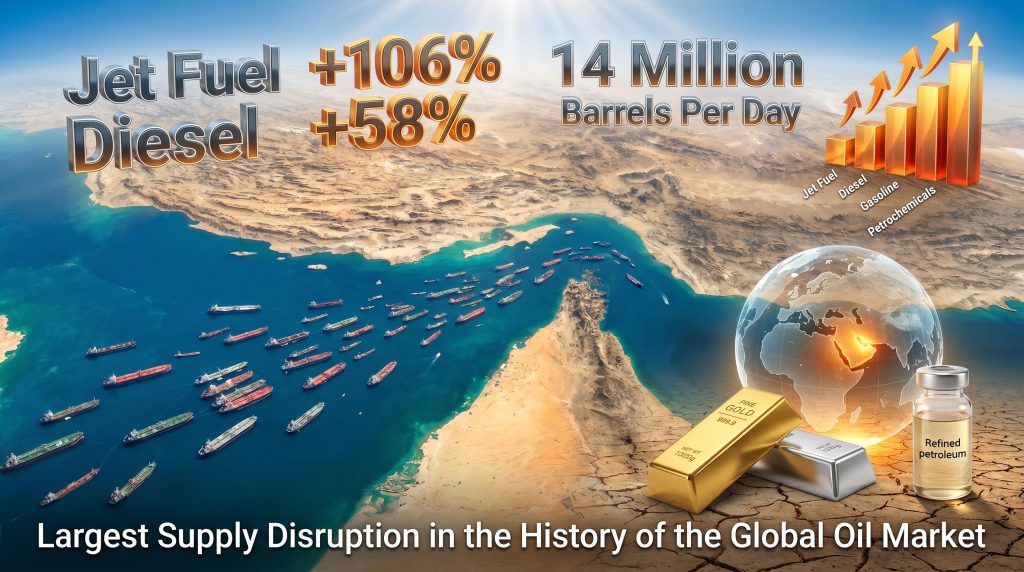
The International Energy Agency has described the disruption caused by the Strait of Hormuz situation as the largest supply disruption in the recorded history of the global oil market. At peak disruption, approximately 14 million barrels per day of oil flow were effectively removed from global circulation.
Even after ceasefire conditions were announced, tanker traffic through the Strait remained well below pre-conflict levels, extending the timeline of product shortages beyond what headline diplomatic developments might suggest.
Refined Product Price Impacts at a Glance
The downstream price effects of the disruption have been severe and uneven across product categories, reflecting the compositional mismatch between available crude and required output:
| Refined Product | Approximate Price Change | Primary Driver |
|---|---|---|
| Jet Fuel | +106% year-over-year | Heavy crude tightness; 14M b/d shut-in |
| Diesel | +58% year-over-year | Middle East supply disruption; logistics cost inflation |
| Gasoline | +42% year-over-year | General crude spike; less compositional exposure |
| Petrochemicals and Plastics | +60% since March | Oil-linked inflation; depleted safety inventories |
California, the West Coast, and the Rationing Scenario
The United States faces an asymmetric regional vulnerability that has gone largely undiscussed in mainstream energy coverage. California, under successive environmental policy mandates, has systematically closed its in-state petroleum refining capacity. The state no longer refines petroleum products domestically. It is entirely dependent on imported refined products to meet consumer and commercial demand.
This creates a structural exposure that does not exist in states with active refining infrastructure. When global supply is disrupted, those disruptions flow directly to California consumers without any domestic buffer. There is no local production to draw on, no ability to increase throughput in response to external shocks.
Fuel rationing scenarios for the U.S. West Coast in the second half of the year are considered credible across both gasoline and diesel categories. Separately, the United States has historically been a net exporter of diesel fuel. That export capacity may be suspended as domestic supply tightens, reflecting just how dramatically the supply picture has shifted.
The compounding factor is structural, not cyclical. California's refining deficit is a policy outcome that cannot be reversed quickly, meaning its vulnerability to global refined products shortages is persistent, not temporary.
The Products Nobody Is Talking About: Lubricants, Sulfuric Acid, and Food Security
Synthetic Lubricants: An Invisible but Critical Vulnerability
Iranian military operations during the conflict specifically targeted the three most strategically significant lubricant production facilities in the Persian Gulf. This detail has received almost no coverage in mainstream financial or energy media, yet its implications are substantial.
Synthetic lubricants are not optional industrial consumables. They are non-negotiable inputs for:
- Commercial aviation turbine engines
- Gas turbines used in power generation and military applications
- High-performance industrial machinery operating under extreme thermal and pressure conditions
- Military ground and air equipment
There are no short-term substitutes. The Gulf States had, over the past two decades, become the world's most cost-efficient producers of synthetic lubricants. Production lead times for alternative supply are long, and the physical targeting of these facilities means restoration cannot happen quickly even if the political conditions for it exist.
Sulfuric Acid and the Fertilizer Chain: A Slow-Moving Food Security Event
Sulfuric acid is a critical precursor chemical in the production of phosphate-based fertilisers. Without adequate sulfuric acid supply, fertiliser manufacturers cannot produce at capacity. Without fertiliser at scale, agricultural yields contract. The transmission from an industrial chemical shortage to elevated food prices is direct and measurable.
The current situation involves two independent supply shocks converging simultaneously:
- Persian Gulf sulfuric acid production has been disrupted by the conflict, removing a major global source from the market.
- China has halted sulfuric acid exports, independently removing another significant supply source.
The convergence of these two shocks compounds the fertiliser shortage beyond what either disruption would produce in isolation. Global urea and sulphur supply chains also route through the Strait of Hormuz, amplifying agricultural input cost inflation further.
This is not a secondary consequence of the energy conflict. It is a food security event developing in slow motion, with timeline implications that will extend well beyond the duration of active hostilities.
How Nations Are Responding: Policy Adaptations Across Key Economies
Governments across Asia and the Pacific have moved quickly to implement demand management and supply prioritisation measures. The responses illustrate both the severity of the disruption and the hierarchy of refined product criticality:
- China ordered major state refiners including Sinopec to halt new fuel export contracts, redirecting refined output toward domestic consumption while maintaining limited exports to select strategic partners.
- India pivoted petroleum procurement toward Russian supply flows as Middle Eastern availability contracted.
- The Philippines mandated a four-day working week as a structured demand-reduction measure to extend limited fuel reserves.
- Indonesia began evaluating policy frameworks to stretch constrained domestic fuel inventories.
- South Korea deliberately slowed lubricant and non-essential refined product output to prioritise diesel production, reflecting an explicit industrial hierarchy where diesel is treated as the critical energy input that must be preserved above other products.
The Diesel Priority: Why Logistics Fuel Matters More Than Pump Politics
Gasoline commands disproportionate political attention because consumers encounter its price directly at retail pumps. Diesel operates more quietly but with far greater economic consequence. Trucking networks, rail freight, maritime shipping, agricultural machinery, and heavy industrial equipment all run on diesel.
Diesel price inflation ripples through every layer of the cost structure for manufactured goods, food distribution, and infrastructure maintenance in a way that gasoline inflation does not. South Korea's deliberate decision to prioritise diesel over other refined products illustrates how sophisticated industrial economies triage their energy supply under constraint. The oil price market impact on downstream logistics costs is, consequently, far broader than headline crude benchmarks suggest.
Inflation, Stagflation, and the Macro Investment Environment
Drawing the 1970s Parallel Carefully
The structural combination of supply-side energy inflation, tightening monetary conditions, and slowing economic growth is drawing direct analytical comparisons to the 1970s oil embargo period. The stagflationary pressure profile, where inflation rises while growth stagnates, is a scenario most active portfolio managers have never navigated professionally.
The current episode differs from the 1970s in important ways, however. The crisis overlaps with:
- An AI-driven speculative equity concentration in major indices
- Tightening credit conditions and elevated sovereign debt levels globally
- A private credit market carrying substantial opaque leverage
- Demographics shifting from net savers to net retirees in major economies
Each of these factors amplifies macro fragility in ways that did not characterise the 1970s environment.
The Credit Market Paradox: Tight Spreads in a Deteriorating Landscape
Perhaps the most counterintuitive feature of current markets is the persistence of historically tight credit spreads despite rising rates and energy-driven inflation. The explanation lies in the volume of institutional capital, including pension funds, insurance vehicles, and yield-seeking funds, that continues to pursue any available return regardless of the underlying risk environment.
Moody's data indicates that approximately two-thirds of current corporate distress situations involve private equity or private credit vehicles. This is a critical insight because it means the true scale of credit deterioration is not visible in public market data. Private equity sponsors routinely deploy non-disclosure agreements that prevent full disclosure of distress at the portfolio company level. The stress dribbles into public view slowly, in fragments, rather than appearing as a coherent systemic signal.
When systemic events occur, they typically arrive as surprises. The opacity of private credit markets means investors may not see the full risk picture until redemption suspensions or forced asset sales begin to surface publicly.
The Rate Rollover Problem and Housing Market Stagnation
Companies that structured their debt expecting refinancing opportunities at lower rates in 2025 and 2026 are now facing a higher-for-longer rate environment that fundamentally changes their financial position. Default activity is expected to increase as this refinancing window closes at unfavourable terms.
The 10-year Treasury yield near 4.5% translates to 30-year fixed mortgage rates in the 6.75 to 7% range. At that level:
- Housing affordability remains severely constrained for first-time buyers
- Transaction volumes stay depressed, reducing real estate market liquidity
- Refinancing incentive for existing homeowners with lower-rate loans effectively disappears, further suppressing transaction activity
The Federal Reserve retains meaningful control only over the very short end of the yield curve. The long end, which drives mortgage rates, is determined by bond market participants whose priorities do not align with domestic housing policy objectives.
The next major ASX story will hit our subscribers first
Precious Metals in a Refined Products Crisis Environment
Why Silver Is Attracting Strategic Physical Buyers
Silver demand is predominantly industrial rather than monetary. Electronics manufacturing, solar panel production, and advanced industrial applications all require silver as a functional input with limited substitution options. Silver's industrial demand gives it a fundamentally different demand profile from gold, and that distinction is increasingly relevant in the current supply disruption environment.
Chinese buyers have maintained aggressive physical silver purchasing even as financial market prices have softened. A notable divergence has emerged between paper pricing on derivatives exchanges and actual physical delivery costs. Obtaining physical delivery of silver in current market conditions can cost 10 to 15% above quoted financial market prices. This spread represents genuine physical scarcity that derivatives pricing has not yet fully captured.
Indian precious metals markets experienced temporary delivery suspensions due to import disruption. Shanghai and London gold markets have increasingly operated with different effective prices. The longer this gap between financial pricing and physical delivery costs persists, the greater the eventual price correction risk embedded in paper market positions.
Gold's Evolving Role as a Reserve Asset
Central bank gold reserves have now surpassed U.S. dollar holdings in absolute reserve weighting on a global basis. This is a structural reallocation with long-term implications for how reserve managers price the opportunity cost of holding gold versus dollar-denominated assets. Furthermore, the gold safe-haven role has strengthened considerably as geopolitical uncertainty broadens beyond the immediate conflict zone.
The historical relationship between Fed funds rates and gold prices has weakened materially. Gold has continued to appreciate even as rates remained elevated, which challenges the conventional opportunity cost framework. The more compelling explanation is that central bank reserve diversification strategy is driving gold demand, and this motivation is largely insensitive to short-term rate differentials.
Gold's appeal in the current environment is explicitly apolitical. It carries no counterparty risk, no refinancing obligation, and no geopolitical alignment requirement. In a world where reserve managers are reassessing exposure to any single sovereign's financial instruments, these characteristics are increasingly valued. Market volatility and gold demand, consequently, are likely to remain closely correlated throughout this period of elevated uncertainty.
Portfolio Positioning in a Refined Products Shortage Environment
Sectors Facing Structural Headwinds
- Passive equity strategies heavily concentrated in AI and technology stocks face compounding risk from both potential valuation correction and energy cost inflation flowing through corporate cost structures.
- Housing and mortgage markets remain structurally constrained by elevated long-end rates, with limited prospect of meaningful affordability improvement.
- Companies with near-term debt refinancing obligations in a higher-for-longer rate environment face elevated default risk as the anticipated refinancing window closes.
- AI-adjacent speculative equities carry particular risk if the current capital expenditure cycle does not translate into commensurate revenue generation.
Sectors With Structural Tailwinds
- Energy infrastructure including pipeline operators and integrated energy companies benefits from sustained elevated refined product prices and constrained supply conditions.
- Precious metals offer inflation protection and reserve diversification appeal in a stagflationary macro environment where the conventional opportunity cost argument against gold has already demonstrably weakened.
- Agricultural commodities and fertiliser producers outside the disrupted Gulf and Chinese supply zones carry pricing power as sulfuric acid and fertiliser shortages tighten supply globally.
- Select mortgage REITs with mid-teens yield profiles provide income generation in an environment where capital preservation is prioritised over growth exposure.
The Barbell Framework
Constructing a portfolio with hard assets and inflation-linked instruments on one side, specifically precious metals, energy infrastructure, and real assets, and high-yield income instruments on the other, including select REITs and dividend-paying energy stocks, provides resilience against both inflationary and deflationary shock scenarios.
This structural approach reduces dependence on the continuation of any single speculative narrative, whether that narrative is AI capital expenditure, rate cut expectations, or energy price normalisation. Reducing exposure to speculative growth assets that depend on continued AI infrastructure spending lowers vulnerability to a valuation correction in a sector where the capital expenditure commitments already made represent levels of leverage that may prove difficult to service if revenue growth disappoints.
Frequently Asked Questions: Refined Products Shortage From the Iran War
What refined products are most affected?
Diesel, jet fuel, synthetic lubricants, sulfuric acid, and petrochemical feedstocks are the most critically affected categories. These are disproportionately sourced from Persian Gulf production and cannot be straightforwardly substituted using lighter U.S. crude-derived alternatives due to the compositional mismatch between feedstock grades and required output.
Why is California especially vulnerable?
California closed its in-state petroleum refining capacity under state environmental policy mandates. With no domestic refining buffer, any global supply disruption transmits directly to local consumers. The state cannot increase throughput in response to shortages because the infrastructure to do so no longer exists.
How does the refined products shortage connect to food prices?
Sulfuric acid is a precursor chemical essential to phosphate fertiliser production. With Persian Gulf supply disrupted and China having halted sulfuric acid exports independently, two major supply sources have been simultaneously removed from global markets. This reduces fertiliser availability, raises agricultural input costs, and ultimately increases food prices throughout global supply chains.
How long could the shortage last?
Asia's oil refiners scrambling to source alternative feedstocks illustrates that rebuilding supply chains, restoring refinery throughput, and replenishing depleted safety stocks typically takes months to years. The economic effects of the refined products shortage from Iran war will persist well beyond the active conflict period regardless of diplomatic outcomes.
What does this mean for inflation expectations?
The combination of diesel-driven logistics cost inflation, fertiliser and food price pressures, and elevated energy input costs across manufacturing creates conditions consistent with double-digit inflation materialising by year-end in some categories. This stagflationary profile, where supply-side inflation meets slowing growth, is distinct from the demand-driven inflation the Fed's primary policy tools are designed to address.
Want to Position Your Portfolio Ahead of the Next Major Resource Discovery?
The commodity supply disruptions reshaping global energy, fertiliser, and precious metals markets are creating structural opportunities across the resources sector — and Discovery Alert's proprietary Discovery IQ model delivers real-time alerts the moment significant ASX mineral discoveries are announced, turning complex market signals into actionable insights. Explore historic discovery returns on Discovery Alert's dedicated discoveries page to understand the scale of opportunity these disruptions can unlock, and begin your 14-day free trial today to ensure you're positioned before the broader market moves.