
August 14, 2026
The Atlantic Basin's Quiet Gas Revolution: Why Offshore Venezuela Is Back on the Map
Beneath the southern Caribbean, one of the Western Hemisphere's most consequential untapped gas accumulations has sat largely dormant for decades, constrained not by geology but by geopolitics. That calculus is beginning to shift. As global LNG demand tightens and new supply pipelines face extended development timelines, the race to secure large-scale, infrastructure-proximate gas resources is intensifying across every basin. Against this backdrop, the ADNOC-backed XRG Venezuela Loran gas license is less a headline transaction and more a structural signal about where international gas capital is flowing next.
Understanding why this deal matters requires looking past the Venezuela risk narrative and examining the underlying resource, the partnership architecture, and the broader strategic logic driving state-affiliated investment vehicles into jurisdictions that traditional Western majors have treated with increasing caution. Furthermore, the oil and gas market tensions reshaping global investment flows make this an especially timely development to examine.
When big ASX news breaks, our subscribers know first
The Loran-Manatee System: A Cross-Border Accumulation Unlike Any Other
Scale, Geology, and Why the Field Has Defied Development
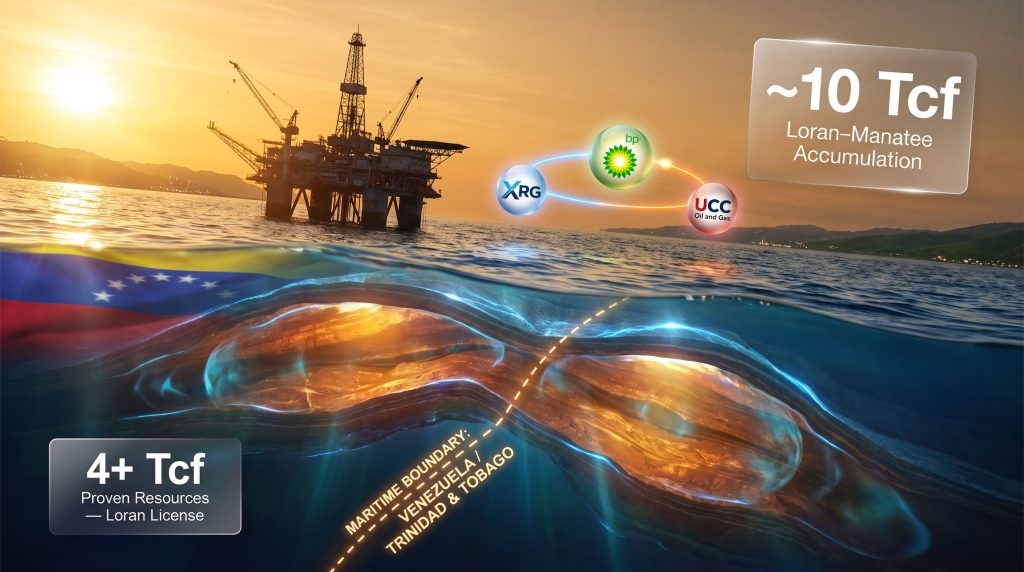
The Loran-Manatee gas accumulation occupies a unique position in global upstream geology. Straddling the maritime boundary between Venezuela and Trinidad and Tobago, it represents a single connected reservoir system that has been administratively divided by an international border, creating a development coordination challenge with few parallels in the offshore world.
The Venezuelan portion alone, known as Loran, holds an estimated 7.0 to 7.5 trillion cubic feet (Tcf) of natural gas resources. When integrated with the Trinidadian Manatee section, the combined accumulation reaches approximately 10 Tcf, placing it among the largest undeveloped offshore gas systems in Latin America.
The Loran Phase 2 license, now the subject of ADNOC-backed XRG's entry, contains more than 4 Tcf of proven natural gas resources within its specific license boundary. This is not prospective or inferred resource territory; the proven classification reflects a degree of subsurface confidence that significantly de-risks the geological dimension of the investment.
What has historically prevented development is not the reservoir's quality but the intersection of three compounding constraints:
- Venezuela's deteriorating upstream infrastructure and PDVSA's constrained capital position
- U.S. and multilateral sanctions regimes that have effectively excluded most Western capital from Venezuelan energy projects
- The administrative complexity of coordinating cross-border reservoir development across two sovereign states with different regulatory and fiscal frameworks
The offshore setting actually works in Loran's favour relative to Venezuela's onshore gas challenges. Offshore fields are physically separated from the country's degraded onshore pipeline and processing infrastructure, and the proximity to Trinidad's established LNG ecosystem creates a route-to-market that does not depend on Venezuela's domestic energy network functioning effectively. Venezuela PDVSA policy shifts have, however, begun to alter this dynamic in ways worth monitoring closely.
The Phased Development Architecture
Venezuela's approach to Loran commercialisation has followed a structured, multi-partner sequencing. Phase 1 of the field's development moved forward in early 2026 with Shell involved in the licensing framework, establishing the commercial and technical foundations for the project. Phase 2, the stage now anchored by XRG, bp, and UCC Oil and Gas in equal interests, represents the next layer of international capital and operational commitment.
This phased approach is significant. It reflects a deliberate strategy by Venezuela to use demonstrable Phase 1 progress as a credibility mechanism to attract additional international partners for subsequent stages, rather than attempting to market the entire undeveloped field in a single transaction.
Who Is XRG and What Is Its Investment Logic?
ADNOC's International Gas Deployment Vehicle
XRG operates as ADNOC's purpose-built international energy investment company, designed specifically to deploy capital into gas and LNG assets outside the UAE's domestic portfolio. Its existing positions span a geographically diverse set of gas corridors:
| Region | Country | Strategic Role |
|---|---|---|
| North America | United States | Gas market exposure, LNG feedstock access |
| North Africa | Egypt | Mediterranean gas corridor |
| Caspian / Eurasian | Azerbaijan, Turkmenistan | Strategic transit and supply positions |
| East Africa | Mozambique | Frontier LNG development |
| Latin America | Argentina | Argentina LNG platform |
| Latin America | Venezuela | Loran Phase 2 (pending approvals) |
The Venezuela entry was not an impulsive move. As early as January 2026, ADNOC's interest in Venezuelan gas assets was being evaluated, with the August 2026 Loran announcement confirming the transition from strategic assessment to active commitment.
The Investment Rationale: Five Converging Drivers
XRG's decision to enter the ADNOC-backed XRG Venezuela Loran gas license transaction reflects a multi-factor investment thesis rather than a single opportunistic calculation:
- Resource quality at scale. A proven 4+ Tcf resource base within a single license boundary provides the volumetric foundation for a long-duration, high-return gas development project.
- Infrastructure adjacency. Loran's offshore position and proximity to Trinidad's LNG infrastructure removes the dependency on Venezuelan domestic processing and pipeline capacity, which remains severely constrained.
- Partner risk distribution. Equal-interest co-participation with bp and UCC distributes both capital expenditure obligations and technical execution risk across three entities with complementary capabilities.
- Atlantic Basin positioning. The deal strengthens XRG's strategic footprint in the Atlantic Basin at a moment when demand for LNG supply diversity is structurally elevated. The broader LNG supply outlook underscores precisely why this kind of positioning matters.
- Platform construction logic. Combined with Argentina LNG, the Loran entry gives XRG two anchor positions for a Southern Atlantic gas strategy with multiple potential monetisation pathways.
The strategic framing from XRG's leadership around this transaction emphasised connecting Venezuelan gas to established infrastructure and creating clear routes to market. The implication is that Loran's value is not purely geological; it is infrastructural and logistical, which materially changes the risk profile compared to a stranded offshore gas resource in a more isolated location.
The Geopolitical Dimension: Sanctions, Sovereignty, and Execution Risk
Why the Regulatory Complexity Cannot Be Understated
The Loran Phase 2 transaction is explicitly conditioned on compliance with applicable international sanctions frameworks. This disclosure is not boilerplate; it reflects the genuine legal complexity of operating in Venezuela's energy sector under current U.S. and EU sanctions regimes.
OFAC (the U.S. Office of Foreign Assets Control) has historically maintained broad secondary sanctions exposure for non-U.S. entities transacting with Venezuelan state energy entities, including PDVSA Gas, which is the transferring party in this deal. Any international operator entering the Venezuelan upstream must navigate:
- Primary sanctions restrictions that directly constrain U.S. persons and entities
- Secondary sanctions risk that can affect non-U.S. companies with U.S. dollar transactions or U.S. counterparties
- Venezuelan domestic energy law requirements, including PDVSA's mandated participation in upstream ventures
- Cross-border treaty and maritime boundary frameworks governing the Loran-Manatee accumulation's joint development
"Risk Framework: Completion of the XRG stake acquisition remains subject to definitive licence and development arrangements, government approvals, and sanctions compliance reviews. Observers should treat the current announcement as an expression of strategic intent rather than a completed transaction. The gap between announcement and financial close in Venezuela-linked energy deals has historically been measured in years rather than months."
The GCC Investment Pattern in Complex Jurisdictions
XRG's approach reflects a broader pattern that has become increasingly visible in global upstream investment. Consequently, Gulf Cooperation Council-affiliated national oil companies and their investment vehicles are demonstrating a different risk tolerance for sanctioned or politically complex markets compared to their Western major counterparts.
This divergence stems from structural factors that are often underappreciated in mainstream investment analysis. In addition, the energy geopolitics and supply dynamics shaping these decisions extend well beyond simple return-on-capital calculations:
- State-backed entities typically operate on investment horizons measured in decades rather than quarters, allowing them to absorb prolonged pre-FID periods that would be unacceptable for publicly listed majors under shareholder return pressure
- Sanctions exposure profiles differ fundamentally between Abu Dhabi-domiciled entities and U.S. or EU-headquartered companies
- Resource security imperatives, particularly for gas-exporting nations seeking to diversify their international supply influence, create strategic motivations that extend beyond pure financial return calculations
Trinidad's LNG Infrastructure: The Hidden Enabler
Why Point Fortin Changes the Development Calculus
One of the least-discussed but most consequential aspects of the Loran opportunity is its relationship with Trinidad and Tobago's energy infrastructure. The Atlantic LNG facility at Point Fortin has operated as one of the Western Hemisphere's most established LNG export terminals for over two decades.
This operational history represents something that cannot be easily replicated: proven cold-chain infrastructure, trained workforce, established shipping relationships, and regulatory frameworks calibrated for continuous LNG operations. Furthermore, the global energy export challenges currently facing other producing regions only heighten the strategic value of this ready-made infrastructure.
The cross-border nature of the Loran-Manatee reservoir means that coordinated development of the Venezuelan Loran portion could logically leverage existing or expanded Trinidadian infrastructure. This infrastructure linkage is precisely what XRG's leadership referred to when emphasising the importance of established infrastructure and clear routes to market in its strategic framing of the transaction.
A coordinated Loran-Manatee development scenario would represent a genuinely novel model for the Atlantic Basin: Venezuelan gas resources commercialised through Trinidadian LNG infrastructure, creating a regional supply integration that neither country could achieve as effectively in isolation.
Comparative Resource Context
| Asset | Location | Estimated Resources | Development Status |
|---|---|---|---|
| Loran (Venezuelan portion) | Offshore Venezuela | 7.0–7.5 Tcf total | Phase 2 licensing active |
| Manatee (Trinidadian portion) | Offshore Trinidad and Tobago | Part of ~10 Tcf combined system | Active development interest |
| XRG Loran Phase 2 Licence | Offshore Venezuela | 4+ Tcf proven | Subject to regulatory approval |
| Atlantic LNG (Trinidad) | Point Fortin, Trinidad | Processing infrastructure | Operational, multi-train facility |
The Partnership Structure: Why Equal Interests Matter
bp, UCC, and the Architecture of Risk Distribution
The equal-interest ownership model shared by XRG, bp, and UCC Oil and Gas is not a coincidental arrangement. It creates a governance structure where no single partner holds a controlling stake, which has both operational and political implications.
bp's participation brings deepwater operational expertise and a long-standing Atlantic Basin presence that adds technical credibility to the consortium. bp has navigated complex offshore gas developments across multiple jurisdictions, and its willingness to commit to Loran Phase 2 on equal footing with XRG signals that the project has passed rigorous internal investment screening.
UCC Oil and Gas contributes a regional operational dimension that the two larger entities cannot replicate independently. In environments like Venezuela's offshore sector, where local regulatory knowledge, community relationships, and in-country operational experience carry disproportionate weight, the inclusion of a regionally embedded operator is a deliberate risk management decision rather than a token partnership inclusion.
The three-way equal split also means that capital calls, development decisions, and cost overrun exposure are distributed symmetrically, reducing the concentration risk that a majority-operator model would create for any single partner.
The next major ASX story will hit our subscribers first
What a Successful Loran Phase 2 Would Mean for Atlantic Basin LNG
Scenario Analysis: The Supply Implications
The Atlantic Basin LNG market is currently navigating a period of structural demand growth against a backdrop of constrained new supply timelines. U.S. Gulf Coast LNG projects face elongated permitting and construction schedules, West African supply growth has been uneven, and Trinidad's own feedgas supply challenges have periodically constrained Atlantic LNG's export capacity.
Against this supply landscape, a commercially producing Loran Phase 2 development would introduce a meaningful new variable:
- In an optimistic scenario where sanctions frameworks are modified over a five to ten year development horizon, Loran Phase 2 could emerge as a material new Atlantic Basin LNG supply source, contributing to European and Asian demand markets that have been aggressively diversifying away from Russian pipeline gas since 2022.
- In a base case scenario, prolonged sanctions complexity delays financial close and FID by several years, but the project advances incrementally as Venezuela continues structured engagement with international partners.
- In a downside scenario, sanctions tighten or geopolitical conditions deteriorate, leaving Loran Phase 2 in an extended holding pattern despite the strength of its underlying resource base.
The regulatory environment, not the geology, is the single most consequential variable in determining which of these scenarios materialises. However, the entry of ADNOC-backed XRG into the Venezuela Loran gas license framework demonstrates that even under current constraints, sophisticated state-backed capital is prepared to position itself for the long game.
Disclaimer: This article contains forward-looking analysis and scenario projections based on publicly available information as of August 2026. Scenarios discussed are speculative in nature and do not constitute investment advice. The regulatory and geopolitical environment surrounding Venezuelan energy assets is subject to rapid and unpredictable change. Readers should conduct independent due diligence before drawing investment conclusions from the information presented.
Want to Track the Next Major Energy Discovery Before the Market Does?
Discovery Alert's proprietary Discovery IQ model scans ASX announcements in real time, instantly identifying significant mineral and energy discoveries and translating complex data into actionable insights — explore historic discovery returns on the Discovery Alert discoveries page to understand the scale of opportunity, then begin your 14-day free trial to position yourself ahead of the broader market.