
August 14, 2026
The Capital Architecture Reshaping Mexican Mining in 2025
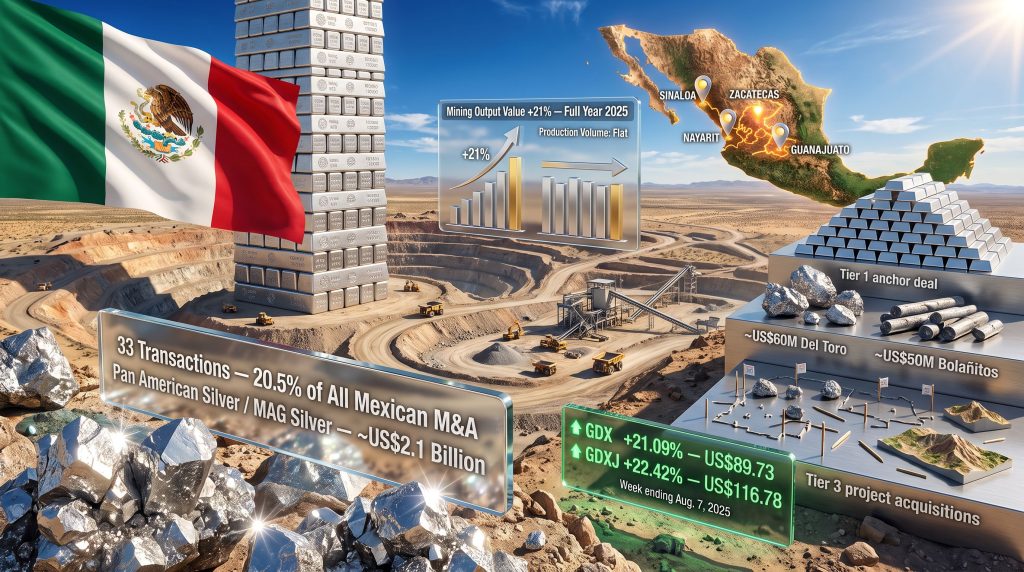
When commodity prices surge without a corresponding increase in production volumes, something structurally significant is happening beneath the surface. That is precisely the dynamic that defined Mexico's mining sector through 2025: a 21% increase in total output value against essentially flat production tonnage, according to CAMIMEX's 2026 annual report. The gap between those two figures tells a more nuanced story than any single headline transaction, and it helps explain why mining mergers and acquisitions in Mexico commanded a larger share of the country's overall dealmaking activity than any other industry.
The mechanism at work is price leverage. When gold and silver prices rise, the revenue per tonne extracted increases without any corresponding rise in costs, expanding operating margins and generating the free cash flow that funds acquisitions. That dynamic played out with notable force in 2025, and its effects rippled through deal structures, asset valuations, and the competitive strategies of both buyers and sellers across the sector.
When big ASX news breaks, our subscribers know first
Mexico's Mining M&A Dominance: What the 2025 Numbers Actually Mean
Mexico's mining sector closed 2025 with 33 completed transactions, representing 20.5% of all recorded M&A activity across the country, according to Seale & Associates data cited in CAMIMEX's 2026 annual report. No other single industry matched that concentration of dealmaking. Furthermore, gold M&A activity in comparable resource economies during the same period underscores just how exceptional Mexico's deal velocity was.
What distinguishes this figure is its composition. The 20.5% share was not manufactured by one or two outsized transactions distorting the aggregate. It was built through a broad-based, sustained redistribution of existing assets across deal tiers, from billion-dollar corporate combinations to concession-level acquisitions targeting permitted ground in specific mineral belts. That breadth is a structural signal, not a statistical anomaly.
The key distinction for investors is that Mexico's M&A dominance in 2025 reflected a sector-wide repricing of asset ownership, not a single capital event. Broad participation across deal sizes typically indicates durable structural change rather than opportunistic timing.
Several forces converged to produce this outcome:
- Mexico's concession pipeline has remained effectively closed to new grants, creating artificial scarcity of legally permitted development ground
- Regulatory changes have elevated uncertainty around new concession applications, shifting acquirer preference toward assets with established legal standing and clean title histories
- Precious metals price appreciation expanded financial headroom for deal financing, particularly for silver-focused operators
- Portfolio rationalisation among larger producers created a supply of non-core assets that smaller, regionally focused acquirers were positioned to absorb
How the Deal Landscape Breaks Down: Three Distinct Tiers
Tier 1: The Benchmark Transaction
The single most consequential transaction in Mexico during 2025 was Pan American Silver's acquisition of MAG Silver for approximately US$2.1 billion. The strategic logic was precise and well-understood: the deal delivered MAG's 44% equity interest in the Juanicipio mine in Zacatecas, one of the highest-grade primary silver operations currently in production anywhere in the world. This silver acquisition deal reshaped the competitive landscape for Mexico-focused precious metals operators almost overnight.
| Deal Parameter | Detail |
|---|---|
| Acquirer | Pan American Silver |
| Target | MAG Silver |
| Transaction Value | ~US$2.1 billion |
| Key Asset | 44% stake, Juanicipio Mine, Zacatecas |
| Asset Classification | High-grade primary silver operation |
| Deal Structure | Full corporate acquisition |
Juanicipio's significance extends beyond its grade profile. The mine sits within the Fresnillo Silver Trend, a northwest-southeast oriented mineralised corridor in Zacatecas that has produced silver continuously for centuries. The structural geology of this trend is characterised by epithermal vein systems hosted in volcanic and sedimentary sequences, with silver mineralisation occurring alongside base metal sulphides including lead and zinc.
For Pan American, the acquisition transforms its silver reserve base at precisely the moment when institutional capital is reassessing silver's dual role as both an industrial input for solar and electrification technologies and a monetary asset.
Tier 2: Mid-Market Portfolio Rationalisation
Below the headline transaction, two mid-tier deals defined the dominant pattern of Mexico's 2025 M&A cycle: established producers exiting non-core assets, with smaller, regionally concentrated operators as the natural buyers.
First Majestic Silver's Del Toro Divestiture
- Seller: First Majestic Silver
- Buyer: Sierra Madre Gold and Silver
- Consideration: ~US$60 million
- Asset Type: Operating silver mine
Endeavour Silver's Bolañitos Exit
- Seller: Endeavour Silver
- Buyer: Guanajuato Silver
- Consideration: ~US$50 million
- Strategic Logic: Basin-level consolidation within the Guanajuato district
Both transactions share a defining architecture. A larger producer monetises a non-core asset at a valuation supported by elevated silver prices, while a smaller operator acquires operational scale without bearing the capital burden and timeline risk of greenfield development. Notably, Endeavour Silver's broader acquisition strategy reflects a wider pattern of portfolio reshaping across the Americas that has been building momentum since 2024.
For Guanajuato Silver in particular, the Bolañitos acquisition fits within a deliberate consolidation strategy targeting the Guanajuato Mining District, one of the world's historically prolific silver-gold producing regions where proximity of operations generates meaningful cost synergies through shared infrastructure, processing capacity, and workforce.
Tier 3: Concession-Level Acquisitions
At the project level, a cluster of acquisitions expanded the footprint of several operators across Mexico's primary mineral belts:
- Vizsla Silver expanded concession control in Nayarit's Panuco district, a high-sulphidation epithermal silver-gold system with significant exploration upside
- Mexican Gold Mining pursued project-level acquisitions targeting gold-silver mineralisation
- Torex Gold added concessions adjacent to existing operational infrastructure in Guerrero
- First Majestic selectively acquired projects to supplement its broader portfolio rationalisation
These transactions share a defining characteristic: they prioritise concession control over corporate control. In an environment where new concession grants are effectively frozen, controlling permitted ground carries a scarcity premium that did not exist to the same degree in prior cycles.
The Permitting Bottleneck: Why Regulatory Scarcity Is Accelerating Deals
Understanding why mining mergers and acquisitions in Mexico have surged requires understanding the permitting environment that has made organic growth through new concessions prohibitively slow.
Mexico's concession system, administered through the General Directorate of Mines under the Ministry of Economy, has faced a pronounced slowdown in new grant processing. Environmental and indigenous consultation requirements introduced under reforms to the Mining Law and the General Law of Ecological Balance have extended review timelines significantly. The practical consequence is that acquiring permitted ground through M&A has become faster and, in many cases, more cost-effective than originating new projects through standard administrative channels.
This creates a counter-intuitive market dynamic: regulatory constraint on new supply does not suppress M&A activity, it intensifies it. When the pipeline for new permitted assets is closed, the secondary market for existing assets reprices upward and transaction volumes rise.
For acquirers, the permitting bottleneck introduces a critical distinction in due diligence: the difference between a concession that is legally clean and one that carries administrative history requiring scrutiny. The DynaResource ruling in Sinaloa crystallised this risk in a manner that all active deal teams in Mexico's mining sector should now incorporate into their assessment frameworks. According to expert analysis of Mexican mining M&A transactions, tax and customs liability reviews have become equally essential alongside standard title verification.
The DynaResource Ruling: A Precedent With Sector-Wide Implications
A Mexican federal district court granted constitutional protection (amparo) to DynaResource de México, covering eight mining concessions associated with the San José de Gracia gold operation in Sinaloa. The court's ruling turned on a procedural deficiency: the company had not been properly served notice of the administrative proceedings that resulted in the apparent cancellation of its concessions.
The amparo is a constitutional remedy rooted in Mexico's legal tradition, available to individuals and legal entities whose constitutional rights have been violated by government action. In the mining context, a successful amparo application can suspend or reverse an administrative concession cancellation, effectively restoring title to ground previously considered lost.
The implications for M&A due diligence are structural:
- Concession cancellations without proper notice may be judicially contestable, meaning assets previously classified as lost may be recoverable through constitutional channels
- Buyers assessing distressed concession packages must now examine whether prior cancellations followed correct administrative procedure, specifically whether proper notification was served
- The amparo mechanism represents a due process protection that operators can deploy against irregular government administrative actions, but its availability depends on procedural facts that require independent legal verification
- Title reports alone are insufficient for concessions with administrative histories; full review of notification procedures in any prior adverse proceedings is now a necessary element of standard due diligence
- Sinaloa's specific risk profile combines the legal complexity of the DynaResource precedent with the security considerations that already require heightened operational risk assessment in the state
For any acquisition involving Mexican mining assets with contested histories or prior cancellation proceedings, independent legal counsel specialising in Mexican mining and constitutional law is not optional, it is a prerequisite for informed capital deployment.
Precious Metals Price Dynamics and the Financial Logic of Mexico's M&A Cycle
The 2025 M&A surge did not occur in isolation from commodity markets. The repricing of precious metals equities provided both the financial capacity and the strategic urgency that drove deal activity to record levels.
| Metric | Value | Period |
|---|---|---|
| VanEck Gold Miners ETF (GDX) Weekly Gain | +21.09% | Week ending Aug. 7, 2025 |
| GDX Price Level | US$89.73 | Aug. 7, 2025 |
| Junior Gold Miners ETF (GDXJ) Weekly Gain | +22.42% | Week ending Aug. 7, 2025 |
| GDXJ Price Level | US$116.78 | Aug. 7, 2025 |
| Mexico Mining Output Value Increase | +21% | Full Year 2025 |
| Production Volume Change | Flat | Full Year 2025 |
The output value and volume figures are particularly instructive. A 21% increase in value against flat production means Mexico's mining sector generated materially more revenue per tonne extracted in 2025 than in the prior year. For operators, this translates directly into expanded free cash flow, reduced debt service burden, and greater capacity to finance acquisitions.
For potential acquirers considering Mexican assets from outside the country, it signals that the assets they are evaluating are generating more cash than headline production statistics would suggest. Fresnillo, Mexico's largest precious metals producer and a FTSE 100 constituent, served as a barometer for this dynamic. The company's half-year profit tripled in 2025, driven by price appreciation rather than volume growth. That performance benchmark shaped acquirer expectations across the sector and helped justify the valuations that supported the year's major transactions.
The next major ASX story will hit our subscribers first
Geopolitical Dimensions: Trade Policy Risks and the Washington Capital Gap
Section 232 Aluminium Tariffs and the USMCA Review
The Coalition for a Prosperous America has formally petitioned the US Treasury and the Office of the United States Trade Representative to preserve Section 232 aluminium tariffs on imports from Mexico and Canada through the USMCA review process. The coalition's position draws a sharp distinction between primary aluminium production and downstream fabrication, arguing that rules of origin verification cannot substitute for tariff-based protection when assessing the true origin content of fabricated aluminium products.
The practical exposure for Mexican mining and metals operations is twofold. The steel and aluminum tariffs introduced under Section 232 have created upstream cost pressure on primary metal imports used as feedstock in Mexican fabrication operations, whilst simultaneously threatening duty escalation on fabricated products exported to the US market. For M&A participants evaluating assets with any aluminium or base metal processing component, trade policy trajectory is now a material variable in deal economics, not a background consideration.
NOM-251-SE-2025: The Steel Compliance Layer
Mexico's Ministry of Economy is implementing the first phase of Official Mexican Standard NOM-251-SE-2025, introducing mandatory technical and commercial compliance parameters for steel products sold domestically. While the standard targets the steel supply chain primarily, its implementation introduces compliance obligations that acquirers of vertically integrated mining assets must factor into operational due diligence assessments and post-acquisition integration planning.
Washington's US$3 Billion Critical Minerals Package: Mexico's Absence
On August 7, 2025, the US federal government committed approximately US$3 billion in loans, equity investments, and grants to critical minerals, battery technology, and mining workforce development. The geographic scope extended from Arizona and Alabama to Australia and Madagascar. However, the US critical minerals strategy has conspicuously left Mexico outside its primary funding framework despite the country's strategic mineral endowment.
| Dimension | Detail |
|---|---|
| Total US Commitment | ~US$3 billion |
| Instruments | Federal loans, equity, grants |
| Geographic Coverage | Arizona, Alabama, Australia, Madagascar |
| Mexico Allocation | US$0 |
| Mexico's Critical Mineral Ranking | Top global producer of 9 US-classified critical minerals |
Mexico's absence from this allocation is a notable policy gap. The country ranks among the world's leading producers of nine minerals classified as critical by Washington for North American supply chain security, yet received no allocation from a package explicitly designed to reduce North American dependence on Chinese mineral supply chains. This is not a statement about any specific project's prospects, but it does indicate that bilateral mineral supply chain integration between the US and Mexico remains structurally incomplete despite geographic proximity and USMCA membership.
The Competitive Landscape: Who Is Buying, Who Is Selling, and Why
| Company | 2025 M&A Role | Primary Strategic Focus | Key Transaction |
|---|---|---|---|
| Pan American Silver | Major acquirer | Silver reserve consolidation | MAG Silver (~US$2.1B) |
| Sierra Madre Gold and Silver | Mid-tier acquirer | Silver operations | Del Toro mine (~US$60M) |
| Guanajuato Silver | Basin consolidator | Guanajuato district | Bolañitos (~US$50M) |
| Vizsla Silver | Project acquirer | Nayarit, Panuco district | Concession expansion |
| Torex Gold | Concession expander | Guerrero gold operations | Adjacent concession additions |
| First Majestic Silver | Net seller, selective buyer | Portfolio rationalisation | Del Toro divestiture |
| Endeavour Silver | Net seller | Non-core asset exit | Bolañitos divestiture |
The table reveals a pattern worth examining closely. The sellers in Mexico's 2025 M&A cycle were not distressed operators exiting under financial pressure. First Majestic and Endeavour Silver are established producers divesting assets that no longer fit their strategic priorities, generating proceeds that can be redeployed into higher-priority projects or returned to shareholders.
The buyers, meanwhile, are operators for whom the acquired assets represent a strategic core, not a peripheral addition. That alignment of strategic fit between buyer and seller is characteristic of a mature M&A market. According to industry data on Mexican M&A activity, mining's outsized share of national dealmaking reflects a sector operating with unusual strategic clarity. It also helps explain why 33 transactions cleared without the protracted negotiations or failed processes that often characterise sectors under stress.
From Ownership Transfer to Value Creation: The Test That Remains
The 33 transactions recorded in 2025 represent committed capital, but the sector's medium-term performance will be determined by what acquirers do with the assets they have purchased. Three variables will define whether Mexico's mining M&A cycle translates into sustained value creation:
- Capital expenditure deployment: Whether new owners invest meaningfully in exploration drilling, development infrastructure, and operational improvement at acquired assets, or whether acquisitions serve primarily as financial repositioning exercises
- Permitting resolution: Whether Mexico's concession and environmental approval backlog clears sufficiently to allow acquired projects to advance through the development pipeline toward production decisions
- Geopolitical alignment: Whether Mexico's position in North American critical mineral supply chains is formalised through bilateral frameworks that unlock the investment incentives and long-term offtake security that Washington has directed toward other jurisdictions
The 2025 M&A cycle has redistributed ownership of Mexico's mineral assets across a new generation of strategic holders. The 2026 to 2027 investment cycle will determine whether that redistribution was productive, measured by drill metres completed, feasibility studies advanced, and production decisions announced.
For investors tracking mining mergers and acquisitions in Mexico, the distinction between ownership transfer and genuine value creation is the most important analytical lens available. Asset redistribution at elevated valuations is necessary but not sufficient. Furthermore, Latin American copper and lithium deals provide a useful comparative benchmark for assessing whether Mexico's silver-dominant consolidation cycle is generating the kind of durable returns seen elsewhere in the region. The productive deployment of capital into the ground is what ultimately separates a sector consolidation that creates lasting wealth from one that merely reshuffles existing claims at cycle-peak prices.
Disclaimer: This article is intended for informational purposes only and does not constitute financial or investment advice. All financial data, transaction values, and market statistics referenced are drawn from publicly available sources including CAMIMEX's 2026 annual report, Seale & Associates data, and Mexico Business News reporting. Readers should conduct independent due diligence before making any investment decisions related to the Mexican mining sector.
Want To Spot the Next Major Mineral Discovery Before the Market Does?
Discovery Alert's proprietary Discovery IQ model delivers real-time alerts on significant ASX mineral discoveries, transforming complex geological and market data into actionable investment insights for both short-term traders and long-term investors — explore the historic returns major discoveries have generated and begin your 14-day free trial today to position yourself ahead of the broader market.