August 14, 2026
Geothermal Energy's Quiet Revolution: Why Land Is Becoming the New Battleground
For most of the past two decades, geothermal energy occupied a predictable corner of the renewable energy conversation. Reliable, yes. Scalable, debatable. Competitive, rarely. Developers could nominate federal parcels, show up at Bureau of Land Management auctions, and secure acreage at the statutory floor price of $2 per acre with minimal resistance. That era is now closing rapidly, and the June 2026 federal geothermal lease sale in New Mexico may represent the clearest evidence yet that geothermal land economics have undergone a structural transformation — one with direct implications for the record-setting geothermal lease bid in New Mexico.
The numbers from that single auction are difficult to contextualise without understanding how dramatically they diverge from historical norms. What was once a sleepy administrative process for locking up public land optionality has become a competitive market, reshaping how developers evaluate parcels, how financiers price risk, and how the broader energy investment community thinks about subsurface resources.
When big ASX news breaks, our subscribers know first
Breaking Down the Record-Setting Geothermal Lease Bid in New Mexico
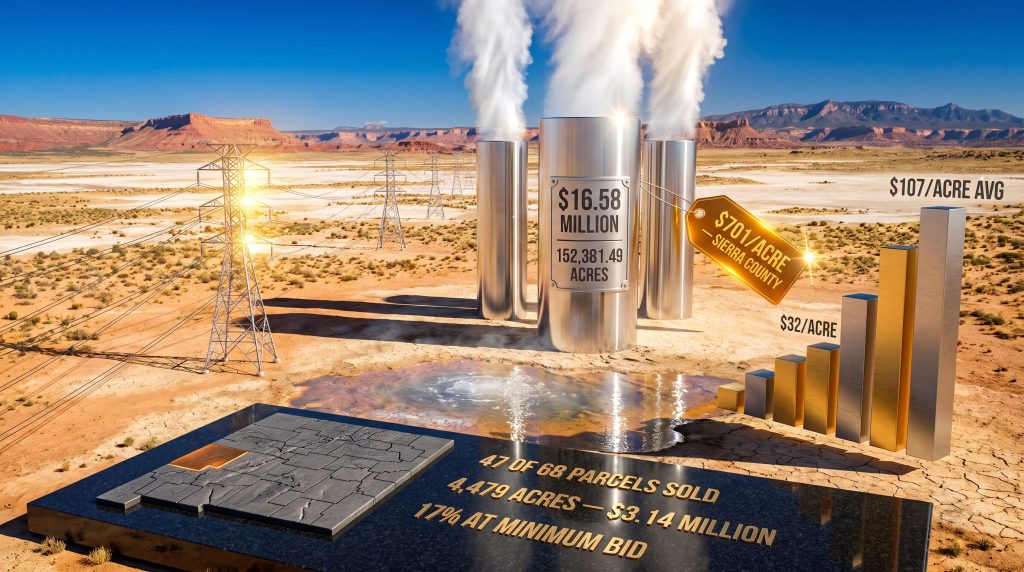
The Bureau of Land Management's June 2026 geothermal lease sale in New Mexico generated $16.58 million in total winning bids across 47 of the 68 parcels offered. That result positions it as the highest-grossing federal geothermal auction in BLM history, according to a BLM spokesperson who confirmed the figures to Utility Dive.
The standout transaction involved a 4,479-acre tract in Sierra County, acquired by Rock Canyon Resources for $3.14 million, translating to a bid of $701 per acre. That single figure represents more than 350 times the statutory minimum floor price and sets an unprecedented per-acre record in BLM geothermal auction history.
The comparative data tells the full story of how rapidly market conditions have shifted:
| Metric | June 2026 New Mexico Sale | October 2025 Nevada Sale | November 2024 New Mexico Sale |
|---|---|---|---|
| Total Revenue | $16.58 million | Lower benchmark | $9,135 |
| Average Price Per Acre | $107 | $32 | Minimal |
| Record Single-Parcel Bid | $701/acre | Not recorded | Not recorded |
| Parcels Sold | 47 of 68 offered | Not disclosed | 1 competitive bid |
| Total Acreage Leased | 152,381.49 acres | Not disclosed | Not disclosed |
| Parcels at Minimum Bid ($2/acre) | 17% | Estimated higher | Not disclosed |
The average price per acre of $107 in June 2026 represents more than triple the $32 per acre average recorded at Nevada's October 2025 sale, according to Enverus Intelligence Research. Perhaps more revealing is the collapse in minimum-bid parcels, falling from 76% of all parcels in 2019 to just 17% in June 2026. That single metric, more than any headline figure, illustrates how deeply competitive pressure has penetrated the federal geothermal leasing landscape.
What Made the Sierra County Parcel Command Such a Premium?
Proximity to transmission infrastructure is widely understood within industry circles to be the dominant financial variable in geothermal land pricing. Industry analysis estimates that access to high-voltage transmission lines with available capacity adds approximately $43 per acre in premium valuation to a geothermal parcel. The Sierra County tract's location relative to grid infrastructure almost certainly contributed a meaningful portion of the premium bid above and beyond the resource quality alone.
This dynamic introduces a pricing layer that many outside the sector may not immediately appreciate. Geothermal development economics are not determined solely by subsurface temperature gradients, reservoir permeability, or fluid chemistry. The ability to physically deliver power to the grid without triggering costly interconnection upgrades or lengthy queue processes can be worth tens of millions of dollars across a project's lifetime, and the market is now pricing that access into upfront land acquisition decisions.
How the Federal Geothermal Leasing System Actually Works
Understanding why this auction matters requires a clear picture of the process that precedes a competitive bid:
-
Nomination Phase: Energy companies and developers identify areas on federal public lands with suspected geothermal resource potential and formally nominate those tracts to the BLM for consideration.
-
BLM Evaluation: The agency assesses nominated parcels across technical, environmental, and resource viability dimensions before determining which tracts proceed to auction.
-
Competitive Lease Auction: Qualifying parcels are offered through open competitive bidding, with a statutory minimum floor of $2 per acre establishing the baseline.
-
Revenue Distribution: Proceeds from bonus bids, annual rental payments, and royalty payments are allocated among the U.S. Treasury, the State of New Mexico, and the counties in which leased parcels are located.
This revenue-sharing structure creates a layered political economy. State and county governments have a direct fiscal incentive to support geothermal development activity, which can smooth the local permitting and community engagement processes that often slow energy infrastructure projects. Furthermore, the broader mining permits overhaul underway at the federal level is creating additional regulatory momentum that may accelerate how quickly nominated parcels move through evaluation and reach auction.
Major participants in the June 2026 New Mexico sale included Ormat Technologies, Zanskar, and Invenergy, alongside the record-setting bid from Rock Canyon Resources. The composition of bidders reflects a broadening participant base, combining established geothermal operators with newer entrants capitalising on growing electricity demand signals.
The Demand-Side Catalyst Reshaping Geothermal Economics
The acceleration in geothermal leasing activity cannot be separated from a broader transformation in electricity demand. Three converging forces are fundamentally altering how developers and investors value firm, dispatchable clean power:
-
AI infrastructure buildout: Data centres supporting large language models and artificial intelligence workloads require continuous, uninterruptible power that cannot be served effectively by weather-dependent generation alone.
-
Electrification of transportation and buildings: Structural growth in electricity consumption across the economy is tightening supply margins in multiple regional grids.
-
Retirement of thermal baseload: As ageing coal and nuclear plants exit service, the pool of always-on generation capacity is shrinking, elevating the premium placed on resources that can replicate that profile from a clean energy source.
Geothermal energy operates continuously regardless of time of day, season, or weather conditions. That characteristic, known in power systems as high capacity factor operation, makes it a strategically distinct complement to solar and wind generation. Unlike batteries, which provide dispatchability over limited discharge windows, geothermal plants can sustain output for extended periods, making them particularly attractive for corporate buyers with around-the-clock power needs. The growing critical minerals demand associated with clean energy infrastructure is similarly reshaping how investors evaluate subsurface resource assets.
The $1 billion partnership between XGS Energy and Meta, announced in June 2025 to construct a 150-MW geothermal plant in New Mexico, exemplifies this dynamic. A hyperscale technology company committing a billion dollars to a single geothermal development signals not just opportunistic interest but a strategic conviction that geothermal can serve as a foundational power source for AI-era electricity demand.
New Mexico's Geothermal Ecosystem: Deeper Than One Auction
New Mexico's emergence as a geothermal development hub predates the June 2026 auction and reflects a convergence of geological, technological, and market factors that distinguish it from other western states.
Zanskar's Lightning Dock facility stands as the only operational utility-scale geothermal plant currently supplying Public Service Company of New Mexico. The 15-MW facility reached full nameplate capacity in May 2025 following an AI-assisted operational overhaul, itself a notable signal of how advanced computational tools are being deployed to optimise reservoir management and power output from existing geothermal assets.
In 2022, Eavor Technologies completed the first deep, two-leg multilateral geothermal well in the United States within New Mexico, establishing the state as a testing ground for next-generation drilling methodologies. Multilateral geothermal wells, which branch from a single surface location into multiple subsurface trajectories, offer the potential to significantly increase the thermal contact area within a reservoir. This technology remains at an early commercialisation stage, but its demonstration in New Mexico adds technical depth to the state's geothermal narrative beyond conventional hydrothermal resources.
Why Transmission Access Has Become the Primary Pricing Variable
The collapse in minimum-bid parcels from 76% in 2019 to just 17% in June 2026 represents one of the most structurally significant inflection points in the history of federal geothermal leasing. It confirms that competitive pressure has fundamentally altered the economics of acreage acquisition, and that the era of near-cost-free geothermal land banking is ending.
For years, the dominant framework for evaluating geothermal parcels centred almost exclusively on resource quality metrics: subsurface temperature at depth, reservoir permeability, fluid enthalpy, and proximity to known hydrothermal systems. Transmission access was considered a downstream development problem, something to solve after securing the land.
That sequencing is now reversed. Developers and their financial backers are applying what might be described as a resource-plus-grid-access scoring model, evaluating parcels simultaneously on geological potential and proximity to high-voltage infrastructure with available interconnection capacity. Industry analysis from Enverus Intelligence Research estimates that transmission access adds approximately $43 per acre to bid values, a figure that represents a meaningful premium at scale across tens of thousands of acres.
Graham Bain, a principal analyst at Enverus Intelligence Research, noted that competition is now materially moving federal geothermal bids, and that the New Mexico results signal the closing window for operators who previously relied on minimum-bid acreage strategies. He identified transmission line access with available capacity as an emerging top driver of what bidders will pay, framing that dynamic as the benchmark heading into the Idaho November sale. (Utility Dive, August 2026)
The 2026 Federal Geothermal Lease Sale Pipeline
New Mexico's results set the competitive baseline for three additional federal geothermal auctions scheduled across the remainder of 2026:
| Scheduled Sale | State | Date | Key Context |
|---|---|---|---|
| Completed | New Mexico | June 2026 | Record $16.58M total; $701/acre single-parcel record |
| Upcoming | Utah | August 18, 2026 | BLM sale scheduled; competitive dynamics anticipated |
| Upcoming | Nevada | October 2026 | BLM seeking public input; prior average $32/acre |
| Upcoming | Idaho | November 2026 | 21 of 35 parcels within 25 km of major transmission corridors |
The Idaho sale carries particular analytical interest. According to Enverus Intelligence Research, 21 of the 35 parcels planned for auction in Idaho are located within 25 kilometres of the Gateway West and Boardman-to-Hemingway transmission corridors, two of the most significant high-voltage routes in the intermountain west.
Scenario modelling for Idaho produces a wide range of outcomes:
-
Base Case (current grid conditions): Average bids estimated at approximately $58 per acre
-
Energised Transmission Scenario: Average bids projected to rise to approximately $70 per acre once Gateway West and Boardman-to-Hemingway lines reach full energisation
-
Premium Upper-Limit Scenario: A modelled ceiling of $344 per acre under highly favourable conditions, though analysts characterise this as an outer bound rather than a central forecast
The spread between the base case and premium scenario is instructive. It quantifies precisely how much optionality value developers are willing to assign to future transmission access, and it explains why parcels near planned but not-yet-energised infrastructure can attract elevated bids that may appear disconnected from current project economics.
The next major ASX story will hit our subscribers first
Investment Themes Emerging from the New Mexico Data
The June 2026 auction's results crystallise several investment themes that are likely to shape geothermal capital allocation over the medium term:
-
Transmission-linked land valuation is becoming a standardised pricing framework for geothermal acreage, paralleling the grid-proximity premium dynamics already embedded in solar and wind project development economics. In addition, the renewable energy solutions emerging across the energy sector are increasingly converging with geothermal development strategies.
-
Corporate offtake as a financial foundation: Direct energy procurement agreements between technology companies and geothermal developers, such as the Meta-XGS Energy deal, provide revenue certainty that supports higher upfront land acquisition costs and de-risks project financing.
-
Next-generation drilling as a resource expander: Technologies including multilateral well designs, closed-loop geothermal systems, and AI-optimised reservoir management are expanding the viable geothermal resource base well beyond traditional hydrothermal zones, opening previously uneconomic areas to competitive development.
-
Federal revenue sharing as a political stabiliser: The distribution of BLM geothermal lease proceeds to state governments and counties creates aligned incentives at the local level, reducing the political friction that can obstruct energy project permitting.
The June 2026 New Mexico sale's scale is itself worth noting. The auction covered 68 parcels across approximately 197,000 acres, a dramatic expansion from the state's previous federal geothermal offering of just seven parcels in 2024. This acceleration in acreage availability reflects both BLM's responsiveness to market demand and the growing recognition that geothermal resources on public lands are a critical component of the clean energy transition.
Frequently Asked Questions: Federal Geothermal Leasing and the New Mexico Record
What was the record-setting geothermal lease bid in New Mexico?
A 4,479-acre parcel in Sierra County sold for $701 per acre, totalling $3.14 million, during the BLM's June 2026 federal geothermal lease sale. This represented the highest per-acre price and highest single-tract total in BLM geothermal auction history, according to a BLM agency spokesperson.
How much did the New Mexico BLM geothermal sale generate in total?
The June 2026 sale generated $16.58 million across 47 winning bids covering approximately 152,381 acres, making it the highest-grossing federal geothermal lease sale on record.
Who submitted the record geothermal bid in New Mexico?
Rock Canyon Resources submitted the record bid of $701 per acre for the Sierra County tract. Other significant participants in the broader sale included Ormat Technologies, Zanskar, and Invenergy.
Why are geothermal land bids increasing so rapidly?
Three converging forces are driving bid escalation: surging electricity demand from AI infrastructure and data centres, the strategic value of firm dispatchable clean power in a grid increasingly dominated by intermittent renewables, and the recognition that proximity to high-voltage transmission infrastructure materially amplifies a geothermal project's economic viability. These forces are also closely tied to broader energy transition minerals dynamics shaping long-term investment decisions.
How is revenue from federal geothermal leases distributed?
Proceeds including bonus bids, annual rental payments, and production royalties are shared between the U.S. Treasury, the State of New Mexico, and the counties in which the leased parcels are located.
What geothermal lease sales follow New Mexico in 2026?
The BLM has a Utah sale scheduled for August 18, 2026, a Nevada sale in October 2026, and an Idaho sale in November 2026. The Idaho auction is drawing particular analyst attention given that 21 of its 35 parcels fall within 25 kilometres of major transmission corridors. Readers seeking further detail on the BLM's leasing process can access official BLM documentation directly.
Key Takeaways: What the New Mexico Auction Signals for America's Energy Future
-
The collapse of minimum-bid dominance, from 76% of parcels in 2019 to just 17% in June 2026, marks a genuine structural inflection in how the market values geothermal acreage.
-
Transmission infrastructure access has emerged as the primary financial differentiator in federal geothermal lease pricing, adding an estimated $43 per acre in premium bid value according to Enverus Intelligence Research.
-
New Mexico's geothermal ecosystem is maturing on multiple fronts, anchored by operational utility-scale assets, next-generation drilling demonstrations, and billion-dollar corporate energy procurement partnerships.
-
The remainder of the 2026 federal lease sale calendar, spanning Utah, Nevada, and Idaho, will serve as a live market test of whether the competitive intensity demonstrated in the record-setting geothermal lease bid in New Mexico represents a durable transformation in geothermal land economics or a geographically specific event driven by site-specific factors.
This article contains forward-looking statements and scenario projections, including bid price estimates and transmission scenario modelling. These projections are based on independent industry research and do not constitute investment advice. Readers should conduct their own due diligence before making any investment or development decisions related to geothermal energy or federal lease activity.
Want to Stay Ahead of the Next Major Energy Resource Discovery?
Discovery Alert's proprietary Discovery IQ model delivers real-time alerts on significant ASX mineral discoveries — including those tied to the energy transition reshaping how investors value subsurface resources — ensuring subscribers can identify actionable opportunities ahead of the broader market. Explore Discovery Alert's discoveries page to understand how historic mineral discoveries have generated substantial returns, and begin your 14-day free trial today to position yourself at the forefront of the next major find.