August 20, 2026
Global energy systems face unprecedented pressure to balance supply security with environmental responsibility. Traditional fossil fuel extraction methods increasingly compete against unconventional alternatives that promise both domestic energy independence and reduced carbon footprints. Within this shifting landscape, coal-bed methane exploration in India emerges as a strategic bridge technology, offering nations the opportunity to monetise existing geological assets while transitioning toward cleaner energy portfolios. Furthermore, the sector presents compelling investment opportunities as energy transition challenges reshape global energy markets.
Understanding Coal-Bed Methane's Strategic Value Proposition
Technical Fundamentals of CBM Resource Development
Coal-bed methane represents natural gas trapped within coal seam structures underground, accessible through specialised extraction techniques that differ fundamentally from conventional gas drilling. The methane molecules attach to coal surfaces through adsorption processes, requiring dewatering and pressure reduction to release commercially viable gas volumes.
Key Technical Characteristics:
- Gas Composition: Primarily methane (85-95%) with minimal impurities
- Extraction Method: Water pumping reduces reservoir pressure, allowing gas desorption
- Well Design: Vertical or horizontal drilling depending on coal seam geometry
- Production Profile: Declining water production with increasing gas output over time
India's position as the world's third-largest gas consumer creates compelling strategic imperatives for domestic CBM development. Current import dependency reaches approximately 50%, exposing the economy to volatile global LNG pricing and supply chain vulnerabilities that impact industrial competitiveness and energy security. However, these dynamics also present opportunities, particularly when considering broader natural gas pricing outlook trends globally.
India's CBM Resource Assessment and Geographic Distribution
National Resource Base:
- Total Prognosticated Resources: 62.4 trillion cubic feet across 33 previously awarded blocks
- Established Gas in Place: 9.9 TCF confirmed through exploration activities
- Estimated National Potential: 2-3 trillion cubic metres spanning major coalfield regions
Primary CBM Basins by Geographic Region:
| Region | State | Basin Name | Estimated Resources (TCM) | Development Status |
|---|---|---|---|---|
| Eastern | West Bengal | Raniganj | 0.8-1.2 | Commercial Production |
| Eastern | Jharkhand | Jharia, Bokaro | 0.6-0.9 | Exploration Phase |
| Central | Madhya Pradesh | Singrauli | 0.4-0.7 | Limited Production |
| Central | Chhattisgarh | Mand-Raigarh | Under Assessment | Early Exploration |
Environmental advantages position CBM as a cleaner alternative to traditional coal combustion. Captured methane reduces greenhouse gas emissions that would otherwise escape during coal mining operations, supporting India's commitment to achieving net-zero emissions by 2070. Consequently, this aligns with broader coal market challenges facing the global energy sector.
When big ASX news breaks, our subscribers know first
Regulatory Framework and Bidding Mechanisms Analysis
Evolution of India's CBM Allocation System
The Directorate General of Hydrocarbons oversees CBM block allocation through specialised bidding rounds designed to attract private sector investment and technical expertise. Recent policy reforms represent a strategic shift from earlier frameworks that produced limited commercial success.
Historical Performance Context:
- Previous Rounds (2001-2008): 33 blocks awarded across four bidding cycles
- Relinquishment Rate: Majority of blocks returned due to low geological prospectivity
- Policy Learning: Work programme-based awards replace previous bidding criteria
Special CBM Bidding Rounds 2025-2026: Strategic Analysis
Bidding Round Structure:
- 2025 Round: 3 blocks offered with mixed competitive response
- 2026 Round: 13 blocks attracting selective industry participation
- Award Criteria: Highest drilling commitment determines block allocation
- Basin Classification: Category II and III basins available for private development
Competitive Response Metrics:
- No-Bid Blocks: 8 out of 16 total blocks failed to attract bidders
- Single-Bidder Scenarios: 4 blocks received only one application
- Multi-Bidder Competition: 2 blocks in Singrauli coalfield generated competitive contests
Policy reforms introduced marketing and pricing freedom for CBM producers, eliminating previous price controls that limited commercial viability. Environmental clearance streamlining and land acquisition support demonstrate government commitment to accelerating domestic gas production. In addition, these developments reflect broader mining innovation trends transforming the resources sector.
Corporate Strategy and Market Leadership Dynamics
Major Player Positioning in 2025-2026 Bidding Rounds
Reliance Industries Strategic Approach:
- Bidding Portfolio: 3 blocks across Chhattisgarh, Odisha, and Telangana
- Geographic Strategy: Multi-basin diversification reducing geological concentration risk
- Current Operations: Active production from 2 Madhya Pradesh CBM blocks
- Competitive Position: Sole bidder for 2 blocks, direct competition for 1 block
Essar Group Aggressive Expansion:
- Total Bid Portfolio: 5 blocks spanning both 2025 and 2026 rounds
- Production Asset: Raniganj East block (West Bengal) with 12 TCF resource base
- Market Position: India's largest producing CBM field operator
- Strategic Focus: Geographic expansion beyond proven West Bengal basin
The company has demonstrated significant commitment to developing India's unconventional gas sector. Moreover, insights from innovation expo insights suggest that technological advancement will play a crucial role in sector development.
Oil India Limited Conservative Approach:
- Selective Bidding: 3 blocks focused on Madhya Pradesh's Singrauli coalfield
- State Ownership Advantage: Potential capital access and policy support benefits
- Risk Management: Concentrated geographic strategy in established producing region
ONGC Strategic Withdrawal:
India's largest oil and gas producer chose not to participate in recent CBM bidding rounds, indicating strategic prioritisation toward conventional upstream assets and capital allocation constraints for unconventional gas development.
Production Success Stories and Commercial Viability
Current Producing Assets:
| Company | Block Location | Resource Base | Production Status | Technical Achievement |
|---|---|---|---|---|
| Essar (EOGEPL) | Raniganj East, West Bengal | 12 TCF | Commercial Production | India's largest CBM field |
| GEECL | Raniganj West, West Bengal | Undisclosed | Commercial Production | Proven basin success |
| Reliance | Madhya Pradesh (2 blocks) | Undisclosed | Active Production | Multi-block operations |
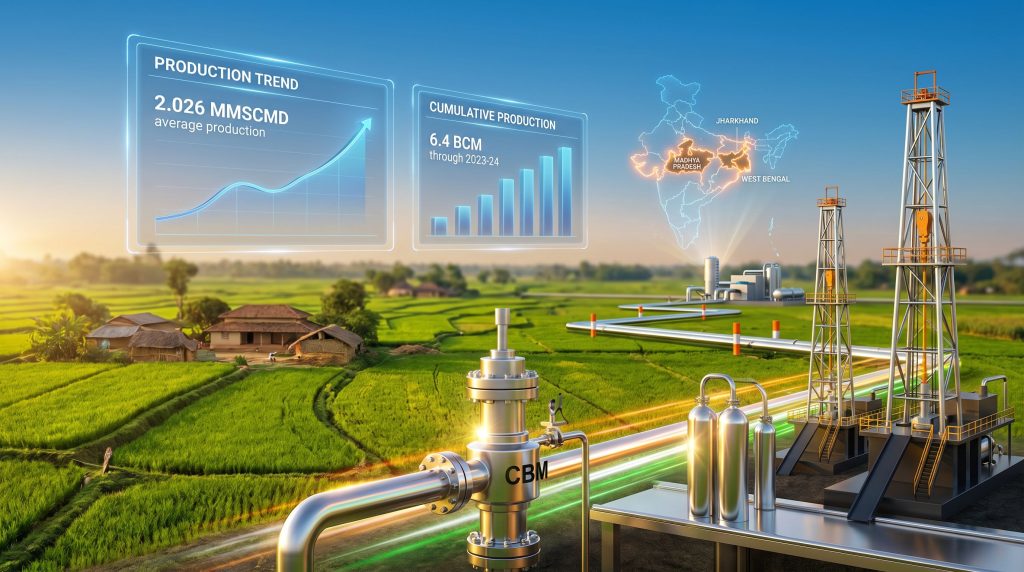
Cumulative CBM production reached 2.026 million metric standard cubic metres per day during April-December 2024, demonstrating technical feasibility and market demand for domestically produced unconventional gas.
Geographic Hotspots and Basin-Specific Investment Opportunities
Eastern India: Proven Commercial Success Region
West Bengal – Raniganj Basin Leadership:
The Raniganj basin demonstrates India's most successful CBM commercialisation, with multiple operators achieving sustained production from adjacent blocks. Existing coal mining infrastructure provides operational synergies and reduces development costs compared to greenfield locations.
Jharkhand – Untapped Potential Assessment:
Jharia and Bokaro coalfields contain substantial CBM resources but remain largely unexplored due to complex land acquisition challenges and competing coal mining operations. Technical studies suggest significant gas volumes await development with appropriate investment and regulatory support.
Central India: Emerging Development Frontier
Madhya Pradesh – Singrauli Coalfield Dynamics:
The Singrauli coalfield attracted multiple bidders across both 2025 and 2026 rounds, indicating industry confidence in geological prospectivity. Existing power generation infrastructure creates immediate market demand for produced gas, supporting project economics.
Competitive Bidding Analysis – Singrauli Blocks:
- Block 1 (2025 Round): EOGEPL vs. Prabha Energy vs. Oilmax-SAS Infotech consortium
- Block 2 (2025 Round): Oil India vs. EOGEPL vs. Oilmax-SAS Infotech vs. Invenire Petrodyne
- Block 3 (2026 Round): Oil India sole bidder positioning
Southern India: Environmental and Agricultural Challenges
Telangana – Godavari Valley Opportunities:
Godavari Valley coalfields received selective bidding interest, with Reliance and EOGEPL competing for specific blocks. Regional gas demand from industrial and power sectors supports commercial development prospects.
Tamil Nadu – Kaveri Delta Controversies:
Agricultural community opposition in the Kaveri Delta region highlights environmental and social challenges facing CBM development. Rice cultivation areas raise concerns about water resource competition and land use conflicts that complicate project implementation.
Economic Factors and Investment Decision Frameworks
Capital Expenditure and Development Cost Analysis
CBM Project Economics Comparison:
| Cost Component | CBM Projects | Conventional Gas | LNG Imports |
|---|---|---|---|
| Development Cost | $3-5/MMBTU | $2-3/MMBTU | $8-12/MMBTU |
| Geological Risk | Medium | Low | None |
| Infrastructure Requirements | High | Medium | Port-dependent |
| Production Timeline | 3-5 years | 2-4 years | Immediate |
| Market Price Exposure | Domestic pricing | Domestic pricing | Global volatility |
Revenue Models and Pricing Mechanism Benefits
Marketing freedom policies enable CBM producers to negotiate direct supply contracts with industrial consumers, power generators, and city gas distribution companies. This pricing flexibility eliminates previous administrative constraints that limited commercial returns and investment incentives.
Revenue Optimisation Strategies:
- Power Sector Contracts: Long-term supply agreements with thermal power plants
- Fertiliser Industry Demand: Feedstock requirements for urea and ammonia production
- City Gas Distribution: Urban consumer market access through pipeline networks
- Industrial Applications: Direct supply to steel, cement, and chemical manufacturing
Government revenue sharing frameworks balance state interests with private sector profitability requirements. Royalty structures and production sharing contracts provide predictable fiscal terms that support long-term investment planning and financing arrangements.
Environmental Sustainability and Social Impact Management
Agricultural Land Use Conflict Resolution
Farmer compensation mechanisms and community engagement strategies become critical success factors for CBM projects in densely populated agricultural regions. The Kaveri Delta example demonstrates how inadequate stakeholder consultation can delay or derail technically viable projects.
Sustainable Development Approaches:
- Compensation Frameworks: Fair market value payments for land acquisition and crop disruption
- Technology Solutions: Directional drilling minimises surface footprint in agricultural areas
- Water Management: Recycling and treatment systems for produced water handling
- Community Benefits: Local employment and revenue sharing with affected villages
Climate Impact and Methane Emissions Reduction
CBM extraction provides environmental benefits by capturing methane that would otherwise escape during conventional coal mining operations. This greenhouse gas reduction supports India's climate commitments while generating economic value from previously wasted resources.
Environmental Performance Metrics:
- Emissions Reduction: Captured methane prevents atmospheric release during coal mining
- Carbon Intensity: Lower CO2 emissions per unit energy compared to coal combustion
- Flaring Minimisation: Pipeline infrastructure reduces methane venting and waste
- Rehabilitation Standards: Land restoration requirements post-extraction completion
The next major ASX story will hit our subscribers first
Future Outlook and Strategic Development Pathways
Production Scaling and Infrastructure Integration
Industry projections suggest potential 300% production growth by 2030 with successful development of awarded blocks and continued policy support. Pipeline infrastructure expansion becomes essential for connecting remote CBM fields with demand centres and distribution networks.
Infrastructure Development Priorities:
- Gas Pipeline Extension: Connecting CBM fields to National Gas Grid system
- Compression Facilities: Processing plants for gas quality standardisation
- Storage Infrastructure: Seasonal demand balancing and supply security
- Distribution Networks: Last-mile connectivity for industrial and residential consumers
Technology Innovation and International Collaboration
Enhanced recovery techniques from international CBM operations offer potential application in Indian geological conditions. Furthermore, according to research published in the Journal of Cleaner Production, digitalisation and automation technologies can improve operational efficiency and reduce development costs across multiple project sites.
Technology Transfer Opportunities:
- US Shale Experience: Horizontal drilling and hydraulic fracturing techniques
- Australian CBM Methods: Coal seam gas production optimisation strategies
- Canadian Innovation: Cold climate and complex geology management approaches
- Data Analytics: Reservoir modelling and production forecasting improvements
What Are the Investment Strategy and Risk Assessment Considerations?
Strategic Investment Positioning
Coal-bed methane exploration in India represents the nation's strategic pivot toward energy independence, with investment commitments exceeding ₹15,000 crore from major industrial houses across recent bidding rounds. First-mover advantages exist in underdeveloped basins where geological data remains limited but resource potential appears substantial.
Portfolio Diversification Benefits:
- Geographic Risk Spreading: Multiple basin exposure reduces concentration risk
- Technology Learning: Operational experience applicable across similar geological settings
- Market Access: Established relationships with gas consumers and distribution partners
- Policy Alignment: Government support for domestic gas production and import substitution
Risk Mitigation and Management Strategies
Primary Risk Categories:
| Risk Type | Mitigation Approach | Monitoring Metrics |
|---|---|---|
| Geological Uncertainty | Phased exploration drilling | Resource confirmation timeline |
| Environmental Compliance | Early stakeholder engagement | Clearance approval progress |
| Market Price Volatility | Long-term contract hedging | Price correlation analysis |
| Regulatory Changes | Government relationship management | Policy development tracking |
Investment Decision Criteria:
- Technical Due Diligence: Geological assessment and resource estimation validation
- Economic Modelling: NPV sensitivity analysis under different price scenarios
- Regulatory Compliance: Environmental clearance and land acquisition status
- Market Access: Gas transportation and sales infrastructure availability
In conclusion, coal-bed methane exploration in India stands at a pivotal juncture where technological advancement meets regulatory support. The sector's evolution will likely determine India's success in achieving greater energy independence whilst meeting environmental commitments. However, investors must carefully evaluate geological, environmental, and market risks before committing capital to this emerging sector.
Disclaimer: This analysis is based on publicly available information and industry reports. Coal-bed methane exploration involves significant geological, technical, and commercial risks. Potential investors should conduct independent due diligence and consult qualified professionals before making investment decisions. Production estimates, resource assessments, and economic projections are subject to uncertainty and may not reflect actual future performance.
Looking to Capitalise on India's Energy Transition Opportunities?
Discovery Alert's proprietary Discovery IQ model provides instant notifications on significant mineral and energy discoveries across global markets, empowering subscribers to identify actionable investment opportunities ahead of mainstream recognition. Explore historic examples of exceptional discovery-driven returns and begin your 14-day free trial today to position yourself strategically within emerging sectors like coal-bed methane exploration.