May 19, 2026
Industrial transformation through advanced gasification technologies represents a critical pathway for nations seeking energy independence while leveraging abundant domestic coal resources. These sophisticated thermochemical processes convert solid carbonaceous materials into synthetic gas, creating opportunities for integrated chemical manufacturing that can reshape entire regional economies. Understanding the technical complexities and operational frameworks of such facilities reveals why major industrial groups are committing substantial capital to develop these multi-product platforms, particularly as the mining industry evolution accelerates towards more sustainable practices.
Understanding Coal Gasification Technology and Its Strategic Importance
Modern coal gasification operates through controlled thermochemical conversion processes that transform solid coal into synthetic gas under elevated temperature and pressure conditions. This syngas, primarily composed of carbon monoxide and hydrogen, serves as a versatile industrial feedstock for multiple downstream applications including ammonia production, hydrogen extraction, and chemical synthesis.
The strategic significance extends beyond mere fuel production. For countries with substantial coal reserves, gasification technology offers a pathway to reduce import dependency for critical petrochemical products while creating value-added manufacturing capabilities. Furthermore, the process essentially transforms low-value solid coal into high-value chemical intermediates, positioning domestic resources as feedstock for advanced manufacturing rather than simple combustion applications.
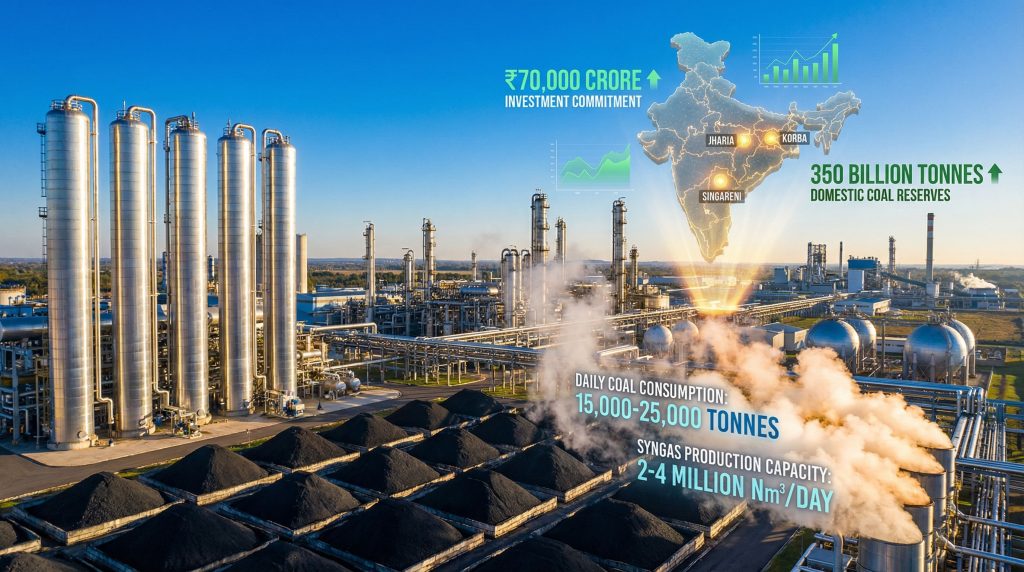
Recent developments demonstrate this potential, with the Adani Group coal gasification plant project representing a ₹70,000 crore commitment for integrated chemical manufacturing near Nagpur. The facility will produce syngas, ammonia, and hydrogen as primary derivatives, targeting both domestic consumption and export markets. According to project leadership, this initiative aims to develop advanced chemical manufacturing capabilities while reducing import dependence for critical industrial inputs.
Technical Process Framework
Gasification technology operates through several distinct phases, each requiring precise control of operating parameters. The feedstock preparation stage involves coal sizing, moisture management, and quality standardization to ensure consistent reactor performance. Moreover, primary gasification occurs in specialised reactors where coal reacts with controlled amounts of oxygen or steam at temperatures typically ranging from 800 to 1,500 degrees Celsius.
Gas cleaning systems remove impurities and particulates from the raw syngas stream, producing specification-grade products suitable for downstream chemical synthesis. Consequently, the process generates multiple co-products simultaneously, creating revenue diversification opportunities that improve project economics compared to single-product facilities.
When big ASX news breaks, our subscribers know first
Multi-Stream Revenue Generation in Integrated Gasification Facilities
Advanced gasification plants generate value through multiple interconnected product streams, each serving distinct market segments with varying demand characteristics. This diversification strategy reduces exposure to single commodity price volatility while maximising utilisation of the gasification infrastructure investment, addressing current coal supply challenges through value-added processing.
Primary product categories include:
• Syngas applications: Direct industrial heating, power generation, and chemical feedstock for downstream processing
• Ammonia production: Fertiliser manufacturing inputs and industrial chemical applications
• Hydrogen extraction: Clean fuel applications for transportation and industrial processes
• Methanol synthesis: Fuel additives, chemical intermediates, and emerging green chemistry applications
The Nagpur project specifically targets syngas, ammonia, and hydrogen production as core revenue streams. Project developers indicate this multi-product approach enables the facility to serve diverse industrial customers while creating flexibility to respond to changing market conditions. Additionally, the integration of multiple chemical production pathways within a single facility generates operational synergies and economies of scale unavailable to standalone production units.
Economic Value Chain Optimisation
Revenue optimisation in gasification facilities depends heavily on operational efficiency metrics and market positioning strategies. Key performance indicators include capacity utilisation rates, energy conversion efficiency, and product quality consistency across multiple output streams, contributing to decarbonisation economic benefits through reduced emissions per unit of chemical output.
Successful facilities typically maintain capacity utilisation above 85% through long-term supply agreements and strategic customer relationships. Energy conversion ratios, measuring the proportion of coal energy content captured in valuable products, directly impact project profitability. Furthermore, advanced facilities achieve conversion efficiencies exceeding 70% through optimised process control and heat integration systems.
Cost structure management focuses on three primary areas: feedstock procurement efficiency, processing optimisation, and distribution network development. Integrated facilities benefit from coal supply chain coordination, particularly when gasification plants are co-located with mining operations or connected through dedicated transportation infrastructure.
Technical Specifications and Infrastructure Requirements for Large-Scale Operations
Large-scale gasification facilities require substantial infrastructure investments and careful integration with existing industrial ecosystems. The technical specifications reflect the complexity of managing multiple high-temperature, high-pressure processes simultaneously while maintaining safety and environmental compliance standards.
| Infrastructure Component | Typical Requirements | Critical Considerations |
|---|---|---|
| Land acquisition | 300-500 acres | Environmental clearances, transportation access |
| Coal handling systems | 15,000-25,000 tonnes/day capacity | Rail connectivity, storage facilities |
| Water management | 8-12 million litres/day | Treatment systems, recycling capabilities |
| Power integration | 500-1,000 MW potential | Grid connection, load balancing |
The Maharashtra Industrial Development Corporation has initiated land acquisition of approximately 400 acres for the Adani Group coal gasification plant, demonstrating the substantial infrastructure footprint required for integrated operations. This scale reflects the need for comprehensive coal handling, chemical processing, product storage, and utilities infrastructure within the facility boundaries.
Process Integration Complexities
Technical challenges in gasification facilities stem from coordinating multiple chemical processes operating at different temperatures, pressures, and residence times. Gasifier design must accommodate varying coal quality characteristics while maintaining consistent syngas composition for downstream processing requirements.
Advanced process control systems monitor thousands of operational parameters continuously, enabling real-time optimisation of conversion efficiency and product quality. However, predictive maintenance protocols minimise unplanned shutdowns through early identification of equipment degradation patterns in high-temperature environments, supporting data-driven mining operations principles.
Safety management systems address the handling of combustible gases, high-pressure operations, and chemical synthesis processes. Emergency response protocols require coordination between multiple process units and specialised training for operations personnel managing complex chemical production systems.
Regional Positioning and Industrial Ecosystem Development
Location selection for gasification facilities depends on multiple factors including coal resource access, transportation infrastructure, industrial customer proximity, and regulatory environment. The Nagpur region has emerged as a significant hub for coal gasification development, with five planned projects indicating regional momentum for this technology cluster.
Maharashtra's positioning as a gasification centre builds on existing advantages:
• Coal resource proximity: Access to high-quality thermal coal from regional mining operations
• Industrial infrastructure: Established chemical manufacturing clusters and supporting services
• Transportation connectivity: Rail networks connecting coal fields with processing facilities and customer markets
• Skilled workforce: Technical education institutions and industrial training capabilities
The concentration of multiple gasification projects in the Nagpur area creates opportunities for shared infrastructure development, technology knowledge transfer, and supply chain optimisation. Western Coalfields Limited and New Era Tech are developing additional projects alongside the Adani Group coal gasification plant, creating a regional ecosystem for advanced coal utilisation technologies.
Competitive Regional Advantages
Different regions across India offer varying advantages for gasification development based on resource availability, infrastructure maturity, and policy support. Odisha's coal basin provides access to high-grade reserves but requires substantial infrastructure development for chemical manufacturing integration.
Chhattisgarh offers proximity to multiple coal mines but faces transportation challenges for product distribution to major industrial centres. In addition, Gujarat's existing chemical clusters provide established customer bases but require coal transportation over longer distances, impacting feedstock costs.
Regional government policies significantly influence project economics through land acquisition support, environmental clearance facilitation, and infrastructure development coordination. States competing for gasification investments are developing specialised policy frameworks to attract these capital-intensive projects.
Investment Structure and Financial Framework Analysis
Coal gasification projects require substantial capital commitments with extended development timelines and complex financing structures. The Adani Group coal gasification plant represents a ₹70,000 crore first phase investment, with an additional ₹70,000 crore planned for future expansion phases, demonstrating the scale of financial commitment required for integrated chemical manufacturing facilities.
Investment models typically incorporate multiple funding sources to manage project risk and optimise capital costs. Public-private partnerships enable access to policy support mechanisms while maintaining private sector efficiency in project execution. Furthermore, technology licensing agreements with international partners provide access to proven gasification processes while sharing development risks.
Capital Deployment Strategy
Phase-wise investment approaches allow developers to validate market assumptions and operational performance before committing to full-scale capacity expansion. Initial phase operations generate cash flow and operational experience that inform subsequent investment decisions and technology optimisation.
Return on investment calculations must account for multiple revenue streams with different pricing dynamics and customer relationships. Ammonia markets may offer stable long-term contracts while hydrogen applications present emerging opportunities with uncertain pricing evolution.
Debt financing typically represents 65-75% of total project costs, requiring detailed technical due diligence and market analysis to satisfy lender requirements. Government policy support through production-linked incentives or accelerated depreciation can significantly improve project economics and financing terms.
Employment Creation and Regional Economic Transformation
Large-scale gasification facilities generate substantial employment across multiple skill categories and economic sectors. The Adani Group coal gasification plant project leadership indicates expectations for creating 30,000 jobs through direct operations and supporting activities, representing significant economic impact for the Nagpur region.
Employment generation occurs across several phases and categories:
• Construction phase: Temporary employment for 3-4 years during facility development
• Operations workforce: Permanent technical positions for plant operations and maintenance
• Support services: Administrative, logistics, security, and specialised technical services
• Research and development: Technical advancement and process optimisation roles
The technical nature of gasification operations requires specialised training programmes and educational partnerships to develop required workforce capabilities. Consequently, collaboration with engineering institutions and technical training centres creates pathways for local workforce development aligned with facility requirements.
Economic Multiplier Effects
Gasification facilities generate indirect economic benefits through supply chain development and service sector expansion. Local vendor networks develop capabilities for specialised equipment maintenance, chemical handling, and technical support services.
Infrastructure development accelerates through requirements for improved transportation, utilities, and telecommunications supporting facility operations. Moreover, housing, healthcare, and educational facility expansion responds to workforce growth and elevated regional economic activity.
Regional chemical industry clusters may develop as gasification facilities provide feedstock for downstream manufacturing operations. This creates additional employment in chemical processing, packaging, and distribution activities serving regional and export markets.
The next major ASX story will hit our subscribers first
Operational Challenges in Complex Chemical Processing Systems
Managing integrated gasification and chemical production systems requires addressing multiple technical challenges simultaneously. Feedstock quality management becomes critical as coal characteristics directly impact gasifier performance and product quality consistency, requiring integration with renewable energy integration strategies for optimal operational efficiency.
Coal preparation systems must accommodate varying moisture content, ash composition, and heating value characteristics while maintaining consistent feed rates to gasification reactors. Quality control procedures ensure feedstock specifications remain within acceptable ranges for optimal conversion efficiency.
Process Control and Automation Requirements
Advanced automation systems monitor and control thousands of process variables across multiple production units. Real-time optimisation algorithms adjust operating parameters to maintain product specifications while maximising energy efficiency and equipment reliability.
Predictive maintenance protocols utilise sensor data and analytics to identify potential equipment failures before they impact production operations. This approach minimises unplanned shutdowns and extends equipment life in high-temperature, corrosive operating environments.
Safety management systems require comprehensive training and emergency response procedures for handling combustible gases, high-pressure systems, and chemical synthesis processes. Regular safety audits and equipment inspections maintain operational integrity across complex integrated facilities.
Market Positioning and Competitive Technology Analysis
Coal gasification technology competes with alternative energy and chemical production pathways based on capital intensity, operational flexibility, and product cost competitiveness. Comparative analysis reveals specific advantages and limitations relative to renewable energy systems, natural gas processing, and petroleum-based chemical manufacturing.
Gasification facilities offer baseload operation capability with 24/7 production availability, contrasting with intermittent renewable energy systems. This operational consistency provides advantages for chemical manufacturing applications requiring stable feedstock supply and consistent product delivery schedules.
Chemical production integration differentiates gasification from electricity-only generation technologies by creating value-added manufacturing capabilities rather than commodity power production. This approach generates higher revenue per unit of resource input while serving industrial customer segments with specialised requirements.
Technology Transition Pathways
Hybrid energy systems increasingly incorporate gasification technology alongside renewable energy sources to provide operational flexibility and grid stability. Carbon utilisation opportunities transform CO₂ from waste stream to valuable industrial feedstock for chemical synthesis applications.
Hydrogen economy development creates new market opportunities for gasification-based hydrogen production, particularly in regions with abundant coal resources and limited renewable energy potential. Integration with fuel cell systems and hydrogen transportation applications expands market reach beyond traditional chemical applications.
Future technology advancement focuses on improving conversion efficiency, reducing environmental impact, and enhancing product quality consistency. Research initiatives explore underground coal gasification, plasma gasification, and advanced gas separation technologies for next-generation facilities.
Market Demand Analysis and Growth Projections
Indian chemical and fertiliser markets demonstrate strong growth trajectories creating opportunities for domestic gasification-based production. Ammonia demand for fertiliser applications grows at 4-6% annually, driven by agricultural expansion and crop yield improvement initiatives.
Steel industry hydrogen requirements present emerging opportunities as decarbonisation policies encourage adoption of hydrogen-based direct reduction processes. This shift from coal-based steelmaking creates new demand for clean hydrogen production from gasification facilities.
Chemical manufacturing expansion in methanol, olefins, and aromatics production supports diversified product portfolio development. Export potential exists for regional markets seeking chemical imports, particularly in South Asia where industrial development creates growing demand for chemical intermediates.
International Market Integration
Export opportunities require compliance with international quality standards and competitive pricing relative to global suppliers. Port infrastructure development supports ammonia and methanol export capabilities through bulk handling facilities and specialised storage systems.
Regional trade agreements facilitate market access while transportation cost optimisation determines competitive positioning in international markets. Product quality certification ensures compliance with importing country requirements and customer specifications.
Price competitiveness depends on feedstock costs, operational efficiency, and transportation expenses compared to established international suppliers. Long-term supply contracts provide market stability while spot market participation captures price premium opportunities.
Technology Evolution and Future Industry Development
Advanced gasification technologies continue evolving through research initiatives focusing on efficiency improvement, environmental performance, and operational flexibility. Underground coal gasification presents opportunities for in-situ resource utilisation without traditional mining operations.
Digital integration transforms facility operations through IoT sensors, artificial intelligence optimisation, and predictive analytics implementation. These technologies enable real-time performance optimisation and autonomous operational adjustments based on market conditions and feedstock characteristics.
Carbon capture, utilisation, and storage integration prepares gasification facilities for future carbon management requirements while creating additional revenue opportunities through CO₂ utilisation applications.
Policy Framework Evolution
Government support mechanisms continue developing through production-linked incentives, research funding allocation, and regulatory framework streamlining. Policy coordination between central and state governments facilitates project approval processes and infrastructure development support.
International cooperation agreements enable technology transfer and joint venture development for advanced gasification systems. These partnerships combine domestic resource access with proven international technology for optimised facility development.
Environmental compliance standards evolve toward stricter emission limits and enhanced monitoring requirements. Technology development focuses on exceeding these standards while maintaining economic competitiveness through operational efficiency improvements.
Disclaimer: This analysis is based on publicly available information and industry trends. Investment decisions should be made after consulting with qualified financial and technical advisors. Market projections and technology performance estimates are subject to various risk factors including commodity price volatility, regulatory changes, and technological development uncertainties.
Could Your Portfolio Benefit from Mining Sector Opportunities?
Stay ahead of rapidly evolving industrial developments with Discovery Alert's real-time notifications on significant ASX mineral discoveries, powered by its proprietary Discovery IQ model. Experience how major discoveries can deliver exceptional returns by exploring Discovery Alert's dedicated discoveries page and begin your 14-day free trial to position yourself ahead of market developments.