
May 19, 2026
The Metallurgical Problem That Billions in Recycled Aluminium Cannot Solve
The modern aluminium recycling system is, by most conventional measures, a success story. Roughly three-quarters of all aluminium ever produced remains in active use, and recycling rates for many product categories exceed 90%. Yet beneath these impressive headline figures lies a structural flaw that quietly erodes billions of dollars in embodied material value every year: the persistent inability of conventional recycling processes to maintain the mechanical quality of the metal as it moves through successive recovery cycles.
This is the downcycling problem, and it sits at the heart of why the Skuld scrap-to-wrought aluminium casting patent represents a technically meaningful departure from decades of recycling process design. Understanding what this patent actually claims, and why it matters, requires first understanding why conventional aluminium recycling consistently falls short of wrought-grade performance standards. Furthermore, this challenge echoes broader processing challenges seen across advanced materials recovery sectors.
When big ASX news breaks, our subscribers know first
Why Conventional Recycling Cannot Preserve Wrought-Grade Aluminium Quality
The Impurity Accumulation Problem
Every time aluminium is remelted, it accumulates trace elements from mixed scrap streams. Iron, silicon, and copper are the most problematic. Iron, in particular, forms brittle intermetallic phases during solidification that reduce ductility and fatigue resistance. Silicon shifts alloy chemistry toward compositions better suited to casting than structural deformation processing. Copper raises conductivity but complicates heat treatment responses.
The practical consequence of this contamination cascade is that most post-consumer and post-industrial wrought aluminium scrap, which originated as sheet, extrusion, or forging, ends up being reprocessed into casting alloys rather than wrought-equivalent products. The mechanical properties of the resulting material reflect this demotion.
To appreciate the scale of what is lost, consider the typical property ranges across alloy classes:
| Property | Cast Alloy (A356-T6) | Wrought 6061-T6 | Wrought 7075-T6 |
|---|---|---|---|
| Ultimate Tensile Strength | 250-280 MPa | 290-320 MPa | 540-580 MPa |
| Yield Strength | 170-200 MPa | 240-280 MPa | 480-520 MPa |
| Elongation to Failure | 3-8% | 8-12% | 8-12% |
| Typical Applications | Automotive wheels, housings | Structural, marine, aerospace | Aerospace, defence, high-load |
These gaps are not trivial. A structural component designed for wrought 7075-T6 cannot be substituted with a standard casting alloy equivalent. The strength differential of roughly 250 to 300 MPa in yield strength represents a fundamental materials engineering boundary, not a minor performance trade-off.
What Wrought Aluminium Actually Requires
The wrought designation in aluminium metallurgy refers not only to alloy chemistry but to the manufacturing history of the metal itself. Deformation processing, whether through rolling, forging, or extrusion, physically refines the grain structure, introduces beneficial dislocation density, and breaks up solidification-era microstructural defects such as dendritic segregation and porosity. Heat treatment then locks in these microstructural improvements through precipitation hardening mechanisms.
This is precisely why casting has historically been considered incapable of replicating wrought-equivalent properties. A cast microstructure, however well controlled, lacks the grain refinement and dislocation architecture that deformation processing creates. Skuld's patent application directly challenges this constraint.
What the Skuld Scrap-to-Wrought Aluminium Casting Patent Actually Claims
The Core Technical Assertion
The patent application filed by Skuld covers a process enabling 6061 and 7075 wrought-grade aluminium alloys to be cast directly from scrap feedstock, with wrought-equivalent mechanical properties achieved through casting geometry design, solidification control, and heat treatment alone, without any rolling, forging, or extrusion step. This is the claim that separates the technology from prior art in scrap aluminium processing.
The selection of 6061 and 7075 is strategically deliberate. These are not niche alloys. They represent two of the most widely specified structural aluminium grades globally, used extensively in aerospace structures, marine hardware, automotive components, and military equipment. A process capable of producing certified-grade equivalents from scrap feedstock would immediately address high-value, high-volume market segments.
Recent casting experiments conducted under the programme have reportedly eliminated cracking in complex cast geometries, which had previously been one of the most persistent barriers to scrap-based structural casting. The elimination of cracking in complex shapes is technically significant because it suggests the process can manage thermal stress and solidification contraction without the microstructural defects that typically force downgrading of scrap-derived castings.
The AMEC Process: How Additive Manufacturing Evaporative Casting Works
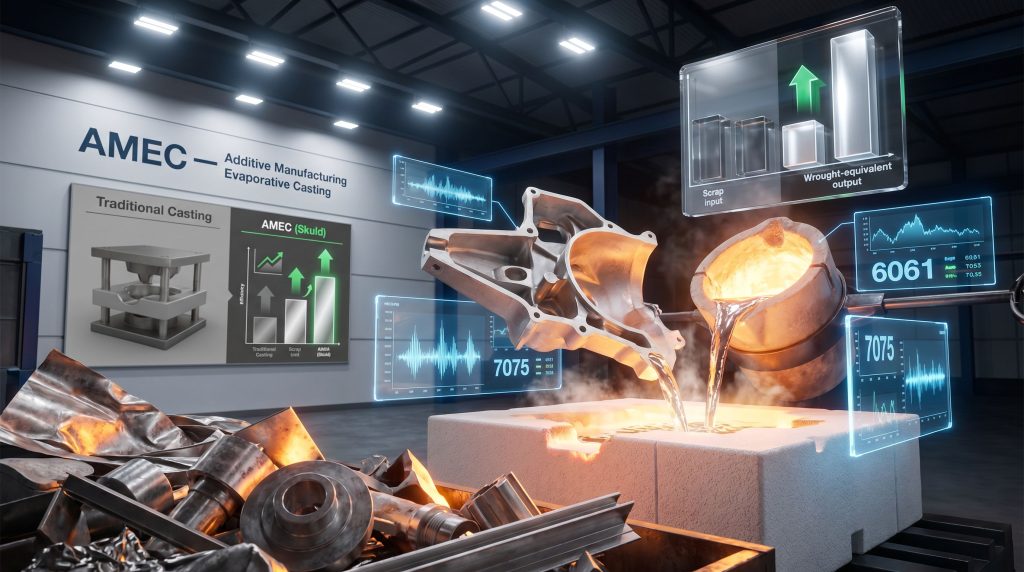
The manufacturing method underlying the patent is called Additive Manufacturing Evaporative Casting (AMEC). It combines two mature but separately developed technologies in a novel configuration.
Lost foam casting, the foundational technique, involves creating a pattern from expandable polystyrene foam, surrounding it in unbonded sand, and pouring molten metal directly onto the foam. The foam vaporises on contact, and the metal fills the resulting void. No hard tooling is required, and the process can reproduce highly complex three-dimensional geometries that conventional die casting or sand casting with hard patterns cannot economically achieve.
The AMEC innovation lies in replacing conventional machined or moulded foam patterns with 3D-printed foam patterns, enabling rapid design iteration, elimination of tooling lead times, and on-demand production of geometrically complex components. The implications of this are significant:
- Traditional casting tooling can take weeks to months to fabricate and costs tens of thousands to hundreds of thousands of dollars for complex parts
- 3D-printed foam patterns can be produced in hours for a fraction of the cost
- Design changes require only updated digital files, not new physical tooling
- Complex internal geometries, thin walls, and undercuts that are difficult or impossible with hard tooling become achievable
| Process Feature | Traditional Casting | AMEC (Skuld) |
|---|---|---|
| Tooling requirement | Hard tooling required | 3D-printed foam patterns |
| Lead time | Weeks to months | Hours to days |
| Geometry complexity | Limited by tooling | High complexity achievable |
| Feedstock | Virgin or controlled alloy | Scrap-based feedstock |
| Post-processing | Rolling/forging typically required | Heat treatment only |
| Target output grade | Cast alloys | Wrought-equivalent alloys |
| Capital cost | High (tooling) | Significantly reduced |
The DARPA Rubble to Rockets Programme: Strategic Context
Why This Programme Exists
The DARPA Rubble to Rockets (R2R) programme addresses a fundamental vulnerability in defence manufacturing logic: conventional military supply chains assume access to controlled alloy inputs, industrial foundry infrastructure, and predictable logistics networks. In contested or resource-constrained operating environments, none of these assumptions hold.
The programme targets three distinct technical challenges:
- Rapid alloy identification from unknown or mixed scrap sources without laboratory infrastructure
- Mechanical performance prediction for non-standard alloy compositions under operational load conditions
- Functional component production from locally sourced scrap without access to conventional industrial supply chains
The strategic implication is significant. A forward-deployed unit that can identify locally available scrap, predict its mechanical behaviour, and cast functional structural components on demand fundamentally changes the logistics calculus of extended military operations. It reduces dependence on long, vulnerable supply lines for critical hardware.
Skuld's Research Partnerships and Technical Division of Labour
Skuld leads the R2R programme and has structured its research around a multi-institutional collaboration that distributes technical complexity across specialised partners:
- Worcester Polytechnic Institute (WPI): Focused on microstructure prediction modelling and understanding how variable scrap compositions affect solidification behaviour and final mechanical properties
- Foundry Casting Systems: Responsible for casting process engineering, equipment integration, and translating laboratory results into operable systems
- MatMicronia: Contributing alloy behaviour analysis and performance prediction modelling to support the closed-loop data pipeline from scrap identification to component certification
This structure is characteristic of well-designed advanced manufacturing research programmes, where materials science, process engineering, and computational modelling must advance simultaneously rather than sequentially.
AI-Assisted Scrap Identification: The Technology Behind Alloy Classification
Spark Testing Reinvented Through Machine Learning
One of the most practically innovative elements of the R2R programme is Skuld's application of AI to spark testing, a technique that has existed in crude form since the early twentieth century. Traditional spark testing involves grinding metal against an abrasive wheel and visually observing the resulting spark pattern, with experienced operators able to make rough alloy family distinctions based on spark colour, length, and branching characteristics.
Skuld's approach replaces subjective human observation with spectral analysis and machine learning. When metal is ground, the resulting sparks emit light at wavelengths characteristic of the specific elements present. By capturing this spectral signature and processing it through trained machine learning models, the system can identify alloy composition with a speed and precision that traditional analytical methods, such as wet chemistry or handheld X-ray fluorescence spectrometry, cannot match in field conditions.
The practical advantage for field-deployed manufacturing is considerable:
- No sample preparation or laboratory consumables required
- Results in seconds rather than minutes or hours
- Equipment is compact and ruggedised for operational environments
- Eliminates the need for alloy labelling or documentation of scrap sources
Closing the Loop: From Identification to Performance Prediction
The AI-assisted identification system feeds directly into the computational modelling work conducted by WPI and MatMicronia. Once a scrap batch's approximate composition is known, predictive models can estimate the microstructural outcomes of casting that material under specific process conditions and forecast the resulting mechanical properties.
This creates what is effectively a closed-loop digital pipeline: scrap composition in, predicted component performance out, with casting parameters adjusted in real time to optimise outcomes for variable feedstock. The ability to close this loop computationally, rather than through iterative physical testing, is what makes the system viable for field deployment where time and material resources are constrained.
How Skuld's Process Compares to Other Scrap-to-Wrought Technologies
The Broader Innovation Landscape
Skuld is not alone in pursuing high-value output from recycled aluminium scrap. The field has attracted significant research investment across multiple institutions and process philosophies. In addition, battery recycling expansion and advances in critical minerals processing illustrate how broadly the push for material recovery innovation is now reaching across the metals industry. The following comparison situates the AMEC process within the broader competitive and complementary technology landscape:
| Technology | Organisation | Process Type | Output Form | Wrought-Equivalent? |
|---|---|---|---|---|
| AMEC (patent-pending) | Skuld | Lost foam casting + heat treatment | Near-net-shape castings | Claimed yes |
| ShAPE process | PNNL | Shear-assisted processing and extrusion | Extruded profiles | Demonstrated for 6061/6063 |
| Controlled remelt + rolling | Various | Conventional melt and deformation | Sheet/plate | Established but energy-intensive |
| Hot-crush separation | Historical research | Physical separation + remelt | Separated streams | Requires pre-sorting |
| Scrap-to-die-cast alloys | Various | Remelt and chemistry adjustment | Die castings | No (cast grade output) |
The Pacific Northwest National Laboratory (PNNL) ShAPE process represents the most directly comparable validated benchmark. PNNL has demonstrated that shear-assisted processing and extrusion can produce 6061 and 6063 aluminium extrusions from 100% post-consumer scrap that meet or exceed ASTM mechanical property standards. However, it produces extruded profiles rather than near-net-shape castings, meaning it cannot economically produce the complex three-dimensional geometries that AMEC targets.
What Makes the Skuld Claim Metallurgically Distinctive
The core controversy in Skuld's technical claim, from a materials science perspective, is whether wrought-equivalent properties can genuinely be achieved through casting and heat treatment alone. The science of dirty alloys — the accumulated impurities and microstructural variability inherent in scrap-based feedstocks — presents one of the most demanding obstacles to achieving consistent structural-grade output.
Skuld's claim implies that through careful control of casting geometry, solidification rate, and heat treatment parameters, it is possible to engineer a microstructure that approximates the outcomes of deformation processing. This is theoretically plausible in specific conditions: rapid solidification can suppress dendritic segregation, controlled solidification geometry can manage thermal gradients, and precipitation heat treatment can compensate for some microstructural deficiencies. Whether this holds consistently across variable scrap feedstock compositions at scale remains the key unresolved technical question.
"The distinction between laboratory demonstration and repeatable industrial-scale performance is where most advanced casting technologies encounter their most challenging validation hurdles."
The next major ASX story will hit our subscribers first
The Patent Filing as a Technology Maturity Signal
Reading IP Strategy in Advanced Manufacturing
A patent application, as distinct from a granted patent, signals that a technology has progressed sufficiently to warrant formal protection but has not yet cleared the full examination process. In the context of a DARPA-funded programme, the filing carries additional strategic significance. DARPA programmes typically require participating organisations to maintain intellectual property rights that enable commercial transition, meaning that filing a patent is often a programme milestone rather than a purely voluntary commercial decision.
The fact that Skuld has specifically named 6061 and 7075 in the patent claims, rather than filing for a broader or more generic aluminium casting process, is itself informative. These alloy designations are high-value commercial targets, and their explicit inclusion signals intent to pursue commercial licensing or manufacturing rights in the most economically significant segments of the structural aluminium market.
The broader intellectual property landscape in this space includes historical filings targeting wrought-cast separation methods, chemistry-adjustment approaches for die-casting alloy production from scrap, and controlled remelt processes. Skuld's AMEC-based approach occupies a distinct position by targeting near-net-shape casting of wrought-grade alloys rather than either separation or chemistry modification.
What This Means for Aluminium's Circular Economy Future
The Quality Gap Within High Recycling Rates
The fundamental paradox of aluminium recycling is that high volumetric recovery rates mask systematic quality degradation. A beverage can that becomes an automotive wheel casting has been recycled in a technical sense, but the embodied energy and processing value invested in producing a wrought-quality alloy has been partially sacrificed. If the scrap from that can had instead re-entered a wrought-grade processing stream, the energy savings and retained material value would be meaningfully higher.
Processes capable of converting mixed or degraded scrap directly into wrought-grade structural components without the energy intensity of primary smelting could fundamentally reshape how the industry values and prices scrap grades. Currently, wrought-grade clean scrap commands a premium over mixed or cast-grade scrap precisely because of the processing difficulty involved in upgrading lower-grade material. A validated process that narrows this performance gap from the casting side would compress that premium and potentially redirect significant scrap volumes toward higher-value applications.
Regulatory and Market Tailwinds for High-Value Recycled Metals
Broader regulatory frameworks in both the United States and Europe are increasingly emphasising embodied carbon reduction, domestic manufacturing resilience, and materials circularity as policy objectives. While these frameworks do not constitute project-specific support for Skuld or the R2R programme, they do create a commercial environment where technologies capable of producing high-performance structural components from scrap are likely to find receptive markets across aerospace, automotive, and defence procurement.
The mining decarbonisation benefits now being recognised across the extractive sector further reinforce why low-carbon, scrap-based manufacturing processes like AMEC are attracting both government and commercial investment. Furthermore, mining innovation trends in 2025 suggest a broader industry pivot toward circular economy models that prioritise material recovery over primary extraction.
The QinetiQ flight test of a structural hinge component produced from 3D-printed titanium recovered from a decommissioned aircraft, reported separately around the same period, illustrates how appetite for validated recycled-metal structural components is growing across the defence and aerospace sectors. This is not an isolated development but part of a broader institutional shift in how advanced manufacturers approach material sourcing and end-of-life recovery.
From Defence Innovation to Commercial Deployment
DARPA-funded research has a documented history of transitioning from military applications into broad commercial deployment. The programme's explicit focus on portable, field-deployable casting systems that can operate without stable supply chains or specialised labour creates a technology architecture that has direct analogues in commercial contexts: disaster response manufacturing, remote infrastructure construction, distributed fabrication in developing economies, and decentralised supply chain models that produce components close to scrap sources rather than at centralised processing facilities.
"If Skuld's AMEC process can be validated at scale with consistent mechanical properties across variable scrap feedstocks, the commercial applications extend well beyond the defence context in which the technology was developed."
Key Questions Investors and Industry Observers Should Track
The Skuld scrap-to-wrought aluminium casting patent raises several forward-looking questions that will determine whether this technology transitions from a promising laboratory result to a commercially significant process:
- Feedstock consistency: Can the process maintain wrought-equivalent properties when scrap composition varies batch-to-batch, as it inevitably does in real industrial recycling environments?
- Scale-up fidelity: Do the microstructural outcomes achieved in laboratory or small-batch casting conditions replicate reliably at production volumes?
- Long-term fatigue data: Yield strength and elongation data are necessary but not sufficient for structural certification. Long-term fatigue performance under cyclic loading is the more demanding test for aerospace and defence applications.
- Certification pathways: What regulatory and standards body frameworks (ASTM, MIL-SPEC, AMS) will the process need to satisfy before structural components produced by AMEC can be deployed in certified applications?
- IP grant timeline: The transition from patent application to granted patent will determine the scope of commercial exclusivity Skuld can enforce and the terms under which licensing arrangements might be structured.
This article discusses emerging technology and patent filings that remain subject to ongoing technical validation and regulatory review. Nothing in this article constitutes financial advice, investment recommendation, or a representation that any technology described will achieve commercial deployment or meet projected performance benchmarks. Patent applications do not guarantee granted patent rights. Investors and industry participants should conduct independent due diligence before making decisions based on information contained herein.
Want to Stay Ahead of the Next Major Materials and Mining Discovery?
Discovery Alert's proprietary Discovery IQ model scans ASX announcements in real time, instantly identifying significant mineral discoveries across more than 30 commodities — turning complex data into actionable investment insights for both short-term traders and long-term investors. Explore historic discoveries and their remarkable returns, then begin your 14-day free trial at Discovery Alert to position yourself ahead of the broader market.