
July 28, 2026
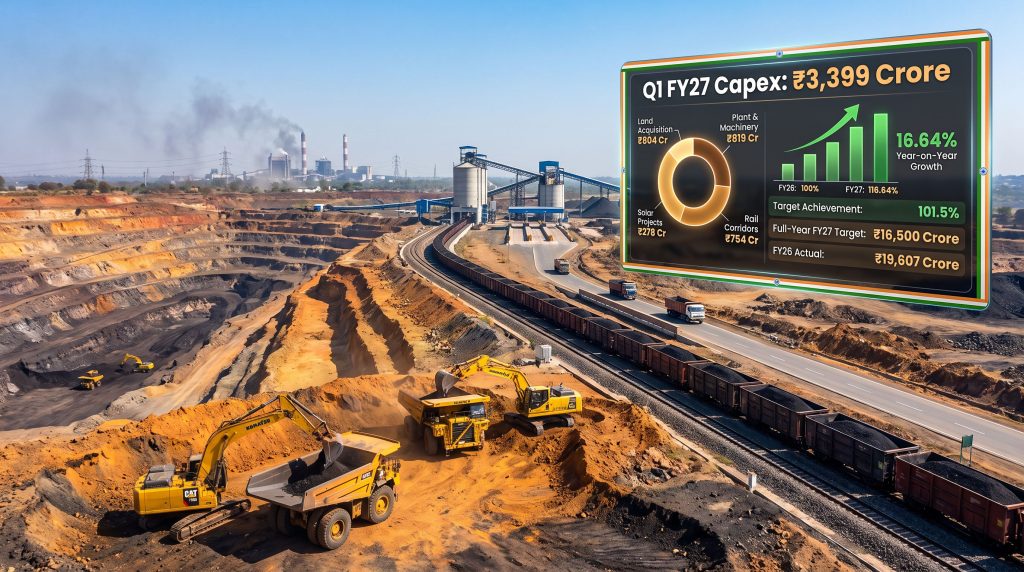
Why India's Largest Coal Producer Is Spending More, Earlier
Few signals carry as much weight in infrastructure investing as front-loaded capital deployment by a state-owned enterprise at the start of a fiscal year. When a large public sector organisation deploys capital ahead of schedule in the first quarter, it typically reflects a combination of cleared procurement pipelines, resolved land tenure processes, and genuine management commitment to full-year execution.
Historically, public sector miners in emerging markets have been characterised by back-end loaded spending, where budgets are consumed in the final two quarters through rushed contractor mobilisation. A departure from that pattern deserves careful analytical attention.
Coal India Q1 capex rises 17% year-on-year to ₹3,399 crore is not simply a quarterly data point. It is a forward signal about India's thermal power supply chain, mining infrastructure depth, and the institutional evolution of the world's single largest coal producer by volume.
When big ASX news breaks, our subscribers know first
What the Q1 FY27 Numbers Actually Reveal
A Rare Public Sector Outperformance in the Opening Quarter
The numbers themselves are instructive. Against a quarterly target of ₹3,349 crore, CIL deployed ₹3,399 crore, achieving 101.5% of planned expenditure in the April to June 2026 period. This represents a 16.64% year-on-year increase compared to the equivalent quarter in FY26.
Surpassing a capex target in Q1 is operationally uncommon for large public sector enterprises in India. The reasons are structural: land acquisition approvals, environmental clearances, contractor bidding cycles, and monsoon-adjacent construction windows all create natural drag in the early part of a fiscal year. CIL's Q1 outperformance, furthermore, implies that a meaningful portion of preparatory groundwork was completed during Q4 FY26, allowing spending to commence without the usual administrative lag.
| Metric | Value |
|---|---|
| Q1 FY27 Capex (Actual) | ₹3,399 crore |
| Q1 FY27 Capex (Target) | ₹3,349 crore |
| Year-on-Year Growth | 16.64% |
| Target Achievement Rate | 101.5% |
| Share of Annual FY27 Target | 20.6% |
| Full-Year FY27 Capex Target | ₹16,500 crore |
| FY26 Full-Year Capex Achieved | ₹19,607 crore |
| FY26 Annual Target | ₹16,000 crore |
The FY26 Precedent and What It Means for FY27
CIL's FY26 total capex of ₹19,607 crore exceeded its annual target of ₹16,000 crore by more than 22%. That degree of outperformance is analytically significant. It suggests either that project pipelines mature faster than CIL's internal budgeting anticipates, or that management has adopted a conservative target-setting approach to ensure declared targets are always achievable.
Either way, the FY27 target of ₹16,500 crore now looks potentially understated. If Q3 and Q4 follow the historically typical pattern of accelerated spending, full-year FY27 capex could again exceed declared targets by a material margin. For a broader coal price update on how market conditions are shaping investment decisions, additional context is readily available.
Scenario Modelling for FY27 Full-Year Capex:
- Base case (Q1 run rate maintained uniformly): ~₹13,600 crore
- Moderate back-end acceleration (Q3/Q4 ramp-up): ~₹16,500 to ₹17,500 crore
- FY26 precedent repeated (22%+ overshoot): ₹18,000 to ₹20,000 crore
The base case appears conservative given the Q1 outperformance, and the FY26 precedent provides a credible ceiling for optimistic scenarios. Investors and analysts monitoring CIL's stock should treat the ₹16,500 crore target as a floor rather than a ceiling.
Where Capital Is Being Deployed: A Category-by-Category Analysis
Land Acquisition and R&R: The Strategic Priority at 23.7% of Q1 Spend
The single largest expenditure category in Q1 FY27 was land acquisition and rehabilitation and resettlement activities, which consumed ₹804 crore, representing approximately 23.7% of total quarterly capex. For the full FY27 year, CIL has allocated ₹4,173 crore to this category, its highest budget line across all investment types.
This prioritisation carries a specific operational logic that is not always visible in headline numbers. Open-cast coal mining in India depends on continuous land acquisition to extend mine boundaries. Unlike underground operations, which can expand vertically within a fixed surface footprint, open-cast mines require regular lateral expansion. Each hectare of unmined coal sitting inside a legal boundary dispute or pending R&R settlement represents a hard ceiling on future production capacity.
A few lesser-known dynamics compound this challenge. The ongoing pressures around coal supply challenges in 2025 have reinforced the urgency of resolving land tenure issues swiftly:
- Many of CIL's operating mines in Jharkhand, Odisha, and Chhattisgarh are located in areas with complex land tenure histories involving tribal land rights under the Panchayat Extension to Scheduled Areas Act
- Community consent processes in these regions can extend project timelines by 18 to 36 months beyond standard regulatory clearance windows
- The R&R component involves not just compensation but resettlement infrastructure including housing, roads, and utilities, all of which require separate contractor pipelines
Front-loading land acquisition spend in Q1 therefore signals that CIL is treating this constraint as the primary operational risk for FY28 and FY29 production targets, not FY27.
Coal Evacuation Infrastructure: Addressing India's Most Persistent Supply Chain Weakness
| Evacuation Sub-Category | Q1 FY27 Spend |
|---|---|
| Railway sidings and rail corridors | ₹754 crore |
| Coal handling plants, silos, weighbridges, and roads | ₹195 crore |
| Total coal evacuation infrastructure | ₹949 crore |
The ₹949 crore directed toward coal evacuation infrastructure in a single quarter represents one of the most consequential investment clusters in CIL's portfolio, even though it receives comparatively less analytical attention than production capacity figures.
India's coal supply chain has a well-documented structural weakness that is poorly understood outside specialist circles: the pithead-to-plant gap. This refers to the recurring situation where thermal power plants face coal shortages not because mines have insufficient production capacity, but because rail and road evacuation infrastructure cannot physically move coal fast enough from the mine gate to the power station bunker.
During periods of peak power demand, typically in the pre-monsoon summer months, this gap has repeatedly forced load shedding even when CIL stockpiles at pithead remain substantial. The investment of ₹754 crore in railway sidings and rail corridors in Q1 alone reflects an institutional recognition that production capacity investments are only as valuable as the evacuation infrastructure that connects them to end users.
Industry insight: Rail siding capacity at mine sites is a known bottleneck because dedicated freight corridor integration requires synchronised capex between CIL, Indian Railways, and state electricity boards. CIL's unilateral investment in rail sidings accelerates this integration without waiting for multi-party coordination to align.
Plant and Machinery: The Production Engine
Capital expenditure on plant and machinery reached ₹819 crore in Q1 FY27, covering:
- Heavy Earth Moving Machinery procurement, including draglines, shovels, and dumpers
- Expansion of coal washery facilities
- Other specialised mining and processing equipment
HEMM procurement deserves particular attention from a technical standpoint. Modern open-cast coal mining in India uses a combination of rope shovels and electric rope draglines for overburden removal, paired with large-capacity rear-dump trucks. The transition toward higher-capacity HEMM units, some with payload capacities exceeding 200 tonnes per cycle, improves productivity per machine but requires simultaneous road and bench infrastructure upgrades.
Washery investment is equally significant from a coal quality standpoint. Indian thermal coal, particularly from older seams in the Gondwana geological belt that underlies most of CIL's operating areas, contains significant ash content ranging from 35% to 45% in raw form. Power plants designed for washed coal with ash content below 34% cannot efficiently combust high-ash run-of-mine coal. Washery expansion therefore directly improves the effective utilisation rate of coal that CIL already produces but cannot fully dispatch to certain end users in its current raw form.
Renewable Energy Diversification: Reading the Strategic Signal Correctly
CIL's ₹278 crore solar investment in Q1 FY27 warrants a more nuanced interpretation than simple energy transition optics. The scale of this commitment, nearly 8.2% of total quarterly capex directed toward a non-core business activity, reflects a deliberate institutional hedging strategy. In this respect, it mirrors broader debates around coal plant strategy as a renewable backup mechanism.
CIL has publicly committed to developing 3,000 MW of solar capacity over the medium term. The quarterly investment pace implied by Q1 figures, if sustained, would represent an annualised solar capex run rate of over ₹1,000 crore, which is meaningful even relative to India's broader renewable energy investment landscape.
Why this matters beyond the energy transition narrative:
- CIL's coal mining leases cover vast land parcels that will progressively become unavailable for coal production as seams deplete
- Solar deployment on post-mining degraded land creates a productive second-use pathway for otherwise stranded assets
- Revenue diversification reduces CIL's long-term exposure to coal demand elasticity as India's renewable energy penetration increases
This is not a contradiction of CIL's core mandate but a rational extension of its land and capital base into adjacent revenue streams.
The Geology Beneath the Numbers: Why CIL's Capital Intensity Is Structurally Justified
Gondwana Coal Seams and Their Implications for Infrastructure Investment
Understanding why CIL requires consistently high capital expenditure requires understanding the geological context of its reserves. The vast majority of India's coal reserves sit within Gondwana-age sedimentary formations, primarily concentrated in the Damodar Valley coalfields of Jharkhand and West Bengal, and the Mahanadi and Godavari valley coalfields of Odisha and Andhra Pradesh.
These formations, deposited approximately 250 to 300 million years ago during the late Paleozoic era, are characterised by:
- Multiple thin to medium seams rather than single thick seams, requiring more complex mining geometry
- High overburden-to-coal ratios in some areas, demanding significant stripping before coal access
- Variable ash and moisture content across seams, creating quality inconsistency that necessitates blending or washing
The multi-seam character of Gondwana deposits means that as surface seams deplete, CIL must invest in deeper access infrastructure and more sophisticated equipment to reach lower seams. This is a geological inevitability that makes sustained high capital intensity structurally necessary, independent of production growth ambitions.
CIL's Q1 FY27 Capex Distribution at a Glance
| Spending Category | Q1 FY27 Amount (₹ crore) | % of Total Q1 Capex |
|---|---|---|
| Land Acquisition and R&R | ₹804 crore | ~23.7% |
| Plant and Machinery (incl. HEMM) | ₹819 crore | ~24.1% |
| Railway Sidings and Rail Corridors | ₹754 crore | ~22.2% |
| Solar Projects | ₹278 crore | ~8.2% |
| Joint Venture Capital Infusion | ₹207 crore | ~6.1% |
| Coal Handling Plants, Silos and Roads | ₹195 crore | ~5.7% |
| Other/Remaining | ~₹342 crore | ~10.1% |
| Total | ₹3,399 crore | 100% |
Operational Variables That Will Determine Full-Year FY27 Execution
The Q2 Monsoon Effect and Back-End Loading Dynamics
Q2 of any Indian fiscal year (July to September) represents a structurally challenging capex execution window. Heavy monsoon rainfall in coal belt states disrupts open-cast mining operations, delays civil construction on rail and road projects, and reduces contractor productivity. CIL's Q2 FY27 capex will almost certainly show a sequential decline from Q1 levels.
This seasonal pattern has a secondary effect: capital that was planned for Q2 often migrates into Q3 and Q4, amplifying the back-end loading effect. Investors should not interpret a Q2 slowdown as a reversal of CIL's spending trajectory but rather as a predictable seasonal artefact of operating in monsoon-affected geographies. According to Coal India's official press releases, the company continues to communicate operational updates transparently throughout the fiscal year.
Key execution variables to monitor across the remaining three quarters:
- Land acquisition clearance velocity in Jharkhand and Odisha
- Equipment delivery timelines for HEMM orders placed in Q4 FY26 and Q1 FY27
- Contractor mobilisation capacity across CIL's subsidiary operations, particularly Mahanadi Coalfields Ltd and South Eastern Coalfields Ltd
- Progress on dedicated freight corridor integration at key mine locations
What Q1 FY27 Capex Performance Signals for FY28 and FY29 Production
Capital expenditure in mining operates with a distinct lag structure that separates it from most other capital-intensive industries. Investments in land acquisition made in FY27 may not translate into mineable access until FY28 or FY29. Rail corridor investments commissioned in the current year typically take 12 to 24 months to achieve full throughput capacity.
This lag dynamic means CIL's Q1 FY27 spending is not a leading indicator for FY27 production, but rather a leading indicator for FY28 to FY29 supply availability. India's power sector planners and industrial consumers of coal should interpret CIL's current capital acceleration as a forward commitment to enhanced supply reliability in the medium term. Consequently, discussions around the proposed India coal trading exchange gain additional relevance in light of this expanded supply outlook.
CIL's chairman noted that the strategic investments made during Q1 have created a strong foundation for achieving production and supply targets for the current fiscal year, according to reporting by ET EnergyWorld published on July 28, 2026.
The next major ASX story will hit our subscribers first
Frequently Asked Questions: Coal India Q1 FY27 Capex
What was Coal India's total capex in Q1 FY27?
Coal India's capital expenditure in Q1 FY27 totalled ₹3,399 crore, representing a 16.64% year-on-year increase. According to detailed Q1 financial analysis, this performance reflects stronger-than-expected execution across multiple spending categories.
Did Coal India meet its Q1 FY27 capex target?
Yes. CIL exceeded its quarterly target of ₹3,349 crore, achieving 101.5% of planned expenditure.
What is Coal India's full-year FY27 capex target?
CIL has set an annual capex target of ₹16,500 crore for FY27. The Q1 spend of ₹3,399 crore accounts for 20.6% of this figure.
What was Coal India's largest capex category in Q1 FY27?
Plant and machinery at ₹819 crore edged out land acquisition and R&R at ₹804 crore, though both represent approximately 24% of total quarterly spend.
How much did CIL invest in renewable energy in Q1 FY27?
CIL allocated ₹278 crore to solar projects during the quarter, reflecting its ongoing diversification strategy.
How did Coal India perform on capex in FY26?
CIL achieved total capital expenditure of ₹19,607 crore in FY26 against a target of ₹16,000 crore, an overshoot of more than 22%. Furthermore, a coal mine expansion context from comparable markets illustrates how such outperformance often reflects structural operational improvements rather than one-off budget windfalls.
Key Takeaways for Analysts, Investors, and Policymakers
- Above-target Q1 execution confirms that CIL's procurement and mobilisation pipelines entered FY27 in strong condition
- Land acquisition at ₹804 crore signals mine expansion is the dominant strategic priority, with production implications extending into FY28 and FY29
- Rail corridor investment at ₹754 crore directly targets the pithead-to-plant evacuation bottleneck that has historically caused power shortages during peak demand periods
- Gondwana geological complexity provides structural justification for sustained high capital intensity, independent of production growth targets
- Solar allocation of ₹278 crore in a single quarter reflects institutional maturity in hedging long-term coal demand risk through land and capital redeployment
- FY26 precedent of ₹19,607 crore against a ₹16,000 crore target makes the FY27 ceiling of ₹16,500 crore appear conservative if operational conditions remain favourable
Disclaimer: This article contains forward-looking analysis, scenario modelling, and speculative projections based on publicly available data. It does not constitute financial advice. Investors should conduct independent due diligence before making investment decisions related to Coal India Ltd or any associated securities.
Want to Stay Ahead of the Next Major Mineral Discovery on the ASX?
While Coal India's capital deployment signals long-term supply chain confidence across thermal and metallurgical commodities, the real-time opportunities often emerge closer to home — Discovery Alert's proprietary Discovery IQ model instantly alerts subscribers to significant ASX mineral discoveries across 30+ commodities, turning complex geological data into actionable investment insights. Explore historic discoveries and their returns to understand the potential scale of early-mover advantage, then begin your 14-day free trial at Discovery Alert to position yourself ahead of the broader market.