July 28, 2026
The Hidden Architecture of Value: How Oil and Gas Consolidation Has Become a Structural Imperative
Across the long arc of commodity cycles, energy companies have repeatedly used downturns to consolidate and upturns to expand. But something fundamentally different is unfolding in the current wave of oil and gas mergers and acquisitions. The strategic logic has shifted away from timing the commodity price cycle toward building enterprises that can generate sustainable returns regardless of where oil trades. This is not opportunistic dealmaking dressed up as strategy. It is a structural reconfiguration of how the industry competes.
Understanding why this shift has occurred, and what separates the companies capturing genuine value from those simply adding complexity, requires looking beyond the headline deal sizes and into the operational philosophies driving integration decisions.
When big ASX news breaks, our subscribers know first
How the Strategic Logic Behind Oil and Gas M&A Has Evolved
For decades, the conventional wisdom in energy dealmaking held that acquisitions made sense when oil prices fell far enough to compress seller valuations. That reactive posture produced boom-bust acquisition cycles that often destroyed as much value as they created.
The current consolidation wave operates on different terms. According to Deloitte analysis, the traditional M&A trigger zone of US$60 to US$80 per barrel has been replaced by a structurally lower buy zone of approximately US$45 to US$55 per barrel, reflecting balance-sheet improvements and cost reductions achieved over the past decade. This compression of the economic entry point means deals now get done at lower price thresholds, and the companies executing them are building for durability rather than chasing near-term growth.
Furthermore, current oil price trends are reinforcing this shift, with producers recalibrating their long-term planning assumptions accordingly. Three structural forces are driving this repositioning:
- Scale as a competitive moat: Larger combined entities can absorb cost inflation, negotiate better service contracts, and maintain drilling programmes through price weakness that would force smaller operators to curtail activity.
- Portfolio quality over quantity: The most active acquirers are targeting premium acreage in established basins, prioritising well productivity and infrastructure access over simply adding reserves.
- Capital efficiency as a differentiator: Combined entities can redirect overhead savings toward high-return drilling inventory, lowering the weighted average cost of capital in the process.
The structural shift from reactive dealmaking to proactive portfolio architecture is the defining characteristic of the current M&A cycle. Companies are building for durability, not just growth.
Quantifying the Consolidation Wave: How Large Is the Market?
The scale of recent activity underscores just how seriously the industry has embraced consolidation as a core mechanism for value creation. The numbers from 2024 alone are striking.
| Metric | Data Point | Source |
|---|---|---|
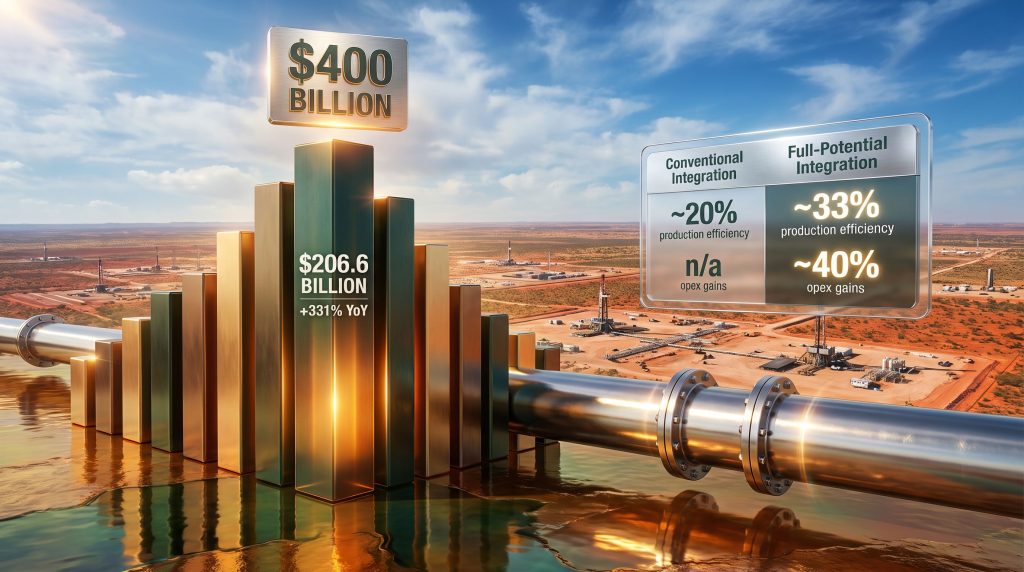
| Global energy acquisitions in 2024 | More than $400 billion | Bain & Company |
| U.S. oil and gas M&A deal value in 2024 | $206.6 billion | EY |
| Year-over-year growth in U.S. deal value | +331% | EY |
| U.S. megadeals above $10 billion in 2024 | 5 transactions | EY |
| Early 2026 trend | Megadeal frequency moderated vs. 2025 peak, but activity shifted toward oil and gas | PwC |
The 331% year-over-year surge in U.S. deal value was not broadly distributed. A concentrated group of frequent acquirers accounted for a disproportionate share of the total, with companies holding stronger balance sheets and lower-cost production bases acquiring premium acreage from capital-constrained operators.
The scarcity of high-quality shale inventory has accelerated acquisition timelines. Buyers recognise that the window to secure contiguous Permian acreage, Marcellus gas positions, and Gulf Coast LNG infrastructure at reasonable valuations is narrowing as consolidation reduces the number of available targets. The broader LNG supply outlook adds further urgency to this dynamic, particularly for gas-weighted acquirers.
Landmark Deals Redefining the Competitive Landscape
Several transformative transactions have set the strategic and operational benchmark for what modern oil and gas mergers and acquisitions look like in practice:
- ExxonMobil and Pioneer Natural Resources: One of the most consequential upstream consolidations in U.S. history, repositioning ExxonMobil as the dominant Permian Basin operator with access to Pioneer's low-cost, high-quality Midland Basin inventory.
- Chevron and Hess Corporation: A strategic move to gain exposure to Guyana's deepwater Stabroek block, diversifying Chevron's geographic production beyond its domestic shale base.
- Diamondback Energy and Endeavor Energy Resources: A shale-focused combination engineered to achieve greater Permian scale and extract meaningful operating leverage from shared infrastructure.
- Occidental Petroleum and CrownRock: A bolt-on acquisition targeting Midland Basin acreage density and production quality.
- Regional combinations involving Eni, Shell, Equinor, and PETRONAS: International operators using M&A to optimise regional production platforms and strengthen basin-level infrastructure positions across multiple geographies.
Each of these transactions was structured not merely to add barrels, but to redesign the operational architecture of the combined enterprise, targeting simultaneous improvements in capital allocation, well performance, and cost structure.
The "Transact to Transform" Philosophy: What Full-Potential Integration Actually Means
The most important conceptual shift in the current M&A cycle is how the most sophisticated acquirers think about what happens after a deal closes. According to McKinsey, the companies capturing the greatest value from oil and gas mergers and acquisitions are those adopting a fundamentally different integration philosophy — one that treats deal completion not as an endpoint but as a structural change window.
This approach, which McKinsey describes as full-potential integration, targets performance improvement across every operational dimension of the combined entity rather than limiting ambitions to headcount rationalisation and overhead elimination.
The Six Dimensions of Full-Potential Integration
- Well performance optimisation: Applying the acquiring company's drilling and completion techniques systematically across the full combined asset base to lift production rates.
- Facility-level efficiency gains: Standardising processing, compression, and handling infrastructure to reduce per-unit operating costs.
- Workforce and capability alignment: Deploying technical talent, particularly engineers and geoscientists, where they generate the highest operational return rather than preserving legacy organisational structures.
- Technology and data integration: Unifying digital systems to enable real-time production monitoring, predictive maintenance, and subsurface analytics across the combined portfolio.
- Contract and procurement renegotiation: Leveraging combined purchasing scale to extract meaningfully lower service costs from drilling contractors, completion providers, and equipment suppliers.
- Capital allocation redesign: Redirecting investment away from duplicated corporate overhead and toward the highest-returning assets and drilling locations in the combined inventory.
Why Integration Methodology Matters More Than Deal Price
McKinsey's analysis of approximately 20 oil and gas transactions involving more than 100 assets over the past decade reveals a measurable and significant performance differential between conventional and full-potential integration approaches:
| Performance Metric | Conventional Integration | Full-Potential Integration |
|---|---|---|
| Production efficiency improvement | ~20% | ~33% |
| Operating expenditure efficiency gain | ~20% | ~40% |
| Overall synergy achievement uplift | Baseline | ~55% higher |
The data points to a counterintuitive conclusion: the integration methodology selected after a deal closes may ultimately determine more value than the acquisition premium paid at signing. Companies that overpay slightly but execute full-potential integration rigorously can outperform disciplined buyers who default to conventional cost-cutting approaches post-close.
Why Mergers of Equals Are Gaining Strategic Traction
A structurally notable feature of the current cycle is the growing prevalence of mergers of equals and peer-level business combinations, distinct from straightforward premium acquisitions. Several converging pressures explain this trend:
- Valuation symmetry: When both parties hold high-quality assets, a merger of equals avoids the premium overpayment risk that frequently erodes acquirer returns in competitive auction processes.
- Operational complementarity: Basin-adjacent combinations allow companies to consolidate gathering and processing infrastructure, reduce per-unit transportation costs, and optimise production sequencing across a larger contiguous acreage footprint.
- Balance-sheet neutrality: Combining without a large cash outlay preserves financial flexibility for capital expenditure programmes and shareholder returns during the integration period.
- Cultural integration dynamics: Peer-level combinations can reduce organisational resistance and accelerate alignment of technical teams, particularly important in asset-intensive operating environments where retaining experienced engineering talent is critical.
The geographies most likely to generate merger-of-equals activity through 2026 include Permian Basin independents competing for supermajor-level scale, gas-weighted producers seeking LNG export infrastructure access, and midstream operators consolidating gathering networks in high-density production corridors. Notably, Canadian energy dealmakers are also emerging as increasingly active participants in cross-border consolidation efforts.
The next major ASX story will hit our subscribers first
The Primary Value Creation Mechanisms Unique to Energy Consolidation
Oil and gas M&A operates differently from sector consolidation in most other industries because physical infrastructure, subsurface resources, and operational capabilities are deeply interdependent. Value creation requires carefully sequenced integration that avoids disrupting production continuity while pursuing structural improvement.
Basin Consolidation and Infrastructure Control
Securing contiguous acreage reduces per-well drilling costs through shared surface infrastructure including roads, water handling, power, and compression. Controlling midstream assets reduces third-party tariff exposure and improves netback economics, directly increasing the cash margin per barrel produced.
Operational Standardisation
Applying best-practice completion designs — including optimised perforation clusters, proppant loading, and fluid volumes — across a larger combined well inventory accelerates production uplift without proportional cost increases. This is a key mechanism through which the 33% production efficiency improvement associated with full-potential integration is achieved.
Top-Quartile Performance Benchmarking
Companies pursuing full-potential integration explicitly target top-quartile operational performance for the combined entity, a materially higher ambition than simply matching pre-merger performance averages. This benchmarking discipline forces acquirers to identify and address underperforming assets rather than allowing them to become permanent drags on the combined portfolio.
Key Risks That Cause Oil and Gas M&A to Underperform
Not all consolidation creates value, and understanding the failure modes is as important as understanding the opportunity:
- Integration sequencing errors: Restructuring operations too rapidly can disrupt production continuity and erode the short-term cash flows that fund integration costs themselves.
- Subsurface risk mispricing: Acquired reserve estimates that prove optimistic post-close significantly reduce return on invested capital, particularly in plays where well performance variability is high.
- Technical talent attrition: In engineering-intensive businesses, retaining key geoscientists and reservoir engineers through integration uncertainty is critical. Poorly managed combinations frequently trigger talent exits at exactly the moment those capabilities are most needed.
- Commodity price exposure during integration: Multi-year integration programmes carry inherent exposure to oil and gas price movements that can compress available integration capital and delay synergy realisation timelines.
- Regulatory and antitrust scrutiny: Large-scale upstream consolidations in concentrated basin markets face increasing FTC review timelines, adding execution uncertainty and potentially delaying synergy capture.
The most successful oil and gas acquirers build commodity price stress scenarios into their integration financial models from day one, not as a post-close afterthought.
Forward-Looking Scenarios for Oil and Gas M&A Through 2026 and Beyond
Scenario 1: Continued Upstream Consolidation Among Mid-Cap Independents
If commodity prices stabilise in the US$65 to US$75 per barrel range and capital markets remain accommodative, a second wave of large-scale upstream consolidations is probable, particularly among mid-cap Permian and Gulf of Mexico operators seeking to compete with supermajor-level scale economies.
Scenario 2: Gas and LNG Infrastructure Attracts Disproportionate Deal Flow
As global LNG demand continues to grow, driven by European energy security imperatives and accelerating Asian import volumes, gas-weighted assets and LNG-linked infrastructure are positioned to attract an outsized share of deal activity through 2026 and into the following years. In addition, the volatility in WTI and Brent futures is influencing how deal terms and price-linked mechanisms are being structured in these transactions.
Scenario 3: Supermajor Divestiture Programmes Create Selective Acquisition Opportunities
Supermajors that completed transformative acquisitions in 2023 and 2024 may pivot toward targeted asset divestiture programmes, selling non-core positions to fund integration costs and return capital to shareholders. This would create concentrated acquisition opportunities for smaller, focused operators with specific basin expertise.
Scenario 4: Accelerating Cross-Border Activity by National Oil Companies
National oil companies from the Middle East, Asia, and South America are increasingly active as international acquirers of upstream and midstream assets. Their involvement is reshaping deal flow patterns in key producing regions and introducing new competitive dynamics into auction processes that were previously dominated by Western majors and private equity. The broader geopolitical risk landscape is consequently becoming a more prominent variable in cross-border deal assessments.
U.S. vs. Global Oil and Gas M&A: Where Is Activity Concentrated?
| Dimension | United States | International Markets |
|---|---|---|
| 2024 deal value | $206.6 billion | Part of $400B+ global total |
| Primary focus | Permian, Marcellus, Eagle Ford shale | Deepwater, LNG, NOC partnerships |
| Deal structure preference | All-stock mergers, bolt-on acquisitions | Joint ventures, asset swaps, PSA restructuring |
| Key acquirer types | U.S. supermajors, large independents | NOCs, integrated majors, private equity |
| Regulatory environment | Increasing FTC scrutiny | Varies significantly by jurisdiction |
| 2026 trend direction | More selective from 2024 peak | Growing NOC and Asian buyer activity |
Frequently Asked Questions: Oil and Gas Mergers and Acquisitions
What Is the Primary Strategic Rationale for Oil and Gas M&A in 2025 and 2026?
Companies are pursuing oil and gas mergers and acquisitions primarily to achieve greater operating scale, reduce per-unit production costs, and secure access to high-quality acreage and infrastructure, rather than responding to short-term commodity price movements. For further context, the Bain & Company M&A report provides detailed analysis of the evolving rationale behind these deals.
What Is the Difference Between a Merger and an Acquisition in the Energy Sector?
A merger typically involves two companies of comparable size combining to form a new entity, often structured as an all-stock transaction. An acquisition involves one company purchasing another, usually at a premium to market value. In the current cycle, mergers of equals are gaining prominence because they avoid premium overpayment risk and preserve balance-sheet flexibility for capital programmes and shareholder returns.
Why Did U.S. Oil and Gas M&A Surge 331% in 2024?
The surge reflected a convergence of factors: strong commodity prices in 2022 and 2023 rebuilt balance sheets, a wave of private equity-backed operators reached exit maturity simultaneously, premium shale acreage became increasingly scarce, and a small number of transformative megadeals including ExxonMobil-Pioneer and Chevron-Hess collectively accounted for a large portion of total deal value.
Is Oil and Gas M&A Activity Slowing Down in 2026?
Early 2026 data from PwC indicates megadeal frequency has moderated compared to the exceptional pace set in 2024. However, deal activity has not disappeared. It has become more selective, with buyers applying stricter capital discipline and tighter valuation thresholds. The structural drivers of consolidation — including acreage scarcity, cost pressures, and the imperative for scale — remain fully intact.
What the Current Oil and Gas M&A Supercycle Means for the Industry
The consolidation reshaping the global oil and gas sector is not a temporary phenomenon triggered by a single commodity price event. It reflects a deeper structural transition toward an industry architecture built around scale, operational excellence, and portfolio quality.
The companies best positioned to benefit are those that combine disciplined deal selection with ambitious post-merger integration programmes targeting top-quartile performance, not just cost reduction. The evidence from McKinsey's analysis of over 100 assets across 20 transactions is clear: how you integrate matters as much as what you acquire.
Disclaimer: This article contains forward-looking scenarios and forecasts based on publicly available industry analysis from Bain & Company, EY, Deloitte, PwC, and McKinsey & Company. These projections are subject to commodity price volatility, regulatory changes, geopolitical developments, and capital market conditions. Nothing in this article constitutes financial or investment advice.
Want to Stay Ahead of the Next Major Resource Discovery Before the Market Moves?
While oil and gas consolidation reshapes the energy sector, significant mineral discoveries on the ASX can generate equally transformative returns — and Discovery Alert's proprietary Discovery IQ model delivers real-time alerts the moment these opportunities emerge. Explore historic examples of what major discoveries can return and begin your 14-day free trial at Discovery Alert to position yourself ahead of the broader market.