May 13, 2026
Coal mining operations across Australia's Hunter Valley region face mounting pressure to extend project lifespans as resource depletion timelines accelerate. The interplay between existing infrastructure investments, regulatory frameworks, and long-term energy export challenges creates complex strategic scenarios that mining companies must navigate with precision. Understanding these dynamics becomes crucial as operators seek to maximise returns on substantial capital expenditures whilst maintaining competitive positioning in evolving global energy markets. Furthermore, the New Hope Bengalla mine expansion presents a compelling case study in strategic resource development planning.
Strategic Infrastructure Positioning Within Hunter Valley Coal Networks
The Hunter Valley's coal mining landscape operates as an integrated supply chain ecosystem where individual mine operations contribute to broader regional export capabilities. Bengalla mine's position within this network demonstrates how geographic advantages translate into operational efficiencies and market access advantages.
Located in Muswellbrook, NSW, the operation benefits from established rail connections that funnel production through Newcastle port terminals. These logistics corridors handle substantial export volumes, with Japan receiving 51% and China 15% of Newcastle's coal shipments according to operational data from early 2026.
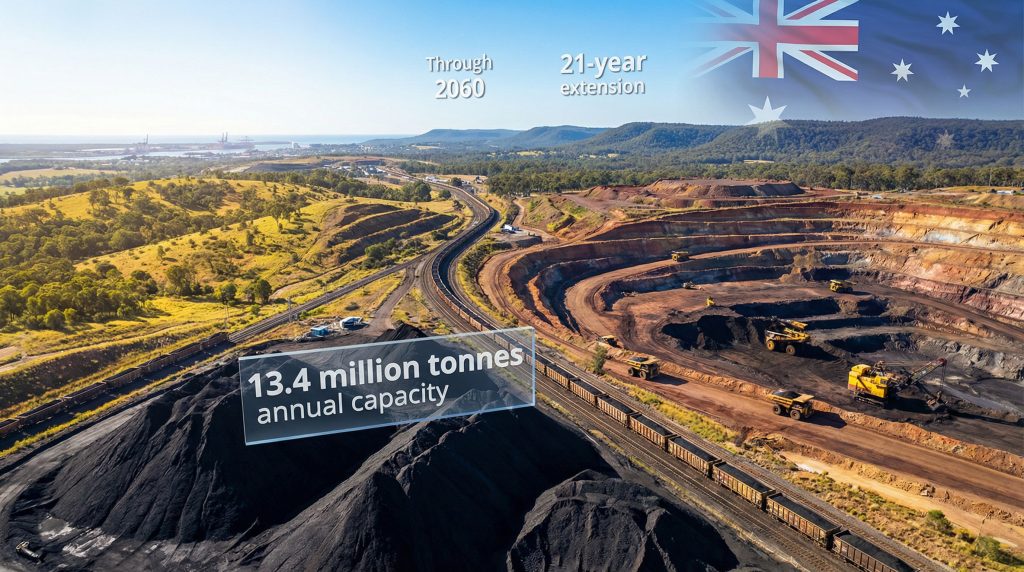
The mine's current production capacity of 13.4 million tonnes per annum positions it as a significant contributor to Australia's thermal coal export profile. This output supports 400 direct employment positions plus 100 contractor roles, creating a workforce of approximately 500 people dependent on continued operations.
Coal Quality Specifications and Export Market Requirements
Hunter Valley coal operations must meet stringent quality specifications to maintain competitiveness in Asian energy markets. The region's high-calorific energy coal typically features energy content levels that satisfy power generation requirements across multiple international markets.
Production from the Whittingham Coal Measures, which underlies the Bengalla operation, provides coal with characteristics suitable for thermal energy generation. These geological formations have supported consistent quality output that meets export contract specifications over multiple decades of extraction.
Regional Production Integration and Market Performance
Recent operational performance indicates strong production momentum across New Hope Group's coal assets. Q1 FY26 group coal production reached 4.1 million tonnes, representing a 5% quarterly increase, whilst coal sales climbed 8.2% to 2.9 million tonnes.
The average realised sales price of $139 per tonne during this period supported quarterly underlying EBITDA of $106.9 million and $214.8 million for the first half of FY26. These financial metrics demonstrate the economic viability of continued operations under current market conditions. However, sustaining this performance requires addressing various coal supply challenges that could impact long-term operations.
When big ASX news breaks, our subscribers know first
Resource Depletion Timeline Analysis and Extension Economics
Mining operations face inevitable resource exhaustion as extraction progresses through defined ore bodies. The timeline between current reserves and operational cessation creates strategic imperatives for mine life extension projects that can fundamentally alter asset valuation and regional economic impact.
Current operational planning indicates potential resource depletion by 2037 under existing production rates, despite formal operational approvals extending through 2039. This two-year discrepancy reflects the relationship between proven reserves and ongoing extraction rates at current capacity levels.
Economic Justification Framework for Mine Life Extension
The business case for extending operations centres on maximising returns from substantial infrastructure investments already committed to the operation. In addition, key economic drivers include:
- Infrastructure asset optimisation: Rail connections, processing facilities, and support infrastructure require extended operational periods to achieve optimal return on investment
- Workforce continuity: Maintaining 500+ direct and contractor positions provides regional economic stability and preserves specialised mining expertise
- Fixed cost amortisation: Spreading capital expenditures over longer operational timeframes improves project economics
- Market positioning: Sustained production capacity maintains contract fulfilment capabilities and market presence
Capital Investment Recovery and Extension Scenarios
The potential 21-year extension through 2060 would provide substantial operational continuity beyond current approval periods. This timeframe allows for recovery of growth project investments and positions the operation to adapt to changing market conditions over extended periods. Consequently, the New Hope Bengalla mine expansion represents a critical strategic initiative for long-term sustainability.
| Scenario | Timeline | Production Impact | Economic Benefits |
|---|---|---|---|
| Current approved operations | Through 2039 | Declining toward cessation | Limited infrastructure ROI |
| Western extension approval | Through 2060 | Sustained 13.4 mtpa capacity | Maximised asset utilisation |
| Partial extension | Variable timeline | Reduced capacity potential | Moderate infrastructure optimisation |
Regulatory Assessment Framework and Approval Pathways
Complex regulatory structures govern major mining extensions in New South Wales, involving multiple jurisdictional levels and assessment criteria. The multi-tiered approval process requires coordination between state planning authorities and federal environmental regulators. Furthermore, understanding mining permitting insights becomes essential for successful project development.
State-Level Planning Assessment Requirements
NSW Department of Planning oversees State Significant Development (SSD) assessments for major mining projects. The SSD-5170 classification indicates the western extension proposal meets criteria for state-level determination rather than local council assessment.
State assessment typically involves:
- Environmental impact evaluation: Comprehensive assessment of potential environmental effects across operational areas
- Community consultation requirements: Public exhibition periods and stakeholder engagement processes
- Economic impact analysis: Regional employment and economic contribution assessment
- Infrastructure capacity review: Evaluation of transport and utility infrastructure adequacy
Federal Environmental Protection and Biodiversity Conservation Act Referral
Federal assessment under the Environment Protection and Biodiversity Conservation Act 1999 triggers when projects may impact Matters of National Environmental Significance. The EPBC Act referral process examines potential effects on protected species, water resources, and heritage areas.
Federal assessment criteria commonly include:
- Water resource impact evaluation in coal-bearing formations
- Listed species habitat assessment and protection measures
- Mine closure planning and long-term environmental management
- Biodiversity offset calculation and implementation strategies
Modification Application Status and Timeline Considerations
Current regulatory progress involves multiple modification applications designed to facilitate continued operations:
- Modification 7: Temporary overburden emplacement planning to manage waste rock placement during extended operations
- Modification 8: Continuation project federal review addressing long-term operational parameters
- Exploration Licence 9431: Western area resource identification covering 556 hectares, granted in July 2022
Western Tenement Strategy and Resource Development Approach
Strategic land acquisition adjacent to existing operations provides the foundation for extended mine life whilst leveraging established infrastructure investments. The western expansion approach demonstrates systematic planning for operational continuity beyond current approved areas.
Adjacent Tenement Acquisition and Geological Continuity
The acquisition of two undeveloped tenements adjacent to current operations provides access to prospective resources within the same geological formation. Exploration Licence 9431 covers 556 hectares of western expansion area with geological continuity to existing mining operations.
The Whittingham Coal Measures formation extends across the expansion area, suggesting potential for similar coal quality characteristics and extraction conditions. Geological continuity reduces exploration risk and supports infrastructure integration between existing and proposed mining areas.
Resource Identification and Exploration Methodology
Systematic exploration programmes aim to define recoverable resources within the western tenement area. Standard exploration approaches include:
- Drilling programme implementation: Grid-based drilling to define coal seam characteristics, thickness variations, and quality parameters
- Coal quality assessment protocols: Testing programmes to verify export specification compliance and energy content levels
- Strip ratio calculations: Economic modelling to determine overburden-to-coal ratios and extraction viability
- Infrastructure integration planning: Engineering studies to connect western areas with existing processing and transport facilities
Resource definition remains dependent on ongoing exploration results, with confirmation required before operational planning can advance to detailed engineering and environmental assessment stages. Moreover, incorporating comprehensive feasibility study insights will be crucial for project success.
Financial Performance Analysis and Market Positioning Context
Strong operational cash flows and robust balance sheet positioning provide New Hope Group with strategic flexibility to pursue growth opportunities across its coal portfolio. The company's diversified asset base and financial strength support investment in mine life extension projects.
Operational Cash Flow Generation and Capital Allocation
Recent financial performance demonstrates the group's capacity to generate substantial cash flows from coal operations. The company closed Q1 FY26 with an available cash balance of $616.8 million, providing significant financial flexibility for growth initiatives and operational investments.
FY26 sustaining capital guidance has been reduced to $100-130 million, reflecting capital optimisation initiatives across the operation. This reduction in maintenance capital requirements improves free cash flow generation and supports discretionary investment capacity. However, investors should carefully consider various investment risk factors when evaluating mining projects.
Portfolio Diversification and Risk Management
New Hope Group's strategic positioning extends beyond individual mine operations through diversified asset exposure:
- Queensland New Acland mine: Delivered 4.9% production increase to 1.8 million tonnes in Q1 FY26, providing geographic diversification
- Malabar Resources stake: 25.97% ownership provides exposure to Maxwell underground mine development
- Processing optimisation: Improved rail performance and higher-yielding coal processing enhanced operational efficiency
This diversified approach reduces dependence on individual operations whilst providing multiple pathways for production growth and cash flow generation. Consequently, New Hope Group's diversified portfolio demonstrates strong strategic positioning within the coal sector.
Regional Economic Impact and Community Considerations
Mining operations create substantial economic multiplier effects within regional communities through direct employment, indirect service provision, and local spending patterns. The potential for extended operations significantly influences long-term regional economic planning and community development initiatives.
Employment Stability and Skills Development
Continued operations through 2060 would maintain employment for 400 direct workers plus 100 contractor positions over an extended timeline. This employment stability supports:
- Skills retention: Preserving specialised mining expertise within the Upper Hunter Valley region
- Apprenticeship programmes: Ongoing training opportunities for entry-level mining professionals
- Service industry support: Indirect employment across regional suppliers and service providers
- Community infrastructure: Sustained population levels supporting schools, healthcare, and retail services
Regional Service Industry Dependencies
Mining operations create demand for specialised services including equipment maintenance, logistics, professional services, and supplier networks. Extended mine life provides certainty for these businesses to invest in capacity expansion and service development.
Regional suppliers benefit from:
- Long-term contract certainty: Extended operational timelines support supplier investment planning
- Equipment and maintenance demand: Ongoing requirements for mining equipment, parts, and technical services
- Logistics and transport: Continued rail and road transport demand supporting regional freight networks
- Professional services: Engineering, environmental, and technical consulting requirements
The next major ASX story will hit our subscribers first
Competitive Positioning Within Hunter Valley Coal Sector
The Hunter Valley hosts multiple large-scale coal operations competing for market share, infrastructure access, and regulatory approval. Understanding competitive dynamics helps assess the strategic importance of mine life extension for maintaining market positioning.
Supply Chain Integration and Port Access
Newcastle port represents Australia's largest coal export terminal, handling approximately 160 million tonnes per annum of thermal and metallurgical coal combined. Access to port capacity and rail infrastructure provides competitive advantages for operations with established logistics connections.
Bengalla mine's integration within this supply chain network provides:
- Established rail access: Direct connection to Hunter Valley rail corridors reducing transport costs
- Port allocation certainty: Long-term relationships with Newcastle port terminals
- Logistics optimisation: Coordination with other New Hope operations for transport efficiency
- Contract fulfilment capacity: Ability to meet long-term supply agreements with Asian customers
Market Share and Production Capacity Maintenance
Maintaining production capacity through extended operations preserves New Hope Group's position within the Hunter Valley production hierarchy. Key competitive considerations include:
- Production volume maintenance: Sustained 13.4 million tonnes per annum capacity
- Quality consistency: Continued access to Whittingham Coal Measures specifications
- Cost competitiveness: Infrastructure amortisation improving per-tonne production costs
- Flexibility for market adaptation: Extended timeline allowing operational adjustments based on market conditions
Investment Risk Assessment and Valuation Implications
Mine life extension projects involve complex risk-return calculations that influence asset valuation and investment attractiveness. Understanding these risk factors helps assess the probability of successful extension approval and subsequent operational performance.
Regulatory Approval Risks and Timeline Uncertainty
The multi-tiered approval process creates regulatory risk that could affect project timeline and investment returns. Key risk factors include:
- Assessment timeline variability: Regulatory processes may extend beyond anticipated timeframes
- Approval conditions: Potential operational restrictions or additional requirements
- Community consultation outcomes: Stakeholder opposition could influence approval decisions
- Environmental compliance costs: Additional environmental management requirements
Market Risk and Long-Term Coal Demand Scenarios
Extended operational timelines expose the project to long-term market risks including:
- Energy transition impacts: Potential reduction in thermal coal demand as renewable energy adoption accelerates
- Price volatility: Coal price fluctuations affecting project economics over 21-year extension period
- Competition from alternative suppliers: New production capacity in competing regions
- Contract renegotiation risk: Long-term supply agreements may require periodic renegotiation
Capital Allocation and Alternative Investment Opportunities
The decision to invest in mine life extension must be evaluated against alternative capital allocation opportunities within New Hope Group's portfolio. Investment considerations include:
- Return on investment comparison: Extension project returns versus alternative mining opportunities
- Capital intensity requirements: Infrastructure and development capital requirements for western expansion
- Operational risk profile: Technical and operational risks associated with extended mining areas
- Strategic portfolio fit: Alignment with long-term company strategy and market positioning
Conclusion: Strategic Positioning for Extended Coal Market Participation
The New Hope Bengalla mine expansion represents a critical strategic decision that extends far beyond simple mine life extension. The proposal encompasses workforce stability, infrastructure optimisation, regulatory navigation, and long-term market positioning within Australia's evolving energy export landscape.
Success in securing the 21-year extension through 2060 would provide New Hope Group with strategic flexibility to adapt production profiles based on changing market conditions whilst maximising returns on substantial infrastructure investments. The western tenement acquisition demonstrates proactive planning, though resource confirmation and regulatory approval remain critical success factors.
The complex regulatory framework involving NSW Department of Planning and federal EPBC Act assessment requires careful navigation of environmental and community considerations. Timeline uncertainty around approval processes creates investment risk that must be balanced against the potential for extended cash flow generation and regional economic benefits.
With $616.8 million in available cash and optimised sustaining capital requirements, New Hope Group maintains strong financial positioning to pursue growth opportunities across its diversified coal portfolio. The New Hope Bengalla mine expansion aligns with broader strategic objectives whilst providing operational continuity for 500+ direct and contractor employees and supporting regional economic stability.
This analysis is based on publicly available information and industry data. Mining investment decisions involve substantial risks and should be evaluated in consultation with qualified financial and technical advisors. Coal market conditions and regulatory requirements may change significantly over extended operational timelines.
Looking to Capitalise on Mining Expansion Opportunities?
Discovery Alert's proprietary Discovery IQ model provides instant notifications on significant ASX mining developments, including major expansion announcements and resource discoveries that could impact market positioning. Begin your 14-day free trial today at Discovery Alert and position yourself ahead of the market with actionable insights into mining investment opportunities.