June 5, 2026
The Industrial Logic Behind India's Largest Coal Gasification Incentive Push
Across the global energy landscape, few transitions are as nuanced as the pivot from raw fossil fuel combustion toward chemical feedstock valorisation. For coal-abundant but petrochemical-import-dependent economies, this shift is not merely strategic — it is economically imperative. India sits at precisely this inflection point, where its vast coal reserves, long treated as a source of kilowatt-hours, are being repositioned as the raw material for an entirely different industrial future.
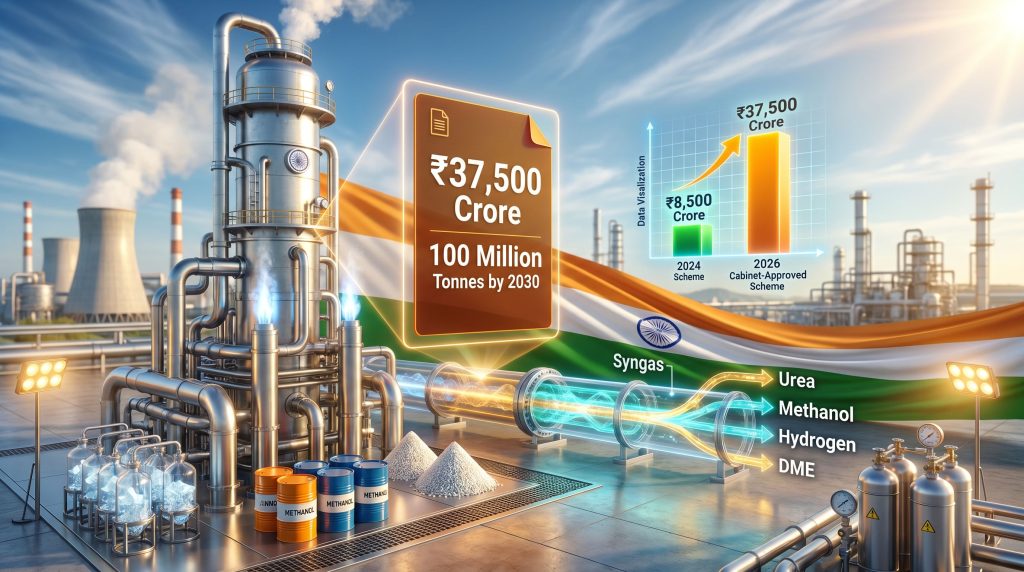
The Coal Ministry's release of a Request for Proposal under the Scheme for Promotion of Surface Coal/Lignite Gasification Projects, backed by a Cabinet-approved financial outlay of ₹37,500 crore, signals that this repositioning is now entering its execution phase. For developers, investors, and industrial off-takers, understanding the mechanics of these Coal Ministry gasification project incentives is no longer optional — it is foundational to participating in one of India's most consequential industrial programmes of the coming decade.
When big ASX news breaks, our subscribers know first
Why India's Coal Reserve Base Changes the Economic Calculus
India holds an estimated 300 billion tonnes of coal reserves, placing it among the top five coal-endowed nations globally. Yet for decades, the dominant use case for this resource has been thermal power generation — a pathway that monetises coal at its lowest value per tonne and generates the most combustion-related emissions per unit of economic output.
Coal gasification flips this equation. Rather than burning coal directly for heat and power, surface gasification converts it into syngas — primarily a mixture of hydrogen and carbon monoxide — which serves as the building block for a wide spectrum of high-value industrial chemicals. The value-add per tonne of coal processed through a gasification and downstream chemical production pathway is substantially higher than combustion-based alternatives, particularly when the output displaces imported commodities priced in foreign currency.
India currently imports significant volumes of urea, ammonia, methanol, and liquefied natural gas. Furthermore, India's approach to India LNG import taxes directly affects the economics of domestic substitution. Each of these can, in principle, be manufactured from domestically gasified coal. The import substitution arithmetic is compelling: replacing foreign-sourced feedstocks with domestic syngas derivatives simultaneously strengthens the current account, creates industrial employment, and monetises a stranded asset base.
Comparing the 2024 and 2026 Incentive Schemes: What Has Changed
The current framework represents a dramatic scaling-up from the earlier incentive structure introduced in 2024. The differences are not cosmetic — they reflect a deliberate policy decision to move from market activation to industrial transformation at scale.
| Parameter | 2024 Framework | 2026 Cabinet-Approved Scheme |
|---|---|---|
| Total Outlay | ₹8,500 crore | ₹37,500 crore |
| Incentive Basis | Up to 15% of capex | Up to 20% of plant and machinery cost |
| Per-Project Cap (PSU) | ₹1,350 crore | ₹5,000 crore |
| Per-Project Cap (Private) | ₹1,000 crore | ₹5,000 crore |
| Group Entity Cap | Not separately specified | ₹12,000 crore across projects |
| Disbursement Method | Milestone-linked tranches | Four equal milestone-linked instalments |
| Scale Target | Early-stage market activation | 100 million tonnes gasified coal by 2030 |
The increase in total outlay by more than four-fold reflects the government's recognition that the 2024 framework, while directionally correct, was insufficient in scale to catalyse the volume of investment required to reach the 100 million tonne annual gasification target by 2030. The Hindu's coverage of the Cabinet approval provides further context on how this decision was framed at the policy level.
Critically, the 2026 scheme also standardises the per-project incentive ceiling across public sector undertakings and private developers at ₹5,000 crore, removing the earlier asymmetry that favoured PSUs. This signals an intent to drive private capital into the sector rather than rely primarily on state-owned enterprise deployment.
How the Earlier Framework Allocated Funds by Applicant Type
Under the 2024 structure, the incentive pool was segmented by developer category:
- PSU and Government JV Pool: ₹4,050 crore ring-fenced for public sector entities and joint ventures, with a per-project ceiling of ₹1,350 crore or 15% of capital expenditure, whichever was lower
- Private Sector and PSU-Private Partnership Pool: ₹3,850 crore available to private developers and hybrid ownership structures, subject to a ₹1,000 crore per-project cap
- Demonstration and Pilot Projects: A dedicated ₹600 crore tranche for small-scale and proof-of-concept facilities, capped at ₹100 crore per project, specifically designed to reduce technology adoption risk at the pre-commercial stage
Eligibility Architecture: Who Qualifies and on What Terms
The 2026 RFP establishes clear qualification thresholds that effectively filter the applicant pool to serious, well-capitalised industrial developers.
Technical Eligibility Requirements
- Only new greenfield surface coal or lignite gasification facilities are eligible — brownfield expansions or conversions of existing assets do not qualify
- Projects must demonstrate a minimum clean syngas production capacity of 500,000 tonnes per annum, establishing a commercial-scale floor that screens out sub-economic proposals
- Eligible downstream products are specifically defined, and syngas must flow into one or more of the following value chains:
- Methanol
- Ammonia
- Urea
- Synthetic natural gas (SNG)
- Hydrogen
- Dimethyl ether (DME)
Financial Standing Thresholds
Applicants — whether individual companies or formally structured consortia — must demonstrate a net worth exceeding 20% of the total project cost. This requirement ensures meaningful equity commitment from recipients and reduces the risk of incentive capture by undercapitalised project vehicles.
A practical illustration of this threshold: a project with a total capital cost of ₹10,000 crore would require the applicant or consortium to demonstrate a minimum net worth of ₹2,000 crore. The maximum incentive receivable on the same project would be capped at ₹5,000 crore, calculated as 20% of plant and machinery costs subject to the absolute ceiling.
Consortium structures are explicitly permitted, broadening participation to include technology licensors, engineering procurement and construction partners, and off-take counterparties within a single application vehicle. This is particularly significant given that India's domestic gasification engineering ecosystem remains limited, and most large-scale projects will require international technology licensors to be integrated into the development structure from the outset.
How Incentives Are Calculated: The Plant and Machinery Methodology
One of the less-discussed technical aspects of this scheme is the calculation basis for the incentive quantum. The 20% incentive is applied specifically to the assessed cost of plant and machinery — not total project cost.
This distinction matters considerably. Civil infrastructure, land acquisition, pre-development expenditure, and working capital requirements are all excluded from the calculation base. For a typical large-scale gasification project, plant and machinery might represent 55% to 65% of total capital expenditure, meaning the effective incentive as a percentage of total project cost is approximately 11% to 13% rather than the headline 20%.
The ₹12,000 crore group-level cap prevents any single corporate group from concentrating incentive allocation across multiple applications. For large conglomerates with the balance sheet to develop several projects simultaneously, this cap effectively limits the total incentive accessible to the group to roughly two or three maximum-sized projects.
The Four-Tranche Disbursement Framework
Approved incentives are disbursed in four equal instalments, each contingent on verified achievement of predefined project development milestones. This structure has two important investor implications:
- Capital requirement front-loading: Developers must finance construction costs independently until each milestone is formally verified and the corresponding tranche is released. This places significant demands on project finance structures and developer balance sheets, particularly in the early construction phases.
- Milestone compliance risk: Any delay in project execution that pushes milestone achievement dates creates a corresponding delay in incentive receipt, affecting project cash flow modelling and debt service coverage calculations.
Developers retain full responsibility for fuel sourcing through commercial coal auction linkages or captive mining arrangements, and for establishing downstream product off-take agreements independently of any government purchase guarantee.
The 50% Revenue Share Rebate: A Less Visible Cost Advantage
Beyond the headline incentive structure, coal gasification projects benefit from a commercially significant policy mechanism that receives considerably less attention: a 50% rebate on the revenue share payable to the government under commercial coal auction policy.
This rebate applies to coal directed toward gasification end-use and can meaningfully reduce the effective cost of the primary feedstock, improving project economics beyond what the capital incentive alone suggests. In addition, proposals such as the India coal trading exchange could further shape how feedstock pricing evolves for gasification developers over time.
The qualifying condition is important: at least 10% of total coal production from the linked mine must be directed toward gasification use. This threshold prevents operators from claiming the rebate on a token allocation while using the majority of production for higher-revenue combustion markets.
Coal Supply Security Through Dedicated Linkage Mechanisms
The Ministry has established a distinct sub-sector classification — production of syngas leading to coal gasification — within the coal linkage auction framework. This creates a procurement pathway that is structurally separate from power sector and industrial coal buyers, offering gasification projects:
- Reduced competition for supply allocations from higher-volume thermal power purchasers
- Long-term coal allotments providing multi-year feedstock visibility essential for project financing and bankability assessments
- A policy signal that feedstock security for gasification projects is being treated as a distinct priority within the overall coal allocation framework
For project financiers evaluating debt serviceability over a 20 to 25-year asset life, this supply security dimension is frequently cited as one of the primary de-risking mechanisms available within the scheme architecture.
The next major ASX story will hit our subscribers first
Downstream Product Strategy: Which Syngas Derivatives Offer the Strongest Commercial Case
Not all downstream products carry equal strategic or commercial logic. The following table maps each eligible product against its current market relevance and import displacement potential:
| Downstream Product | Strategic Relevance | Import Substitution Potential |
|---|---|---|
| Urea | Core agricultural fertiliser; India is a significant net importer | High — reduces dependence on Middle East and Central Asian supply |
| Ammonia | Fertiliser feedstock and emerging energy carrier | High — critical across agricultural and industrial value chains |
| Methanol | Fuel blending, chemicals, and maritime applications | Moderate-High — growing domestic industrial and transport demand |
| Synthetic Natural Gas | Grid injection and industrial process heating | Moderate — complements piped gas infrastructure |
| Hydrogen | Clean energy carrier and refinery input | Emerging — coal gasification provides a bridge to hydrogen economy |
| Dimethyl Ether (DME) | LPG substitute and diesel alternative | Moderate — meaningful rural energy access applications |
Urea and ammonia offer the clearest near-term commercial case, given India's established import dependency in both categories. Methanol's trajectory is strengthening as fuel blending mandates and maritime decarbonisation requirements create incremental demand. Hydrogen from coal gasification, while debated in terms of its carbon credentials, occupies a pragmatic middle ground that could support India's broader hydrogen economy ambitions — provided carbon capture considerations are addressed over time. These dynamics also intersect meaningfully with broader energy transition and security considerations that extend well beyond coal alone.
Step-by-Step: Navigating the RFP Application Process
For industrial developers and investor consortia evaluating participation, the application pathway involves the following sequential steps:
- Obtain and review the RFP documentation issued by the Coal Ministry under the Scheme for Promotion of Surface Coal/Lignite Gasification Projects
- Conduct project eligibility assessment against the 500,000 TPA clean syngas minimum capacity threshold, greenfield facility requirement, and eligible downstream product alignment
- Establish financial qualification by calculating the applicant or consortium net worth relative to projected total project cost and confirming the 20% minimum threshold is achievable
- Structure the consortium where required — identify and formally engage technology licensors, EPC partners, and off-take counterparties whose participation strengthens technical and commercial credibility
- Prepare the technical proposal covering gasification technology selection rationale, feedstock sourcing strategy, syngas processing configuration, and downstream product specifications
- Submit through the transparent competitive selection process, designed to ensure objective allocation of the limited incentive pool across competing applications
- Develop a milestone compliance schedule that aligns the project execution timeline with the four disbursement tranches to ensure incentive instalments are triggered without unnecessary delay
Key Investment Risks That Developers Must Price Into Project Models
Technology and Execution Complexity
Surface coal gasification at commercial scale carries significant execution risk. Construction timelines from financial close to first syngas output typically range from four to seven years, depending on technology selection, site conditions, and supply chain availability. The choice of gasification configuration — entrained flow, fixed bed, or fluidised bed — materially affects feedstock flexibility, thermal efficiency, and upfront capital intensity, all of which influence incentive utilisation rates.
India's limited domestic gasification engineering talent pool means large-scale projects will depend heavily on international technology partners, introducing foreign exchange exposure on licensing fees and engineering service contracts.
Market and Off-Take Exposure
Developers carry full commercial responsibility for selling their syngas derivatives into open markets without any government-backed purchase guarantee. This places the entire revenue risk on bilateral contracts with fertiliser manufacturers, gas utilities, refineries, or industrial chemical buyers — counterparties whose own financial positions can shift over multi-decade project horizons.
Syngas derivative commodities — particularly urea and methanol — are priced in global markets where supply and demand dynamics extend well beyond India's domestic policy environment. Long-term revenue forecasting for projects with 20 to 25-year asset lives requires careful scenario analysis around commodity price cycles, technology displacement risks from competing green chemistry pathways, and potential policy shifts in downstream product markets.
Concentration of Simultaneous Development Activity
Achieving the 100 million tonne annual gasification target by 2030 implies the concurrent development of multiple large-scale projects across India within a compressed timeframe. This creates systemic risks that individual project models may not fully capture:
- Competition for scarce gasification-qualified engineering and construction resources
- Potential equipment supply chain bottlenecks for specialised gasification components
- Simultaneous competition for coal linkage allocations within the dedicated gasification sub-sector
However, these challenges are not entirely without precedent. Efforts in steel decarbonisation collaboration demonstrate that large-scale industrial transitions can be coordinated across complex stakeholder environments when policy incentives are sufficiently structured.
Frequently Asked Questions on Coal Ministry Gasification Project Incentives
What is the total financial outlay of the 2026 coal gasification incentive scheme?
The Cabinet-approved scheme carries a total financial outlay of ₹37,500 crore, representing more than a four-fold increase over the earlier ₹8,500 crore framework introduced in 2024.
What is the maximum incentive a single project can receive?
A single project can receive incentives of up to ₹5,000 crore, calculated as 20% of the assessed cost of plant and machinery, subject to this absolute cap regardless of total project size.
Can a corporate group access incentives across multiple projects?
Yes, but the aggregate incentive receivable by any applicant and its affiliated group companies across all projects is capped at ₹12,000 crore.
What is the minimum production capacity required for eligibility?
Projects must demonstrate the capability to produce a minimum of 500,000 tonnes of clean syngas per annum to satisfy the scheme's eligibility threshold.
Are existing gasification or industrial gas facilities eligible?
No. The scheme is restricted exclusively to new greenfield surface coal or lignite gasification facilities. Brownfield expansions, conversions, or upgrades to existing operations do not qualify.
How is the incentive paid out?
Approved incentives are disbursed in four equal instalments, each linked to verified achievement of predefined project development milestones, with developers remaining responsible for feedstock procurement and product sales throughout.
What is the 50% revenue share rebate and how does it apply?
Coal directed toward gasification use attracts a 50% reduction in the revenue share otherwise payable under commercial auction policy, provided at least 10% of total production from the linked mine is allocated to gasification end-use.
What the 2030 Target Implies for India's Industrial Future
Achieving 100 million tonnes of annual gasified coal by 2030 would constitute one of the most significant structural transformations in how India monetises its primary energy resource base. Success across even a substantial fraction of this target would simultaneously compress the national import bill across fertilisers, petrochemicals, and gas; create tens of thousands of direct and indirect industrial jobs; and establish domestic engineering capability in an area where India currently has limited expertise.
The methanol-to-olefins and methanol-to-gasoline pathways, while not directly supported under this scheme, represent natural downstream extensions that could substantially deepen the industrial value chain if first-generation gasification projects achieve commercial viability. Consequently, green iron production developments offer a useful parallel for understanding how industrial decarbonisation incentives translate into real project pipelines at scale.
The hydrogen pathway from coal gasification, paired with emerging carbon capture and storage considerations, positions this infrastructure as a potential bridge toward lower-carbon industrial hydrogen production over a medium to long-term horizon. For investors, developers, and off-take counterparties evaluating participation, the Coal Ministry gasification project incentives framework provides a policy foundation that is substantive in scale and architecturally coherent. The central challenge now moves from policy design to execution — and the ability to navigate that execution complexity will separate successful projects from those that remain proposals on paper.
This article is intended for informational purposes only and does not constitute financial, investment, or project development advice. Forecasts, targets, and incentive structures are subject to change based on regulatory developments and individual project circumstances. Readers are encouraged to conduct independent due diligence and seek professional advice before making any investment or commercial decisions.
For ongoing coverage of India's coal sector policy developments, syngas strategy, and energy transition initiatives, visit ET EnergyWorld at energy.economictimes.indiatimes.com/news/coal.
Want to Identify the Next Major Resource Discovery Before the Broader Market?
Discovery Alert's proprietary Discovery IQ model delivers real-time alerts on significant ASX mineral discoveries — instantly translating complex data across more than 30 commodities into actionable investment insights for both short-term traders and long-term investors. Explore how historic discoveries have generated substantial returns on Discovery Alert's dedicated discoveries page, and begin a 14-day free trial today to position yourself ahead of the market.